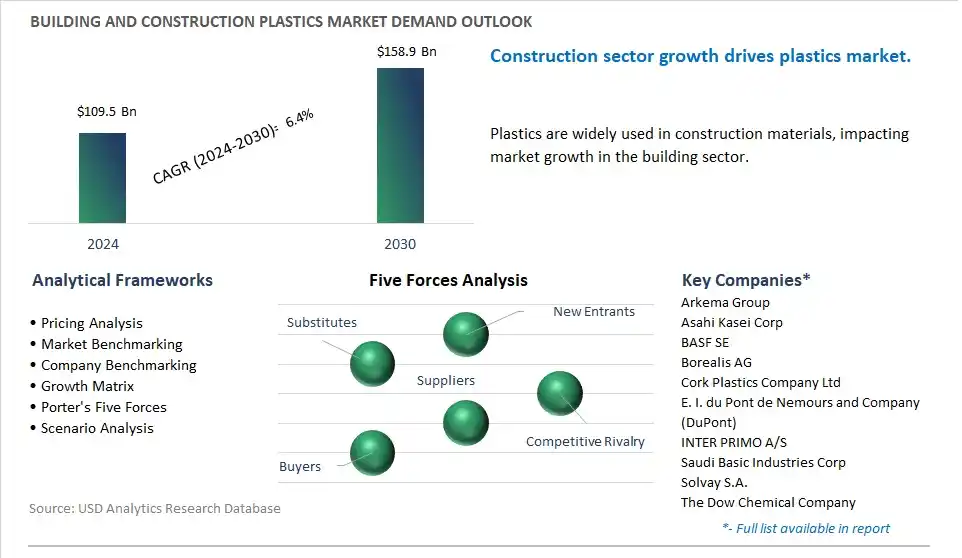
The global Building and Construction Plastics Market is poised to register a 6.4% CAGR from $109.5 Billion in 2024 to $158.9 Billion in 2030.
The global Building and Construction Plastics Market Study analyzes and forecasts the market size across 6 regions and 24 countries for diverse segments -By Product (Polyurethanes, Polyethylene, Polystyrene, Polyvinyl Chloride, Others), By Application (Windows, Wall Coverings, Pipes & Ducts, Insulation, Roofing, Others).
An Introduction to Global Building and Construction Plastics Market in 2024
The building and construction plastics market is experiencing notable transformations driven by urbanization, infrastructure development, and sustainability initiatives. One key trend shaping the future of the industry is the increasing adoption of high-performance and eco-friendly plastics in building and construction applications, including insulation, piping, roofing, and windows. As architects, developers, and policymakers prioritize energy efficiency, durability, and environmental responsibility, there's a growing demand for plastics with enhanced thermal insulation properties, weather resistance, and recyclability. Moreover, the integration of innovative plastics technologies, such as reinforced composites, thermoplastic elastomers, and bioplastics, is enabling the development of lightweight and cost-effective building materials that meet stringent performance standards and regulatory requirements. Additionally, the rising focus on circular economy principles is driving initiatives to promote plastic recycling, reuse, and waste reduction in the construction sector, fostering market growth while addressing environmental challenges associated with plastic usage.
Building and Construction Plastics Market Competitive Landscape
The market report analyses the leading companies in the industry including Arkema Group, Asahi Kasei Corp, BASF SE, Borealis AG, Cork Plastics Company Ltd, E. I. du Pont de Nemours and Company (DuPont), INTER PRIMO A/S, Saudi Basic Industries Corp, Solvay S.A., The Dow Chemical Company.
Building and Construction Plastics Market Dynamics
Building and Construction Plastics Market Trend: Shift Towards Sustainable and Recyclable Materials
A prominent trend in the building and construction plastics market is the shift towards sustainable and recyclable materials. With increasing awareness of environmental issues and regulations promoting sustainable construction practices, there is a growing demand for plastics that are recyclable, biodegradable, or made from renewable sources. Builders, architects, and developers are seeking eco-friendly alternatives to traditional plastics to reduce carbon footprint and minimize waste generation in construction projects. As a result, there is a rising interest in bio-based plastics, recycled plastics, and innovative composite materials that offer comparable performance to conventional plastics while addressing environmental concerns. This trend towards sustainability is reshaping the building and construction plastics market, driving innovation and the development of greener plastic solutions.
Building and Construction Plastics Market Driver: Urbanization and Infrastructure Development
A primary driver fueling the building and construction plastics market is urbanization and infrastructure development worldwide. As populations grow, cities expand, and infrastructure ages, there is increasing demand for construction materials, including plastics, to support urban development projects such as residential buildings, commercial complexes, transportation networks, and utilities. Plastics are valued in construction for their versatility, durability, and cost-effectiveness, making them suitable for a wide range of applications such as pipes, insulation, roofing, windows, and siding. Moreover, advancements in plastic technologies, such as PVC, HDPE, and composite materials, offer superior performance characteristics such as weather resistance, thermal insulation, and structural strength, further driving their adoption in building and construction projects. With ongoing investments in infrastructure upgrades and urban renewal initiatives globally, the demand for building and construction plastics is expected to continue growing, providing market opportunities for plastic manufacturers and suppliers.
Building and Construction Plastics Market Opportunity: Innovation in Recycled and Composite Plastics
An opportunity within the building and construction plastics market lies in innovation in recycled and composite plastics to meet sustainability goals and address market demands for eco-friendly materials. Companies can capitalize on this opportunity by investing in research and development of recycled plastic products made from post-consumer or post-industrial waste streams, such as recycled PVC, PET, or HDPE. Additionally, there is potential to develop composite plastics incorporating recycled materials, natural fibers, or bio-based polymers to enhance performance and sustainability while reducing reliance on virgin plastics. By offering innovative solutions that meet both performance and environmental criteria, companies can differentiate themselves in the market, attract environmentally conscious customers, and contribute to the circular economy by promoting the reuse and recycling of plastics in building and construction applications.
Building and Construction Plastics Market Share Analysis: Polyvinyl Chloride (PVC) segment generated the highest revenue in the industry
Polyvinyl Chloride (PVC) is the largest segment in the Building and Construction Plastics Market for diverse compelling reasons. The PVC offers a unique combination of versatility, durability, and cost-effectiveness, making it a preferred choice for a wide range of building and construction applications. PVC products, such as pipes, fittings, profiles, and sheets, are extensively used in various construction projects, including residential, commercial, and infrastructure development. PVC's inherent properties, including resistance to corrosion, weathering, and chemical exposure, make it ideal for outdoor applications such as window frames, doors, roofing, and siding. Additionally, PVC's lightweight nature facilitates ease of handling, transportation, and installation, contributing to its widespread adoption in the construction industry. In addition, advancements in PVC formulation and manufacturing technologies have led to the development of eco-friendly and energy-efficient PVC products, further driving their demand in sustainable building practices. As the construction industry continues to grow globally, fueled by urbanization, infrastructure development, and renovation projects, PVC remains at the forefront as the largest segment in the Building and Construction Plastics Market.
Building and Construction Plastics Market Share Analysis: Insulation Segment is poised to register the fastest growth rate (CAGR) over the forecast period to 2030
The Insulation segment is the fastest-growing category in the Building and Construction Plastics Market for diverse compelling reasons. The there is a growing emphasis on energy efficiency and sustainability in building design and construction, driving the demand for high-performance insulation materials. Plastic-based insulation products, such as expanded polystyrene (EPS), extruded polystyrene (XPS), and polyurethane foam, offer excellent thermal insulation properties, helping to reduce heat loss or gain and improve indoor comfort levels. Additionally, plastic insulation materials are lightweight, easy to install, and resistant to moisture, mold, and pests, making them suitable for a wide range of applications, including walls, roofs, floors, and HVAC systems. In addition, stringent building codes and regulations aimed at reducing energy consumption and greenhouse gas emissions further stimulate the adoption of plastic insulation solutions in both residential and commercial construction projects. As builders, developers, and homeowners increasingly prioritize energy-efficient building practices and seek cost-effective insulation solutions, the demand for plastic insulation materials continues to grow rapidly, propelling the Insulation segment to become the fastest-growing segment in the Building and Construction Plastics Market.
Building and Construction Plastics Market Report Segmentation
By Product
Polyurethanes
Polyethylene
Polystyrene
Polyvinyl Chloride
Others
By Application
Windows
Wall Coverings
Pipes & Ducts
Insulation
Roofing
Others
Regions Included
North America (US, Canada, Mexico)
Europe (Germany, UK, France, Spain, Italy, Russia, Rest of Europe)
Asia Pacific (China, India, Japan, South Korea, Australia, South East Asia, Rest of Asia)
South America (Brazil, Argentina, Rest of South America)
Middle East and Africa (Saudi Arabia, UAE, Rest of Middle East, South Africa, Egypt, Rest of Africa)
Building and Construction Plastics Companies Profiled in the Market Study
Arkema Group
Asahi Kasei Corp
BASF SE
Borealis AG
Cork Plastics Company Ltd
E. I. du Pont de Nemours and Company (DuPont)
INTER PRIMO A/S
Saudi Basic Industries Corp
Solvay S.A.
The Dow Chemical Company
*- List Not Exhaustive
TABLE OF CONTENTS
1 Introduction to 2024 Building and Construction Plastics Market
1.1 Market Overview
1.2 Quick Facts
1.3 Scope/Objective of the Study
1.4 Market Definition
1.5 Countries and Regions Covered
1.6 Units, Currency, and Conversions
1.7 Industry Value Chain
2 Research Methodology
2.1 Market Size Estimation
2.2 Sources and Research Methodology
2.3 Data Triangulation
2.4 Assumptions and Limitations
3 Executive Summary
3.1 Global Building and Construction Plastics Market Size Outlook, $ Million, 2021 to 2030
3.2 Building and Construction Plastics Market Outlook by Type, $ Million, 2021 to 2030
3.3 Building and Construction Plastics Market Outlook by Product, $ Million, 2021 to 2030
3.4 Building and Construction Plastics Market Outlook by Application, $ Million, 2021 to 2030
3.5 Building and Construction Plastics Market Outlook by Key Countries, $ Million, 2021 to 2030
4 Market Dynamics
4.1 Key Driving Forces of Building and Construction Plastics Industry
4.2 Key Market Trends in Building and Construction Plastics Industry
4.3 Potential Opportunities in Building and Construction Plastics Industry
4.4 Key Challenges in Building and Construction Plastics Industry
5 Market Factor Analysis
5.1 Value Chain Analysis
5.2 Competitive Landscape
5.2.1 Global Building and Construction Plastics Market Share by Company (%), 2023
5.2.2 Product Offerings by Company
5.3 Porter’s Five Forces Analysis
5.4 Pricing Analysis and Outlook
6 Growth Outlook Across Scenarios
6.1 Growth Analysis-Case Scenario Definitions
6.2 Low Growth Scenario Forecasts
6.3 Reference Growth Scenario Forecasts
6.4 High Growth Scenario Forecasts
7 Global Building and Construction Plastics Market Outlook by Segments
7.1 Building and Construction Plastics Market Outlook by Segments, $ Million, 2021- 2030
By Product
Polyurethanes
Polyethylene
Polystyrene
Polyvinyl Chloride
Others
By Application
Windows
Wall Coverings
Pipes & Ducts
Insulation
Roofing
Others
8 North America Building and Construction Plastics Market Analysis and Outlook To 2030
8.1 Introduction to North America Building and Construction Plastics Markets in 2024
8.2 North America Building and Construction Plastics Market Size Outlook by Country, 2021-2030
8.2.1 United States
8.2.2 Canada
8.2.3 Mexico
8.3 North America Building and Construction Plastics Market size Outlook by Segments, 2021-2030
By Product
Polyurethanes
Polyethylene
Polystyrene
Polyvinyl Chloride
Others
By Application
Windows
Wall Coverings
Pipes & Ducts
Insulation
Roofing
Others
9 Europe Building and Construction Plastics Market Analysis and Outlook To 2030
9.1 Introduction to Europe Building and Construction Plastics Markets in 2024
9.2 Europe Building and Construction Plastics Market Size Outlook by Country, 2021-2030
9.2.1 Germany
9.2.2 France
9.2.3 Spain
9.2.4 United Kingdom
9.2.4 Italy
9.2.5 Russia
9.2.6 Norway
9.2.7 Rest of Europe
9.3 Europe Building and Construction Plastics Market Size Outlook by Segments, 2021-2030
By Product
Polyurethanes
Polyethylene
Polystyrene
Polyvinyl Chloride
Others
By Application
Windows
Wall Coverings
Pipes & Ducts
Insulation
Roofing
Others
10 Asia Pacific Building and Construction Plastics Market Analysis and Outlook To 2030
10.1 Introduction to Asia Pacific Building and Construction Plastics Markets in 2024
10.2 Asia Pacific Building and Construction Plastics Market Size Outlook by Country, 2021-2030
10.2.1 China
10.2.2 India
10.2.3 Japan
10.2.4 South Korea
10.2.5 Indonesia
10.2.6 Malaysia
10.2.7 Australia
10.2.8 Rest of Asia Pacific
10.3 Asia Pacific Building and Construction Plastics Market size Outlook by Segments, 2021-2030
By Product
Polyurethanes
Polyethylene
Polystyrene
Polyvinyl Chloride
Others
By Application
Windows
Wall Coverings
Pipes & Ducts
Insulation
Roofing
Others
11 South America Building and Construction Plastics Market Analysis and Outlook To 2030
11.1 Introduction to South America Building and Construction Plastics Markets in 2024
11.2 South America Building and Construction Plastics Market Size Outlook by Country, 2021-2030
11.2.1 Brazil
11.2.2 Argentina
11.2.3 Rest of South America
11.3 South America Building and Construction Plastics Market size Outlook by Segments, 2021-2030
By Product
Polyurethanes
Polyethylene
Polystyrene
Polyvinyl Chloride
Others
By Application
Windows
Wall Coverings
Pipes & Ducts
Insulation
Roofing
Others
12 Middle East and Africa Building and Construction Plastics Market Analysis and Outlook To 2030
12.1 Introduction to Middle East and Africa Building and Construction Plastics Markets in 2024
12.2 Middle East and Africa Building and Construction Plastics Market Size Outlook by Country, 2021-2030
12.2.1 Saudi Arabia
12.2.2 UAE
12.2.3 Oman
12.2.4 Rest of Middle East
12.2.5 Egypt
12.2.6 Nigeria
12.2.7 South Africa
12.2.8 Rest of Africa
12.3 Middle East and Africa Building and Construction Plastics Market size Outlook by Segments, 2021-2030
By Product
Polyurethanes
Polyethylene
Polystyrene
Polyvinyl Chloride
Others
By Application
Windows
Wall Coverings
Pipes & Ducts
Insulation
Roofing
Others
13 Company Profiles
13.1 Company Snapshot
13.2 SWOT Profiles
13.3 Products and Services
13.4 Recent Developments
13.5 Financial Profile
Arkema Group
Asahi Kasei Corp
BASF SE
Borealis AG
Cork Plastics Company Ltd
E. I. du Pont de Nemours and Company (DuPont)
INTER PRIMO A/S
Saudi Basic Industries Corp
Solvay S.A.
The Dow Chemical Company
14 Appendix
14.1 Customization Offerings
14.2 Subscription Services
14.3 Related Reports
14.4 Publisher Expertise
By Product
Polyurethanes
Polyethylene
Polystyrene
Polyvinyl Chloride
Others
By Application
Windows
Wall Coverings
Pipes & Ducts
Insulation
Roofing
Others
Countries Analyzed
North America (US, Canada, Mexico)
Europe (Germany, UK, France, Spain, Italy, Russia, Rest of Europe)
Asia Pacific (China, India, Japan, South Korea, Australia, South East Asia, Rest of Asia)
South America (Brazil, Argentina, Rest of South America)
Middle East and Africa (Saudi Arabia, UAE, Rest of Middle East, South Africa, Egypt, Rest of Africa)
