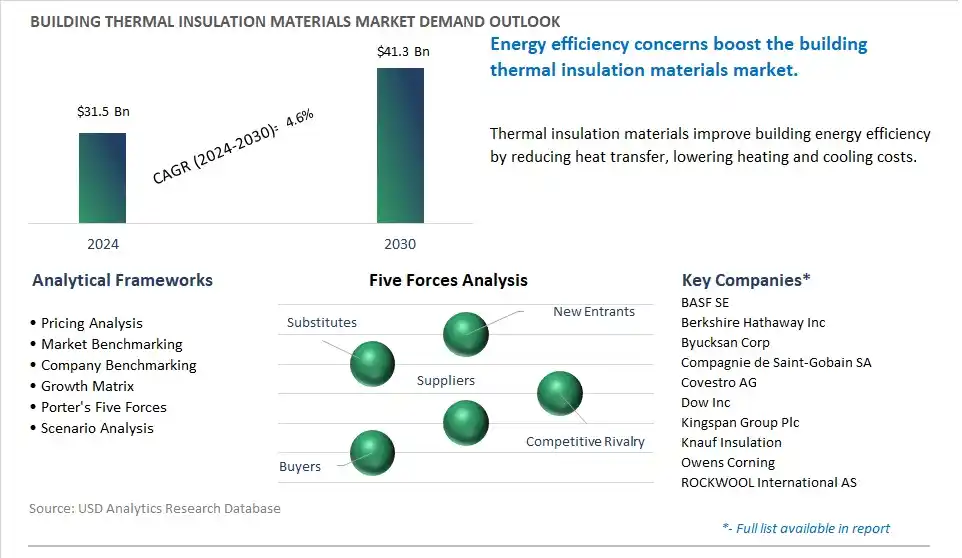
The global Building Thermal Insulation Materials Market is poised to register a 4.6% CAGR from $31.5 Billion in 2024 to $41.3 Billion in 2030.
The global Building Thermal Insulation Materials Market Study analyzes and forecasts the market size across 6 regions and 24 countries for diverse segments -By Material (Stone Wool, Glass Wool, Plastic Foam, Others), By Application (Roof, Wall, Floor).
An Introduction to Global Building Thermal Insulation Materials Market in 2024
The market for building thermal insulation materials is experiencing significant growth, driven by increasing energy efficiency regulations, sustainability initiatives, and the need for climate-resilient infrastructure. Key trends shaping the future of the industry include advancements in insulation materials technology, such as aerogels, vacuum insulation panels, and phase change materials, offering higher thermal performance with reduced thickness and environmental impact. Manufacturers are focusing on innovating insulation products that provide not only excellent thermal resistance but also enhanced fire safety, moisture management, and acoustic insulation properties. Additionally, there is a growing emphasis on integrated building envelope systems and holistic energy management solutions, driving the adoption of insulation materials that contribute to overall building performance and occupant comfort while minimizing energy consumption and carbon footprint. Moreover, advancements in building codes, standards, and certification programs are driving market innovation, promoting the use of high-performance thermal insulation materials in residential, commercial, and industrial construction projects to meet stringent energy efficiency goals and sustainability targets. Overall, the future of building thermal insulation materials lies in continuous research and development efforts to improve material performance, affordability, and environmental sustainability, as well as collaboration across the construction industry to drive widespread adoption of energy-efficient building solutions and mitigate the impacts of climate change.
Building Thermal Insulation Materials Market Competitive Landscape
The market report analyses the leading companies in the industry including BASF SE, Berkshire Hathaway Inc, Byucksan Corp, Compagnie de Saint-Gobain SA, Covestro AG, Dow Inc, Kingspan Group Plc, Knauf Insulation, Owens Corning, ROCKWOOL International AS.
Building Thermal Insulation Materials Market Dynamics
Building Thermal Insulation Materials Market Trend: Increasing Emphasis on Energy Efficiency and Sustainable Construction
In the Building Thermal Insulation Materials market, a prominent trend is the increasing emphasis on energy efficiency and sustainable construction practices. As awareness of environmental issues and energy conservation grows, there's a rising demand for building materials that improve the thermal performance of structures, reduce energy consumption, and minimize carbon emissions. Building thermal insulation materials play a crucial role in enhancing the energy efficiency of buildings by reducing heat transfer through walls, roofs, and floors, thereby reducing heating and cooling costs and improving occupant comfort. This trend is driven by factors such as government initiatives promoting energy-efficient building codes, green building certification programs, and consumer preferences for eco-friendly and cost-effective insulation solutions, leading to a growing market demand for thermal insulation materials that offer high performance and sustainability.
Building Thermal Insulation Materials Market Driver: Stringent Regulatory Standards and Energy Efficiency Mandates
A significant driver in the Building Thermal Insulation Materials market is stringent regulatory standards and energy efficiency mandates. Governments and regulatory bodies worldwide are imposing strict building codes, standards, and mandates aimed at improving energy efficiency and reducing greenhouse gas emissions in the built environment. This driver is fueled by concerns about climate change, energy security, and the economic benefits of energy-efficient buildings, driving the adoption of thermal insulation materials as a key strategy to meet regulatory requirements and achieve sustainability goals. Manufacturers and construction professionals are motivated to invest in thermal insulation solutions that comply with energy codes, offer high thermal resistance (R-value), and contribute to achieving green building certifications such as LEED (Leadership in Energy and Environmental Design) and BREEAM (Building Research Establishment Environmental Assessment Method).
Building Thermal Insulation Materials Market Opportunity: Innovation in High-performance and Sustainable Insulation Technologies
A promising opportunity within the Building Thermal Insulation Materials market lies in innovation in high-performance and sustainable insulation technologies. As demand for energy-efficient buildings continues to rise, there's an opportunity for manufacturers to develop advanced insulation materials that offer superior thermal performance, durability, and environmental sustainability. Opportunities exist in researching and commercializing novel insulation materials such as aerogels, vacuum insulation panels (VIPs), phase change materials (PCMs), and bio-based insulation products that address specific challenges in thermal insulation, such as space constraints, moisture management, and fire safety. By investing in innovation and product development, manufacturers can capitalize on this opportunity to differentiate their offerings, meet evolving market needs, and gain a competitive edge in the growing market for building thermal insulation materials.
Building Thermal Insulation Materials Market Share Analysis: Plastic Foam generated the highest revenue in 2024
Plastic Foam is the largest segment in the Building Thermal Insulation Materials Market. plastic foam insulation materials, such as expanded polystyrene (EPS), extruded polystyrene (XPS), and polyurethane (PU) foam, offer excellent thermal insulation properties, making them highly effective in reducing heat transfer and energy consumption in buildings. These materials have low thermal conductivity, which helps maintain indoor temperatures and improve energy efficiency, leading to significant cost savings on heating and cooling expenses. Additionally, plastic foam insulation materials are lightweight, easy to install, and versatile, allowing for seamless integration into various building structures and applications. Further, plastic foam insulation materials exhibit excellent moisture resistance, dimensional stability, and durability, ensuring long-term performance and longevity in building insulation systems. Furthermore, the growing emphasis on sustainable and eco-friendly building practices has led to the development of recyclable and environmentally friendly plastic foam insulation materials, further driving their adoption in the market. Therefore, the Plastic Foam segment continues to dominate the Building Thermal Insulation Materials Market as the preferred choice for thermal insulation in residential, commercial, and industrial buildings, fueled by its superior insulation properties, ease of installation, and environmental sustainability.
Building Thermal Insulation Materials Market Share Analysis: Wall application segment is poised to register the fastest growth rate (CAGR) over the forecast period to 2030
The fastest-growing segment in the Building Thermal Insulation Materials Market is the Wall application segment. walls represent a significant surface area in buildings, making them crucial for thermal insulation to enhance energy efficiency and indoor comfort. As building regulations and standards worldwide continue to prioritize energy conservation and sustainability, there is increasing demand for effective wall insulation materials to minimize heat loss and reduce heating and cooling costs. Additionally, the rising trend of green building practices and energy-efficient construction techniques further drives the adoption of high-performance thermal insulation materials for walls. Furthermore, technological advancements and innovation in insulation materials, such as aerogels, vacuum insulation panels, and advanced foams, offer superior thermal performance and thin-profile solutions suitable for wall applications. Further, the growing construction activities in residential, commercial, and industrial sectors, particularly in emerging economies, contribute to the increased demand for wall insulation materials. Therefore, the Wall application segment presents significant growth opportunities in the Building Thermal Insulation Materials Market, driven by the imperative for energy efficiency, sustainability, and technological innovation in building construction.
Building Thermal Insulation Materials Market Report Segmentation
By Material
Stone Wool
Glass Wool
Plastic Foam
Others
By Application
Roof
-Flat Roof
-Pitched Roof
Wall
-External Wall
-Internal Wall
-Cavity Wall
Floor
Regions Included
North America (US, Canada, Mexico)
Europe (Germany, UK, France, Spain, Italy, Russia, Rest of Europe)
Asia Pacific (China, India, Japan, South Korea, Australia, South East Asia, Rest of Asia)
South America (Brazil, Argentina, Rest of South America)
Middle East and Africa (Saudi Arabia, UAE, Rest of Middle East, South Africa, Egypt, Rest of Africa)
Building Thermal Insulation Materials Companies Profiled in the Market Study
BASF SE
Berkshire Hathaway Inc
Byucksan Corp
Compagnie de Saint-Gobain SA
Covestro AG
Dow Inc
Kingspan Group Plc
Knauf Insulation
Owens Corning
ROCKWOOL International AS
*- List Not Exhaustive
TABLE OF CONTENTS
1 Introduction to 2024 Building Thermal Insulation Materials Market
1.1 Market Overview
1.2 Quick Facts
1.3 Scope/Objective of the Study
1.4 Market Definition
1.5 Countries and Regions Covered
1.6 Units, Currency, and Conversions
1.7 Industry Value Chain
2 Research Methodology
2.1 Market Size Estimation
2.2 Sources and Research Methodology
2.3 Data Triangulation
2.4 Assumptions and Limitations
3 Executive Summary
3.1 Global Building Thermal Insulation Materials Market Size Outlook, $ Million, 2021 to 2030
3.2 Building Thermal Insulation Materials Market Outlook by Type, $ Million, 2021 to 2030
3.3 Building Thermal Insulation Materials Market Outlook by Product, $ Million, 2021 to 2030
3.4 Building Thermal Insulation Materials Market Outlook by Application, $ Million, 2021 to 2030
3.5 Building Thermal Insulation Materials Market Outlook by Key Countries, $ Million, 2021 to 2030
4 Market Dynamics
4.1 Key Driving Forces of Building Thermal Insulation Materials Industry
4.2 Key Market Trends in Building Thermal Insulation Materials Industry
4.3 Potential Opportunities in Building Thermal Insulation Materials Industry
4.4 Key Challenges in Building Thermal Insulation Materials Industry
5 Market Factor Analysis
5.1 Value Chain Analysis
5.2 Competitive Landscape
5.2.1 Global Building Thermal Insulation Materials Market Share by Company (%), 2023
5.2.2 Product Offerings by Company
5.3 Porter’s Five Forces Analysis
5.4 Pricing Analysis and Outlook
6 Growth Outlook Across Scenarios
6.1 Growth Analysis-Case Scenario Definitions
6.2 Low Growth Scenario Forecasts
6.3 Reference Growth Scenario Forecasts
6.4 High Growth Scenario Forecasts
7 Global Building Thermal Insulation Materials Market Outlook by Segments
7.1 Building Thermal Insulation Materials Market Outlook by Segments, $ Million, 2021- 2030
By Material
Stone Wool
Glass Wool
Plastic Foam
Others
By Application
Roof
-Flat Roof
-Pitched Roof
Wall
-External Wall
-Internal Wall
-Cavity Wall
Floor
8 North America Building Thermal Insulation Materials Market Analysis and Outlook To 2030
8.1 Introduction to North America Building Thermal Insulation Materials Markets in 2024
8.2 North America Building Thermal Insulation Materials Market Size Outlook by Country, 2021-2030
8.2.1 United States
8.2.2 Canada
8.2.3 Mexico
8.3 North America Building Thermal Insulation Materials Market size Outlook by Segments, 2021-2030
By Material
Stone Wool
Glass Wool
Plastic Foam
Others
By Application
Roof
-Flat Roof
-Pitched Roof
Wall
-External Wall
-Internal Wall
-Cavity Wall
Floor
9 Europe Building Thermal Insulation Materials Market Analysis and Outlook To 2030
9.1 Introduction to Europe Building Thermal Insulation Materials Markets in 2024
9.2 Europe Building Thermal Insulation Materials Market Size Outlook by Country, 2021-2030
9.2.1 Germany
9.2.2 France
9.2.3 Spain
9.2.4 United Kingdom
9.2.4 Italy
9.2.5 Russia
9.2.6 Norway
9.2.7 Rest of Europe
9.3 Europe Building Thermal Insulation Materials Market Size Outlook by Segments, 2021-2030
By Material
Stone Wool
Glass Wool
Plastic Foam
Others
By Application
Roof
-Flat Roof
-Pitched Roof
Wall
-External Wall
-Internal Wall
-Cavity Wall
Floor
10 Asia Pacific Building Thermal Insulation Materials Market Analysis and Outlook To 2030
10.1 Introduction to Asia Pacific Building Thermal Insulation Materials Markets in 2024
10.2 Asia Pacific Building Thermal Insulation Materials Market Size Outlook by Country, 2021-2030
10.2.1 China
10.2.2 India
10.2.3 Japan
10.2.4 South Korea
10.2.5 Indonesia
10.2.6 Malaysia
10.2.7 Australia
10.2.8 Rest of Asia Pacific
10.3 Asia Pacific Building Thermal Insulation Materials Market size Outlook by Segments, 2021-2030
By Material
Stone Wool
Glass Wool
Plastic Foam
Others
By Application
Roof
-Flat Roof
-Pitched Roof
Wall
-External Wall
-Internal Wall
-Cavity Wall
Floor
11 South America Building Thermal Insulation Materials Market Analysis and Outlook To 2030
11.1 Introduction to South America Building Thermal Insulation Materials Markets in 2024
11.2 South America Building Thermal Insulation Materials Market Size Outlook by Country, 2021-2030
11.2.1 Brazil
11.2.2 Argentina
11.2.3 Rest of South America
11.3 South America Building Thermal Insulation Materials Market size Outlook by Segments, 2021-2030
By Material
Stone Wool
Glass Wool
Plastic Foam
Others
By Application
Roof
-Flat Roof
-Pitched Roof
Wall
-External Wall
-Internal Wall
-Cavity Wall
Floor
12 Middle East and Africa Building Thermal Insulation Materials Market Analysis and Outlook To 2030
12.1 Introduction to Middle East and Africa Building Thermal Insulation Materials Markets in 2024
12.2 Middle East and Africa Building Thermal Insulation Materials Market Size Outlook by Country, 2021-2030
12.2.1 Saudi Arabia
12.2.2 UAE
12.2.3 Oman
12.2.4 Rest of Middle East
12.2.5 Egypt
12.2.6 Nigeria
12.2.7 South Africa
12.2.8 Rest of Africa
12.3 Middle East and Africa Building Thermal Insulation Materials Market size Outlook by Segments, 2021-2030
By Material
Stone Wool
Glass Wool
Plastic Foam
Others
By Application
Roof
-Flat Roof
-Pitched Roof
Wall
-External Wall
-Internal Wall
-Cavity Wall
Floor
13 Company Profiles
13.1 Company Snapshot
13.2 SWOT Profiles
13.3 Products and Services
13.4 Recent Developments
13.5 Financial Profile
BASF SE
Berkshire Hathaway Inc
Byucksan Corp
Compagnie de Saint-Gobain SA
Covestro AG
Dow Inc
Kingspan Group Plc
Knauf Insulation
Owens Corning
ROCKWOOL International AS
14 Appendix
14.1 Customization Offerings
14.2 Subscription Services
14.3 Related Reports
14.4 Publisher Expertise
By Material
Stone Wool
Glass Wool
Plastic Foam
Others
By Application
Roof
-Flat Roof
-Pitched Roof
Wall
-External Wall
-Internal Wall
-Cavity Wall
Floor
Countries Analyzed
North America (US, Canada, Mexico)
Europe (Germany, UK, France, Spain, Italy, Russia, Rest of Europe)
Asia Pacific (China, India, Japan, South Korea, Australia, South East Asia, Rest of Asia)
South America (Brazil, Argentina, Rest of South America)
Middle East and Africa (Saudi Arabia, UAE, Rest of Middle East, South Africa, Egypt, Rest of Africa)
