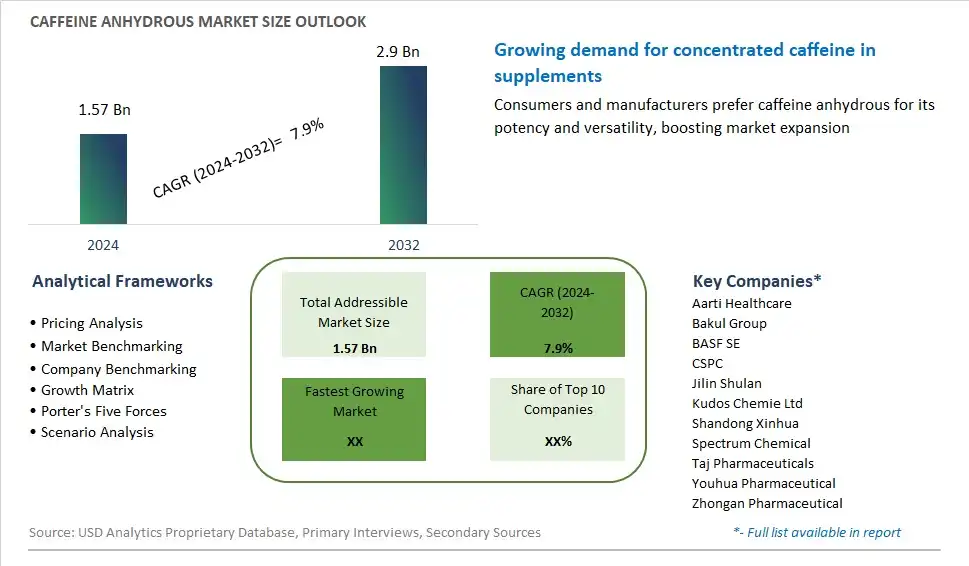
Global Caffeine Anhydrous Market Size is valued at $1.57 Billion in 2024 and is forecast to register a growth rate (CAGR) of 7.9% to reach $2.9 Billion by 2032.
The global Caffeine Anhydrous Market Comprehensive Study analyzes and forecasts the market size across 6 regions and 24 countries for diverse segments -By Type (Synthesis Caffeine, Natural Caffeine), By Application (Food & Beverage, Pharmaceutical, Nutraceuticals, Cosmetics, Others), By Form (Powder, Granules, Liquid, Others)
An Introduction to Caffeine Anhydrous Market
Caffeine anhydrous is a dehydrated form of caffeine, commonly used as a central nervous system stimulant and performance enhancer in 2024. It is derived from natural sources such as coffee beans and tea leaves but processed to remove water, resulting in a concentrated powder or crystalline form of caffeine. Caffeine anhydrous is widely used in dietary supplements, energy drinks, pre-workout formulas, and pharmaceutical products for its ability to increase alertness, improve focus, and enhance physical performance. It is often favored for its potency and rapid absorption compared to caffeine found naturally in beverages. With the growing demand for energy-boosting products, cognitive enhancers, and sports nutrition supplements, the market for caffeine anhydrous is expanding, driven by consumer preferences for convenient and effective ways to boost energy levels, mental acuity, and athletic performance in various daily activities and competitive endeavors.
Caffeine Anhydrous Competitive Landscape
The market report analyses the leading companies in the industry including Aarti Healthcare, Bakul Group, BASF SE, CSPC, Jilin Shulan, Kudos Chemie Ltd, Shandong Xinhua, Spectrum Chemical, Taj Pharmaceuticals, Youhua Pharmaceutical, Zhongan Pharmaceutical, and Others.
Caffeine Anhydrous Market Dynamics
Caffeine Anhydrous Market Trend: Rising Demand for Performance-Enhancing Supplements
The market for caffeine anhydrous is experiencing a prominent trend driven by the rising demand for performance-enhancing supplements among consumers. Caffeine anhydrous, a dehydrated form of caffeine, is highly sought after for its stimulatory effects on the central nervous system, which can improve alertness, focus, and physical performance. This trend is fueled by the growing interest in sports nutrition, fitness optimization, and cognitive enhancement, as individuals seek ways to boost energy levels, increase endurance, and enhance mental clarity in various aspects of their lives. Caffeine anhydrous is a key ingredient in pre-workout supplements, energy drinks, fat burners, and nootropic formulations, catering to the needs of athletes, fitness enthusiasts, students, and professionals looking for a competitive edge or productivity boost. As consumers continue to prioritize health, wellness, and performance optimization, the demand for caffeine anhydrous as a potent and convenient energy-boosting supplement is expected to rise.
Market Driver: Growth of the Sports Nutrition and Wellness Industry
A significant driver of the caffeine anhydrous market is the growth of the sports nutrition and wellness industry. Caffeine anhydrous is widely used in sports supplements and performance-enhancing products due to its ergogenic properties, which can improve physical performance, endurance, and stamina during exercise and athletic activities. Athletes, bodybuilders, and fitness enthusiasts rely on caffeine supplementation to increase energy levels, enhance focus, and delay fatigue during workouts or competitions. Moreover, caffeine anhydrous is also utilized in weight management supplements and thermogenic formulas for its metabolism-boosting effects, aiding in fat oxidation and calorie burning. The expanding sports nutrition market, driven by increasing health consciousness, fitness trends, and the pursuit of active lifestyles, presents opportunities for caffeine anhydrous manufacturers to meet the growing demand for high-quality and effective performance supplements, supporting the continued growth and innovation in the industry.
Market Opportunity: Diversification into Functional Beverages and Snacks
An opportunity for the caffeine anhydrous market lies in diversification into functional beverages and snacks. Beyond traditional supplements, caffeine anhydrous can be incorporated into a variety of food and beverage products to provide energy-boosting benefits and appeal to consumers seeking convenient consumption options. There is a growing demand for functional beverages such as energy shots, ready-to-drink coffees, and performance-enhancing drinks that offer quick and convenient energy boosts for on-the-go consumers. Additionally, caffeine-infused snacks such as energy bars, protein cookies, and chewable tablets provide alternative consumption formats while delivering the desired stimulatory effects. By collaborating with food and beverage manufacturers and exploring innovative product formulations, caffeine anhydrous suppliers can capitalize on the growing market for functional foods and beverages, leveraging caffeine's performance-enhancing properties to create value-added offerings that cater to evolving consumer preferences and lifestyle needs.
Caffeine Anhydrous Market Share Analysis: Synthetic Caffeine held the dominant market share in 2024
Synthetic caffeine is the largest segment in the caffeine anhydrous market, driven by its cost-effectiveness, consistent quality, and versatility in various industries. Synthetic caffeine, produced through chemical synthesis, offers manufacturers greater control over production processes, resulting in a more predictable and standardized product compared to natural caffeine sources. This reliability makes synthetic caffeine the preferred choice for applications requiring precise dosing, such as pharmaceuticals, energy drinks, and dietary supplements. Additionally, synthetic caffeine's scalability and lower production costs make it an attractive option for businesses seeking efficient and economical solutions for incorporating caffeine into their products. Further, the stable supply chain of synthetic caffeine ensures uninterrupted availability, further solidifying its dominance in the market. As industries continue to demand caffeine anhydrous for a wide range of applications, synthetic caffeine maintains its position as the largest segment in the caffeine anhydrous market, offering consistent quality and cost-effective solutions to meet industry needs.
Caffeine Anhydrous Market Share Analysis: Nutraceuticals Propel market is poised to register the fastest growth rae over the forecast period to 2032
The nutraceuticals segment is the fastest-growing segment in the caffeine anhydrous market, driven by increasing consumer awareness of the health benefits associated with caffeine supplementation and the rising demand for energy-boosting and performance-enhancing products. Caffeine anhydrous finds extensive use in nutraceutical formulations aimed at promoting physical endurance, mental alertness, and weight management. As consumers seek natural alternatives to traditional pharmaceuticals for addressing health concerns and improving overall well-being, nutraceutical manufacturers are incorporating caffeine anhydrous into a diverse range of supplements, including pre-workout formulas, energy bars, and weight loss aids. Furthermore, the growing popularity of functional beverages and dietary supplements among health-conscious consumers further fuels the demand for caffeine anhydrous in the nutraceuticals segment. With its proven efficacy and versatility in enhancing physical and cognitive performance, caffeine anhydrous continues to drive innovation and growth in the nutraceutical industry, positioning the segment as a key driver of expansion in the caffeine anhydrous market.
Caffeine Anhydrous Market Share Analysis: Powder Form held the dominant market share in 2024
The powder form segment is the largest segment in the caffeine anhydrous market due to its versatility, ease of handling, and diverse applications across various industries. Powdered caffeine anhydrous offers manufacturers and end-users greater flexibility in formulation and dosage, making it suitable for a wide range of products such as energy drinks, dietary supplements, pharmaceuticals, and personal care items. Its fine particulate size allows for rapid dissolution and uniform distribution, ensuring consistent potency and efficacy in finished products. Further, the powder form's extended shelf life and stability make it a preferred choice for long-term storage and transportation, further contributing to its dominance in the market. Additionally, the powder form's adaptability to different manufacturing processes and packaging formats enhances its appeal to businesses seeking efficient and cost-effective solutions for incorporating caffeine anhydrous into their products. As industries continue to innovate and expand their offerings, the powder form segment maintains its position as the largest segment in the caffeine anhydrous market, driven by its widespread use and proven performance across diverse applications.
Caffeine Anhydrous Market Segmentation
By Type
Synthesis Caffeine
Natural Caffeine
By Application
Food & Beverage
Pharmaceutical
Nutraceuticals
Cosmetics
Others
By Form
Powder
Granules
Liquid
Others
Countries Analyzed
North America (US, Canada, Mexico)
Europe (Germany, UK, France, Spain, Italy, Russia, Rest of Europe)
Asia Pacific (China, India, Japan, South Korea, Australia, South East Asia, Rest of Asia)
South America (Brazil, Argentina, Rest of South America)
Middle East and Africa (Saudi Arabia, UAE, Rest of Middle East, South Africa, Egypt, Rest of Africa)
Caffeine Anhydrous Companies Profiled in the Study
Aarti Healthcare
Bakul Group
BASF SE
CSPC
Jilin Shulan
Kudos Chemie Ltd
Shandong Xinhua
Spectrum Chemical
Taj Pharmaceuticals
Youhua Pharmaceutical
Zhongan Pharmaceutical
*- List Not Exhaustive
Chapter 1. TABLE OF CONTENTS
Chapter 2. Introduction to Caffeine Anhydrous Market
2.1. Market Overview
2.2. Key Statistics and Report Highlights
2.3. Scope of the Comprehensive Study
2.3.1. Market Definition
2.3.2 Countries and Regions Covered
2.3.3 Research Objective
2.3.4 Units, Currency, and Conversions
2.3.5 Industry Value Chain
2.4. Key Market Segments
2.5. Key Companies
2.6. Study Period
Chapter 3. Strategic Analysis Review
3.1. Caffeine Anhydrous Pricing Analysis and Forecast
3.2. Porter’s Five Forces
3.3. Market Ecosystem
3.4. SWOT Analysis
3.5. Regulatory Scenario
3.3. Effects of Inflation, Russia-Ukraine War, moderating economic growth, and other macroeconomic factors
Chapter 4. Competitive Landscape
4.1. Market Share Analysis
4.1.1. Global Caffeine Anhydrous Market Share by Company, 2023
4.1.2. Product Offerings of Leading Caffeine Anhydrous Companies
4.2. Market Entropy
4.2.1. New Product Launches in the Industry
4.2.2. Mergers, Acquisitions, Joint ventures, and Partnerships
4.3. Key Strategies and Best Practices
Chapter 5. Global Market Projections: Best, Reference, and Low Case Scenarios
5.1. Growth Analysis- Case Scenario Definitions
5.2. Low Growth Case Scenario Forecasts
5.3. Reference Growth Case Scenario Forecasts
5.4. High Growth Case Scenario Forecasts
Chapter 6. Market Dynamics
6.1. Caffeine Anhydrous Market Drivers
6.2. Caffeine Anhydrous Market Challenges
6.6. Caffeine Anhydrous Market Opportunities
6.4. Caffeine Anhydrous Market Trends
Chapter 7. Global Caffeine Anhydrous Market Outlook Trends
7.1. Global Caffeine Anhydrous Revenue (USD Million) and CAGR (%) by Type (2021-2032)
7.2. Global Caffeine Anhydrous Revenue (USD Million) and CAGR (%) by Application (2021-2032)
7.3. Global Caffeine Anhydrous Revenue (USD Million) and CAGR (%) by Product (2021-2032)
By Type
Synthesis Caffeine
Natural Caffeine
By Application
Food & Beverage
Pharmaceutical
Nutraceuticals
Cosmetics
Others
By Form
Powder
Granules
Liquid
Others
Chapter 8. Global Caffeine Anhydrous Regional Analysis and Outlook
8.1. Global Caffeine Anhydrous Revenue (USD Million) By Regions (2021- 2032)
8.2. North America Caffeine Anhydrous Revenue (USD Million) by Country (2021-2032)
8.2.1. United States Caffeine Anhydrous Regional Analysis and Outlook
8.2.2. Canada Caffeine Anhydrous Regional Analysis and Outlook
8.2.3. Mexico Caffeine Anhydrous Regional Analysis and Outlook
8.3. Europe Caffeine Anhydrous Revenue (USD Million), by Country (2021-2032)
8.3.1. Germany Caffeine Anhydrous Regional Analysis and Outlook
8.3.2. France Caffeine Anhydrous Regional Analysis and Outlook
8.3.3. United Kingdom Caffeine Anhydrous Regional Analysis and Outlook
8.3.4. Spain Caffeine Anhydrous Regional Analysis and Outlook
8.3.5. Italy Caffeine Anhydrous Regional Analysis and Outlook
8.3.6. Russia Caffeine Anhydrous Regional Analysis and Outlook
8.3.7. Rest of Europe Caffeine Anhydrous Regional Analysis and Outlook
8.4. Asia Pacific Caffeine Anhydrous Revenue (USD Million) by Country (2021-2032)
8.4.1. China Caffeine Anhydrous Regional Analysis and Outlook
8.4.2. Japan Caffeine Anhydrous Regional Analysis and Outlook
8.4.3. India Caffeine Anhydrous Regional Analysis and Outlook
8.4.4. South Korea Caffeine Anhydrous Regional Analysis and Outlook
8.4.5. Australia Caffeine Anhydrous Regional Analysis and Outlook
8.4.6. South East Asia Caffeine Anhydrous Regional Analysis and Outlook
8.4.7. Rest of Asia Pacific Caffeine Anhydrous Regional Analysis and Outlook
8.5. South America Caffeine Anhydrous Revenue (USD Million), by Country (2021-2032)
8.5.1. Brazil Caffeine Anhydrous Regional Analysis and Outlook
8.5.2. Argentina Caffeine Anhydrous Regional Analysis and Outlook
8.5.3. Rest of South America Caffeine Anhydrous Regional Analysis and Outlook
8.6. Middle East and Africa Caffeine Anhydrous Revenue (USD Million) by Country (2021-2032)
8.6.1. Middle East Caffeine Anhydrous Regional Analysis and Outlook
8.6.2. Africa Caffeine Anhydrous Regional Analysis and Outlook
Chapter 9. North America Caffeine Anhydrous Analysis and Outlook
9.1. North America Caffeine Anhydrous Revenue (USD Million) by Segments (2021-2032)
9.1.1. North America Caffeine Anhydrous Revenue (USD Million) by Type (2021-2032)
9.1.2. North America Caffeine Anhydrous Revenue (USD Million) by Application (2021-2032)
9.1.3. North America Caffeine Anhydrous Revenue (USD Million) by Product (2021-2032)
By Type
Synthesis Caffeine
Natural Caffeine
By Application
Food & Beverage
Pharmaceutical
Nutraceuticals
Cosmetics
Others
By Form
Powder
Granules
Liquid
Others
Chapter 10. Europe Caffeine Anhydrous Analysis and Outlook
10.1. Europe Caffeine Anhydrous Revenue (USD Million), by Segments (USD Million) (2021-2032)
10.1.1. Europe Caffeine Anhydrous Revenue (USD Million) by Type (2021-2032)
10.1.2. Europe Caffeine Anhydrous Revenue (USD Million) by Application (2021-2032)
10.1.3. Europe Caffeine Anhydrous Revenue (USD Million) by Product (2021-2032)
By Type
Synthesis Caffeine
Natural Caffeine
By Application
Food & Beverage
Pharmaceutical
Nutraceuticals
Cosmetics
Others
By Form
Powder
Granules
Liquid
Others
Chapter 11. Asia Pacific Caffeine Anhydrous Analysis and Outlook
11.1. Asia Pacific Caffeine Anhydrous Revenue (USD Million), and Revenue (USD Million) by Segments (2021-2032)
11.1.1. Asia Pacific Caffeine Anhydrous Revenue (USD Million) by Type (2021-2032)
11.1.2. Asia Pacific Caffeine Anhydrous Revenue (USD Million) by Application (2021-2032)
11.1.3. Asia Pacific Caffeine Anhydrous Revenue (USD Million) by Product (2021-2032)
By Type
Synthesis Caffeine
Natural Caffeine
By Application
Food & Beverage
Pharmaceutical
Nutraceuticals
Cosmetics
Others
By Form
Powder
Granules
Liquid
Others
Chapter 12. South America Caffeine Anhydrous Analysis and Outlook
12.1. South America Caffeine Anhydrous Revenue (USD Million), by Segments (2021-2032)
12.1.1. South America Caffeine Anhydrous Revenue (USD Million) by Type (2021-2032)
12.1.2. South America Caffeine Anhydrous Revenue (USD Million) by Application (2021-2032)
12.1.3. South America Caffeine Anhydrous Revenue (USD Million) by Product (2021-2032)
By Type
Synthesis Caffeine
Natural Caffeine
By Application
Food & Beverage
Pharmaceutical
Nutraceuticals
Cosmetics
Others
By Form
Powder
Granules
Liquid
Others
Chapter 13. Middle East and Africa Caffeine Anhydrous Analysis and Outlook
13.1. Middle East and Africa Caffeine Anhydrous Revenue (USD Million), by Segments (2021-2032)
13.1.1. Middle East and Africa Caffeine Anhydrous Revenue (USD Million) by Type (2021-2032)
13.1.2. Middle East and Africa Caffeine Anhydrous Revenue (USD Million) by Application (2021-2032)
13.1.3. Middle East and Africa Caffeine Anhydrous Revenue (USD Million) by Product (2021-2032)
By Type
Synthesis Caffeine
Natural Caffeine
By Application
Food & Beverage
Pharmaceutical
Nutraceuticals
Cosmetics
Others
By Form
Powder
Granules
Liquid
Others
Chapter 14. Caffeine Anhydrous Company Profiles
14.1 Business Overview
14.2 Product Profiles
14.3 SWOT Profiles
14.5 Recent Developments
14.6 Financial Profile
List of Companies
Aarti Healthcare
Bakul Group
BASF SE
CSPC
Jilin Shulan
Kudos Chemie Ltd
Shandong Xinhua
Spectrum Chemical
Taj Pharmaceuticals
Youhua Pharmaceutical
Zhongan Pharmaceutical
15. Methodology and Data Sources
15.1 Customization Offerings
15.2 Subscription Services
15.3 Related Reports
15.4 Publisher Expertise
LIST OF TABLES
Table 1 Market Segmentation Analysis
Table 2 Global Caffeine Anhydrous Market Share of Leading Companies, 2023
Table 3 Product Offerings of Leading Companies
Table 4 Low Growth Scenario Forecasts
Table 5 Reference Case Growth Scenario
Table 6 High Growth Case Scenario
Table 7 Global Caffeine Anhydrous Revenue (USD Million) And CAGR (%) By Type (2021-2032)
Table 8 Global Caffeine Anhydrous Revenue (USD Million) And CAGR (%) By Application (2021-2032)
Table 9 Global Caffeine Anhydrous Revenue (USD Million) And CAGR (%) By Product (2021-2032)
Table 10 Global Caffeine Anhydrous Market Revenue (USD Million) By Regions (2021-2032)
Table 11 Global Caffeine Anhydrous Market Share (%) By Regions (2021-2032)
Table 12 North America Caffeine Anhydrous Revenue (USD Million) By Country (2021-2032)
Table 13 Europe Caffeine Anhydrous Revenue (USD Million) By Country (2021-2032)
Table 14 Asia Pacific Caffeine Anhydrous Revenue (USD Million) By Country (2021-2032)
Table 15 South America Caffeine Anhydrous Revenue (USD Million) By Country (2021-2032)
Table 16 Middle East and Africa Caffeine Anhydrous Revenue (USD Million) By Region (2021-2032)
Table 17 North America Caffeine Anhydrous Revenue (USD Million) By Type (2021-2032)
Table 18 North America Caffeine Anhydrous Revenue (USD Million) By Application (2021-2032)
Table 19 North America Caffeine Anhydrous Revenue (USD Million) By Product (2021-2032)
Table 20 Europe Caffeine Anhydrous Revenue (USD Million) By Type (2021-2032)
Table 21 Europe Caffeine Anhydrous Revenue (USD Million) By Application (2021-2032)
Table 22 Europe Caffeine Anhydrous Revenue (USD Million) By Product (2021-2032)
Table 23 Asia Pacific Caffeine Anhydrous Revenue (USD Million) By Type (2021-2032)
Table 24 Asia Pacific Caffeine Anhydrous Revenue (USD Million) By Application (2021-2032)
Table 25 Asia Pacific Caffeine Anhydrous Revenue (USD Million) By Product (2021-2032)
Table 26 South America Caffeine Anhydrous Revenue (USD Million) By Type (2021-2032)
Table 27 South America Caffeine Anhydrous Revenue (USD Million) By Application (2021-2032)
Table 28 South America Caffeine Anhydrous Revenue (USD Million) By Product (2021-2032)
Table 29 Middle East and Africa Caffeine Anhydrous Revenue (USD Million) By Type (2021-2032)
Table 30 Middle East and Africa Caffeine Anhydrous Revenue (USD Million) By Application (2021-2032)
Table 31 Middle East and Africa Caffeine Anhydrous Revenue (USD Million) By Product (2021-2032)
LIST OF FIGURES
Figure 1. Market Scope
Figure 2. Pricing Forecasts Per Unit, 2023- 2032
Figure 3. Porter’s Five Forces
Figure 4. Global Caffeine Anhydrous Market Revenue (USD Million) By Regions (2021-2032)
Figure 5. Global Caffeine Anhydrous Market Share (%) By Regions (2023)
Figure 6. North America Caffeine Anhydrous Revenue (USD Million) By Country (2021-2032)
Figure 7. United States Caffeine Anhydrous Revenue (USD Million) By Country (2021-2032)
Figure 8. Canada Caffeine Anhydrous Revenue (USD Million) By Country (2021-2032)
Figure 9. Mexico Caffeine Anhydrous Revenue (USD Million) By Country (2021-2032)
Figure 10. Europe Caffeine Anhydrous Revenue (USD Million) By Country (2021-2032)
Figure 11. Germany Caffeine Anhydrous Revenue (USD Million) By Country (2021-2032)
Figure 12. France Caffeine Anhydrous Revenue (USD Million) By Country (2021-2032)
Figure 13. United Kingdom Caffeine Anhydrous Revenue (USD Million) By Country (2021-2032)
Figure 14. Spain Caffeine Anhydrous Revenue (USD Million) By Country (2021-2032)
Figure 15. Italy Caffeine Anhydrous Revenue (USD Million) By Country (2021-2032)
Figure 16. Russia Caffeine Anhydrous Revenue (USD Million) By Country (2021-2032)
Figure 17. Rest of Europe Caffeine Anhydrous Revenue (USD Million) By Country (2021-2032)
Figure 11. Asia Pacific Caffeine Anhydrous Revenue (USD Million) By Country (2021-2032)
Figure 12. China Caffeine Anhydrous Revenue (USD Million) By Country (2021-2032)
Figure 13. Japan Caffeine Anhydrous Revenue (USD Million) By Country (2021-2032)
Figure 14. India Caffeine Anhydrous Revenue (USD Million) By Country (2021-2032)
Figure 15. South Korea Caffeine Anhydrous Revenue (USD Million) By Country (2021-2032)
Figure 16. Australia Caffeine Anhydrous Revenue (USD Million) By Country (2021-2032)
Figure 17. South East Asia Caffeine Anhydrous Revenue (USD Million) By Country (2021-2032)
Figure 18. South America Caffeine Anhydrous Revenue (USD Million) By Country (2021-2032)
Figure 19. Brazil Caffeine Anhydrous Revenue (USD Million) By Country (2021-2032)
Figure 20. Argentina Caffeine Anhydrous Revenue (USD Million) By Country (2021-2032)
Figure 21. Rest of Asia Pacific Caffeine Anhydrous Revenue (USD Million) By Country (2021-2032)
Figure 22. Middle East and Africa Caffeine Anhydrous Revenue (USD Million) By Region (2021-2032)
Figure 23. Saudi Arabia Caffeine Anhydrous Revenue (USD Million) By Region (2021-2032)
Figure 24. The UAE Caffeine Anhydrous Revenue (USD Million) By Region (2021-2032)
Figure 25. Rest of Middle East Caffeine Anhydrous Revenue (USD Million) By Region (2021-2032)
Figure 26. South Africa Caffeine Anhydrous Revenue (USD Million) By Region (2021-2032)
Figure 27. Africa Caffeine Anhydrous Revenue (USD Million) By Region (2021-2032)
Figure 28. North America Caffeine Anhydrous Revenue (USD Million) By Type (2021-2032)
Figure 29. North America Caffeine Anhydrous Revenue (USD Million) By Application (2021-2032)
Figure 30. North America Caffeine Anhydrous Revenue (USD Million) By Product (2021-2032)
Figure 31. Europe Caffeine Anhydrous Revenue (USD Million) By Type (2021-2032)
Figure 32. Europe Caffeine Anhydrous Revenue (USD Million) By Application (2021-2032)
Figure 33. Europe Caffeine Anhydrous Revenue (USD Million) By Product (2021-2032)
Figure 34. Asia Pacific Caffeine Anhydrous Revenue (USD Million) By Type (2021-2032)
Figure 35. Asia Pacific Caffeine Anhydrous Revenue (USD Million) By Application (2021-2032)
Figure 36. Asia Pacific Caffeine Anhydrous Revenue (USD Million) By Product (2021-2032)
Figure 37. South America Caffeine Anhydrous Revenue (USD Million) By Type (2021-2032)
Figure 38. South America Caffeine Anhydrous Revenue (USD Million) By Application (2021-2032)
Figure 39. South America Caffeine Anhydrous Revenue (USD Million) By Product (2021-2032)
Figure 40. Middle East and Africa Caffeine Anhydrous Revenue (USD Million) By Type (2021-2032)
Figure 41. Middle East and Africa Caffeine Anhydrous Revenue (USD Million) By Application (2021-2032)
Figure 42. Middle East and Africa Caffeine Anhydrous Revenue (USD Million) By Product (2021-2032)
By Type
Synthesis Caffeine
Natural Caffeine
By Application
Food & Beverage
Pharmaceutical
Nutraceuticals
Cosmetics
Others
By Form
Powder
Granules
Liquid
Others
Countries Analyzed
North America (US, Canada, Mexico)
Europe (Germany, UK, France, Spain, Italy, Russia, Rest of Europe)
Asia Pacific (China, India, Japan, South Korea, Australia, South East Asia, Rest of Asia)
South America (Brazil, Argentina, Rest of South America)
Middle East and Africa (Saudi Arabia, UAE, Rest of Middle East, South Africa, Egypt, Rest of Africa)
