Market Overview: Calcium Zinc Stabilizer Market Growth Anchored in Tin Replacement, PVC Infrastructure Standards, and Sustainable Additive Localization
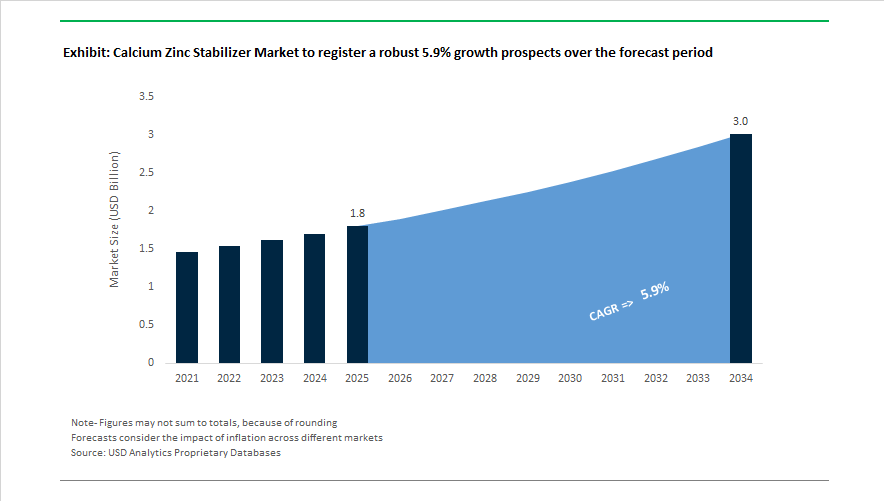
The calcium zinc stabilizer market is projected to rise from USD 1.8 billion in 2025 to USD 3.0 billion by 2034, registering a CAGR of 5.9% as global PVC processors accelerate the shift toward non-toxic, heavy-metal-free heat stabilizers. Capacity localization gained momentum in July 2024 when RA Chemicals, via Foxcon Elements, began commercial production of 45,000 MTPA of CaZn stabilizers in Ahmedabad under the STABICON brand, strengthening India’s domestic polymer additive supply base. In August 2024, Baerlocher USA expanded its North American distribution reach through an agreement with Palmer Holland, improving access to sustainable CaZn stabilizer systems for regional converters. April 2024 developments from SONGWON Industrial Group at ACS highlighted integrated light and heat protection technologies, reinforcing CaZn compatibility with advanced PVC formulations.
Regulatory alignment and performance validation drove wider industrial acceptance during 2024 and 2025. In May 2024, Baerlocher USA partnered with the EREMA Group to demonstrate CaZn-based BAEROPOL T-Blend stabilization in post-consumer recycled films, reducing gel defects by nearly half and addressing quality barriers in mechanical recycling. Reagens USA Inc. achieved the first NSF 14 certification for CaZn stabilizers in 2024, validating their suitability for potable water PVC pressure pipes in North America. During 2025, SONGWON advanced high-temperature SONGSTAB cable stabilizers for 105°C–125°C PVC insulation, supporting electrical infrastructure upgrades. September 2025 saw Valtris Specialty Chemicals announce a major expansion of its Thane, India facility, targeting localized demand from construction and automotive sectors in South Asia. At K 2025, Baerlocher introduced its Tin Replacement initiative, positioning CaZn systems as lower-carbon, regulation-compliant alternatives.
Strategic portfolio refinement and sustainability trends intensified through 2026. November 2025 marked SONGWON’s greenfield One Pack Systems plant investment in Saudi Arabia to produce integrated CaZn additive blends for Middle Eastern pipe and cable manufacturers. February 2026 leadership changes at Valtris were aligned with a sustainability-focused strategy, while the company’s February 2026 divestiture of Champlor Renewables sharpened its core polymer additives focus. Industry momentum toward PFAS-free processing solutions accelerated in 2025 and early 2026, prompting reformulation of CaZn stabilizers with alternative internal lubricants to replace fluoropolymer aids.
Lead-Free Compliance Acceleration, High-Speed Extrusion Chemistry, and Circular PVC Retargeting Define Trends and Opportunities in the Calcium Zinc Stabilizer Market
Lead-Free Mandates Transform Calcium Zinc Stabilizers From Choice to Compulsion
The Calcium Zinc Stabilizer Market has transitioned into a mandatory component of potable water and infrastructure PVC systems due to binding regulatory action. Effective November 29, 2024, the European Union enforced a full lead prohibition above 0.1% in PVC products, compelling total conversion to calcium-zinc and organic stabilizers for all newly financed piping networks entering 2025. In India, regulatory pressure is equally decisive. The Lead Stabilizers in PVC Pipes and Fittings (Amendment) Rules notified in May 2022 established a time-bound phase-out that reached enforcement maturity by 2024–2025. For public tenders under the Jal Jeevan Mission, compliance with BIS lead-free standards is now a non-negotiable entry requirement. Because potable water infrastructure is a non-deferrable capital expenditure category, these mandates have created structurally inelastic demand for CaZn stabilizers.
Advanced “One-Pack” CaZn Systems Enable High-Speed, Defect-Free Co-Extrusion
Innovation in stabilizer formulation is reshaping operational economics in PVC processing lines. Producers are introducing “one-pack” thermal systems that integrate co-stabilizers, lubricants, and inorganic acid scavengers to deliver high-speed extrusion while preventing plate-out and die fouling. New 2025-generation CaZn masterbatches are engineered to sustain extrusion speeds beyond 120 meters per minute at temperatures between 190°C and 210°C. From a performance standpoint, calcium-zinc stabilizers are demonstrating stronger color stability than traditional lead alternatives, particularly for dark PVC window profiles. This allows processors to reduce pigment additions and capture raw material cost savings while supporting long-term UV weathering performance, which is critical for architectural exterior profiles exposed to solar load.
High-Purity Calcium Zinc Stabilizers for USP-Compliant Medical Devices
The medical PVC segment is emerging as a premium-margin niche for CaZn producers. Healthcare procurement standards require stabilizer systems that are not only non-toxic but also compliant with United States Pharmacopeia requirements for human-contact materials. Producers such as Goldstab Organics are developing USP-compliant CaZn systems using plant-derived stearic acids and high-purity zinc and calcium oxides to avoid extractables and leachables during sterilization. Gamma radiation and ethylene oxide sterilization are now standard for IV tubing, blood bags, and catheter-grade PVC. CaZn stabilizers have demonstrated superior mechanical and optical retention following these sterilization cycles, positioning them as the preferred replacement for mixed-metal stabilizers in health-critical applications.
“Re-Stabilizer” Chemistry Unlocks the PVC Circular Economy
As construction and demolition waste becomes a major recycled PVC feedstock, specialized CaZn “re-stabilization” additives are emerging as essential enablers of circular value chains. Under the EU Circular Economy Action Plan and India’s Waste Rules 2025, manufacturers face phased recycled-content obligations that are driving the need to reintroduce post-consumer PVC into high-spec products such as window profiles and sanitary piping. VinylPlus reported in May 2025 that more than 724,000 tonnes of PVC were recycled in the prior year. To use this output in high-performance applications, CaZn additives must neutralize degradation residues and rebuild thermal stability lost during the initial lifecycle. Manufacturers are therefore investing in restabilization kits that allow recycled PVC to meet engineering-grade lifecycle requirements in 2025 and beyond.
Calcium Zinc Stabilizer Market Share and Segmentation Insights
Market Share by Application: Pipes and Profiles Anchor Volume While Medical Grades Add Premium Value
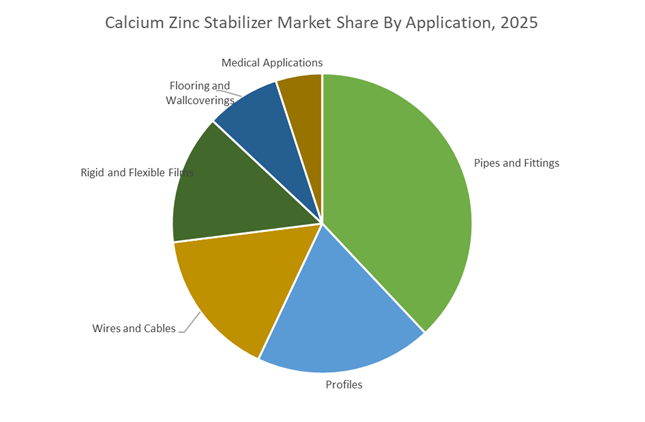
Pipes and fittings account for 38% of calcium zinc stabilizer consumption in 2025, reflecting widespread adoption in potable water networks, sewage lines, and drainage systems where CaZn systems deliver long-term thermal stability and meet NSF, WRAS, and ACS drinking-water approvals. Global phase-out of lead stabilizers and accelerating infrastructure investment in developing economies are sustaining demand. Profiles represent the second-largest segment, serving window frames, door systems, and siding with strong weatherability and color retention, supported by energy-efficiency mandates and residential construction activity, particularly in Europe’s lead-free window conversion programs. Wires and cables form a fast-growing segment, leveraging CaZn stabilizers for RoHS-compliant PVC insulation in low-voltage power and communication lines as 5G rollouts, data centers, and renewable energy projects expand. Rigid and flexible films support packaged food and e-commerce logistics, while flooring and wallcoverings utilize CaZn for dimensional stability in LVT and sheet vinyl. Medical applications remain the smallest by volume but highest in value, requiring ISO 10993 biocompatibility for IV tubing, blood bags, and pharmaceutical packaging.
Market Share by End Use Industry: Construction Dominates as Electrification and Healthcare Reinforce Demand
Building and construction account for 52% of calcium zinc stabilizer demand in 2025, spanning pipes, profiles, roofing membranes, flooring, and waterproofing systems, driven by lead replacement mandates, green building certifications, and infrastructure stimulus programs. Electrical and electronics is the second-largest and fastest-growing sector, transitioning wires, cables, and enclosures toward lead-free stabilization alongside halogen-free flame-retardant formulations, with renewable energy and EV charging networks emerging as high-growth subsegments. Packaging follows through rigid PVC blisters and flexible food films as circular economy initiatives favor non-toxic stabilizer systems. Automotive and transportation apply CaZn stabilizers in under-hood wiring and interior films where low VOC and low fogging are critical, while healthcare and life sciences represent a recession-resistant, value-intensive niche supplying ultra-pure materials for medical devices and drug packaging.
Competitive Landscape of the Calcium Zinc Stabilizer Market
The global calcium zinc (Ca-Zn) stabilizer market in 2026 is defined by the accelerating shift toward lead-free PVC formulations, rising demand from construction profiles, pipes, wires & cables, medical tubing, and EV interiors, and rapid innovation around PCR-compatible stabilizers, low-VOC systems, and multifunctional one-packs. Competition increasingly centers on application-specific Ca-Zn blends, circular PVC compatibility, phenol-free formulations, and integrated additive systems. Market leaders are differentiating through local application labs, backward integration into metal soaps, and sustainability-driven product platforms, enabling processors to meet tightening environmental regulations while improving extrusion efficiency, surface finish, and long-term thermal stability.
Calcium-based PVC leadership and circular formulation expertise by Baerlocher GmbH
Baerlocher remains the global architect of calcium zinc stabilization, having pioneered Europe’s transition away from lead systems. Its BAEROPAN and BAEROSTAB one-pack stabilizers are the 2026 industry standard for rigid PVC window and technical profiles, combining stabilizers, lubricants, and functional additives in dust-free formats. In early 2026, Baerlocher strengthened its Circular PVC initiative, launching Ca-Zn systems engineered to offset thermal degradation in post-consumer recycled PVC used in flooring and pipes. With application labs worldwide, Baerlocher custom-formulates by resin grade and climate zone. Its 2026 strategy centers on “Sustainability as a Service,” lowering total cost of ownership through high-efficiency pellets that reduce scrap and extrusion energy.
Wire & cable performance and synergistic stabilization from Songwon Industrial Co., Ltd.
Songwon enters 2026 as a high-end Ca-Zn specialist for wire, cable, and medical PVC applications. Its SONGSTAB™ Calcium Organic family delivers superior Congo Red thermal stability and ultra-low moisture uptake for 105°C–125°C cable insulation. Backward integration into calcium and zinc soaps enables consistent purity and pricing despite raw material volatility. Songwon also dominates biocompatible stabilizers for IV tubing and blood bags, maintaining clarity without leaching. Its solution-oriented R&D combines Ca-Zn systems with SONGSORB® UV absorbers to deliver 2026-grade outdoor durability for decking and profiles, positioning Songwon as a technology partner rather than a commodity additive supplier.
Complex Ca-Zn blends for construction durability by Reagens Group
Reagens leads the market for high-performance complex Ca-Zn stabilizers, especially in building and construction. Its REAPAK portfolio, including the REAPAK G-AV series, enables high filler loading in PVC pipes while preserving mechanical strength and surface quality. After expanding North American and Asian hubs in 2025, Reagens now delivers just-in-time liquid and solid blends to regional siding and profile producers. The company is also recognized for multifunctional liquid Ca-Zn systems used in PVC films and plastisols, offering excellent initial color and long-term transparency for food packaging and decorative foils. ISO 45001 and 14001 recertifications in 2026 reinforce Reagens’ zero-harm manufacturing commitment.
Integrated additive systems and phenol-free innovation by Valtris Specialty Chemicals
Valtris is a dominant Western supplier of mixed-metal and calcium zinc stabilizers, emphasizing low-VOC and phenol-free technologies. Its Therm-Chek® and Akcrostab™ ranges lead 2026 adoption of regulatory-compliant stabilizers for automotive dashboard skins and interior PVC. Following divestment of non-core renewables in early 2026, Valtris doubled down on sustainable polymer additives, integrating Ca-Zn stabilizers with Plas-Chek® epoxy co-stabilizers and specialty plasticizers to deliver full additive packages. The company’s 2026 focus on EV interiors highlights Ca-Zn systems engineered for lightweighting, flame retardancy, and long-term heat stability, strengthening Valtris’ position in mobility-driven PVC applications.
Asia-Pacific lead-free transition powered by Sun Ace
Sun Ace is a cornerstone of the Asia-Pacific Ca-Zn market, known for ecoSTAB™ technology that accelerates lead-to-lead-free conversion. Its SAK-CZH and SAK-CZW one-packs are widely used in rigid PVC window profiles, decking, and telecom ducting, delivering balanced lubrication and enhanced weatherability. Sun Ace was the region’s first stabilizer producer with ISO 14001 certification and remains a sustainability-first partner for infrastructure projects. In 2026, the company expanded into 5G and fiber-optic PVC protection systems and introduced low-dosage Ca-Zn formulations that achieve equivalent stability at 15% lower loading, helping processors meet environmental and cost targets simultaneously.
Hybrid Ca-Zn systems for automotive and electronics by Adeka Corporation
Adeka leverages advanced R&D to push Ca-Zn stabilizer performance in automotive interiors, flexible films, and consumer electronics. Its 2026 grades are prized for low-fogging behavior, supporting strict in-cabin air quality standards. Adeka combines Ca-Zn stabilizers with proprietary antioxidants and flame retardants to deliver synergistic stabilization packages for complex PVC formulations. With capacity expansion and partnerships across China and Southeast Asia, Adeka is positioning itself as an Asia-Pacific growth engine. Recognized in 2026 for hybrid organic-inorganic Ca-Zn technology, the company achieved a 20% improvement in UV resistance for outdoor building materials, reinforcing its reputation as a high-performance stabilizer innovator.
China remains the largest production and consumption hub in the global calcium zinc stabilizer industry, driven by aggressive lead-free substitution policies and unmatched PVC processing capacity. Under the national “Lead-Free Transition” directive, Chinese manufacturers have optimized compounding lines to scale calcium-zinc based one-pack stabilizers, which accounted for approximately 38% of total domestic stabilizer consumption by early 2025. This structural shift reflects a decisive move away from legacy lead-based systems toward non-toxic Ca-Zn stabilizers for rigid PVC pipes, window profiles, and cable insulation.
China produces an estimated 50% to 60% of the world’s PVC pipes, positioning rigid-grade Ca-Zn stabilizers at the center of municipal water supply, sewage infrastructure, and irrigation pipeline expansion. Refinery integration across coastal petrochemical hubs has strengthened supply security, particularly with expanded production of epoxidized soybean oil (ESBO) and organic co-stabilizers that enhance thermal stability and long-term color retention in high-performance Ca-Zn blends. In late 2024, the industrial power cable segment reported an 18% increase in Ca-Zn stabilizer adoption, driven by stricter fire-safety and low-smoke emission requirements in renewable energy grid installations.
India’s Urban Water Infrastructure and One-Pack Stabilizer Adoption Driving Ca-Zn Market Expansion
India’s calcium zinc stabilizer market is closely aligned with public infrastructure expansion and rapid urbanization. Under the AMRUT (Atal Mission for Rejuvenation and Urban Transformation) scheme, more than 13.4 million new water tap connections have been delivered, generating sustained demand for non-toxic Ca-Zn stabilized PVC piping in municipal water distribution networks. With over 40% of the population projected to reside in urban centers by 2030, mid-income housing demand is accelerating consumption of Ca-Zn stabilized window profiles, conduit pipes, and resilient PVC flooring systems.
Capacity additions are reinforcing domestic supply. In late 2023, Baerlocher India commissioned a new facility in Madhya Pradesh dedicated to sustainable calcium-based additives for the fast-growing plumbing and building materials sector. Regulatory stability is also improving: the proposed Oilfields (Regulation and Development) Amendment Act 2025 aims to stabilize domestic feedstock pricing for specialty chemicals, including metallic soaps used in Ca-Zn stabilizer formulations.
Germany’s Tin Replacement Strategy and Circular PVC Economy Advancing High-Performance Ca-Zn Systems
Germany is a European benchmark for advanced calcium zinc stabilizer technology, driven by regulatory leadership and sustainability mandates. Under the “Tin Replacement” initiative, German producers are scaling REACH- and RoHS-compliant Ca-Zn stabilizer systems that deliver up to a 50% reduction in CO₂-equivalent emissions per kilogram compared to conventional tin-based alternatives. This transition supports low-carbon PVC processing in construction, electrical, and automotive segments.
At K Show 2025, German manufacturers introduced “Smart Stabilization” platforms integrating digital sensors that monitor melt temperature and automatically adjust Ca-Zn stabilizer dosing in real time, enhancing thermal stability and minimizing degradation during extrusion. Circular economy integration is a defining trend: new-generation Ca-Zn stabilizers are engineered to maintain polymer integrity across 8 to 10 recycling cycles, aligning with EU mandates for increased post-consumer recycled (PCR) content in PVC building materials.
United States’ Recyclability Mandates and Liquid Ca-Zn Innovation Reshaping PVC Stabilizer Demand
The United States calcium zinc stabilizer market is undergoing structural transformation driven by regulatory tightening, distribution consolidation, and automotive lightweighting trends. In March 2024, Valtris Specialty Chemicals appointed Barentz as a primary North American distribution partner, streamlining access to mixed-metal and Ca-Zn stabilizers across the region.
The U.S. automotive sector, producing over 10.6 million vehicles annually, is increasing its use of Ca-Zn stabilized PVC in interior trim components to meet indoor air quality (IAQ) and non-toxic compliance standards. Liquid Ca-Zn stabilizers now account for over 52% of the domestic coatings segment, favored for superior dispersion in flexible PVC plastisols. Complementary innovations such as non-phthalate Vulcabond™ liquid bonding agents are being integrated with Ca-Zn systems to produce high-strength PVC-coated fabrics for transportation and construction applications, reinforcing performance-oriented additive demand.
Turkey’s Post-Reconstruction Construction Boom and EU-Aligned Compliance Boosting Ca-Zn One-Pack Systems
Turkey has emerged as a strategic calcium zinc stabilizer production and export bridge between Asia and Europe. Companies such as Baerlocher Turkey are expanding one-pack Ca-Zn stabilizer solutions tailored for Middle Eastern and European construction markets. Post-earthquake reconstruction initiatives have significantly increased demand for durable Ca-Zn stabilized PVC window profiles, siding, and piping systems.
In January 2025, SONGWON appointed Altek International FZE as a regional distributor to expand premium Ca-Zn stabilizer availability across the Middle East, leveraging Turkey’s logistical advantage. Turkish PVC processors are increasingly adopting hybrid Ca-Zn/LDH stabilizer systems to enable higher filler loading without compromising thermal stability or color retention.
Vietnam’s FDI-Driven Smart Infrastructure and Tariff Liberalization Accelerating Ca-Zn Conversion
Vietnam’s calcium zinc stabilizer market is expanding on the back of foreign direct investment, tariff liberalization, and export-oriented manufacturing. Vinhomes JSC committed $966 million to smart city developments, significantly increasing demand for Ca-Zn stabilized PVC pipes, window frames, and electrical conduits in infrastructure projects.
Government reductions in import tariffs on specialty chemical additives have encouraged local compounders to transition from low-cost lead stabilizers to high-performance Ca-Zn powder systems. As a global footwear and garment production hub, Vietnam is experiencing rising demand for flexible Ca-Zn stabilized PVC films and labels, particularly as multinational brands mandate “Clean Chemistry” standards within supply chains.
Calcium Zinc Stabilizer Market Report Scope
Calcium Zinc Stabilizer Market
Parameter
Details
Market Size (2025)
$1.8 Billion
Market Size (2034)
$3 Billion
Market Growth Rate
5.9%
Segments
By Physical Form (Solid, Liquid), By Product Chemistry (Calcium Zinc Stearates, Calcium Organic Stabilizers, Rare Earth Modified Systems, Hydrotalcite Based Systems), By Application (Pipes and Fittings, Profiles, Wires and Cables, Rigid and Flexible Films, Medical Applications, Flooring and Wallcoverings), By End Use Industry (Building and Construction, Automotive and Transportation, Electrical and Electronics, Healthcare and Life Sciences, Packaging)
Study Period
2019- 2025 and 2026-2034
Units
Revenue (USD)
Qualitative Analysis
Porter’s Five Forces, SWOT Profile, Market Share, Scenario Forecasts, Market Ecosystem, Company Ranking, Market Dynamics, Industry Benchmarking
Companies
Baerlocher, Adeka Corporation, Reagens, Platinum Industries, Galata Chemicals, Valtris Specialty Chemicals, Songwon Industrial, Pau Tai Industrial, Sun Ace Kakoh, Hebei Jingxin Chemical Group, Shandong Jinchangshu New Material, Goldstab Organics, Vikas Ecotech, PMC Group, Kisuma Chemicals
Countries
US, Canada, Mexico, Germany, France, Spain, Italy, UK, Russia, China, India, Japan, South Korea, Australia, South East Asia, Brazil, Argentina, Middle East, Africa
Calcium Zinc Stabilizer Market Segmentation
By Physical Form
Solid
Liquid
By Product Chemistry
Calcium Zinc Stearates
Calcium Organic Stabilizers
Rare Earth Modified Systems
Hydrotalcite Based Systems
By Application
Pipes and Fittings
Profiles
Wires and Cables
Rigid and Flexible Films
Medical Applications
Flooring and Wallcoverings
By End Use Industry
Building and Construction
Automotive and Transportation
Electrical and Electronics
Healthcare and Life Sciences
Packaging
By Region
North America (United States, Canada, Mexico)
Europe (Germany, France, United Kingdom, Spain, Italy, Rest of Europe)
Asia Pacific (China, India, Japan, South Korea, Australia, Rest of APAC)
South and Central America (Brazil, Argentina, Rest of SCA)
Middle East and Africa (Saudi Arabia, UAE, South Africa, Rest of Middle East, Rest of Africa)
2. Calcium Zinc Stabilizer Market Landscape and Outlook (2025–2034)
2.1. Introduction to Calcium Zinc Stabilizer Chemistry
2.2. Market Valuation and Growth Outlook (2025–2034)
2.3. Lead Replacement, Tin Substitution, and Regulatory Acceleration
2.4. High-Speed PVC Extrusion and One-Pack Stabilizer Innovation
2.5. Circular PVC and Re-Stabilization Demand
3. Strategic Trends and Opportunities
3.1. Lead-Free Mandates in Potable Water Infrastructure
3.2. Advanced One-Pack CaZn Systems for High-Speed Co-Extrusion
3.3. High-Purity USP-Compliant Medical PVC Stabilization
3.4. Re-Stabilizer Chemistry for Recycled PVC
3.5. PFAS-Free Lubricant Reformulation in CaZn Systems
4. Competitive Landscape and Strategic Developments
4.1. Global Tin Replacement and Heavy-Metal-Free Transition
4.2. Capacity Localization and Regional Manufacturing Expansion
4.3. Integrated Additive Systems and Multifunctional Blends
4.4. Circular PVC Compatibility and PCR Stabilization Platforms
4.5. Distribution Alliances and Technical Service Expansion
5. Market Share and Segmentation Insights: Calcium Zinc Stabilizer Market
5.1. By Physical Form
5.1.1. Solid
5.1.2. Liquid
5.2. By Product Chemistry
5.2.1. Calcium Zinc Stearates
5.2.2. Calcium Organic Stabilizers
5.2.3. Rare Earth Modified Systems
5.2.4. Hydrotalcite Based Systems
5.3. By Application
5.3.1. Pipes and Fittings
5.3.2. Profiles
5.3.3. Wires and Cables
5.3.4. Rigid and Flexible Films
5.3.5. Medical Applications
5.3.6. Flooring and Wallcoverings
5.4. By End Use Industry
5.4.1. Building and Construction
5.4.2. Automotive and Transportation
5.4.3. Electrical and Electronics
5.4.4. Healthcare and Life Sciences
5.4.5. Packaging
6. Country Analysis and Outlook of Calcium Zinc Stabilizer Market
6.1. United States
6.2. Canada
6.3. Mexico
6.4. Germany
6.5. France
6.6. United Kingdom
6.7. Spain
6.8. Italy
6.9. China
6.10. India
6.11. Japan
6.12. South Korea
6.13. Australia
6.14. Brazil
6.15. Argentina
6.16. Middle East
6.17. Africa
7. Calcium Zinc Stabilizer Market Size Outlook by Region (2025–2034)
7.1. North America Calcium Zinc Stabilizer Market Size Outlook
7.1.1. By Physical Form
7.1.2. By Product Chemistry
7.1.3. By Application
7.1.4. By End Use Industry
7.2. Europe Calcium Zinc Stabilizer Market Size Outlook
7.2.1. By Physical Form
7.2.2. By Product Chemistry
7.2.3. By Application
7.2.4. By End Use Industry
7.3. Asia Pacific Calcium Zinc Stabilizer Market Size Outlook
7.3.1. By Physical Form
7.3.2. By Product Chemistry
7.3.3. By Application
7.3.4. By End Use Industry
7.4. South and Central America Calcium Zinc Stabilizer Market Size Outlook
7.4.1. By Physical Form
7.4.2. By Product Chemistry
7.4.3. By Application
7.4.4. By End Use Industry
7.5. Middle East and Africa Calcium Zinc Stabilizer Market Size Outlook
7.5.1. By Physical Form
7.5.2. By Product Chemistry
7.5.3. By Application
7.5.4. By End Use Industry
8. Company Profiles: Leading Players in the Calcium Zinc Stabilizer Market
8.1. Baerlocher
8.2. Adeka Corporation
8.3. Reagens
8.4. Platinum Industries
8.5. Galata Chemicals
8.6. Valtris Specialty Chemicals
8.7. Songwon Industrial
8.8. Pau Tai Industrial
8.9. Sun Ace Kakoh
8.10. Hebei Jingxin Chemical Group
8.11. Shandong Jinchangshu New Material
8.12. Goldstab Organics
8.13. Vikas Ecotech
8.14. PMC Group
8.15. Kisuma Chemicals
9. Methodology
9.1. Research Scope
9.2. Primary and Secondary Research Framework
9.3. Market Sizing and Forecast Model
9.4. Assumptions and Limitations
9.5. Validation and Triangulation
10. Appendix
10.1. Acronyms and Abbreviations
10.2. List of Tables
10.3. List of Figures
Calcium Zinc Stabilizer Market Segmentation
By Physical Form
Solid
Liquid
By Product Chemistry
Calcium Zinc Stearates
Calcium Organic Stabilizers
Rare Earth Modified Systems
Hydrotalcite Based Systems
By Application
Pipes and Fittings
Profiles
Wires and Cables
Rigid and Flexible Films
Medical Applications
Flooring and Wallcoverings
By End Use Industry
Building and Construction
Automotive and Transportation
Electrical and Electronics
Healthcare and Life Sciences
Packaging
By Region
North America (United States, Canada, Mexico)
Europe (Germany, France, United Kingdom, Spain, Italy, Rest of Europe)
Asia Pacific (China, India, Japan, South Korea, Australia, Rest of APAC)
South and Central America (Brazil, Argentina, Rest of SCA)
Middle East and Africa (Saudi Arabia, UAE, South Africa, Rest of Middle East, Rest of Africa)
The Calcium Zinc Stabilizer Market is valued at USD 1.8 billion in 2025 and is projected to reach USD 3.0 billion by 2034, expanding at a CAGR of 5.9%. Growth is structurally supported by global lead bans in PVC, rising potable water infrastructure, and accelerating adoption of CaZn one-pack systems across pipes, profiles, and cables.
Pipes and fittings account for about 38% of CaZn consumption in 2025, anchored by potable water and sewage infrastructure. Profiles for windows and doors follow, while wires and cables represent the fastest-growing segment due to RoHS compliance, renewable energy grids, and data center expansion. Medical PVC adds premium value through USP-grade CaZn systems.
EU lead prohibitions, India’s BIS mandates, and recycled-content requirements are turning CaZn stabilizers from optional to mandatory. New “re-stabilizer” chemistries enable post-consumer PVC to re-enter high-spec applications like pipes and profiles. This circular PVC shift is creating sustained demand for advanced CaZn blends with degradation-neutralizing capability.
Next-generation CaZn one-pack systems integrate stabilizers, lubricants, and scavengers to support extrusion speeds above 120 m/min while minimizing plate-out and die fouling. High-purity formulations now deliver improved color retention, lower VOCs, and compatibility with PFAS-free processing, helping converters reduce scrap and energy consumption.
Key players include Baerlocher, Songwon Industrial, Valtris Specialty Chemicals, Reagens, Adeka Corporation, and Sun Ace Kakoh. Competition centers on application-specific CaZn systems, recycled-PVC compatibility, medical-grade purity, and localized one-pack manufacturing for construction and electrification markets.