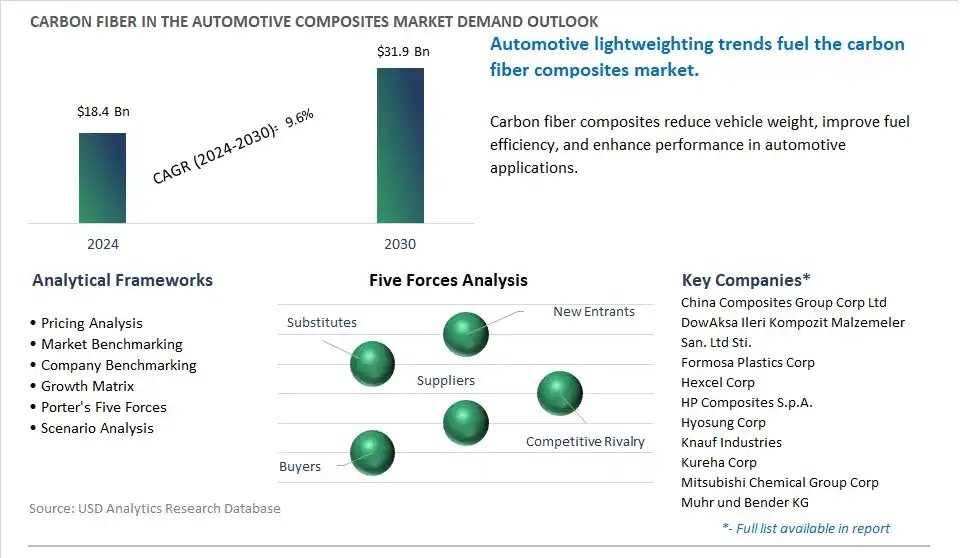
The global Carbon Fiber in the Automotive Composites Market is poised to register a 9.6% CAGR from $18.4 Billion in 2024 to $31.9 Billion in 2030.
The global Carbon Fiber in the Automotive Composites Market Study analyzes and forecasts the market size across 6 regions and 24 countries for diverse segments -By Material (Long Fiber Thermoplastic, Sheet Moulding Compound, Prepreg, Short Fiber Thermoplastic, Others), By Application (Exterior Components, Interior Components, Structural and Powertrains, Chassis Systems, Others).
An Introduction to Global Carbon Fiber in the Automotive Composites Market in 2024
The market for carbon fiber in automotive composites is experiencing significant growth, driven by the automotive industry's focus on lightweighting, fuel efficiency, and emission reduction. Key trends shaping the future of the industry include advancements in carbon fiber production technology, resin systems, and composite manufacturing processes, enabling the development of lightweight automotive components that offer superior strength, stiffness, and crashworthiness compared to traditional materials such as steel and aluminum. Additionally, there is a growing emphasis on electric and hybrid vehicles, where reducing vehicle weight is crucial for extending range and improving energy efficiency, driving the adoption of carbon fiber composites in applications such as body panels, chassis components, and structural reinforcements. Moreover, advancements in recycling technologies, lifecycle assessment, and circular economy initiatives are driving innovation in carbon fiber recycling and reuse, promoting the development of sustainable supply chains and closed-loop material cycles that minimize environmental impact and reduce carbon footprint in automotive manufacturing. Furthermore, collaborations between automotive OEMs, carbon fiber suppliers, and research institutions are shaping the development of next-generation carbon fiber composites tailored for automotive applications, driving market growth and competitiveness in the global automotive industry. Overall, the future of carbon fiber in automotive composites lies in continuous research and development efforts to improve material properties, reduce production costs, and scale up manufacturing capacity to meet the growing demand for lightweight solutions in the automotive sector while addressing sustainability and environmental challenges.
Carbon Fiber in the Automotive Composites Market Competitive Landscape
The market report analyses the leading companies in the industry including China Composites Group Corp Ltd, DowAksa Ileri Kompozit Malzemeler San. Ltd Sti., Formosa Plastics Corp, Hexcel Corp, HP Composites S.p.A., Hyosung Corp, Knauf Industries, Kureha Corp, Mitsubishi Chemical Group Corp, Muhr und Bender KG, Plasan Sasa Ltd, Revchem Composites Inc, SAERTEX GmbH and Co.KG, Saudi Basic Industries Corp, SGL Carbon SE, Shenzhen KIY Carbon Co. Ltd, Solvay SA, Teijin Ltd, Toray Industries Inc.
Carbon Fiber in the Automotive Composites Market Dynamics
Carbon Fiber in the Automotive Composites Market Trend: Increasing Demand for Lightweight Materials in Automotive Manufacturing
In the Carbon Fiber in the Automotive Composites market, a prominent trend is the increasing demand for lightweight materials in automotive manufacturing. Carbon fiber composites offer significant weight savings compared to traditional materials like steel and aluminum, leading to improved fuel efficiency, performance, and range in vehicles. This trend is driven by stricter fuel economy regulations, rising consumer preference for fuel-efficient and environmentally friendly vehicles, and the growing adoption of electric and hybrid vehicles. As automakers strive to meet emission targets and enhance vehicle performance, there's a rising market demand for carbon fiber composites as a key solution for lightweighting automotive components and structures.
Carbon Fiber in the Automotive Composites Market Driver: Regulatory Pressure for Fuel Efficiency and Emissions Reduction
A significant driver in the Carbon Fiber in the Automotive Composites market is regulatory pressure for fuel efficiency and emissions reduction. Governments around the world are implementing stringent regulations and emission standards to address climate change and air pollution, driving automakers to develop vehicles with lower fuel consumption and reduced greenhouse gas emissions. This driver is fueled by factors such as the Paris Agreement commitments, corporate average fuel economy (CAFE) standards, and vehicle emissions regulations in major automotive markets. Carbon fiber composites offer automakers a viable solution to meet these regulatory requirements by reducing vehicle weight and improving fuel efficiency without compromising safety or performance, driving the market demand for carbon fiber materials in automotive applications.
Carbon Fiber in the Automotive Composites Market Opportunity: Penetration into Mainstream Vehicle Models and Mass Production
A promising opportunity within the Carbon Fiber in the Automotive Composites market lies in penetration into mainstream vehicle models and mass production. While carbon fiber composites have been predominantly used in high-end sports cars and luxury vehicles due to cost constraints, advancements in manufacturing technologies and economies of scale are making carbon fiber more accessible for mass-market vehicles. Opportunities exist in collaborating with automakers to integrate carbon fiber components into mainstream vehicle models such as sedans, SUVs, and trucks, leveraging the benefits of lightweighting to improve fuel economy and performance across a broader range of vehicle segments. By targeting mass production and offering cost-effective carbon fiber solutions, manufacturers can capitalize on this opportunity to expand their market presence, increase adoption of carbon fiber composites in the automotive industry, and drive growth in the carbon fiber automotive composites market.
Carbon Fiber in the Automotive Composites Market Share Analysis: Prepreg material generated the highest revenue in 2024
The largest segment in the Carbon Fiber in the Automotive Composites Market is the Prepreg material segment. This dominance is. prepreg carbon fiber materials offer superior mechanical properties, including high strength, stiffness, and impact resistance, making them well-suited for structural automotive components requiring lightweight and high-performance materials. Prepregs consist of carbon fibers pre-impregnated with a resin matrix, epoxy or thermoplastic resin, which ensures uniform resin distribution and optimal fiber alignment during the manufacturing process, resulting in consistent and high-quality composite parts. Additionally, prepreg carbon fiber materials offer excellent dimensional stability, fatigue resistance, and corrosion resistance, making them ideal for use in automotive applications where durability and reliability are essential. Further, advancements in prepreg manufacturing technology, such as automated layup processes, improved resin formulations, and advanced curing techniques, have enhanced the efficiency, productivity, and cost-effectiveness of producing prepreg composite components for automotive use. Furthermore, the growing demand for lightweight materials to improve fuel efficiency, reduce emissions, and enhance vehicle performance drives the adoption of prepreg carbon fiber composites in automotive manufacturing. Therefore, the Prepreg material segment continues to lead the Carbon Fiber in the Automotive Composites Market due to its superior performance characteristics, reliability, and extensive application across various automotive components.
Carbon Fiber in the Automotive Composites Market Share Analysis: Structural and Powertrains segment is poised to register the fastest growth rate (CAGR) over the forecast period to 2030
The fastest-growing segment in the Carbon Fiber in the Automotive Composites Market is the Structural and Powertrains application segment. There is an increasing trend towards lightweighting in the automotive industry to improve fuel efficiency, reduce emissions, and enhance vehicle performance. Carbon fiber composites offer significant weight savings compared to traditional materials like steel and aluminum while maintaining high strength and stiffness, making them ideal for structural components and powertrain parts. Further, as automotive manufacturers strive to meet stringent emissions regulations and customer demands for greener vehicles, they are increasingly turning to carbon fiber composites to reduce vehicle weight and improve overall efficiency. Additionally, advancements in carbon fiber manufacturing technology, such as automated layup processes, resin infusion techniques, and hybrid material solutions, have lowered production costs and improved manufacturing efficiency, making carbon fiber composites more attractive for structural and powertrain applications. Further, the increasing adoption of electric and hybrid vehicles, which require lightweight yet durable components to maximize battery range and performance, further drives the demand for carbon fiber composites in structural and powertrain applications. Therefore, the Structural and Powertrains application segment presents significant growth opportunities in the Carbon Fiber in the Automotive Composites Market, driven by the imperative for lightweighting, regulatory compliance, and technological advancements in automotive manufacturing.
Carbon Fiber in the Automotive Composites Market Report Segmentation
By Material
Long Fiber Thermoplastic
Sheet Moulding Compound
Prepreg
Short Fiber Thermoplastic
Others
By Application
Exterior Components
Interior Components
Structural and Powertrains
Chassis Systems
Others
Regions Included
North America (US, Canada, Mexico)
Europe (Germany, UK, France, Spain, Italy, Russia, Rest of Europe)
Asia Pacific (China, India, Japan, South Korea, Australia, South East Asia, Rest of Asia)
South America (Brazil, Argentina, Rest of South America)
Middle East and Africa (Saudi Arabia, UAE, Rest of Middle East, South Africa, Egypt, Rest of Africa)
Carbon Fiber in the Automotive Composites Companies Profiled in the Market Study
China Composites Group Corp Ltd
DowAksa Ileri Kompozit Malzemeler San. Ltd Sti.
Formosa Plastics Corp
Hexcel Corp
HP Composites S.p.A.
Hyosung Corp
Knauf Industries
Kureha Corp
Mitsubishi Chemical Group Corp
Muhr und Bender KG
Plasan Sasa Ltd
Revchem Composites Inc
SAERTEX GmbH and Co.KG
Saudi Basic Industries Corp
SGL Carbon SE
Shenzhen KIY Carbon Co. Ltd
Solvay SA
Teijin Ltd
Toray Industries Inc
*- List Not Exhaustive
TABLE OF CONTENTS
1 Introduction to 2024 Carbon Fiber in the Automotive Composites Market
1.1 Market Overview
1.2 Quick Facts
1.3 Scope/Objective of the Study
1.4 Market Definition
1.5 Countries and Regions Covered
1.6 Units, Currency, and Conversions
1.7 Industry Value Chain
2 Research Methodology
2.1 Market Size Estimation
2.2 Sources and Research Methodology
2.3 Data Triangulation
2.4 Assumptions and Limitations
3 Executive Summary
3.1 Global Carbon Fiber in the Automotive Composites Market Size Outlook, $ Million, 2021 to 2030
3.2 Carbon Fiber in the Automotive Composites Market Outlook by Type, $ Million, 2021 to 2030
3.3 Carbon Fiber in the Automotive Composites Market Outlook by Product, $ Million, 2021 to 2030
3.4 Carbon Fiber in the Automotive Composites Market Outlook by Application, $ Million, 2021 to 2030
3.5 Carbon Fiber in the Automotive Composites Market Outlook by Key Countries, $ Million, 2021 to 2030
4 Market Dynamics
4.1 Key Driving Forces of Carbon Fiber in the Automotive Composites Industry
4.2 Key Market Trends in Carbon Fiber in the Automotive Composites Industry
4.3 Potential Opportunities in Carbon Fiber in the Automotive Composites Industry
4.4 Key Challenges in Carbon Fiber in the Automotive Composites Industry
5 Market Factor Analysis
5.1 Value Chain Analysis
5.2 Competitive Landscape
5.2.1 Global Carbon Fiber in the Automotive Composites Market Share by Company (%), 2023
5.2.2 Product Offerings by Company
5.3 Porter’s Five Forces Analysis
5.4 Pricing Analysis and Outlook
6 Growth Outlook Across Scenarios
6.1 Growth Analysis-Case Scenario Definitions
6.2 Low Growth Scenario Forecasts
6.3 Reference Growth Scenario Forecasts
6.4 High Growth Scenario Forecasts
7 Global Carbon Fiber in the Automotive Composites Market Outlook by Segments
7.1 Carbon Fiber in the Automotive Composites Market Outlook by Segments, $ Million, 2021- 2030
By Material
Long Fiber Thermoplastic
Sheet Moulding Compound
Prepreg
Short Fiber Thermoplastic
Others
By Application
Exterior Components
Interior Components
Structural and Powertrains
Chassis Systems
Others
8 North America Carbon Fiber in the Automotive Composites Market Analysis and Outlook To 2030
8.1 Introduction to North America Carbon Fiber in the Automotive Composites Markets in 2024
8.2 North America Carbon Fiber in the Automotive Composites Market Size Outlook by Country, 2021-2030
8.2.1 United States
8.2.2 Canada
8.2.3 Mexico
8.3 North America Carbon Fiber in the Automotive Composites Market size Outlook by Segments, 2021-2030
By Material
Long Fiber Thermoplastic
Sheet Moulding Compound
Prepreg
Short Fiber Thermoplastic
Others
By Application
Exterior Components
Interior Components
Structural and Powertrains
Chassis Systems
Others
9 Europe Carbon Fiber in the Automotive Composites Market Analysis and Outlook To 2030
9.1 Introduction to Europe Carbon Fiber in the Automotive Composites Markets in 2024
9.2 Europe Carbon Fiber in the Automotive Composites Market Size Outlook by Country, 2021-2030
9.2.1 Germany
9.2.2 France
9.2.3 Spain
9.2.4 United Kingdom
9.2.4 Italy
9.2.5 Russia
9.2.6 Norway
9.2.7 Rest of Europe
9.3 Europe Carbon Fiber in the Automotive Composites Market Size Outlook by Segments, 2021-2030
By Material
Long Fiber Thermoplastic
Sheet Moulding Compound
Prepreg
Short Fiber Thermoplastic
Others
By Application
Exterior Components
Interior Components
Structural and Powertrains
Chassis Systems
Others
10 Asia Pacific Carbon Fiber in the Automotive Composites Market Analysis and Outlook To 2030
10.1 Introduction to Asia Pacific Carbon Fiber in the Automotive Composites Markets in 2024
10.2 Asia Pacific Carbon Fiber in the Automotive Composites Market Size Outlook by Country, 2021-2030
10.2.1 China
10.2.2 India
10.2.3 Japan
10.2.4 South Korea
10.2.5 Indonesia
10.2.6 Malaysia
10.2.7 Australia
10.2.8 Rest of Asia Pacific
10.3 Asia Pacific Carbon Fiber in the Automotive Composites Market size Outlook by Segments, 2021-2030
By Material
Long Fiber Thermoplastic
Sheet Moulding Compound
Prepreg
Short Fiber Thermoplastic
Others
By Application
Exterior Components
Interior Components
Structural and Powertrains
Chassis Systems
Others
11 South America Carbon Fiber in the Automotive Composites Market Analysis and Outlook To 2030
11.1 Introduction to South America Carbon Fiber in the Automotive Composites Markets in 2024
11.2 South America Carbon Fiber in the Automotive Composites Market Size Outlook by Country, 2021-2030
11.2.1 Brazil
11.2.2 Argentina
11.2.3 Rest of South America
11.3 South America Carbon Fiber in the Automotive Composites Market size Outlook by Segments, 2021-2030
By Material
Long Fiber Thermoplastic
Sheet Moulding Compound
Prepreg
Short Fiber Thermoplastic
Others
By Application
Exterior Components
Interior Components
Structural and Powertrains
Chassis Systems
Others
12 Middle East and Africa Carbon Fiber in the Automotive Composites Market Analysis and Outlook To 2030
12.1 Introduction to Middle East and Africa Carbon Fiber in the Automotive Composites Markets in 2024
12.2 Middle East and Africa Carbon Fiber in the Automotive Composites Market Size Outlook by Country, 2021-2030
12.2.1 Saudi Arabia
12.2.2 UAE
12.2.3 Oman
12.2.4 Rest of Middle East
12.2.5 Egypt
12.2.6 Nigeria
12.2.7 South Africa
12.2.8 Rest of Africa
12.3 Middle East and Africa Carbon Fiber in the Automotive Composites Market size Outlook by Segments, 2021-2030
By Material
Long Fiber Thermoplastic
Sheet Moulding Compound
Prepreg
Short Fiber Thermoplastic
Others
By Application
Exterior Components
Interior Components
Structural and Powertrains
Chassis Systems
Others
13 Company Profiles
13.1 Company Snapshot
13.2 SWOT Profiles
13.3 Products and Services
13.4 Recent Developments
13.5 Financial Profile
China Composites Group Corp Ltd
DowAksa Ileri Kompozit Malzemeler San. Ltd Sti.
Formosa Plastics Corp
Hexcel Corp
HP Composites S.p.A.
Hyosung Corp
Knauf Industries
Kureha Corp
Mitsubishi Chemical Group Corp
Muhr und Bender KG
Plasan Sasa Ltd
Revchem Composites Inc
SAERTEX GmbH and Co.KG
Saudi Basic Industries Corp
SGL Carbon SE
Shenzhen KIY Carbon Co. Ltd
Solvay SA
Teijin Ltd
Toray Industries Inc
14 Appendix
14.1 Customization Offerings
14.2 Subscription Services
14.3 Related Reports
14.4 Publisher Expertise
By Material
Long Fiber Thermoplastic
Sheet Moulding Compound
Prepreg
Short Fiber Thermoplastic
Others
By Application
Exterior Components
Interior Components
Structural and Powertrains
Chassis Systems
Others
Countries Analyzed
North America (US, Canada, Mexico)
Europe (Germany, UK, France, Spain, Italy, Russia, Rest of Europe)
Asia Pacific (China, India, Japan, South Korea, Australia, South East Asia, Rest of Asia)
South America (Brazil, Argentina, Rest of South America)
Middle East and Africa (Saudi Arabia, UAE, Rest of Middle East, South Africa, Egypt, Rest of Africa)
