Market Overview: GLDA Innovation, ISCC-Certified Bio Chelants, and Water Treatment Expansion Shape Chelating Agents Market
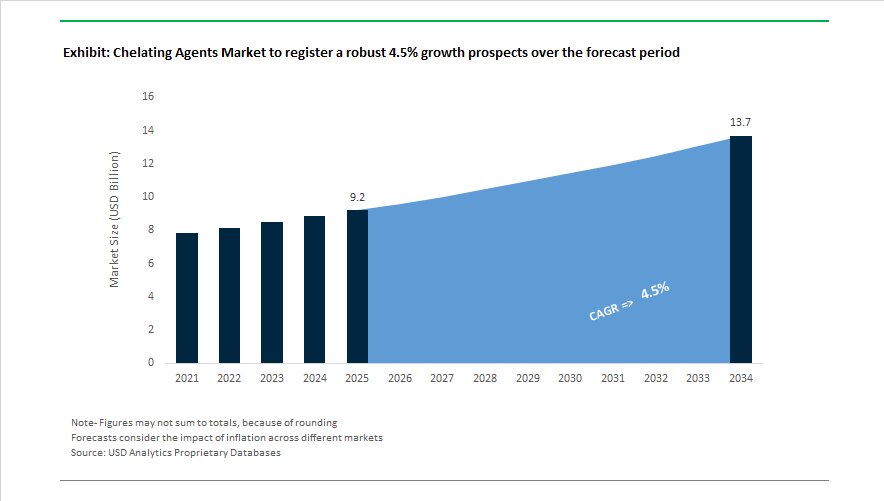
The Chelating Agents Market is projected to expand from USD 9.2 billion in 2025 to USD 13.7 billion by 2034, progressing at a CAGR of 4.5% as industries shift toward biodegradable chelating agents, green cleaning formulations, and advanced water treatment chemistry. In April 2024, Italmatch Chemicals partnered with Univar Solutions to distribute Dequest PB phosphonate-based chelants, addressing demand for eco-friendly antiscalants in industrial water treatment. During May 2024, Innospec strengthened its French footprint through a distribution alliance with Ingretech for Enviomet biodegradable chelating agents, targeting sustainable personal care and I&I formulations. Regulatory momentum intensified in 2024 when China introduced stricter heavy metal discharge standards, accelerating industrial chelant adoption across wastewater treatment plants in Guangdong and Jiangsu.
Product innovation accelerated in April 2025 when BASF launched Trilon G, a GLDA-based chelating agent containing about 56% renewable carbon and readily biodegradable chemistry for home care and I&I cleaning. In the same month, Dow Chemical raised prices on VERSENE EDTA chelants in North America, reflecting cost pressure on traditional aminopolycarboxylate chemistry and improving the competitiveness of bio-based alternatives. May 2025 saw Nouryon report that 74% of its innovation pipeline now targets sustainability, expanding Eco-Premium Solutions that replace persistent chelants. In October 2025, Nouryon introduced the Dissolvine MAX range at SEPAWA, offering ISCC PLUS-certified, 100% renewable carbon chelants for laundry and dishwashing. Complementing these moves, BASF advanced bio-based surfactant integration through APG capacity expansions in Thailand and a new U.S. plant planned for 2026, enabling formulation of fully renewable cleaning systems combining green surfactants and biodegradable chelants.
Portfolio realignment and water treatment strategies intensified from December 2025 onward. BASF agreed to divest its optical brightening agent business to Catexel to prioritize high-growth sustainable chelating technologies, with closure expected in early 2026. Nouryon broke ground on a Customer Experience and Innovation Center in Brazil to develop region-specific bio-based chelates. In January 2026, Kemira achieved CDP leadership status for Water Security and Climate Change, reinforcing its push toward renewable chelant solutions. Kemira simultaneously outlined plans to double long-term water treatment revenues, focusing on replacing conventional chelants with biodegradable chemistries.
Trends and Opportunities Shaping the Chelating Agents Market
Accelerated Phase-Out of Phosphonates and EDTA in Cleaning Formulations
Environmental compliance is now the most powerful market force. The Council of the European Union’s updated Detergents and Surfactants Regulation (approved December 8, 2025) replaces EC No. 648/2004 and introduces Digital Product Passports (DPPs), mandating biodegradability transparency via QR-coded product data. The 3.5-year transition window is already triggering early reformulations by contract manufacturers to prevent delisting risk in EU retail channels.
In the U.S., the EPA Safer Choice Program and American Cleaning Institute (ACI) data show more than 60% of certified laundry and dishwashing categories now rely on readily biodegradable chelating agents, reflecting a defensive pivot toward EDTA-free formulations. This trend has spillover impact on Asia-Pacific producers, who must meet minimum-biodegradability thresholds to maintain export compliance with EU and North American private-label suppliers.
Strategic Investment in Bio-Based and Mass-Balance Chelating Complexes
Chelant innovation is no longer limited to molecular substitution. It is now tied to carbon accounting and certification-backed decarbonization.
Nouryon’s January 2025 ISCC PLUS certification for its Herkenbosch plant marks a milestone, enabling Dissolvine® GL (GLDA) production from fully biomass-balanced inputs. BASF’s 2025 Trilon® G launch further fuels competitive intensity—targeting high-alkaline industrial cleaning and offering 56% renewable carbon. GLDA-based products now position themselves as drop-in replacements that deliver both biodegradability and carbon footprint reductions, supporting corporate Scope-3 emissions reporting and retailer-led sustainability scorecarding.
Ultra-High Purity Chelants for Semiconductor Fabrication and Lithium-Ion Battery Materials
The global “Silicon Renaissance”—including sub-3nm fabrication nodes—requires chelants that deliver impurity control at parts-per-billion levels. These formulations must remain stable in low-pH semiconductor cleaning systems and avoid binding interference with wafer materials. Capital investments into U.S. and Asian fabs create multi-year locked-in demand for ultrapure ligands that protect yield rates, making this a defensible margin-premium segment of the market.
Within lithium-ion battery production, chelating agents are emerging as a process-integrity safeguard. They prevent metallic ion cross-contamination during cathode active material (CAM) purification—reducing defect rates that could cause battery shorts or thermal failures. With India alone adding 40 GWh of cell-production capacity by late 2025, inorganic chelants are positioned to scale alongside domestic energy-storage supply chains.
Selective Molecular Chelation for Critical-Mineral Recovery and E-Waste Processing
The geopolitical shift toward localized supply of cobalt, lithium, and rare earth elements is converting chelating agents into a core enabler of circular mineral economics.
India’s September 2025 ₹1,500 crore incentive program for critical-mineral recycling under NCMM provides direct subsidies tied to extraction purity metrics, making chelation technology commercially decisive. Research also shows that optimized ligand chemistry can reduce water consumption in hydrometallurgy by up to 30% and improve metal sequestration efficiency by up to 50 percent, strengthening ROI for facilities that recover neodymium, cerium, and gadolinium from black mass and e-waste.
Chelating Agents Market Share and Segmentation Insights
Aminopolycarboxylates Maintain Market Leadership as Biodegradable Chelants Gain Momentum
Aminopolycarboxylates command the largest share of the global chelating agents market, accounting for 48% in 2025, led by EDTA and DTPA due to their strong metal sequestration performance across wide pH ranges. These chelating chemicals are extensively used in detergents and cleaners, water treatment chemicals, pulp and paper processing, and agrochemical formulations. However, environmental persistence and low biodegradability are driving regulatory pressure in Europe and parts of North America, accelerating gradual substitution. Organophosphonates such as ATMP, HEDP, and PBTC hold the second-largest share, supported by scale inhibition and corrosion control in industrial water treatment and oilfield applications. Biodegradable chelating agents including MGDA, GLDA, and IDS represent the fastest-growing category, benefiting from EU Detergents Regulation, EU Ecolabel certification, and corporate sustainability mandates. Hydroxycarboxylic acids and legacy phosphates remain niche, constrained by performance limits and tightening phosphate bans.
Cleaning and Detergents Anchor Demand While Water Treatment and Agrochemicals Drive Volume Growth
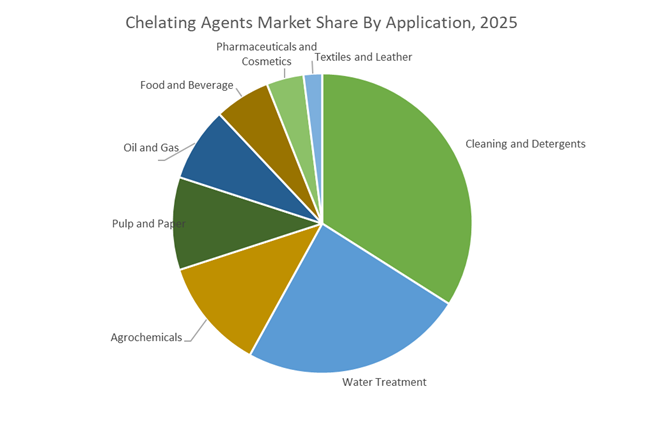
Cleaning and detergents represent 34% of total chelating agent consumption, making it the dominant application segment. Chelators enhance surfactant efficiency, prevent mineral scale, and improve stain removal in laundry detergents, automatic dishwashing products, and industrial cleaners, with phosphate-free and cold-wash formulations boosting MGDA and GLDA adoption. Water treatment ranks second, leveraging chelating agents and organophosphonates in boiler systems, cooling towers, reverse osmosis plants, and municipal infrastructure to control corrosion and metal fouling, supported by global desalination expansion. Agrochemicals form a major growth pillar, using EDTA, DTPA, and EDDHA as micronutrient carriers in precision agriculture and high-value horticulture. Pulp and paper relies on DTPA in ECF and TCF bleaching, while oil and gas applications expand through scale removal and EOR. Food, pharmaceuticals, and textiles remain smaller but specialized demand centers.
Competitive Landscape of the Chelating Agents Market
The global chelating agents market in 2026 is being reshaped by rapid adoption of bio-based chelants, phosphate-free formulations, and high-performance metal sequestration technologies across home care, industrial cleaning, water treatment, agriculture, and food processing. Market leaders are competing on renewable carbon content, concentrated liquid formats, eco-label compliance, and digital formulation tools, while vertical integration and low-carbon manufacturing are becoming decisive differentiators. Demand growth is strongest in automatic dishwashing, laundry pods, circular water systems, pulp & paper, and sustainable agriculture, where MGDA, GLDA, and next-generation biodegradable chelators are replacing legacy EDTA. Innovation now centers on green chelation, supply chain resilience, and application-specific performance optimization.
BASF drives green chelation leadership with MGDA and renewable GLDA platforms
BASF remains the global technology leader in sustainable chelating agents, anchored by its MGDA-based Trilon® M portfolio, now the 2026 benchmark for phosphate-free automatic dishwashing. The company strengthened its bio-based offering with Trilon® G, a GLDA chelant containing approximately 56% renewable carbon, engineered to enhance surfactant efficiency in laundry and manual dishwashing. BASF’s Trilon® ecosystem spans both next-gen MGDA and legacy EDTA, giving formulators a one-stop chelation platform. Its 2026 strategy prioritizes bio-based scaling to meet Eco-Label and Nordic Swan criteria. Backed by its Verbund integration, BASF internally produces key raw materials, insulating supply from global feedstock volatility.
Nouryon dominates high-concentration GLDA for pods and low-carbon formulations
Nouryon enters 2026 as the concentration champion, specializing in ultra-high-activity liquid chelates that reduce logistics emissions and formulation water content. Its Dissolvine® GL Premium, delivering 55% active GLDA, is widely adopted in laundry and dishwashing pods due to PVOH-film compatibility. The company expanded innovation capacity with a new Shanghai Innovation Center dedicated to cleaning and personal care applications, enabling localized chelant development across Asia-Pacific. With a 2025 EcoVadis Platinum rating, Nouryon has become a preferred supplier for sustainability-led procurement. European production is now shifting toward low-carbon batches powered by renewable electricity following the launch of its Herkenbosch facility.
Dow strengthens industrial chelation with digital modeling and extreme-environment performance
Dow leads the industrial and agricultural chelating agents segment, focusing on metal-ion control in oilfields, pulp & paper, textiles, and food processing. Its VERSENE™ CA and NA grades remain critical in 2026 for preventing metal-driven spoilage and discoloration in food and pharmaceutical formulations. A major differentiator is Dow’s PIMIC™ computer modeling service, allowing customers to simulate chelant performance in complex chemical systems before physical trials. Dow chelates are essential for geothermal scale prevention and sustainable paper bleaching. Integration with its amines and ethylene oxide value chains enables customized Metal Signature™ analytics, positioning Dow as a solution partner for high-severity industrial environments.
Kemira advances biodegradable chelation for circular water and fiber recycling
Kemira is the 2026 specialist for water-intensive industries, delivering chelating agents optimized for municipal water treatment and recycled fiber processing. Its acquisition of SIDRA Wasserchemie strengthens service-led water chemistry capabilities across the DACH region. Guided by its 2030 renewable roadmap, Kemira targets having half its portfolio improve customer resource efficiency, including biodegradable-by-design chelants for wastewater systems. The company also ranks among the top Nordic innovators for water solutions, leading patent activity in metal sequestration for recycled paper streams without compromising fiber strength. This focus positions Kemira at the center of circular water and packaging sustainability strategies.
Clariant integrates bio-adjuvants and cold-process chelation for clean beauty and agriculture
Clariant differentiates in 2026 through bio-adjuvant innovation, combining specialty surfactants with high-performance chelating agents for cosmetics and agriculture. Its Genapol® and GlucoPure® platforms support cold-processable chelants that reduce energy consumption in personal care manufacturing. Expansion of its Daya Bay Care Chemicals plant has made China a central hub for high-purity chelators serving the fast-growing Clean Beauty market. Clariant also launched Synergen™ Soil technology, applying chelation principles to improve zinc and manganese uptake in challenging agricultural soils. Its 2026 strategy emphasizes heavy-metal-free chemistries, accelerating adoption of bio-based alternatives across textiles and polymer processing.
United States: GLDA Transition, Section 301 Feedstock Realignment, and Precision Nutrient Chelation Funding
The U.S. chelating agents market is undergoing structural transformation driven by biodegradability mandates, tariff-induced supply chain shifts, and high-purity pharmaceutical standards. In late 2025, BASF confirmed the final phase of its Alkyl Polyglucosides (APG) and specialty surfactant production line in Cincinnati, Ohio, scheduled for full start-up in H1 2026. The facility is engineered to deliver synergistic blends of biodegradable surfactants and next-generation chelating agents for the North American home care and institutional cleaning markets. Concurrently, the U.S. Environmental Protection Agency updated its Safer Choice Criteria in mid-2025, requiring chelating agents in certified formulations to demonstrate rapid mineralization. This regulatory tightening is accelerating the substitution of phosphorus-based builders with GLDA (Glutamic acid, N,N-diacetic acid) and IDS (Iminodisuccinate).
Trade policy has also reshaped raw material sourcing. Early 2025 Section 301 tariff measures on specialty intermediates reduced reliance on Chinese-origin EDTA feedstocks, prompting U.S. formulators to pivot toward domestically produced bio-based GLDA. Following the February 2025 NIST SRM Special Publication updates, Thermo Fisher Scientific introduced new certified reference materials to validate chelating agent purity in API synthesis. In agriculture, the United States Department of Agriculture launched a $25 million precision nutrient delivery program in late 2025, funding R&D into chelated micronutrients to reduce heavy metal runoff in the Mississippi River Basin. Strengthening distribution resilience, Nouryon partnered with Brenntag Specialties in late 2024 to expand access to high-concentration Dissolvine® GL Premium across U.S. construction and asphalt sectors.
China’s chelating agents industry is scaling under explicit industrial policy support and strategic rare earth (REE) controls. In September 2025, the Ministry of Industry and Information Technology of China issued its 2025–2026 Work Plan mandating 5% annual growth for high-end fine chemicals, explicitly prioritizing domestic R&D of electronic-grade chelating agents. The government has established innovation centers and industrial data nodes to accelerate non-grain bio-based chelate commercialization in coatings and agrochemicals.
In October 2025, Ministry of Commerce of China imposed new export controls on rare earth extraction technologies, intensifying internal demand for proprietary phosphonate and aminocarboxylate chelants for high-purity REE separation. Semiconductor hubs in Shanghai and Shenzhen reported a 15% rise in ultra-pure chelating agent consumption in 2025 for CMP slurries. Under the “AI + Petrochemicals” initiative, large-scale facilities integrated automated life cycle assessment (LCA) systems to provide real-time carbon footprint data for export-grade chelates. The Gulei Petrochemical complex further strengthened cost competitiveness by integrating captive ethylene and ammonia streams in 2025, reducing dependency on European imports for technical-grade chelant production.
India: PLI 1.2 Incentives, Agrochemical Export Surge, and AI-Driven Formulation Modeling
India’s chelating agents market is expanding through policy-backed industrialization and export-led agrochemical growth. In November 2025, the Government of India launched the third round of the Production Linked Incentive (PLI) scheme, incorporating strategic incentives for specialty steel and associated processing chemicals, thereby encouraging domestic synthesis of high-performance chelating agents for metal finishing and surface treatment.
In February 2026, BASF India added a new dispersions and specialty line at its Mangalore site to support demand for sustainable construction materials and industrial detergents. BASF also announced a Global Digital Hub in Hyderabad (Q1 2026) leveraging AI-driven modeling to optimize chelating formulations tailored to India’s variable water hardness conditions. India’s agrochemical exports reached $5.4 billion in 2025, fueling domestic production of chelating adjuvants that stabilize pesticide suspensions in hard-water regions. By early 2026, more than 40 Indian manufacturing sites achieved ISO 17034 accreditation, strengthening export competitiveness in certified reference chelants for EU and U.S. pharmaceutical markets.
Germany: Net-Zero MGDA Modernization, Digital Product Passports, and Green Chelate Divestment Strategy
Germany is repositioning its chelating agents industry around net-zero production, regulatory transparency, and portfolio specialization. In January 2026, BASF detailed a €1.1 billion cost-saving and Green Transformation program, prioritizing modernization of Trilon® M (MGDA) production lines to align with net-zero emission targets. At in-cosmetics Global 2025, German producers presented Lamesoft® OP Plus, a wax-based dispersion stabilized with bio-derived chelating agents as sustainable alternatives to traditional opacifiers.
In late 2025, Evonik Industries transitioned its German chemical park operations into SYNEQT GmbH, enabling sharper focus on high-margin rhamnolipids and green chelates. Digital Product Passports were implemented across German exports in late 2025, providing granular data on raw material origin and mineralization rates in compliance with EU regulations. In February 2026, Evonik adopted a dynamic dividend policy to free capital for superforce projects, particularly the expansion of animal-free and bio-based chelating solutions targeting Asian markets.
The Netherlands: High-Concentration GLDA Leadership, ISCC PLUS Circularity, and Water Policy Mandates
The Netherlands is strengthening its global leadership in biodegradable chelating agents through high-concentration GLDA innovation and circular certification frameworks. In July 2025, Nouryon launched Dissolvine® GL Premium, the most concentrated liquid GLDA chelating agent available commercially, reducing logistics-related emissions by minimizing water content in shipments. Nouryon’s Herkenbosch site retained ISCC PLUS certification throughout 2025, enabling circular chelate production from waste-stream bio-feedstocks.
In early 2026, Nouryon named BASF Chemical Intermediates as its 2025 Supplier of the Year, highlighting integrated European precursor supply chains for amine and acid feedstocks. The Dutch government’s “Water Management 2025” framework mandates the phase-out of non-biodegradable chelants in industrial boiler cleaning by 2027, creating a structurally protected market for high-performance green alternatives.
Thailand: APG Capacity Expansion, 30% Lead-Time Reduction, and BCG Economy Alignment
Thailand is emerging as Southeast Asia’s bio-based chelating agent formulation hub. In November 2025, BASF inaugurated a major APG capacity expansion in Bangpakong, creating a regional base for integrated bio-based formulations combining specialty chelating agents with surfactants for personal care and industrial cleaning applications.
This expansion forms part of BASF’s global Agility Initiative, reducing Asian customer lead times by approximately 30% by bypassing Europe-origin supply chains. Thailand’s Bio-Circular-Green (BCG) Economy Model further prioritizes biodegradable chelates for agriculture, particularly in fruit and rubber export sectors, to mitigate soil salinity and heavy metal accumulation. The combination of regional manufacturing agility, policy support, and sustainable farming integration positions Thailand as a strategic growth node within the global chelating agents value chain.
Chelating Agents Market Report Scope
Chelating Agents Market
Parameter
Details
Market Size (2025)
$9.2 Billion
Market Size (2034)
$13.7 Billion
Market Growth Rate
4.5%
Segments
By Type (Aminopolycarboxylates, Biodegradable Chelating Agents, Organophosphonates, Hydroxycarboxylic Acids, Other Chelating Agents), By Source (Synthetic, Bio-based), By Form (Powder, Liquid), By Application (Cleaning and Detergents, Water Treatment, Pulp and Paper, Agrochemicals, Food and Beverage, Pharmaceuticals and Cosmetics, Textiles and Leather, Oil and Gas)
Study Period
2019- 2025 and 2026-2034
Units
Revenue (USD)
Qualitative Analysis
Porter’s Five Forces, SWOT Profile, Market Share, Scenario Forecasts, Market Ecosystem, Company Ranking, Market Dynamics, Industry Benchmarking
US, Canada, Mexico, Germany, France, Spain, Italy, UK, Russia, China, India, Japan, South Korea, Australia, South East Asia, Brazil, Argentina, Middle East, Africa
Chelating Agents Market Segmentation
By Type
Aminopolycarboxylates
Biodegradable Chelating Agents
Organophosphonates
Hydroxycarboxylic Acids
Other Chelating Agents
By Source
Synthetic
Bio-based
By Form
Powder
Liquid
By Application
Cleaning and Detergents
Water Treatment
Pulp and Paper
Agrochemicals
Food and Beverage
Pharmaceuticals and Cosmetics
Textiles and Leather
Oil and Gas
By Region
North America (United States, Canada, Mexico)
Europe (Germany, France, United Kingdom, Spain, Italy, Rest of Europe)
Asia Pacific (China, India, Japan, South Korea, Australia, Rest of APAC)
South and Central America (Brazil, Argentina, Rest of SCA)
Middle East and Africa (Saudi Arabia, UAE, South Africa, Rest of Middle East, Rest of Africa)
Top Companies in Chelating Agents Industry
BASF SE
Nouryon
Dow
Kemira
Mitsubishi Chemical Group
AkzoNobel
Innospec
Lanxess
Evonik Industries
Archer Daniels Midland
Hexion
Jungbunzlauer
Shandong IRO Chelating Chemical
Aquapharm Chemical
Nippon Shokubai
*- List not Exhaustive
Table of Contents: Chelating Agents Market
1. Executive Summary
1.1. Market Snapshot and Growth Outlook (2025–2034)
1.2. Key Regulatory and Sustainability Drivers
1.3. Strategic Shifts Toward Biodegradable Chelants
1.4. Competitive Positioning Overview
2. Chelating Agents Market Overview and Industry Dynamics
2.1. Introduction to Chelating Chemistry and Ligand Mechanisms
2.2. Market Size Forecast and Growth Projections
2.3. Regulatory Landscape: EU Detergents Regulation, EPA Safer Choice, REACH
2.4. Carbon Accounting and ISCC PLUS Certification Trends
2.5. Raw Material Supply Chain and Feedstock Integration
2.6. Impact of Phosphonate and EDTA Phase-Out Policies
3. Trends and Opportunities Shaping the Chelating Agents Market
3.1. Biodegradable Chelating Agents and Renewable Carbon Integration
3.2. Ultra-High Purity Chelants for Semiconductor and Battery Applications
3.3. Critical Mineral Recovery and E-Waste Hydrometallurgy
3.4. Precision Agriculture and Chelated Micronutrient Formulations
3.5. Digital Product Passports and LCA Transparency in Cleaning Systems
4. Competitive Landscape and Strategic Developments
4.1. Capacity Expansions and Bio-Based Production Investments
4.2. Portfolio Realignments and Divestment Strategies
4.3. Vertical Integration and Verbund Manufacturing Advantages
4.4. ESG Differentiation and Renewable Electricity Adoption
4.5. Distribution Alliances and Regional Innovation Centers
5. Market Share and Segmentation Insights: Chelating Agents Market
5.1. By Type
5.1.1. Aminopolycarboxylates
5.1.2. Biodegradable Chelating Agents
5.1.3. Organophosphonates
5.1.4. Hydroxycarboxylic Acids
5.1.5. Other Chelating Agents
5.2. By Source
5.2.1. Synthetic
5.2.2. Bio-Based
5.3. By Form
5.3.1. Powder
5.3.2. Liquid
5.4. By Application
5.4.1. Cleaning and Detergents
5.4.2. Water Treatment
5.4.3. Pulp and Paper
5.4.4. Agrochemicals
5.4.5. Food and Beverage
5.4.6. Pharmaceuticals and Cosmetics
5.4.7. Textiles and Leather
5.4.8. Oil and Gas
6. Country Analysis and Strategic Developments
6.1. United States
6.2. China
6.3. India
6.4. Germany
6.5. The Netherlands
6.6. Thailand
6.7. France
6.8. United Kingdom
6.9. Japan
6.10. South Korea
6.11. Brazil
6.12. Argentina
6.13. Saudi Arabia
6.14. UAE
6.15. South Africa
6.16. Rest of World
7. Chelating Agents Market Size Outlook by Region (2025–2034)
7.1. North America Chelating Agents Market Size Outlook
7.1.1. By Type
7.1.2. By Source
7.1.3. By Form
7.1.4. By Application
7.2. Europe Chelating Agents Market Size Outlook
7.2.1. By Type
7.2.2. By Source
7.2.3. By Form
7.2.4. By Application
7.3. Asia Pacific Chelating Agents Market Size Outlook
7.3.1. By Type
7.3.2. By Source
7.3.3. By Form
7.3.4. By Application
7.4. South and Central America Chelating Agents Market Size Outlook
7.4.1. By Type
7.4.2. By Source
7.4.3. By Form
7.4.4. By Application
7.5. Middle East and Africa Chelating Agents Market Size Outlook
7.5.1. By Type
7.5.2. By Source
7.5.3. By Form
7.5.4. By Application
8. Company Profiles: Leading Players in the Chelating Agents Market
8.1. BASF SE
8.2. Nouryon
8.3. Dow
8.4. Kemira
8.5. Mitsubishi Chemical Group
8.6. AkzoNobel
8.7. Innospec
8.8. Lanxess
8.9. Evonik Industries
8.10. Archer Daniels Midland
8.11. Hexion
8.12. Jungbunzlauer
8.13. Shandong IRO Chelating Chemical
8.14. Aquapharm Chemical
8.15. Nippon Shokubai
9. Research Methodology
9.1. Research Scope and Assumptions
9.2. Data Collection and Primary Interviews
9.3. Market Modeling and Forecast Framework
9.4. Bottom-Up and Top-Down Validation
9.5. Limitations and Disclaimer
10. Appendix
10.1. Abbreviations and Acronyms
10.2. List of Tables
10.3. List of Figures
Chelating Agents Market Segmentation
By Type
Aminopolycarboxylates
Biodegradable Chelating Agents
Organophosphonates
Hydroxycarboxylic Acids
Other Chelating Agents
By Source
Synthetic
Bio-based
By Form
Powder
Liquid
By Application
Cleaning and Detergents
Water Treatment
Pulp and Paper
Agrochemicals
Food and Beverage
Pharmaceuticals and Cosmetics
Textiles and Leather
Oil and Gas
By Region
North America (United States, Canada, Mexico)
Europe (Germany, France, United Kingdom, Spain, Italy, Rest of Europe)
Asia Pacific (China, India, Japan, South Korea, Australia, Rest of APAC)
South and Central America (Brazil, Argentina, Rest of SCA)
Middle East and Africa (Saudi Arabia, UAE, South Africa, Rest of Middle East, Rest of Africa)
The Chelating Agents Market is valued at USD 9.2 billion in 2025 and is projected to reach USD 13.7 billion by 2034, expanding at a CAGR of 4.5%. Growth is driven by biodegradable chelants, GLDA adoption in detergents, and rising demand from water treatment, agrochemicals, and semiconductor manufacturing.
While aminopolycarboxylates still hold about 48% share, biodegradable chelants such as MGDA, GLDA, and IDS are the fastest-growing segment. Regulatory pressure on EDTA and phosphonates, combined with EU Digital Product Passports and U.S. Safer Choice criteria, is accelerating substitution toward renewable, readily biodegradable alternatives.
Cleaning and detergents remain the largest application at roughly 34% share, but water treatment and agrochemicals are driving volume growth. High-purity chelants for semiconductors and lithium-ion batteries are emerging as premium-margin segments, while critical-mineral recovery and e-waste recycling are opening new demand channels for selective molecular chelation.
EU Detergents Regulation updates, Digital Product Passports, and tightening biodegradability thresholds are forcing formulators to move away from EDTA toward GLDA and MGDA. In parallel, China’s stricter wastewater standards and U.S. Safer Choice requirements are pushing global suppliers to certify renewable carbon content and demonstrate rapid mineralization, reshaping long-term supply contracts.
Key players include BASF SE, Nouryon, Dow, Kemira, Evonik Industries, Innospec, and Lanxess. Competition centers on GLDA/MGDA platforms, ISCC PLUS certification, ultra-high-concentration liquids, and application-specific chelation for cleaning, water, agriculture, and advanced materials.