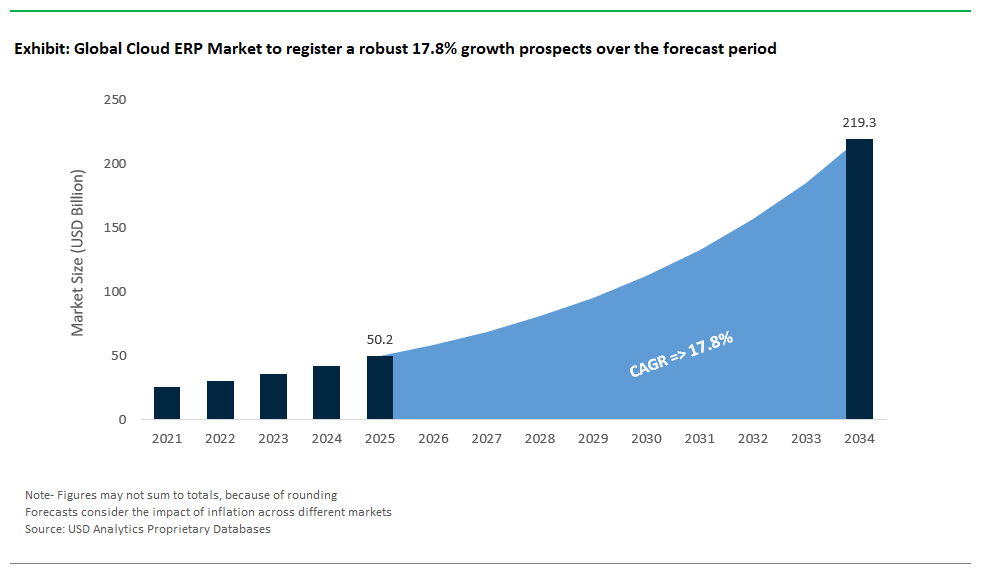
The Global Cloud ERP Market Size is estimated at $50.2 Billion in 2025 and is forecast to register an annual growth rate (CAGR) of 17.8% to reach $219.3 Billion by 2034. Download now
The global Cloud ERP Market Study analyzes and forecasts the market size across 6 regions and 24 countries for diverse segments -By Deployment (Private Cloud, Public Cloud, Hybrid Cloud), By Enterprise Size (Small and Medium-sized Enterprises, Large Enterprises), By Function (Finance, Supply Chain, Human Resources, Others), By End-User (Manufacturing, BFSI, Healthcare, Retail & E-commerce, Government, Aerospace & Defense, IT & Telecom, Others).
An Introduction to Cloud ERP Market in 2025
The Cloud ERP (Enterprise Resource Planning) market has experienced significant growth due to the increasing adoption of cloud-based solutions by businesses of all sizes. Cloud ERP systems provide scalability, flexibility, and cost efficiency, making them particularly attractive to small and medium enterprises (SMEs) that might not have the resources to manage on-premise solutions. As businesses embrace digital transformation, the demand for real-time data analytics, remote accessibility, and seamless integration across departments has fueled Cloud ERP adoption. Key trends in this market include the integration of artificial intelligence (AI) and machine learning (ML) for advanced decision-making, automation of routine tasks, and predictive analytics. The ongoing shift to cloud infrastructure, coupled with the need for disaster recovery, cybersecurity, and compliance with data privacy regulations, is driving further growth in the sector. While large enterprises were initially the main adopters, SMEs now represent a growing segment, making the market more competitive. The rising importance of remote work and global operations is another driver pushing businesses to seek out agile and cloud-based solutions for enterprise resource management.
Cloud ERP Competitive Landscape
The market report analyses the leading companies in the industry including Acumatica, Aptean, BizAutomation, Deltek, Deskera, ECI, Epicor, IFS, Infor, Intuit, Microsoft, Odoo, Oracle, Plex System, Priority Software, QAD, Ramco, Reyebex, Rootstock Software, Sage Group, SAP, Syspro, Tech Cloud ERP, TYAsuite, Unit4, Versa Cloud ERP, Visma, Zenscale, and others.
Cloud ERP Market Dynamics
Market Trend: Shift Toward Multi-Cloud and Hybrid Cloud Deployments
The Cloud ERP market is experiencing a significant trend toward multi-cloud and hybrid cloud deployments, driven by businesses seeking greater flexibility and risk mitigation in their operations. Organizations are increasingly adopting these models to avoid vendor lock-in, enhance scalability, and optimize performance across various cloud environments. By integrating multiple cloud services, companies can better tailor their ERP solutions to their specific needs, whether for data storage, processing, or disaster recovery. This trend aligns with the growing demand for customization and the flexibility to scale operations across regions and departments.
Market Driver: Growing Demand for Real-Time Data and Analytics
The demand for real-time data processing and analytics is one of the primary drivers of the Cloud ERP market. Organizations are under increasing pressure to make informed decisions quickly, and cloud-based ERP systems offer the ability to provide live updates and instant data-driven insights. As industries continue to evolve into data-centric models, the need for real-time operational visibility, from supply chain management to customer relations, is growing rapidly. Cloud ERP systems enable this by providing centralized platforms that aggregate data from various departments, improving overall decision-making and performance.
Market Opportunity: Integration with AI and Automation
A major opportunity in the Cloud ERP market is the growing potential for integrating artificial intelligence (AI) and automation into ERP systems. These technologies can automate routine tasks such as data entry, reporting, and workflow management, significantly reducing human error and operational costs. AI can also enhance predictive analytics, enabling businesses to forecast demand, optimize inventory, and improve financial planning. This trend is expected to revolutionize cloud-based ERP solutions, providing organizations with not just tools for efficiency, but also for driving innovation and competitive advantage.
Cloud ERP Market Share Analysis: Finance is expected to generate the highest revenue in 2025.
The Finance segment is likely the largest in the Cloud ERP market by function due to its critical role in business operations across industries. Financial management is the backbone of enterprise resource planning, encompassing core functionalities such as accounting, budgeting, revenue tracking, tax compliance, and financial reporting. Organizations across all sectors prioritize cloud-based financial ERP solutions to enhance real-time data accessibility, automate workflows, and ensure regulatory compliance. Additionally, the rise of global business operations, evolving tax regulations, and the increasing complexity of financial transactions have accelerated the adoption of cloud ERP in finance. Advanced analytics, AI-driven insights, and integration with banking and payment systems further strengthen its demand, making finance the dominant segment in the Cloud ERP market.
Cloud ERP Market Share Analysis: Hybrid Cloud is set to achieve the highest growth rate (CAGR) during the forecast period from 2025 to 2034
The Hybrid Cloud segment is expected to be the fastest-growing in the Cloud ERP market over the forecast period to 2034, driven by the increasing demand for flexibility, security, and scalability in enterprise resource planning. Organizations are increasingly adopting hybrid cloud ERP solutions to balance the benefits of both private and public cloud environments—leveraging the cost efficiency and scalability of public cloud while maintaining control over sensitive data in a private cloud setup. This approach is particularly appealing to industries with strict regulatory requirements, such as finance, healthcare, and government, where data security and compliance are critical. Additionally, as businesses expand and digital transformation accelerates, hybrid cloud ERP enables seamless integration with legacy systems while supporting advanced AI-driven analytics, IoT applications, and multi-cloud strategies. The growing need for customizable and resilient ERP solutions that can adapt to evolving business models makes the hybrid cloud segment the fastest-growing in the Cloud ERP market.
Cloud ERP Market Share Analysis: Manufacturing is expected to generate the highest revenue in 2025.
The Manufacturing segment is likely the largest in the Cloud ERP market by end-user due to the industry's complex supply chain operations, production planning requirements, and need for real-time data integration. Manufacturing companies rely heavily on Cloud ERP solutions to streamline processes such as inventory management, procurement, production scheduling, and demand forecasting. The adoption of smart manufacturing, IoT-enabled automation, and Industry 4.0 initiatives has further accelerated the need for cloud-based ERP systems that provide scalability, remote accessibility, and advanced analytics. Additionally, manufacturers operate across multiple locations and require seamless coordination between suppliers, distributors, and logistics partners, making cloud ERP a crucial enabler of operational efficiency. The sector’s continuous investment in digital transformation and cost-optimization strategies positions manufacturing as the dominant segment in the Cloud ERP market.
Cloud ERP Industry Outlook by Country
China Cloud ERP Market
China’s Cloud ERP market is driven by its digital transformation policies, state-backed industrial modernization, and the rise of homegrown cloud providers. The government's emphasis on data sovereignty and cybersecurity, particularly through regulations like the Cybersecurity Law and Data Security Law, has led enterprises to prioritize domestic cloud ERP solutions from players like Huawei Cloud and Alibaba Cloud over foreign vendors. The manufacturing sector, particularly in high-tech industrial zones such as the Yangtze River Delta and Pearl River Delta, is a major driver, demanding AI-integrated ERP solutions to optimize supply chains and production efficiency. Additionally, the rapid expansion of e-commerce and fintech industries, fueled by platforms like JD.com and Ant Group, has increased demand for scalable and AI-driven ERP systems that support omnichannel operations and real-time financial analytics.
India Cloud ERP Market
India’s Cloud ERP market is shaped by the country’s booming SME sector, increasing adoption of GST-compliant ERP systems, and government initiatives promoting digitalization, such as "Digital India" and "Make in India." The rise of affordable cloud computing services from local providers like Zoho and Tally, along with hyperscalers like AWS and Microsoft Azure, has enabled widespread ERP adoption among small and mid-sized enterprises. The growth of India’s IT services and startup ecosystem, particularly in cities like Bengaluru and Hyderabad, has also spurred demand for industry-specific ERP solutions, particularly in SaaS-based HR, accounting, and CRM integrations. Furthermore, the manufacturing sector, particularly in pharmaceuticals and automotive industries, is driving ERP adoption to enhance supply chain transparency and regulatory compliance.
United States Cloud ERP Market
The U.S. Cloud ERP market is driven by enterprise-level digital transformation, the integration of AI and analytics in ERP solutions, and industry-specific regulatory demands. Large enterprises, especially in sectors such as healthcare, finance, and manufacturing, are increasingly migrating to cloud-based ERP solutions to ensure compliance with regulations like HIPAA and SOX while improving operational efficiency. The shift towards composable ERP, where businesses adopt modular and API-driven solutions rather than monolithic systems, is also gaining traction, with vendors like Oracle, SAP, and Workday leading innovation. Additionally, the growing demand for cybersecurity in ERP systems, driven by increasing cyber threats, has accelerated the adoption of cloud-native security features, particularly in government and defense sectors.
Germany Cloud ERP Market
Germany’s Cloud ERP market is heavily influenced by its industrial backbone, particularly the automotive and manufacturing sectors, which demand highly customized ERP solutions with deep IoT and AI integrations. The adoption of Industry 4.0 principles, supported by government-backed initiatives like “Plattform Industrie 4.0,” has accelerated the demand for cloud ERP systems that facilitate predictive maintenance, digital twins, and real-time production monitoring. Strict data protection regulations under GDPR have also impacted vendor selection, with many German enterprises opting for local or EU-based cloud providers like SAP and IONOS over U.S.-based hyperscalers. Additionally, the Mittelstand (Germany’s small and mid-sized enterprises) is gradually transitioning from on-premise ERP to hybrid and cloud-based models to enhance operational agility and global competitiveness.
France Cloud ERP Market
France’s Cloud ERP market is shaped by its focus on data sovereignty, regulatory compliance, and the growing digitalization of mid-sized enterprises. The French government's “France Num” initiative to promote digital adoption among SMEs has spurred demand for affordable, scalable ERP solutions, particularly in retail, logistics, and services sectors. The banking and finance industry, heavily regulated under European financial compliance laws, is a key driver of ERP adoption, with increasing integration of AI-powered financial forecasting and risk management tools. Additionally, France’s robust aerospace and defense sector, home to industry giants like Airbus and Thales, requires highly secure and customized ERP solutions, leading to increased investment in private cloud and hybrid ERP deployments.
Middle East Cloud ERP Market
The Middle East’s Cloud ERP market is driven by large-scale economic diversification efforts, particularly in the Gulf Cooperation Council (GCC) nations, where governments are pushing digital transformation under initiatives like Saudi Vision 2030 and UAE’s Smart Government Strategy. The oil and gas sector, historically reliant on legacy ERP systems, is gradually shifting to cloud-based ERP solutions to enhance supply chain efficiency and predictive maintenance. Additionally, the region’s rapidly growing retail and e-commerce sectors, especially in the UAE and Saudi Arabia, have increased demand for ERP solutions with integrated inventory management and AI-driven customer analytics. The high adoption of fintech solutions, driven by regulatory modernization in countries like Bahrain and the UAE, has also fueled demand for ERP systems with robust financial management and compliance features.
Cloud ERP Market Report Scope
|
Parameter
|
Details
|
|
Market Size (2025)
|
$50.2 Billion
|
|
Market Size (2034)
|
$219.3 Billion
|
|
Market Growth Rate
|
17.8%
|
|
Segments
|
By Deployment (Private Cloud, Public Cloud, Hybrid Cloud), By Enterprise Size (Small and Medium-sized Enterprises, Large Enterprises), By Function (Finance, Supply Chain, Human Resources, Others), By End-User (Manufacturing, BFSI, Healthcare, Retail & E-commerce, Government, Aerospace & Defense, IT & Telecom, Others)
|
|
Study Period
|
2019- 2024 and 2025-2034
|
|
Units
|
Revenue (USD)
|
|
Qualitative Analysis
|
Porter’s Five Forces, SWOT Profile, Market Share, Scenario Forecasts, Market Ecosystem, Company Ranking, Market Dynamics, Industry Benchmarking
|
|
Companies
|
Acumatica, Aptean, BizAutomation, Deltek, Deskera, ECI, Epicor, IFS, Infor, Intuit, Microsoft, Odoo, Oracle, Plex System, Priority Software, QAD, Ramco, Reyebex, Rootstock Software, Sage Group, SAP, Syspro, Tech Cloud ERP, TYAsuite, Unit4, Versa Cloud ERP, Visma, Zenscale
|
|
Countries
|
US, Canada, Mexico, Germany, France, Spain, Italy, UK, Russia, China, India, Japan, South Korea, Australia, South East Asia, Brazil, Argentina, Middle East, Africa
|
Cloud ERP Market Segmentation
By Deployment
Private Cloud
Public Cloud
Hybrid Cloud
By Enterprise Size
Small and Medium-sized Enterprises
Large Enterprises
By Function
Finance
Supply Chain
Human Resources
Others
By End-User
Manufacturing
BFSI
Healthcare
Retail & E-commerce
Government
Aerospace & Defense
IT & Telecom
Others
Countries Analyzed
North America (US, Canada, Mexico)
Europe (Germany, UK, France, Spain, Italy, Russia, Rest of Europe)
Asia Pacific (China, India, Japan, South Korea, Australia, South East Asia, Rest of Asia)
South America (Brazil, Argentina, Rest of South America)
Middle East and Africa (Saudi Arabia, UAE, Rest of Middle East, South Africa, Egypt, Rest of Africa)
Cloud ERP Companies Profiled in the Study
Acumatica
Aptean
BizAutomation
Deltek
Deskera
ECI
Epicor
IFS
Infor
Intuit
Microsoft
Odoo
Oracle
Plex System
Priority Software
QAD
Ramco
Reyebex
Rootstock Software
Sage Group
SAP
Syspro
Tech Cloud ERP
TYAsuite
Unit4
Versa Cloud ERP
Visma
Zenscale
*- List Not Exhaustive
About USD Analytics
Table of Contents
List of Charts and Exhibits
List of Tables
1. Executive Summary
What’s New in 2025?
Top 10 Takeaways from the industry
Potential Opportunities for Industry Stakeholders
Strategic Imperatives
Company Market Positioning
Industry Benchmarking Matrix
2. Research Scope and Methodology
Market Definition
- Market Segments
- Companies Profiled
Research Methodology
- Bottom-Up Method
- Top-Down Method
- Data Triangulation
Forecast Methodology
- Data Sources
- USDA Proprietary Databases
- External Sources
- Primary Research and Interviews
Conversion Rates for USD
Abbreviations
3. Strategic Landscape: Key Insights and Implications
Spotlight: Key Strategies opted by Business Leaders
Competitive Landscape
Market Size ($ Million) and Share (%) by Company, 2024
SWOT Analysis
- Key Market Strengths
- Key Market Weaknesses
- Potential Opportunities
- Potential Threats
Porter’s Five Force Analysis
- Summary
- Bargaining Power of Buyers- Impact Analysis
- Bargaining Power of Suppliers- Impact Analysis
- Threat of new entrants- Impact Analysis
- Intensity of Competitive Rivalry- Impact Analysis
Macro-Environmental Analysis
- Economic forecasts by Country, 2010- 2035
- Population forecasts by Country, 2010- 2035
- Inflation Outlook by Country, 2010-2035
- Impact of Russia-Ukraine Conflict, Sluggish China Growth, US Developments
5. Growth Opportunity Analysis
Trends at a Glance
- What are the most noteworthy trends in the market
- Where should leaders pay attention?
- What industries are likely to be affected by the growth?
Market Dynamics
- Charting a path forward
- Growth Drivers
- Growth Barriers
Key Industry Stakeholders
- Suppliers
- Manufacturers and Service Providers
- Distribution Channels
- End-Users and Applications
- Regulators
- Investors, Traders, and R&D Institutes
Regulatory Landscape
6. Market Size Outlook to 2034
Global Cloud ERP Market Size Forecast, USD Million, 2018- 2034
- Historic Market Size, 2018- 2024
- Forecast Market Size, 2024- 2034
Scenario Analysis
- Low Growth Scenario: Definition and Outlook to 2034
- Reference Case: Definition and Outlook to 2034
- High Growth Scenario: Definition and Outlook to 2034
Pricing Analysis and Outlook
- Cloud ERP Average Price Forecast, 2021- 2034
- Key Factors Shaping the Pricing Patterns
7. Historical Cloud ERP Market Size by Segments, 2018- 2024
Key Statistics, 2024
Cloud ERP Market Size Outlook by Type, USD Million, 2018- 2024
Growth Comparison (y-o-y) across Cloud ERP Types, 2018- 2024
Cloud ERP Market Size Outlook by Application, USD Million, 2018- 2024
Growth Comparison (y-o-y) across Cloud ERP Applications, 2018- 2024
8. Cloud ERP Market Size Outlook by Segments, 2024- 2034
By Deployment
Private Cloud
Public Cloud
Hybrid Cloud
By Enterprise Size
Small and Medium-sized Enterprises
Large Enterprises
By Function
Finance
Supply Chain
Human Resources
Others
By End-User
Manufacturing
BFSI
Healthcare
Retail & E-commerce
Government
Aerospace & Defense
IT & Telecom
Others
9. Cloud ERP Market Size Outlook by Region
North America
Key Market Dynamics
North America Cloud ERP Market Size Outlook by Type, USD Million, 2021-2034
North America Cloud ERP Market Size Outlook by Application, USD Million, 2021-2034
North America Cloud ERP Market Size Outlook by Sales Channel, USD Million, 2021-2034
North America Cloud ERP Market Size Outlook by Country, USD Million, 2021-2034
Europe
Key Market Dynamics
Europe Cloud ERP Market Size Outlook by Type, USD Million, 2021-2034
Europe Cloud ERP Market Size Outlook by Application, USD Million, 2021-2034
Europe Cloud ERP Market Size Outlook by Sales Channel, USD Million, 2021-2034
Europe Cloud ERP Market Size Outlook by Country, USD Million, 2021-2034
Asia Pacific
Key Market Dynamics
Asia Pacific Cloud ERP Market Size Outlook by Type, USD Million, 2021-2034
Asia Pacific Cloud ERP Market Size Outlook by Application, USD Million, 2021-2034
Asia Pacific Cloud ERP Market Size Outlook by Sales Channel, USD Million, 2021-2034
Asia Pacific Cloud ERP Market Size Outlook by Country, USD Million, 2021-2034
South America
Key Market Dynamics
South America Cloud ERP Market Size Outlook by Type, USD Million, 2021-2034
South America Cloud ERP Market Size Outlook by Application, USD Million, 2021-2034
South America Cloud ERP Market Size Outlook by Sales Channel, USD Million, 2021-2034
South America Cloud ERP Market Size Outlook by Country, USD Million, 2021-2034
Middle East and Africa
Key Market Dynamics
Middle East and Africa Cloud ERP Market Size Outlook by Type, USD Million, 2021-2034
Middle East and Africa Cloud ERP Market Size Outlook by Application, USD Million, 2021-2034
Middle East and Africa Cloud ERP Market Size Outlook by Sales Channel, USD Million, 2021-2034
Middle East and Africa Cloud ERP Market Size Outlook by Country, USD Million, 2021-2034
10. United States Cloud ERP Market Analysis and Outlook, 2021- 2034
Key Statistics
United States Cloud ERP Market Size Outlook by Type, 2021- 2034
United States Cloud ERP Market Size Outlook by Application, 2021- 2034
United States Cloud ERP Market Size Outlook by End-User, 2021- 2034
11. Canada Cloud ERP Market Analysis and Outlook, 2021- 2034
Key Statistics
Canada Cloud ERP Market Size Outlook by Type, 2021- 2034
Canada Cloud ERP Market Size Outlook by Application, 2021- 2034
Canada Cloud ERP Market Size Outlook by End-User, 2021- 2034
12. Mexico Cloud ERP Market Analysis and Outlook, 2021- 2034
Key Statistics
Mexico Cloud ERP Market Size Outlook by Type, 2021- 2034
Mexico Cloud ERP Market Size Outlook by Application, 2021- 2034
Mexico Cloud ERP Market Size Outlook by End-User, 2021- 2034
13. Germany Cloud ERP Market Analysis and Outlook, 2021- 2034
Key Statistics
Germany Cloud ERP Market Size Outlook by Type, 2021- 2034
Germany Cloud ERP Market Size Outlook by Application, 2021- 2034
Germany Cloud ERP Market Size Outlook by End-User, 2021- 2034
14. France Cloud ERP Market Analysis and Outlook, 2021- 2034
Key Statistics
France Cloud ERP Market Size Outlook by Type, 2021- 2034
France Cloud ERP Market Size Outlook by Application, 2021- 2034
France Cloud ERP Market Size Outlook by End-User, 2021- 2034
15. United Kingdom Cloud ERP Market Analysis and Outlook, 2021- 2034
Key Statistics
United Kingdom Cloud ERP Market Size Outlook by Type, 2021- 2034
United Kingdom Cloud ERP Market Size Outlook by Application, 2021- 2034
United Kingdom Cloud ERP Market Size Outlook by End-User, 2021- 2034
16. Spain Cloud ERP Market Analysis and Outlook, 2021- 2034
Key Statistics
Spain Cloud ERP Market Size Outlook by Type, 2021- 2034
Spain Cloud ERP Market Size Outlook by Application, 2021- 2034
Spain Cloud ERP Market Size Outlook by End-User, 2021- 2034
17. Italy Cloud ERP Market Analysis and Outlook, 2021- 2034
Key Statistics
Italy Cloud ERP Market Size Outlook by Type, 2021- 2034
Italy Cloud ERP Market Size Outlook by Application, 2021- 2034
Italy Cloud ERP Market Size Outlook by End-User, 2021- 2034
18. Benelux Cloud ERP Market Analysis and Outlook, 2021- 2034
Key Statistics
Benelux Cloud ERP Market Size Outlook by Type, 2021- 2034
Benelux Cloud ERP Market Size Outlook by Application, 2021- 2034
Benelux Cloud ERP Market Size Outlook by End-User, 2021- 2034
19. Nordic Cloud ERP Market Analysis and Outlook, 2021- 2034
Key Statistics
Nordic Cloud ERP Market Size Outlook by Type, 2021- 2034
Nordic Cloud ERP Market Size Outlook by Application, 2021- 2034
Nordic Cloud ERP Market Size Outlook by End-User, 2021- 2034
20. Rest of Europe Cloud ERP Market Analysis and Outlook, 2021- 2034
Key Statistics
Rest of Europe Cloud ERP Market Size Outlook by Type, 2021- 2034
Rest of Europe Cloud ERP Market Size Outlook by Application, 2021- 2034
Rest of Europe Cloud ERP Market Size Outlook by End-User, 2021- 2034
21. China Cloud ERP Market Analysis and Outlook, 2021- 2034
Key Statistics
China Cloud ERP Market Size Outlook by Type, 2021- 2034
China Cloud ERP Market Size Outlook by Application, 2021- 2034
China Cloud ERP Market Size Outlook by End-User, 2021- 2034
22. India Cloud ERP Market Analysis and Outlook, 2021- 2034
Key Statistics
India Cloud ERP Market Size Outlook by Type, 2021- 2034
India Cloud ERP Market Size Outlook by Application, 2021- 2034
India Cloud ERP Market Size Outlook by End-User, 2021- 2034
23. Japan Cloud ERP Market Analysis and Outlook, 2021- 2034
Key Statistics
Japan Cloud ERP Market Size Outlook by Type, 2021- 2034
Japan Cloud ERP Market Size Outlook by Application, 2021- 2034
Japan Cloud ERP Market Size Outlook by End-User, 2021- 2034
24. South Korea Cloud ERP Market Analysis and Outlook, 2021- 2034
Key Statistics
South Korea Cloud ERP Market Size Outlook by Type, 2021- 2034
South Korea Cloud ERP Market Size Outlook by Application, 2021- 2034
South Korea Cloud ERP Market Size Outlook by End-User, 2021- 2034
25. Australia Cloud ERP Market Analysis and Outlook, 2021- 2034
Key Statistics
Australia Cloud ERP Market Size Outlook by Type, 2021- 2034
Australia Cloud ERP Market Size Outlook by Application, 2021- 2034
Australia Cloud ERP Market Size Outlook by End-User, 2021- 2034
26. South East Asia Cloud ERP Market Analysis and Outlook, 2021- 2034
Key Statistics
South East Asia Cloud ERP Market Size Outlook by Type, 2021- 2034
South East Asia Cloud ERP Market Size Outlook by Application, 2021- 2034
South East Asia Cloud ERP Market Size Outlook by End-User, 2021- 2034
27. Rest of Asia Pacific Cloud ERP Market Analysis and Outlook, 2021- 2034
Key Statistics
Rest of Asia Pacific Cloud ERP Market Size Outlook by Type, 2021- 2034
Rest of Asia Pacific Cloud ERP Market Size Outlook by Application, 2021- 2034
Rest of Asia Pacific Cloud ERP Market Size Outlook by End-User, 2021- 2034
28. Brazil Cloud ERP Market Analysis and Outlook, 2021- 2034
Key Statistics
Brazil Cloud ERP Market Size Outlook by Type, 2021- 2034
Brazil Cloud ERP Market Size Outlook by Application, 2021- 2034
Brazil Cloud ERP Market Size Outlook by End-User, 2021- 2034
29. Argentina Cloud ERP Market Analysis and Outlook, 2021- 2034
Key Statistics
Argentina Cloud ERP Market Size Outlook by Type, 2021- 2034
Argentina Cloud ERP Market Size Outlook by Application, 2021- 2034
Argentina Cloud ERP Market Size Outlook by End-User, 2021- 2034
30. Rest of South America Cloud ERP Market Analysis and Outlook, 2021- 2034
Key Statistics
Rest of South America Cloud ERP Market Size Outlook by Type, 2021- 2034
Rest of South America Cloud ERP Market Size Outlook by Application, 2021- 2034
Rest of South America Cloud ERP Market Size Outlook by End-User, 2021- 2034
31. United Arab Emirates Cloud ERP Market Analysis and Outlook, 2021- 2034
Key Statistics
United Arab Emirates Cloud ERP Market Size Outlook by Type, 2021- 2034
United Arab Emirates Cloud ERP Market Size Outlook by Application, 2021- 2034
United Arab Emirates Cloud ERP Market Size Outlook by End-User, 2021- 2034
32. Saudi Arabia Cloud ERP Market Analysis and Outlook, 2021- 2034
Key Statistics
Saudi Arabia Cloud ERP Market Size Outlook by Type, 2021- 2034
Saudi Arabia Cloud ERP Market Size Outlook by Application, 2021- 2034
Saudi Arabia Cloud ERP Market Size Outlook by End-User, 2021- 2034
33. Rest of Middle East Cloud ERP Market Analysis and Outlook, 2021- 2034
Key Statistics
Rest of Middle East Cloud ERP Market Size Outlook by Type, 2021- 2034
Rest of Middle East Cloud ERP Market Size Outlook by Application, 2021- 2034
Rest of Middle East Cloud ERP Market Size Outlook by End-User, 2021- 2034
34. South Africa Cloud ERP Market Analysis and Outlook, 2021- 2034
Key Statistics
South Africa Cloud ERP Market Size Outlook by Type, 2021- 2034
South Africa Cloud ERP Market Size Outlook by Application, 2021- 2034
South Africa Cloud ERP Market Size Outlook by End-User, 2021- 2034
35. Rest of Africa Cloud ERP Market Analysis and Outlook, 2021- 2034
Key Statistics
Rest of Africa Cloud ERP Market Size Outlook by Type, 2021- 2034
Rest of Africa Cloud ERP Market Size Outlook by Application, 2021- 2034
Rest of Africa Cloud ERP Market Size Outlook by End-User, 2021- 2034
36. Key Companies
Market Share Analysis
Acumatica
Aptean
BizAutomation
Deltek
Deskera
ECI
Epicor
IFS
Infor
Intuit
Microsoft
Odoo
Oracle
Plex System
Priority Software
QAD
Ramco
Reyebex
Rootstock Software
Sage Group
SAP
Syspro
Tech Cloud ERP
TYAsuite
Unit4
Versa Cloud ERP
Visma
Zenscale
Company Benchmarking
Financial Analysis
37. Recent Market Developments
38. Appendix
Looking Ahead
Research Methodology
Legal Disclaimer
