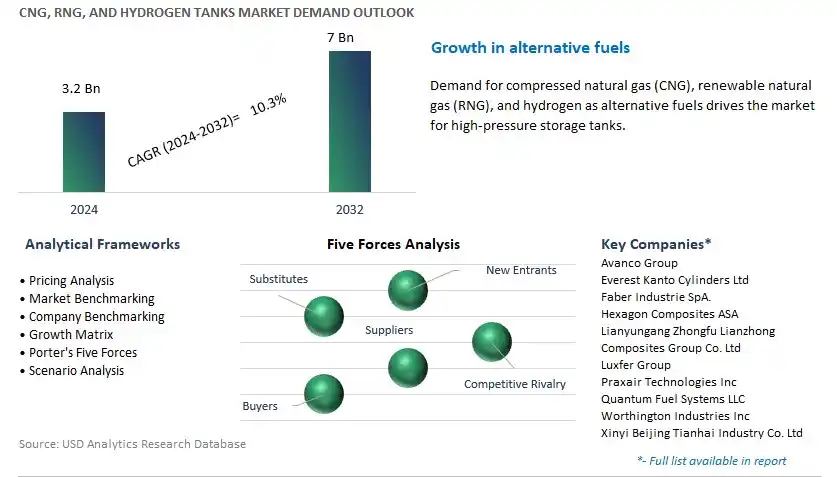
Global CNG, RNG, and Hydrogen Tanks Market Size is valued at $3.2 Billion in 2024 and is forecast to register a growth rate (CAGR) of 10.3% to reach $7 Billion by 2032.
The global CNG, RNG, and Hydrogen Tanks Market Study analyzes and forecasts the market size across 6 regions and 24 countries for diverse segments -By Material (Metal, Glass Fiber, Carbon Fiber), By Tank (Type 1, Type 2, Type 3, Type 4), By Gas (CNG, RNG, Hydrogen), By Application (Fuel Tank, Transportation Tank).
An Introduction to CNG, RNG, and Hydrogen Tanks Market in 2024
CNG (Compressed Natural Gas), RNG (Renewable Natural Gas), and hydrogen tanks are specialized containers designed to store and transport gaseous fuels for use in vehicles, industrial processes, and energy storage systems. The market for CNG, RNG, and hydrogen tanks is driven by the increasing adoption of alternative fuels and renewable energy sources to reduce greenhouse gas emissions and dependence on fossil fuels. CNG tanks store natural gas, which is primarily composed of methane, while RNG tanks store biogas derived from organic waste sources, such as landfills, wastewater treatment plants, and agricultural residues. Hydrogen tanks store hydrogen gas, which is produced through electrolysis, steam reforming of natural gas, or renewable energy sources such as solar and wind power. These tanks are typically made from high-strength materials such as carbon fiber-reinforced composites, aluminum alloys, or advanced steel alloys to withstand high pressures and ensure safety during storage and transportation. Further, advancements in tank design, material technology, and manufacturing processes are driving innovation and market growth within the CNG, RNG, and hydrogen tank industry. As governments, industries, and consumers transition towards cleaner and more sustainable energy solutions, the demand for efficient and safe storage systems for alternative fuels s to rise, positioning CNG, RNG, and hydrogen tanks as key components of the future energy landscape.
CNG, RNG, and Hydrogen Tanks Market Competitive Landscape
The market report analyses the leading companies in the industry including Avanco Group, Everest Kanto Cylinders Ltd, Faber Industrie SpA., Hexagon Composites ASA, Lianyungang Zhongfu Lianzhong Composites Group Co. Ltd, Luxfer Group, Praxair Technologies Inc, Quantum Fuel Systems LLC, Worthington Industries Inc, Xinyi Beijing Tianhai Industry Co. Ltd, and others.
CNG, RNG, and Hydrogen Tanks Market Dynamics
Market Trend: Shift Towards Alternative Fuel Vehicles
A significant trend in the CNG (Compressed Natural Gas), RNG (Renewable Natural Gas), and hydrogen tanks market is the shift towards alternative fuel vehicles. With increasing concerns about environmental pollution and greenhouse gas emissions, there is a growing demand for vehicles powered by cleaner and renewable energy sources such as natural gas and hydrogen. CNG and RNG tanks are essential components of vehicles that run on compressed natural gas or renewable natural gas, offering efficient storage solutions for these alternative fuels. Similarly, hydrogen tanks play a crucial role in storing hydrogen fuel for fuel cell electric vehicles (FCEVs). This trend is reshaping the automotive industry, driving investments in infrastructure for alternative fueling stations and spurring innovation in tank design and manufacturing to meet the growing demand for eco-friendly transportation solutions.
Market Driver: Government Initiatives and Regulations
The market for CNG, RNG, and hydrogen tanks is driven by government initiatives and regulations aimed at promoting cleaner energy and reducing dependence on fossil fuels. Governments worldwide are implementing policies to incentivize the adoption of alternative fuel vehicles and invest in the development of infrastructure for natural gas refueling stations and hydrogen fueling stations. Additionally, regulatory standards and emission targets are pushing automotive manufacturers to introduce more eco-friendly vehicles powered by natural gas or hydrogen fuel cells. As a result, there is a growing demand for CNG, RNG, and hydrogen tanks to support the expansion of alternative fuel vehicle fleets and comply with regulatory requirements, driving growth in the market.
Market Opportunity: Diversification into Renewable Energy Storage Solutions
An opportunity for market expansion in the CNG, RNG, and hydrogen tanks industry lies in diversifying into renewable energy storage solutions. While these tanks are primarily used for storing natural gas and hydrogen for transportation purposes, there is potential to leverage their storage capabilities for renewable energy applications. For example, CNG and RNG tanks can be repurposed for storing biogas produced from organic waste or agricultural residues, providing a sustainable energy storage solution for off-grid communities or industrial facilities. Similarly, hydrogen tanks can be used to store excess renewable energy generated from sources such as solar and wind power, facilitating grid stability and energy storage for intermittent renewable energy sources. By exploring new applications and partnerships in the renewable energy sector, manufacturers of CNG, RNG, and hydrogen tanks can capitalize on the growing demand for sustainable energy storage solutions and contribute to the transition towards a low-carbon economy.
CNG, RNG, and Hydrogen Tanks Market Share Analysis: Metal segment generated the highest revenue in 2024
In the CNG, RNG, and Hydrogen Tanks Market, the Metal segment is the largest and most influential. Metal tanks, such as steel and aluminum alloys, have been widely used for storing compressed natural gas (CNG), renewable natural gas (RNG), and hydrogen due to their durability, reliability, and cost-effectiveness. Metal tanks offer high mechanical strength and resistance to corrosion, making them suitable for demanding applications in automotive, transportation, and energy sectors. Additionally, metal tanks can withstand high pressure conditions required for storing compressed gases, ensuring safety and performance. The widespread adoption of metal tanks in commercial fleets, public transportation, and hydrogen fuelling stations further contributes to the dominance of the Metal segment in the market. With the increasing focus on clean energy and sustainable transportation solutions, the demand for metal tanks is expected to continue growing, solidifying their leading position in the CNG, RNG, and Hydrogen Tanks Market.
CNG, RNG, and Hydrogen Tanks Market Share Analysis: Type 4 Tanks is poised to register the fastest CAGR over the forecast period
Among the tank types in the CNG, RNG, and Hydrogen Tanks Market, Type 4 tanks emerge as the fastest-growing segment. Type 4 tanks are characterized by a lightweight design consisting of a polymer liner wrapped with carbon fiber composite materials. This construction offers significant advantages over traditional tank types, including Type 1, Type 2, and Type 3. Type 4 tanks provide superior strength-to-weight ratio, corrosion resistance, and durability, making them ideal for applications requiring high-pressure storage of compressed gases such as CNG, RNG, and hydrogen. Additionally, Type 4 tanks offer enhanced safety features, such as impact resistance and leak prevention, contributing to their growing popularity in automotive, transportation, and energy sectors. The increasing demand for lightweight and high-capacity storage solutions, coupled with advancements in composite materials and manufacturing processes, further drive the adoption of Type 4 tanks in the market. With their superior performance characteristics and suitability for a wide range of applications, Type 4 tanks are poised to continue their rapid growth trajectory in the CNG, RNG, and Hydrogen Tanks Market, shaping the future of compressed gas storage solutions.
CNG, RNG, and Hydrogen Tanks Market Share Analysis: CNG Tanks segment generated the highest revenue in 2024
In the CNG, RNG, and Hydrogen Tanks Market, the CNG (Compressed Natural Gas) segment is the largest and most influential. CNG tanks are extensively used for storing compressed natural gas, which is a clean and sustainable alternative fuel sourced from natural gas reserves. The widespread adoption of CNG as a transportation fuel, particularly in commercial fleets, public transit systems, and passenger vehicles, fuels the demand for CNG tanks. These tanks are typically made of high-strength materials such as metals or composite materials to withstand the high pressure required for storing compressed gases. Additionally, the growing focus on reducing emissions and transitioning to cleaner energy sources drives the demand for CNG-powered vehicles and infrastructure, further propelling the growth of the CNG Tanks segment. With the increasing emphasis on sustainability and the expansion of CNG refuelling infrastructure worldwide, the demand for CNG tanks is expected to continue growing, solidifying their leading position in the CNG, RNG, and Hydrogen Tanks Market.
CNG, RNG, and Hydrogen Tanks Market Share Analysis: Transportation Tank is poised to register the fastest CAGR over the forecast period
Among the applications in the CNG, RNG, and Hydrogen Tanks Market, the Transportation Tank segment is the fastest-growing. Transportation tanks are specifically designed to store compressed natural gas (CNG), renewable natural gas (RNG), or hydrogen for use in vehicles, including passenger cars, buses, trucks, and other modes of transportation. The transportation sector is increasingly adopting alternative fuels such as CNG, RNG, and hydrogen as part of efforts to reduce greenhouse gas emissions and dependence on fossil fuels. As governments worldwide implement stricter emission regulations and incentivize the adoption of clean transportation solutions, the demand for transportation tanks is experiencing significant growth. Moreover, advancements in tank design, materials, and manufacturing processes are improving the efficiency, safety, and performance of transportation tanks, further driving their adoption. With the increasing focus on sustainability and the transition towards low-carbon transportation, the Transportation Tank segment is poised to continue its rapid growth trajectory in the CNG, RNG, and Hydrogen Tanks Market, shaping the future of clean and efficient mobility.
CNG, RNG, and Hydrogen Tanks Market
By Material
Metal
Glass Fiber
Carbon Fiber
By Tank
Type 1
Type 2
Type 3
Type 4
By Gas
CNG
RNG
Hydrogen
By Application
Fuel Tank
Transportation TankCountries Analyzed
North America (US, Canada, Mexico)
Europe (Germany, UK, France, Spain, Italy, Russia, Rest of Europe)
Asia Pacific (China, India, Japan, South Korea, Australia, South East Asia, Rest of Asia)
South America (Brazil, Argentina, Rest of South America)
Middle East and Africa (Saudi Arabia, UAE, Rest of Middle East, South Africa, Egypt, Rest of Africa)
CNG RNG and Hydrogen Tanks Companies Profiled in the Study
Avanco Group
Everest Kanto Cylinders Ltd
Faber Industrie SpA.
Hexagon Composites ASA
Lianyungang Zhongfu Lianzhong Composites Group Co. Ltd
Luxfer Group
Praxair Technologies Inc
Quantum Fuel Systems LLC
Worthington Industries Inc
Xinyi Beijing Tianhai Industry Co. Ltd
*- List Not Exhaustive
TABLE OF CONTENTS
1 Introduction to 2024 CNG RNG and Hydrogen Tanks Market
1.1 Market Overview
1.2 Quick Facts
1.3 Scope/Objective of the Study
1.4 Market Definition
1.5 Countries and Regions Covered
1.6 Units, Currency, and Conversions
1.7 Industry Value Chain
2 Research Methodology
2.1 Market Size Estimation
2.2 Sources and Research Methodology
2.3 Data Triangulation
2.4 Assumptions and Limitations
3 Executive Summary
3.1 Global CNG RNG and Hydrogen Tanks Market Size Outlook, $ Million, 2021 to 2032
3.2 CNG RNG and Hydrogen Tanks Market Outlook by Type, $ Million, 2021 to 2032
3.3 CNG RNG and Hydrogen Tanks Market Outlook by Product, $ Million, 2021 to 2032
3.4 CNG RNG and Hydrogen Tanks Market Outlook by Application, $ Million, 2021 to 2032
3.5 CNG RNG and Hydrogen Tanks Market Outlook by Key Countries, $ Million, 2021 to 2032
4 Market Dynamics
4.1 Key Driving Forces of CNG RNG and Hydrogen Tanks Industry
4.2 Key Market Trends in CNG RNG and Hydrogen Tanks Industry
4.3 Potential Opportunities in CNG RNG and Hydrogen Tanks Industry
4.4 Key Challenges in CNG RNG and Hydrogen Tanks Industry
5 Market Factor Analysis
5.1 Value Chain Analysis
5.2 Competitive Landscape
5.2.1 Global CNG RNG and Hydrogen Tanks Market Share by Company (%), 2023
5.2.2 Product Offerings by Company
5.3 Porter’s Five Forces Analysis
5.4 Pricing Analysis and Outlook
6 Growth Outlook Across Scenarios
6.1 Growth Analysis-Case Scenario Definitions
6.2 Low Growth Scenario Forecasts
6.3 Reference Growth Scenario Forecasts
6.4 High Growth Scenario Forecasts
7 Global CNG RNG and Hydrogen Tanks Market Outlook by Segments
7.1 CNG RNG and Hydrogen Tanks Market Outlook by Segments, $ Million, 2021- 2032
By Material
Metal
Glass Fiber
Carbon Fiber
By Tank
Type 1
Type 2
Type 3
Type 4
By Gas
CNG
RNG
Hydrogen
By Application
Fuel Tank
Transportation Tank
8 North America CNG RNG and Hydrogen Tanks Market Analysis and Outlook To 2032
8.1 Introduction to North America CNG RNG and Hydrogen Tanks Markets in 2024
8.2 North America CNG RNG and Hydrogen Tanks Market Size Outlook by Country, 2021-2032
8.2.1 United States
8.2.2 Canada
8.2.3 Mexico
8.3 North America CNG RNG and Hydrogen Tanks Market size Outlook by Segments, 2021-2032
By Material
Metal
Glass Fiber
Carbon Fiber
By Tank
Type 1
Type 2
Type 3
Type 4
By Gas
CNG
RNG
Hydrogen
By Application
Fuel Tank
Transportation Tank
9 Europe CNG RNG and Hydrogen Tanks Market Analysis and Outlook To 2032
9.1 Introduction to Europe CNG RNG and Hydrogen Tanks Markets in 2024
9.2 Europe CNG RNG and Hydrogen Tanks Market Size Outlook by Country, 2021-2032
9.2.1 Germany
9.2.2 France
9.2.3 Spain
9.2.4 United Kingdom
9.2.4 Italy
9.2.5 Russia
9.2.6 Norway
9.2.7 Rest of Europe
9.3 Europe CNG RNG and Hydrogen Tanks Market Size Outlook by Segments, 2021-2032
By Material
Metal
Glass Fiber
Carbon Fiber
By Tank
Type 1
Type 2
Type 3
Type 4
By Gas
CNG
RNG
Hydrogen
By Application
Fuel Tank
Transportation Tank
10 Asia Pacific CNG RNG and Hydrogen Tanks Market Analysis and Outlook To 2032
10.1 Introduction to Asia Pacific CNG RNG and Hydrogen Tanks Markets in 2024
10.2 Asia Pacific CNG RNG and Hydrogen Tanks Market Size Outlook by Country, 2021-2032
10.2.1 China
10.2.2 India
10.2.3 Japan
10.2.4 South Korea
10.2.5 Indonesia
10.2.6 Malaysia
10.2.7 Australia
10.2.8 Rest of Asia Pacific
10.3 Asia Pacific CNG RNG and Hydrogen Tanks Market size Outlook by Segments, 2021-2032
By Material
Metal
Glass Fiber
Carbon Fiber
By Tank
Type 1
Type 2
Type 3
Type 4
By Gas
CNG
RNG
Hydrogen
By Application
Fuel Tank
Transportation Tank
11 South America CNG RNG and Hydrogen Tanks Market Analysis and Outlook To 2032
11.1 Introduction to South America CNG RNG and Hydrogen Tanks Markets in 2024
11.2 South America CNG RNG and Hydrogen Tanks Market Size Outlook by Country, 2021-2032
11.2.1 Brazil
11.2.2 Argentina
11.2.3 Rest of South America
11.3 South America CNG RNG and Hydrogen Tanks Market size Outlook by Segments, 2021-2032
By Material
Metal
Glass Fiber
Carbon Fiber
By Tank
Type 1
Type 2
Type 3
Type 4
By Gas
CNG
RNG
Hydrogen
By Application
Fuel Tank
Transportation Tank
12 Middle East and Africa CNG RNG and Hydrogen Tanks Market Analysis and Outlook To 2032
12.1 Introduction to Middle East and Africa CNG RNG and Hydrogen Tanks Markets in 2024
12.2 Middle East and Africa CNG RNG and Hydrogen Tanks Market Size Outlook by Country, 2021-2032
12.2.1 Saudi Arabia
12.2.2 UAE
12.2.3 Oman
12.2.4 Rest of Middle East
12.2.5 Egypt
12.2.6 Nigeria
12.2.7 South Africa
12.2.8 Rest of Africa
12.3 Middle East and Africa CNG RNG and Hydrogen Tanks Market size Outlook by Segments, 2021-2032
By Material
Metal
Glass Fiber
Carbon Fiber
By Tank
Type 1
Type 2
Type 3
Type 4
By Gas
CNG
RNG
Hydrogen
By Application
Fuel Tank
Transportation Tank
13 Company Profiles
13.1 Company Snapshot
13.2 SWOT Profiles
13.3 Products and Services
13.4 Recent Developments
13.5 Financial Profile
Avanco Group
Everest Kanto Cylinders Ltd
Faber Industrie SpA.
Hexagon Composites ASA
Lianyungang Zhongfu Lianzhong Composites Group Co. Ltd
Luxfer Group
Praxair Technologies Inc
Quantum Fuel Systems LLC
Worthington Industries Inc
Xinyi Beijing Tianhai Industry Co. Ltd
14 Appendix
14.1 Customization Offerings
14.2 Subscription Services
14.3 Related Reports
14.4 Publisher Expertise
By Material
Metal
Glass Fiber
Carbon Fiber
By Tank
Type 1
Type 2
Type 3
Type 4
By Gas
CNG
RNG
Hydrogen
By Application
Fuel Tank
Transportation Tank
Countries Analyzed
North America (US, Canada, Mexico)
Europe (Germany, UK, France, Spain, Italy, Russia, Rest of Europe)
Asia Pacific (China, India, Japan, South Korea, Australia, South East Asia, Rest of Asia)
South America (Brazil, Argentina, Rest of South America)
Middle East and Africa (Saudi Arabia, UAE, Rest of Middle East, South Africa, Egypt, Rest of Africa)
