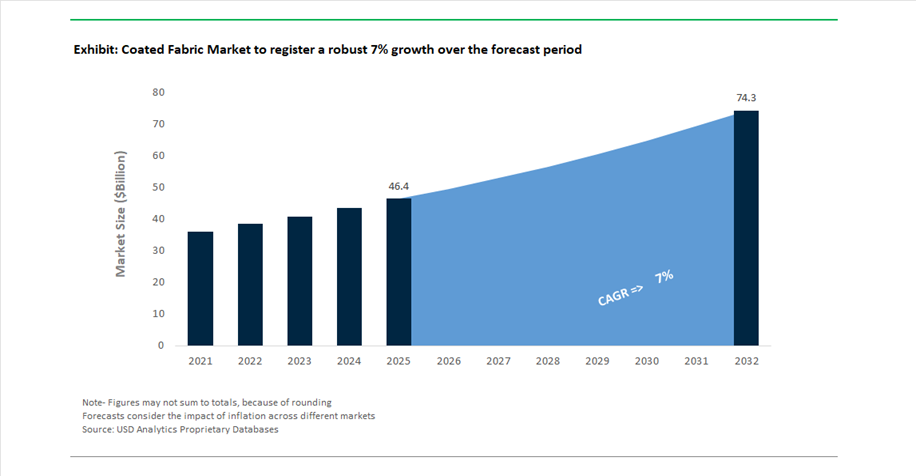
The global coated fabric market was valued at $46.4 billion in 2025 and is projected to expand at a CAGR of 7% between 2025 and 2032, reaching $74.5 billion by 2032. This robust growth trajectory reflects accelerating demand across automotive interiors, industrial protective clothing, transportation, construction membranes, medical textiles, and advanced packaging applications, where coated fabrics deliver critical performance characteristics such as water resistance, chemical protection, durability, and flexibility.
The market is undergoing a structural transformation driven by the convergence of polymer science, technical textiles, and sustainability mandates. Coated fabrics, traditionally dominated by PVC, polyurethane (PU), and rubber-based coatings, are now evolving toward water-based, solvent-free, and bio-based alternatives. This shift is primarily influenced by stringent global regulations on volatile organic compounds (VOCs) and hazardous chemicals such as Dimethylformamide (DMF), particularly in Europe and North America.
A major growth vector is the increasing adoption of lightweight, high-strength coated textiles in mobility and infrastructure sectors. In automotive applications, coated fabrics are being used extensively in seat covers, airbags, convertible roofs, and EV interior components, where durability and aesthetics must coexist. Similarly, in construction, architectural membranes and tensile structures are gaining traction due to their long service life, design flexibility, and energy efficiency benefits.
Additionally, the emergence of “smart” and functional textiles, including self-healing, antimicrobial, and temperature-responsive coated fabrics, is expanding the application landscape. These innovations are particularly relevant in defense, healthcare, and extreme industrial environments, where performance reliability and lifecycle optimization are critical. Rapid industrialization in Asia-Pacific, especially India and Southeast Asia, continues to strengthen demand fundamentals, supported by expanding manufacturing ecosystems and infrastructure investments.
Recent developments in the coated fabric market underscore a decisive shift toward technology integration, portfolio consolidation, and sustainability-driven innovation. In February 2026, Freudenberg Performance Materials announced the debut of the MehlerHeytex brand at Techtextil 2026, following the merger of Mehler Texnologies and Heytex. This strategic move positions the company as a global leader in coated technical textiles, supported by new nonwoven and laminated solutions tailored for automotive and industrial applications.
Capacity expansion and regional localization remain central to growth strategies. Freudenberg’s October 2025 expansion of its manufacturing facility in India reflects increasing demand for coated and nonwoven materials in South Asia, particularly for high-performance apparel and industrial use. Similarly, companies are strengthening their presence in emerging markets to capitalize on cost advantages and proximity to end-use industries.
Corporate restructuring and financial optimization are also shaping competitive dynamics. Trelleborg AB’s share buyback program (July 2025–April 2026) highlights a strategic pivot toward high-margin engineered polymer solutions, including advanced coated fabrics for industrial and medical applications. Meanwhile, Continental AG’s 2026 realignment strategy focuses on improving profitability within its ContiTech division, emphasizing sustainable surface materials and high-value industrial segments following demand softness in 2025.
Innovation in material science is rapidly advancing the market frontier. The transition from passive to “active” coated fabrics is evident with the commercialization of self-healing textiles in early 2026, utilizing micro-encapsulation and light-responsive polymers. These materials can autonomously repair minor abrasions, significantly extending product lifespan in protective gear and industrial applications. Additionally, Low & Bonar’s focus on water-based polyurethane coatings (2025–2026 roadmap) eliminates harmful solvents like DMF, targeting sustainable upholstery and vegan leather markets with low-VOC, high-durability solutions.
Product innovation and branding strategies are reinforcing market positioning. Sioen Industries’ Sioline rebrand and digital transformation (April 2024) introduced advanced coated textiles for transport, tensile architecture, and fire containment, while emphasizing vertical integration and European manufacturing capabilities. In parallel, Seaman Corporation’s 40-year service life certification (January 2025) for its FiberTite® roofing membranes demonstrates the increasing importance of lifecycle performance and environmental transparency, supported by Environmental Product Declarations (EPDs).
Strategic acquisitions are further enabling vertical integration and market expansion. The INX Group’s acquisition of Coatings & Adhesives Corporation (November 2024) has strengthened its capabilities in polymer coatings and adhesive technologies, enhancing its ability to deliver integrated solutions for packaging and coated materials markets. Additionally, Saint-Gobain’s 2026 expansion into new geographies reinforces its commitment to sustainable construction materials, with coated architectural fabrics playing a critical role in its long-term growth strategy.
PFAS Elimination in Performance Textiles Driving Industry-Wide Reformulation
The coated fabric industry is undergoing a decisive material transition as regulatory pressure intensifies against per- and polyfluoroalkyl substances (PFAS) used in performance textiles. While a comprehensive EU-wide restriction is still under finalization, individual member states have already implemented strict bans. Notably, France’s prohibition on PFAS-containing apparel, effective January 1, 2026, has forced global brands to rapidly redesign product portfolios to maintain market access.
This regulatory fragmentation is accelerating a unified industry response. Approximately 85% of premium outdoor apparel brands have transitioned to non-fluorinated alternatives such as polyurethane- and silicone-based durable water-repellent coatings. These systems eliminate reliance on legacy C6 and C8 fluorochemistries, reducing aquatic toxicity by approximately 70% per product unit. Additionally, Denmark’s ban on the import of PFAS-containing textiles from July 2026 is reinforcing momentum toward a broader “universal PFAS restriction” across Europe.
The transition is also delivering measurable sustainability gains. Non-fluorinated coatings enable improved recyclability, increasing fiber recovery rates by approximately 30% in textile recycling processes. This is particularly important as circular economy frameworks gain traction across the apparel industry.
However, reformulation challenges remain. Manufacturers must balance water repellency, breathability, and durability without fluoropolymers, driving innovation in hybrid coating systems. As regulatory enforcement expands, PFAS-free coatings are becoming the global standard, reshaping material selection and product design across the coated fabric industry.
EPA TSCA Regulation on Formaldehyde Accelerating Shift to Non-Toxic Textile Coatings
The U.S. coated fabric sector is experiencing parallel regulatory pressure under the EPA’s Toxic Substances Control Act, particularly targeting formaldehyde-based resins used in textile backcoatings. Following updated risk evaluations in 2025–2026, formaldehyde has been classified as posing an “unreasonable risk,” triggering stricter exposure controls and driving widespread material substitution.
The regulatory framework introduces lower exposure thresholds, with a revised acute inhalation benchmark of 0.3 ppm, significantly tightening allowable emission levels in manufacturing environments. Facilities using formaldehyde-based coatings must now maintain a Margin of Exposure greater than one, necessitating substantial investments in ventilation and emission control systems. Industry data indicates that this has increased capital expenditure by approximately 20% for affected facilities.
Consumer safety concerns are further accelerating change. Regulatory findings highlight potential risks associated with formaldehyde emissions from coated textiles, increasing litigation exposure for manufacturers. As a result, approximately 60% of U.S.-based producers are transitioning toward alternative chemistries, including acrylic binders, bio-based resins, and isocyanate-free polyurethane systems.
The environmental benefits of this transition are significant. The shift away from formaldehyde-based coatings is projected to eliminate more than 500 tons of hazardous air pollutant emissions annually across North America by 2027. This aligns with broader industry efforts to reduce chemical exposure risks while maintaining performance in coated fabric applications.
Graphene-Enhanced Polyurethane Coatings Revolutionizing Medical Textile Performance
The healthcare sector is emerging as a high-value application area for coated fabrics, particularly through the adoption of graphene-enhanced polyurethane coatings in medical textiles. These advanced materials are being deployed in pressure relief mattresses and patient support surfaces, where thermal management and hygiene are critical performance factors.
Graphene integration delivers substantial thermal performance improvements. Coatings incorporating graphene exhibit approximately 40% higher thermal conductivity compared to standard polyurethane systems, reducing patient interface temperatures by around 2°C. This temperature reduction is clinically significant, helping to prevent the formation of pressure ulcers in long-term care environments.
Antimicrobial performance is another key advantage. Recent clinical evaluations demonstrate that graphene-enhanced coatings achieve a 99.9% reduction in common pathogens such as MRSA and E. coli within 24 hours, without relying on traditional biocidal additives. This supports infection control strategies while minimizing chemical exposure risks.
Durability enhancements further strengthen their value proposition. Graphene-reinforced coatings improve tensile strength by approximately 25%, enabling medical textiles to withstand more than 1,000 industrial washing cycles with aggressive disinfectants. This extended lifecycle reduces replacement frequency and operational costs for healthcare providers.
Silicone-Coated Fiberglass Fabrics Enabling Fire-Safe EV Battery Protection Systems
The rapid expansion of electric vehicle production is creating a specialized demand for high-performance coated fabrics capable of withstanding extreme thermal conditions. Silicone-coated fiberglass is emerging as a critical material for battery fire barriers and thermal insulation systems, particularly in high-energy lithium-ion battery packs.
These fabrics offer exceptional heat resistance, with continuous operating temperatures of up to 550°C and the ability to withstand thermal shocks exceeding 1,200°C for short durations. This performance is essential for containing thermal runaway events, providing a critical safety window for passenger evacuation.
Weight efficiency is another key advantage. Compared to traditional mica-based insulation systems, silicone-coated fiberglass fabrics deliver approximately 15% weight reduction while maintaining compliance with stringent flammability standards such as UL 94 V-0. This contributes to improved vehicle efficiency and extended driving range.
Chemical resistance further enhances their suitability. These coatings exhibit complete resistance to electrolyte leakage and acidic gases generated during battery failure, ensuring structural integrity under extreme conditions. This is particularly important for maintaining containment during the most volatile phases of battery degradation.
Adoption is accelerating rapidly. By 2026, approximately one-third of newly manufactured electric vehicles incorporate silicone-coated fiberglass materials within battery modules to meet evolving safety standards such as UNECE R100.
Coated Fabric Market Share and Segmentation Insights
Market Share by Coating Material: Polyvinyl Chloride (PVC) Leads with 38% Share Backed by Cost-Performance Superiority
Polyvinyl Chloride (PVC) dominates the global coated fabric market with a 38% market share in 2025, driven by its optimal balance of cost efficiency, durability, and scalable processing characteristics. PVC-coated fabrics deliver robust abrasion resistance, weatherability, and inherent flame retardancy, making them the material of choice for high-volume industrial applications such as tarpaulins, truck covers, industrial curtains, and conveyor belts. From a manufacturing standpoint, PVC offers superior processability and compatibility with polyester and nylon substrates, enabling large-scale production at competitive price points compared to polyurethane (PU), rubber-coated fabrics, and silicone-based systems. Additionally, PVC’s versatility supports a broad range of end-use sectors including automotive interiors, inflatable structures, and protective covers, reinforcing its volume leadership. Despite increasing regulatory scrutiny and environmental concerns in regions such as Europe, particularly around plasticizers and recyclability, PVC continues to maintain its dominant position due to entrenched supply chains, cost advantages, and widespread application across industrial and commercial segments.
Market Share by Application Area: Building and Construction Segment Captures 28% Share Driven by Infrastructure and Tensile Architecture Growth
The building and construction segment accounts for 28% of the coated fabric market in 2025, emerging as the largest application area due to expanding infrastructure development and the rising adoption of tensile architectural solutions. Coated fabrics are extensively utilized in applications such as stadium roofs, tensile canopies, scaffolding sheets, temporary shelters, geomembranes, and facade membranes, where lightweight, flexible, and durable materials are required. These applications demand high-performance characteristics including UV stability, waterproofing, flame resistance, and long-term weather durability, positioning PVC-coated polyester and silicone-coated fabrics as industry standards. The segment’s growth is further fueled by rapid urbanization, increasing investments in commercial construction, and the need for cost-effective, modular building solutions, particularly in emerging economies across Asia-Pacific and the Middle East. Additionally, the use of coated fabrics in temporary and semi-permanent structures enhances their appeal in disaster relief housing and event infrastructure, further strengthening demand within the construction sector.
Coated Fabric Market Competitive Landscape Driven by Technical Textiles, Bio-Based Coatings, and High-Performance Applications
The coated fabric market is evolving with advanced technical textiles, bio-based coated fabrics, and high-performance polymer coatings. Key players are focusing on automotive lightweighting, medical-grade fabrics, protective clothing, and sustainable coated materials to meet rising demand across transportation, healthcare, construction, and industrial sectors.
Continental drives automotive coated fabrics with lightweight bio-based materials and EV-focused innovation
Continental AG is repositioning its coated fabric business amid a strategic shift toward a tire-focused portfolio, including the planned divestment of its ContiTech division. The company is advancing lightweight coated fabrics using rice-husk silica and natural rubber, achieving 15–20% weight reduction for EV interiors. Its Conti Home and Ambienc3 series offer vegan leather alternatives with digitally printable and bio-based coatings. Strong integration with automotive OEMs supports applications such as flame-retardant seat covers and battery enclosure fabrics. The company maintains stable EBIT margins of 11.0% to 12.5% despite market volatility. Product development focuses on lightweight materials, sustainability, and EV applications.
Trelleborg leads engineered coated fabrics with zoned coating technology and aerospace-grade solutions
Trelleborg AB is a global leader in engineered coated fabrics, specializing in high-margin industrial, aerospace, and medical applications. Its Dartex Zoned Coatings technology enables variable performance characteristics within a single fabric, improving functionality in medical pressure-relief systems. The integration of Alpha Engineered Composites strengthens its North American market position. Trelleborg supplies critical coated fabrics for aircraft evacuation slides and protective gear meeting strict safety standards. Its “Polymers for Tomorrow” initiative targets circular materials using bio-based and recycled polymers. Product innovation focuses on engineered fabrics, aerospace safety, and sustainable polymer coatings.
Saint-Gobain strengthens coated fabric leadership with high-performance polymers and smart textile integration
Saint-Gobain leverages its €47.9 billion revenue base to dominate high-performance coated fabrics and polymer solutions. Its PTFE-coated glass fiber fabrics are widely used in solar-integrated façades with a 25-year lifecycle. Expansion in construction chemicals supports demand for coated membranes in green building applications. The company is investing in PFAS-free coatings and advanced industrial membranes following strategic asset divestments. Multi-layer co-casting technology enables integration of conductive layers, supporting smart textiles and e-textile innovation. Product development focuses on high-performance fabrics, sustainability, and advanced material integration.
Serge Ferrari advances coated fabrics with Precontraint technology and recyclable membrane solutions
Serge Ferrari Group is a leader in tensile architecture fabrics and coated membrane solutions, driven by its proprietary Precontraint technology. This process ensures dimensional stability and long-term durability in architectural applications. The company is expanding its Texyloop recycling initiative, supporting circular economy adoption in large infrastructure projects. Its Soltis Veoz product offers high-transparency solar protection with enhanced aesthetics. Growing demand in public infrastructure has increased adoption of biocide-free antimicrobial coated fabrics. Product innovation focuses on recyclable materials, architectural fabrics, and sustainable coatings.
Sioen Industries expands coated fabric applications with protective textiles and renewable energy solutions
Sioen Industries is a vertically integrated leader in coated fabrics, covering the full value chain from yarn production to coating. Its SYNQ multi-hazard workwear complies with stringent EN ISO standards, supporting growth in protective clothing markets. The company is expanding into defense applications with anti-ballistic coated fabrics and high-performance protective gear. Investments in automated production lines support scalability and cost efficiency. Sioen is also targeting renewable energy applications, including hydrogen storage membranes and reinforced fabrics. Product development focuses on protective textiles, industrial fabrics, and energy transition solutions.
Spradling drives coated fabric market with design-led innovation and antimicrobial surface technologies
Spradling International is a leading provider of PVC and PU coated fabrics for marine, healthcare, and hospitality sectors. Its Permablok3 and Silverguard finishes deliver antimicrobial, stain-resistant, and abrasion-resistant performance. Expansion in Southeast Asia supports rising demand from furniture and interior applications. The company emphasizes design-driven innovation, integrating color and texture trends into high-performance coated fabrics. Transition toward phthalate-free and DMF-free coatings ensures compliance with global environmental regulations. Product strategy focuses on antimicrobial coatings, sustainable materials, and premium design solutions.
China Coated Fabric Market: Intelligent Manufacturing and Solvent-Free Innovation Driving Global Leadership
China remains the dominant force in the coated fabric market, transitioning toward high-performance and sustainable production systems. Advanced facilities such as Allnex’s Jiaxing site are accelerating the development of waterborne and UV-curable resins for synthetic leather and industrial applications.
A major transformation is the 40% increase in adoption of DMF-free polyurethane coating processes, driven by strict environmental export standards. The booming New Energy Vehicle (NEV) sector—producing over 10 million units annually—is fueling demand for silicone-coated fabrics used in battery fire protection and premium interiors. Additionally, China’s semiconductor expansion is driving niche demand for precision-coated fabrics in CMP processes, while new green manufacturing standards are phasing out solvent-based systems. These factors reinforce China’s leadership in scale, sustainability, and innovation.
United States Coated Fabric Market: Infrastructure Modernization and Defense Applications Driving Growth
The United States coated fabric market is experiencing a strong resurgence, supported by reshoring initiatives and federal investments. The CHIPS Act is increasing demand for high-purity coated fabrics used in semiconductor cleanrooms and chemical-resistant insulation systems.
Infrastructure projects under the IIJA are driving adoption of PTFE-coated fiberglass membranes for large architectural structures such as stadiums and transit hubs. Defense and aerospace sectors are also key drivers, with rising demand for rubber-coated fabrics in protective gear and flight suits. Regulatory pressure from the EPA is accelerating the shift toward TPU and silicone coatings, replacing traditional PVC systems. Additionally, growth in automotive refinish and aerospace MRO activities is boosting demand for durable, fire-resistant coated textiles, positioning the U.S. as a high-value innovation market.
Germany Coated Fabric Market: Circular Economy and Bio-Based Resin Innovation Leading Sustainability
Germany leads Europe in sustainable coated fabric technologies, driven by strict environmental regulations and circular economy principles. The adoption of the Ecodesign for Sustainable Products Regulation (ESPR) and Digital Product Passports is enabling full lifecycle traceability of coated fabrics.
Innovation is centered on sustainability and advanced materials. German companies are commercializing lignin-based and castor-oil-derived polyurethane coatings, reducing CO₂ emissions by up to 45%. Additionally, the development of permeation-resistant coated fabrics is supporting hydrogen storage and transport infrastructure. Advances in energy-efficient curing technologies—such as IR and UV systems—are reducing energy consumption by over 20%. These developments position Germany as a leader in eco-friendly, high-performance coated fabrics.
India Coated Fabric Market: PLI-Driven Expansion and Infrastructure Growth Fueling Rapid Demand
India is emerging as a high-growth market for coated fabrics, supported by strong government incentives and expanding industrial applications. The PLI scheme for technical textiles has attracted over $120 billion in investment, accelerating domestic production of high-value coated materials.
Infrastructure and industrial demand are key growth drivers. Expansion of railway networks, including Vande Bharat trains, is increasing demand for fire-resistant coated fabrics, while construction and water management projects are boosting use of bitumen-coated and polymer-modified fabrics. The automotive sector is also driving demand for synthetic leather upholstery, supported by manufacturing hubs in Tamil Nadu and Gujarat. Additionally, strong growth in agribusiness is increasing demand for UV-stabilized coated tarpaulins, positioning India as a major global supplier.
Japan Coated Fabric Market: Nanotechnology and Functional Performance Driving Advanced Applications
Japan’s coated fabric market is defined by cutting-edge innovation and high-performance materials. The integration of carbon nanotubes (CNTs) into coatings is enabling electrically conductive fabrics for smart textiles and sensor-enabled applications.
The market is also advancing in specialized applications. Development of super-hydrophobic and oleophobic coated fabrics is improving durability and cleanliness in public infrastructure, while aerogel-infused fabrics are enhancing thermal insulation in EV battery systems. Sustainability initiatives, including waterless CO₂ dyeing and solvent-free coating lines, are helping achieve zero-discharge targets. Additionally, innovations in signal-transparent coated fabrics are supporting autonomous mobility systems, reinforcing Japan’s leadership in advanced functional textiles.
Brazil Coated Fabric Market: Agribusiness Synergy and Biofuel Applications Driving Growth
Brazil’s coated fabric market is closely linked to its agribusiness and energy sectors. The “Fuel of the Future” law is driving demand for biofuel-resistant coated fabrics used in storage and transportation systems.
Agricultural expansion is also a key driver, with increased demand for chemical-resistant protective gear and heavy-duty coated materials for equipment and logistics. Investments in renewable energy and offshore oil exploration are boosting demand for saltwater-resistant coated fabrics for subsea applications. Additionally, the rise of sustainable fashion is encouraging adoption of recycled polyester fabrics coated with bio-based polyurethane, positioning Brazil as a leader in eco-friendly coated textile solutions.
Vietnam is emerging as a critical hub in the global coated fabric market under the “China Plus One” strategy. The country’s textile exports reached $46 billion in 2025, with increasing focus on high-value technical coated fabrics.
Growth is driven by diverse applications. The expansion of EV manufacturing is increasing demand for fire-retardant coated fabrics in battery assembly, while the logistics boom is driving production of PVC-coated tarpaulins for transportation and warehousing. Vietnam’s dominance in furniture exports is also boosting demand for stain-resistant and breathable upholstery fabrics. Strategic trade agreements such as EVFTA are encouraging adoption of EU-compliant non-toxic coatings, while investments in automation are improving production efficiency. These factors position Vietnam as a key emerging player in the global coated fabric market.
Coated Fabric Market Report Scope
Coated Fabric Market
Parameter
Details
Market Size (2025)
$46.4 Billion
Market Size (2032)
$74.5 Billion
Market Growth Rate
7%
Segments
By Coating Material (Polymer-Coated Fabrics, Polyvinyl Chloride (PVC), Polyurethane (PU), Polyethylene (PE), Acrylic, Rubber-Coated Fabrics, Neoprene and Nitrile, Silicone, Hypalon (CSM), Specialty and Bio-based Coatings), By Fabric Substrate (Polyester, Nylon (Polyamide), Cotton and Blends, Glass Fiber and Aramid, Non-Woven and Knitted Substrates), By Application Area (Transportation, Protective Clothing, Industrial, Building and Construction, Furniture and Seating, Outdoor and Sports), By Functional Enhancement (Antimicrobial and Antiviral, Flame Retardant (FR), UV and Weather Resistant, Conductive and Smart Textiles)
Study Period
2019- 2025 and 2026-2032
Units
Revenue (USD)
Qualitative Analysis
Porter’s Five Forces, SWOT Profile, Market Share, Scenario Forecasts, Market Ecosystem, Company Ranking, Market Dynamics, Industry Benchmarking
US, Canada, Mexico, Germany, France, Spain, Italy, UK, Russia, China, India, Japan, South Korea, Australia, South East Asia, Brazil, Argentina, Middle East, Africa
Coated Fabric Market Segmentation
By Coating Material
Polymer-Coated Fabrics
Polyvinyl Chloride (PVC)
Polyurethane (PU)
Polyethylene (PE)
Acrylic
Rubber-Coated Fabrics
Neoprene and Nitrile
Silicone
Hypalon (CSM)
Specialty and Bio-based Coatings
By Fabric Substrate
Polyester
Nylon (Polyamide)
Cotton and Blends
Glass Fiber and Aramid
Non-Woven and Knitted Substrates
By Application Area
Transportation
Protective Clothing
Industrial
Building and Construction
Furniture and Seating
Outdoor and Sports
By Functional Enhancement
Antimicrobial and Antiviral
Flame Retardant (FR)
UV and Weather Resistant
Conductive and Smart Textiles
Leading Countries in the Industry
North America (United States, Canada, Mexico)
Europe (Germany, France, Spain, United Kingdom, Italy, Russia, Rest of Europe)
Asia Pacific (China, India, Japan, South Korea, Australia, South East Asia, Rest of APAC)
South and Central America (Brazil, Argentina, Rest of SCA)
Middle East and Africa (Saudi Arabia, UAE, MENA, Sub-Saharan Africa)
2. Coated Fabric Market Landscape & Outlook (2025–2032)
2.1. Introduction to Coated Fabric Market
2.2. Market Valuation and Growth Projections (2025–2032)
2.3. Market Drivers: Automotive, Construction, and Technical Textile Demand
2.4. Regulatory Landscape: VOC, PFAS, and Formaldehyde Compliance
2.5. Technology Evolution: Polymer Innovation, Smart Textiles, and Sustainable Coatings
3. Innovations Reshaping the Coated Fabric Market
3.1. Trend: Shift Toward Water-Based, Solvent-Free, and Bio-Based Coatings
3.2. Trend: Smart and Functional Textiles Including Self-Healing and Antimicrobial Fabrics
3.3. Opportunity: Graphene-Enhanced Polyurethane Coatings in Medical Textiles
3.4. Opportunity: Silicone-Coated Fiberglass for EV Battery Fire Protection Systems
4. Competitive Landscape and Strategic Initiatives
4.1. Mergers and Acquisitions
4.2. R&D and Material Innovation
4.3. Sustainability and ESG Strategies
4.4. Market Expansion and Regional Focus
5. Market Share and Segmentation Insights: Coated Fabric Market
5.1. By Coating Material
5.1.1. Polymer-Coated Fabrics
5.1.1.1. Polyvinyl Chloride (PVC)
5.1.1.2. Polyurethane (PU)
5.1.1.3. Polyethylene (PE)
5.1.1.4. Acrylic
5.1.2. Rubber-Coated Fabrics
5.1.2.1. Neoprene and Nitrile
5.1.2.2. Silicone
5.1.2.3. Hypalon (CSM)
5.1.3. Specialty and Bio-based Coatings
5.2. By Fabric Substrate
5.2.1. Polyester
5.2.2. Nylon (Polyamide)
5.2.3. Cotton and Blends
5.2.4. Glass Fiber and Aramid
5.2.5. Non-Woven and Knitted Substrates
5.3. By Application Area
5.3.1. Transportation
5.3.2. Protective Clothing
5.3.3. Industrial
5.3.4. Building and Construction
5.3.5. Furniture and Seating
5.3.6. Outdoor and Sports
5.4. By Functional Enhancement
5.4.1. Antimicrobial and Antiviral
5.4.2. Flame Retardant (FR)
5.4.3. UV and Weather Resistant
5.4.4. Conductive and Smart Textiles
6. Country Analysis and Outlook of Coated Fabric Market
6.1. United States
6.2. Canada
6.3. Mexico
6.4. Germany
6.5. France
6.6. Spain
6.7. Italy
6.8. UK
6.9. Russia
6.10. China
6.11. India
6.12. Japan
6.13. South Korea
6.14. Australia
6.15. South East Asia
6.16. Brazil
6.17. Argentina
6.18. Middle East
6.19. Africa
7. Coated Fabric Market Size Outlook by Region (2025–2032)
7.1. North America Coated Fabric Market Size Outlook to 2032
7.1.1. By Coating Material
7.1.2. By Fabric Substrate
7.1.3. By Application Area
7.1.4. By Functional Enhancement
7.2. Europe Coated Fabric Market Size Outlook to 2032
7.2.1. By Coating Material
7.2.2. By Fabric Substrate
7.2.3. By Application Area
7.2.4. By Functional Enhancement
7.3. Asia Pacific Coated Fabric Market Size Outlook to 2032
7.3.1. By Coating Material
7.3.2. By Fabric Substrate
7.3.3. By Application Area
7.3.4. By Functional Enhancement
7.4. South America Coated Fabric Market Size Outlook to 2032
7.4.1. By Coating Material
7.4.2. By Fabric Substrate
7.4.3. By Application Area
7.4.4. By Functional Enhancement
7.5. Middle East and Africa Coated Fabric Market Size Outlook to 2032
7.5.1. By Coating Material
7.5.2. By Fabric Substrate
7.5.3. By Application Area
7.5.4. By Functional Enhancement
8. Company Profiles: Leading Players in the Coated Fabric Market
8.1. Continental AG
8.2. Trelleborg AB
8.3. Serge Ferrari Group
8.4. Saint-Gobain S.A.
8.5. Freudenberg Group
8.6. Sioen Industries NV
8.7. Seaman Corporation
8.8. SRF Limited
8.9. Spradling International, Inc.
8.10. Haartz Corporation
8.11. Cooley Group Holdings, Inc.
8.12. OMNOVA Solutions Inc.
8.13. Dickson Constant
8.14. Endutex Coated Technical Textiles
8.15. Morbern Inc.
9. Methodology
9.1. Research Scope
9.2. Market Research Approach
9.3. Market Sizing and Forecasting Model
9.4. Research Coverage
9.5. Data Horizon
9.6. Deliverables
10. Appendix
10.1. Acronyms and Abbreviations
10.2. List of Tables
10.3. List of Figures
Coated Fabric Market Segmentation
By Coating Material
Polymer-Coated Fabrics
Polyvinyl Chloride (PVC)
Polyurethane (PU)
Polyethylene (PE)
Acrylic
Rubber-Coated Fabrics
Neoprene and Nitrile
Silicone
Hypalon (CSM)
Specialty and Bio-based Coatings
By Fabric Substrate
Polyester
Nylon (Polyamide)
Cotton and Blends
Glass Fiber and Aramid
Non-Woven and Knitted Substrates
By Application Area
Transportation
Protective Clothing
Industrial
Building and Construction
Furniture and Seating
Outdoor and Sports
By Functional Enhancement
Antimicrobial and Antiviral
Flame Retardant (FR)
UV and Weather Resistant
Conductive and Smart Textiles
Leading Countries in the Industry
North America (United States, Canada, Mexico)
Europe (Germany, France, Spain, United Kingdom, Italy, Russia, Rest of Europe)
Asia Pacific (China, India, Japan, South Korea, Australia, South East Asia, Rest of APAC)
South and Central America (Brazil, Argentina, Rest of SCA)
Middle East and Africa (Saudi Arabia, UAE, MENA, Sub-Saharan Africa)
The coated fabric market was valued at USD 46.4 billion in 2025 and is projected to reach USD 74.5 billion by 2032, growing at a CAGR of 7%. Growth is supported by strong demand across automotive, construction, and industrial applications. Increasing adoption of high-performance polymer coatings is accelerating market expansion. Emerging economies are further strengthening demand fundamentals.
Regulations targeting PFAS, VOCs, and chemicals like DMF and formaldehyde are driving a shift toward water-based, solvent-free, and bio-based coatings. Over 85% of premium textile brands are transitioning to non-fluorinated alternatives such as PU and silicone coatings. This shift improves recyclability and reduces environmental impact. Manufacturers are investing heavily in green chemistry and circular materials.
Coated fabrics are increasingly used in EV interiors, seat covers, airbags, and battery protection systems. Silicone-coated fiberglass fabrics provide high thermal resistance for battery safety, withstanding temperatures above 1000°C. Lightweight coated textiles also improve energy efficiency and vehicle range. These materials are becoming critical for meeting EV safety and performance standards.
The market is evolving toward advanced functional textiles such as self-healing, antimicrobial, and temperature-responsive coated fabrics. Innovations like graphene-enhanced polyurethane coatings improve thermal management and provide 99.9% antimicrobial performance. These textiles are widely adopted in healthcare, defense, and industrial environments. This shift is expanding high-value application segments.
Key players include Continental AG, Trelleborg AB, Serge Ferrari Group, Saint-Gobain S.A., Freudenberg Group, and Sioen Industries NV. These companies focus on sustainable coatings, smart textiles, and high-performance industrial applications.