Coin-Operated Washing Machine Market Size Outlook 2025–2034
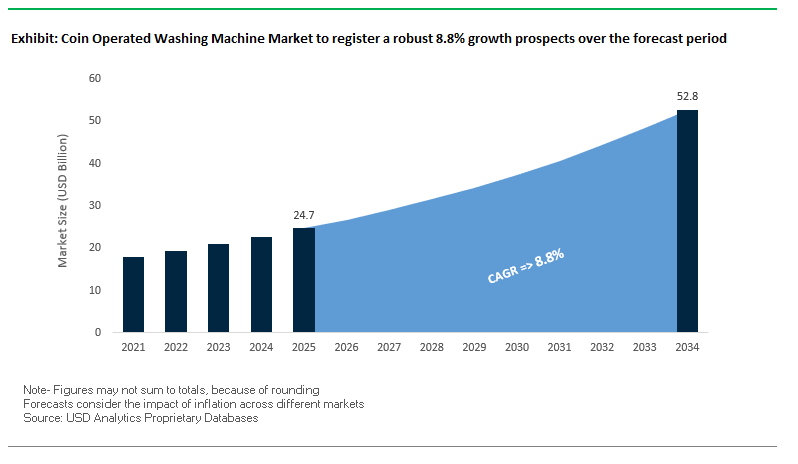
The global coin-operated washing machine market is expected to grow from USD 24.7 billion in 2025 to USD 52.8 billion by 2034, registering a CAGR of 8.8%. The growth is driven by urbanization, changing lifestyles, and the swift transition towards cashless payment systems and IoT-based laundry solutions. Laundromats, multi-housing laundry facilities, and institutional laundry services are embracing machines featuring enhanced efficiency capabilities, lowering operational expenses and achieving sustainability goals. Hospitality and healthcare industries are also driving demand for high-capacity, hygiene-centric laundry machinery.
Key Insights for Industry Professionals
- Digital Transition – Over 55% of laundromats now accept mobile payments, nearly doubling since 2022.
- Urban Laundry Demand – Self-service facilities are expanding rapidly in student housing, urban apartments, and high-density residential areas.
- Sustainability Focus – 35%+ of operators are investing in energy-efficient, water-recycling machines.
- Smart Operations – IoT-enabled models offer real-time performance tracking, predictive maintenance, and remote control.
- Sector Expansion – Hospitality and healthcare laundry demand is growing for large-load, high-durability equipment.
Coin-Operated Washing Machine Market Analysis – Recent Developments and Industry Shifts
The coin washing machine industry is experiencing technological change, with robust uptake of cashless payments, IoT functionalities, and eco-friendly upgrades. Quick Clean Pvt. Ltd. raised $5.77 million in February 2025 to venture into healthcare and hospitality laundry, announcing expansion into non-traditional laundromats. Manufacturers are focusing on energy-saving designs, water recycling systems, and quick cycle times to contain operating expenses.
IoT integration is becoming the norm, allowing operators to monitor usage patterns, schedule predictive maintenance, and remotely control settings. Whirlpool and Alliance Laundry Systems have heavily invested in mobile payment compatibility and cloud-based laundry management, while Electrolux Professional is marketing its Line 6000 series with automatic detergent dosing and water recycling.
Innovation across adjacent markets also impacts design of laundry equipment. The YEEDI M14 PLUS robot cleaner (January 2025) illustrates hygienic automation trends, while the Anti-Legionella Flow-Thru™ Valve from Global Water Solutions (August 2025) illustrates the growing criticality of water safety in commercial buildings. Innovation across adjacent markets in durable coatings, wireless charging, and self-sanitizing materials will also be expected to inform the next generation of commercial laundry equipment.
Emerging Trends and High-Value Opportunities in the Coin-Operated Washing Machine Market
Cryptocurrency Payment Integration Transforming Transaction Models
The addition of cryptocurrency payment systems to coin-operated washing machines is reshaping the payment process in laundromats. By facilitating payments in Bitcoin, Ethereum, or stablecoins, operators can provide a safe, cashless, and worldwide accessible payment method that appeals to both locally sophisticated technology users and overseas tourists. These systems, which settle the payment immediately in the operator's base fiat currency, minimize reliance on cash handling, decrease transaction fees relative to traditional credit card processing, and remove the hassle of currency exchange for travelers. This trend not only makes operations more efficient but also serves as a brand discriminator, establishing laundromats as cutting-edge, digitally driven service establishments.
UV-C Drum Sanitization Enhancing Hygiene Standards
With increased hygiene consciousness after the pandemic, UV-C sanitizing technology has emerged as a worthwhile addition to coin-operated washing machines. By incorporating short-wavelength UV-C light within the drum, operators can provide a chemical-free, hospital-grade sanitizing cycle that inactivates bacteria, viruses, and mold spores prior to every use. This visible and rapid sanitizing process enhances consumer confidence, particularly in popular laundromats and healthcare-oriented installations. The technology augments, not replaces, legacy cleaning cycles, maintaining deep-clean performance as well as high sanitation standards a key selling differentiator for operators competing in hygiene-conscious markets.
SaaS-Driven Laundromat Management Platforms
Software as Service (SaaS) management platforms are changing laundromat operations. The cloud-based platforms facilitate dynamic pricing to maximize machine use, remote monitoring to improve maintenance effectiveness, and real-time analytics to inform business strategy. Attributes like client-facing mobile apps for machine booking and cycle alerts enhance user experience and encourage loyalty. SaaS systems bridge the gap between operational control and revenue maximization, offering laundromat owners scalable, data-driven solutions to remain competitive in highly technology-enabled markets.
Microfranchising Models for Developing Economies
Microfranchising presents a low-cost, scalable entry strategy for entrepreneurs in developing economies where laundry services are underpenetrated. This turnkey business model offers brand standardization, operations training, access to the supply chain, and pre-set coin-operated machines, lessening the risk for new business owners considerably. By filling the void of quality, affordable laundry services, microfranchising not only promotes local economic growth but also enhances the reach of franchisors' brands. This opportunity is in line with impact investment strategies, offering both financial yield and quantifiable social return.
Coin-Operated Washing Machine Market Share Insights
Market Share by Machine Type: Washers Lead with Efficiency-Driven Upgrades
Washers maintain the largest share at 48%, fueled by their more frequent replacement in laundromats and continuous improvements in energy-saving front-load designs. These appliances provide lower water and electricity usage, which resonates with price-sensitive operators. Dryers, at 30%, are still necessary but experience lower replacement rates. Stack washer-dryer pairs are seeing robust growth in urban, space-limited multi-housing complexes, while specialty machines such as models offering steam sanitation or heavy-duty durability are finding their niches in healthcare and hospitality applications. The swift acceptance of smart card and contactless payment technologies (90% in new installations) is also updating machine operation in every category.
.png)
Market Share by End-User: Laundromats Lead, Multi-Housing Grows Dramatically
Self-service laundries dominate the market at 45%, but their business models are shifting to high-end "laundry lounge" formats with seating, Wi-Fi, and in-unit retail. Multi-housing properties run a close second at 35%, riding the stable demand from residents of apartment buildings and dormitory students. Hotel and hostel establishments are incorporating small, fast-cycle machines to increase the convenience of guests, while hospitals focus on infection-control units with high-end sanitization capabilities. Industrial and commercial uses, while lower in quantity, ensure consistent demand for high-capacity machines that can be operated continuously.
Competitive Landscape – Global Leaders in Coin-Operated Laundry Solutions
The competitive landscape is controlled by firms that combine technological innovation, resilient engineering, and worldwide distribution networks. Major players were Alliance Laundry Systems, Whirlpool Corporation, Dexter Laundry, Inc., Girbau Group, Miele, Electrolux Professional, LG Electronics, Maytag, Speed Queen, Econ-O-Wash, American Dryer Corporation (ADC), B&C Technologies, Schulthess, Haier Group, Lavatec Laundry Technology GmbH, Others.
Alliance Laundry Systems LLC – Commercial Laundry Equipment Global Leader
Alliance Laundry Systems runs a portfolio of powerful brands, such as Speed Queen, Huebsch, and Primus, known for toughness and performance. The company has been instrumental in the shift from coin to cashless payments, adding mobile loyalty programs and sophisticated machine analytics. Its lineup covers front-loaders, top-loaders, dryers, and stack units, used in laundromats, multi-housing, and institutional settings. Alliance's worldwide distributor network provides solid after-sales support, and its cloud-based management systems provide operators insightful data.
Whirlpool Corporation – Household Name with Solid Commercial Competencies
Whirlpool integrates brand recognition with engineering capabilities to provide coin- and card-operated washers and dryers designed for multi-housing and small business applications. Its commercial machines feature IoT-capable remote diagnostics and usage monitoring, enabling operators to manage fleets optimally. Built for heavy-duty use, the equipment strikes a balance between energy efficiency, user convenience, and robustness, making them the go-to choice for operators who need a cost-efficient yet reliable option.
Electrolux Professional AB – Sustainability and High Efficiency at Scale
Electrolux Professional's Line 6000 series showcases its focus on sustainability and cost-effectiveness, with automated dosing systems, heat pump drying, and recycling of water. Its machines are ergonomically designed for both the comfort of the operator and ease of use. With distribution across more than 140 countries, Electrolux utilizes a large service network and regularly produces innovations that lower environmental footprint while enhancing profitability for laundry operators.
Miele & Cie. KG – Excellence in Engineering for Lifetime Value
Miele's business laundry products embody German engineering superiority, aimed at industries such as hospitality, healthcare, and luxury laundromats. Long lifespan and programable wash cycles characterize Miele machines, complemented by accurate water/detergent dosing for maximum efficiency. As a premium brand, Miele is focused on achieving a high return on investment with zero downtime and low maintenance, complemented by its "Immer Besser" (Forever Better) philosophy.
United States: Transition to Digital Payment Systems and Smart Laundromats
The United States remains a leading market for coin-operated washing machines, undergoing a rapid transition from traditional coin-only systems to advanced digital and contactless payment solutions. This shift is driven by increasing urban density, changing consumer preferences, and the convenience of mobile transactions. Operators are integrating IoT-enabled washers and dryers that allow remote monitoring, predictive maintenance, and data-driven operational decisions, significantly improving efficiency. ENERGY STAR-certified models, which use 25% less energy and 45% less water than standard units, are becoming the norm as both eco-conscious customers and cost-focused operators seek to reduce utility expenses. Tariffs on imported laundry equipment have also impacted procurement strategies, encouraging partnerships with domestic suppliers and diversifying sourcing options.
The U.S. market is also witnessing a transformation in the business model of laundromats and multi-housing laundry facilities. Many operators are enhancing customer experience by offering mobile app notifications for machine availability and cycle completion, as well as introducing pickup and delivery laundry services to create new revenue streams. Multi-housing developments in urban areas are increasingly incorporating shared laundry facilities as a space-saving amenity, fueling demand for commercial-grade coin-operated machines. This blend of technology adoption, sustainable practices, and service diversification positions the U.S. market for strong continued growth.
Germany: Energy-Efficient Commercial Laundry Solutions for B2B Applications
Germany’s coin-operated washing machine market is dominated by strong demand from the hospitality and healthcare sectors, which require large-scale, durable laundry systems for daily operations. Hotels, guesthouses, hospitals, and clinics prioritize machines with high-temperature sanitization capabilities to meet strict hygiene requirements. In line with the EU’s stringent energy and environmental regulations, German operators favor machines with IoT-based control systems for remote monitoring, water optimization, and power-saving features. This preference for smart, energy-efficient equipment ensures compliance while reducing operational costs, making advanced technology a standard in the market.
Germany’s strong industrial manufacturing base and reliable infrastructure also provide a solid foundation for the growth of modern laundry solutions. Partnerships between global equipment manufacturers and local distributors enhance after-sales support, logistics, and maintenance. Leasing models are gaining traction, allowing smaller businesses and independent laundromats to access premium equipment without the high upfront capital expenditure. These factors, combined with a highly structured B2B market, make Germany a competitive and innovation-driven hub for commercial laundry systems in Europe.
Japan: High-Density Laundromat Network and Multi-Functional Service Models
Japan’s coin-operated washing machine industry is one of the most developed globally, with laundromats present in almost every urban neighborhood sometimes rivaling the number of convenience stores. This density is fueled by the lifestyle needs of dual-income households and single residents, who rely on laundromats for regular washing, especially for large household items like bedding and carpets. Machines with capacities ranging from 12kg to 25kg dominate the market, catering to this demand. Advanced IoT integration allows customers to make payments, check availability, and even reserve machines via smartphone applications, creating a seamless laundry experience.
The evolution of Japanese laundromats into multi-functional spaces is another defining market trend. Many facilities now integrate cafés, relaxation lounges, or small retail sections to increase dwell time and enhance customer satisfaction. Cross-industry collaborations have introduced unique services such as dry cleaning pick-up and drop-off within laundromats. These innovations, combined with a strong focus on user-friendly technology and efficiency, position Japan as a market leader in the development of convenience-driven, tech-enabled, and customer-centric laundry solutions.
Australia: Cashless Technology and Sustainable Public Laundry Solutions
Australia’s coin-operated washing machine market is moving steadily toward cashless payment technology, a change accelerated by the pandemic’s influence on hygiene and convenience preferences. Modern systems enable operators to adjust pricing, run promotional offers, and track usage data remotely, enhancing profitability and operational control. Machine innovations such as direct-drive motors for quieter operation and water-efficient features like “Twin Spray” and “atomizing spray” systems are being actively promoted by distributors. Sustainability is central to market growth, with shared public laundry use recognized as a means to reduce landfill waste and extend the life cycle of durable goods.
Growth is also driven by the rising demand for shared laundry facilities in apartment buildings, which save space in smaller residential units and lower maintenance responsibilities for property owners. Newer coin-operated models in Australia are incorporating water-operated drain valves that cut dead water volume by up to 97%, aligning with environmental conservation goals. Combined with urban population growth and the trend toward multi-residential living, these sustainability-focused and technology-enhanced laundry solutions are shaping a robust market outlook for the country.
Coin Operated Washing Machine Market Report Scope
Coin Operated Washing Machine Market
|
Parameter
|
Details
|
|
Market Size (2025)
|
$24.7 Billion
|
|
Market Size (2034)
|
$52.8 Billion
|
|
Market Growth Rate
|
8.8%
|
|
Segments
|
By Machine Type (Washers (Top-Load, Front-Load), Dryers, Stackable Washer-Dryer Units, Specialized Machines (Industrial Washers, Commercial Dryers)), By Payment System (Coin-Operated, Card-Operated, Mobile App/Digital Payment), By End-User (Multi-Housing Facilities (Apartment Buildings, Dormitories), Self-Service Laundromats, Hospitality (Hotels, Resorts), Healthcare Facilities (Hospitals, Clinics), Industrial & Commercial Facilities)
|
|
Study Period
|
2019- 2024 and 2025-2034
|
|
Units
|
Revenue (USD)
|
|
Qualitative Analysis
|
Porter’s Five Forces, SWOT Profile, Market Share, Scenario Forecasts, Market Ecosystem, Company Ranking, Market Dynamics, Industry Benchmarking
|
|
Companies
|
Alliance Laundry Systems, Whirlpool Corporation, Dexter Laundry, Inc., Girbau Group, Miele, Electrolux Professional, LG Electronics, Maytag, Speed Queen, Econ-O-Wash, American Dryer Corporation (ADC), B&C Technologies, Schulthess, Haier Group, Lavatec Laundry Technology GmbH, Others.
|
|
Countries
|
US, Canada, Mexico, Germany, France, Spain, Italy, UK, Russia, China, India, Japan, South Korea, Australia, South East Asia, Brazil, Argentina, Middle East, Africa
|
Coin Operated Washing Machine Market Segmentation
By Machine Type
- Washers
- Dryers
- Stackable Washer-Dryer Units
- Specialized Machines
- Industrial Washers
- Commercial Dryers
By Payment System
- Coin-Operated
- Card-Operated
- Mobile App/Digital Payment
By End-User
- Multi-Housing Facilities (Apartment Buildings, Dormitories)
- Self-Service Laundromats
- Hospitality (Hotels, Resorts)
- Healthcare Facilities (Hospitals, Clinics)
- Industrial & Commercial Facilities
Countries Analyzed
- North America (US, Canada, Mexico)
- Europe (Germany, UK, France, Spain, Italy, Russia, Rest of Europe)
- Asia Pacific (China, India, Japan, South Korea, Australia, South East Asia, Rest of Asia)
- South America (Brazil, Argentina, Rest of South America)
- Middle East and Africa (Saudi Arabia, UAE, Rest of Middle East, South Africa, Egypt, Rest of Africa)
Top Companies in Coin Operated Washing Machine Market
- Alliance Laundry Systems
- Whirlpool Corporation
- Dexter Laundry Inc.
- Girbau Group
- Miele
- Electrolux Professional
- LG Electronics
- Maytag
- Speed Queen
- Econ-O-Wash
- American Dryer Corporation (ADC)
- B&C Technologies
- Schulthess
- Haier Group
- Lavatec Laundry Technology GmbH
* List Not Exhaustive
Research Coverage
Prepared by USDAnalytics, this report investigates the global Coin-Operated Washing Machine Market from 2025 to 2034, providing detailed insights into market drivers, emerging technologies, and competitive dynamics. It reviews recent breakthroughs in payment integration, UV-C sanitization, IoT-enabled performance tracking, and SaaS-based laundromat management platforms, while also exploring high-potential business models such as microfranchising in developing economies. The analysis highlights sector-specific demand in hospitality, healthcare, and multi-housing environments, supported by sustainability trends driving energy-efficient, water-recycling equipment adoption. With comprehensive market share analysis by machine type, payment system, and end-user, plus coverage of over 25 countries across all major regions, this report is an essential resource for equipment manufacturers, laundry operators, franchise developers, and investors seeking to capture opportunities in this rapidly evolving market. Scope includes-
- Segmentation:
- By Machine Type – Washers, Dryers, Stackable Washer-Dryer Units, Specialized Machines
- By Payment System – Coin-Operated, Card-Operated, Mobile App/Digital Payment
- By End-User – Multi-Housing Facilities, Self-Service Laundromats, Hospitality, Healthcare Facilities, Industrial & Commercial Facilities
- Geographic Scope: Analysis spans 25+ countries across North America, Europe, Asia Pacific, Latin America, and Middle East & Africa
- Time Frame: Historic data 2021–2024 and forecast data 2025–2034
- Companies: Profiles and analysis of 15+ companies including Alliance Laundry Systems, Whirlpool Corporation, Dexter Laundry Inc., Girbau Group, Miele, Electrolux Professional, LG Electronics, Maytag, Speed Queen, Econ-O-Wash, American Dryer Corporation (ADC), B&C Technologies, Schulthess, Haier Group, and Lavatec Laundry Technology GmbH
Methodology
USDAnalytics employed a hybrid research approach, integrating both top-down and bottom-up methodologies to ensure accuracy and reliability. Primary research included interviews with laundromat operators, multi-housing facility managers, hospitality procurement teams, equipment distributors, and technology providers. Secondary research leveraged trade publications, patent databases, regulatory filings, and import/export data to validate trends and performance benchmarks. Market size and forecasts (2025–203were modeled using demand-side adoption rates, machine replacement cycles, and technology penetration scenarios, with scenario analysis for cryptocurrency payment adoption, UV-C sanitation integration, and smart laundry management software. The final estimates were validated through triangulation of multiple data sources and sensitivity analysis to account for regional regulatory, economic, and competitive factors.
Deliverables:
- Comprehensive Market Research Report (PDF and Excel) with detailed tables, charts, and interactive visualizations.
- Country-Specific Forecasts & Analysis.
- Segment-Wise Revenue Forecasts (2025–2034).
- Competitive Analysis, Benchmarking, and SWOT Profiles.
- Recent Developments & Innovation Tracker.
- Executive Summary & Analyst Commentary.
- Post-Purchase Analyst Support for Client-Specific Questions and Custom Data Requirements.
