
The global Compounded Resins Market Study analyzes and forecasts the market size across 6 regions and 24 countries for diverse segments -By Type (Epoxy Resin, Unsaturated Polyester Resin, Phenolic Resin, Others), By Application (Automotive, Building & Construction, Aerospace, Others).
The market for compounded resins is witnessing growth, driven by increasing demand for high-performance polymer materials in various industries such as automotive, electronics, packaging, and consumer goods. Key trends shaping the future of the industry include advancements in resin compounding technology, polymer science, and material engineering to meet the evolving needs of manufacturers for customized, functional, and cost-effective polymer formulations. Compounded resins offer enhanced properties such as impact resistance, flame retardancy, conductivity, and chemical resistance compared to neat polymers, making them suitable for demanding applications and harsh operating conditions. Additionally, there is a growing emphasis on sustainable, bio-based, and recycled resins in compounding, driven by environmental concerns, regulatory pressures, and consumer preferences for eco-friendly products. Moreover, advancements in additive manufacturing, 3D printing, and material science are driving innovation in compounded resins, enabling the development of new formulations tailored for additive manufacturing processes and emerging applications such as medical devices, aerospace components, and electronic enclosures. Furthermore, collaborations between resin suppliers, compounders, and end-users are shaping the development of customized resin formulations that meet specific performance, processing, and regulatory requirements for diverse applications and industries. Overall, the future of compounded resins lies in continuous research and development efforts to improve material properties, enhance sustainability, and address emerging market needs for high-performance, customized polymer materials in a wide range of applications and industries.
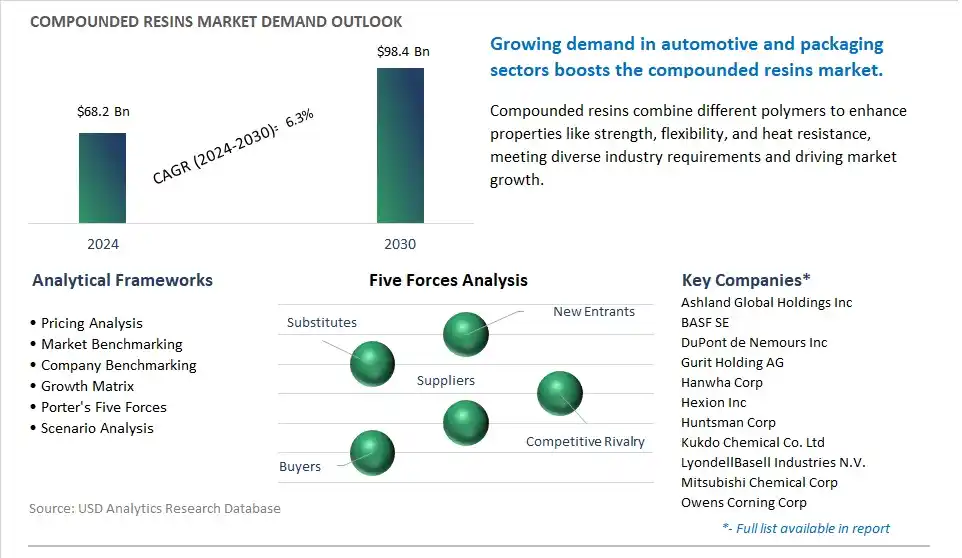
The market report analyses the leading companies in the industry including Ashland Global Holdings Inc, BASF SE, DuPont de Nemours Inc, Gurit Holding AG, Hanwha Corp, Hexion Inc, Huntsman Corp, Kukdo Chemical Co. Ltd, LyondellBasell Industries N.V., Mitsubishi Chemical Corp, Owens Corning Corp, Royal DSM N.V., RTP Company, Saudi Basic Industries Corp (SABIC), Scott Bader Company Ltd, Sicomin SAS, Solvay SA, Sumitomo Bakelite Co. Ltd.
In the Compounded Resins market, a prominent trend is the growing demand for customized resin formulations. With increasing complexity in end-user applications and requirements for specific performance attributes, there's a rising need for compounded resins that are tailored to meet precise performance, processing, and application requirements. This trend is driven by factors such as advancements in polymer science, technological innovation in compounding processes, and the desire for enhanced material properties such as strength, flexibility, and heat resistance. As industries such as automotive, electronics, and packaging demand higher-performance materials, there's a growing market demand for compounded resins that offer customization options, specialized additives, and tailored properties, driving innovation and adoption in the compounded resins market.
A significant driver in the Compounded Resins market is the growth in manufacturing and industrial applications. With expansion in sectors such as automotive, construction, consumer goods, and electronics manufacturing, there's a robust demand for high-performance materials to meet stringent performance, regulatory, and cost requirements. This driver is fueled by factors such as population growth, urbanization, infrastructure development, and technological advancements driving product innovation and process efficiency. As manufacturers seek to improve product quality, reduce production costs, and enhance product differentiation, there's a corresponding market demand for compounded resins that offer superior mechanical properties, processing characteristics, and end-use performance, driving growth and investment in the compounded resins industry.
A promising opportunity within the Compounded Resins market lies in the development of specialty compounded resins for emerging applications and industries. Opportunities exist in researching and commercializing resins tailored for specific niche markets such as 3D printing, medical devices, renewable energy, and aerospace. These specialty resins may offer unique properties such as biodegradability, conductivity, flame retardancy, or bio-compatibility, addressing unmet needs and enabling innovation in diverse sectors. By focusing on the development of specialty compounded resins, manufacturers can differentiate themselves in the market, target high-growth segments, and capitalize on new opportunities arising from technological advancements and evolving market trends.
The largest segment in the Compounded Resins Market is the Epoxy Resin segment. This dominance is. epoxy resins are widely used in various industries due to their exceptional mechanical properties, excellent adhesion, chemical resistance, thermal stability, and versatility in formulation. Epoxy resins can be compounded with various additives, fillers, and modifiers to tailor their properties for specific applications, making them suitable for a wide range of end-use industries such as construction, automotive, aerospace, electronics, and coatings. Additionally, epoxy resins offer superior bonding strength and durability, making them ideal for structural adhesives, composite materials, protective coatings, and electrical encapsulation applications. Further, epoxy resins exhibit excellent curing characteristics, allowing for rapid curing at room temperature or elevated temperatures, which enhances productivity and reduces processing time in manufacturing operations. Furthermore, epoxy resins can be formulated as solvent-based, water-based, or powder coatings, providing flexibility and compatibility with different application methods and environmental requirements. Additionally, epoxy resins are known for their exceptional chemical resistance to solvents, acids, alkalis, and other harsh chemicals, making them suitable for demanding industrial applications such as chemical processing, oil and gas, marine, and automotive coatings. Furthermore, advancements in epoxy resin technology, such as low-VOC formulations, bio-based alternatives, and high-performance additives, continue to drive innovation and market growth in the Compounded Resins Market. These advancements address environmental concerns, regulatory requirements, and industry trends toward sustainability, safety, and performance enhancement. Additionally, epoxy resins are preferred in high-performance applications where reliability, durability, and long-term performance are critical, further reinforcing their dominance in the Compounded Resins Market. Therefore, the Epoxy Resin segment remains the largest in the Compounded Resins Market due to its superior properties, versatility, wide range of applications, and continuous technological advancements driving innovation and market expansion.
The fastest-growing segment in the Compounded Resins Market is the Aerospace application segment. The aerospace industry demands high-performance materials with exceptional mechanical properties, lightweight characteristics, and resistance to harsh environmental conditions to meet stringent safety, reliability, and performance requirements. Compounded resins, particularly advanced composite materials reinforced with fibers such as carbon fiber or glass fiber, offer superior strength-to-weight ratios, impact resistance, fatigue resistance, and corrosion resistance compared to traditional metallic materials, making them ideal for aerospace applications. Additionally, compounded resins provide design flexibility, allowing for the fabrication of complex shapes and structures while reducing overall weight, which is critical for improving fuel efficiency and reducing emissions in aerospace vehicles. Further, compounded resins offer thermal stability and flame retardancy properties, essential for aerospace applications where materials must withstand extreme temperatures and meet strict fire safety regulations. Furthermore, the increasing demand for commercial aircraft, military aircraft, unmanned aerial vehicles (UAVs), and space exploration vehicles drives the growth of compounded resins in the aerospace sector. With the rising demand for air travel, the expansion of commercial airline fleets, and the development of next-generation aircraft platforms, there is a growing need for lightweight, durable, and high-performance materials to enhance aircraft performance, fuel efficiency, and passenger comfort. Additionally, the aerospace industry is increasingly adopting composite materials for various applications such as fuselage structures, wings, empennage, interior components, and engine components to reduce overall weight, improve aerodynamics, and enhance operational efficiency. Furthermore, advancements in composite manufacturing processes, such as resin transfer molding (RTM), compression molding, and additive manufacturing, enable the production of complex aerospace components with tighter tolerances, reduced waste, and improved cost-effectiveness, further driving the adoption of compounded resins in the aerospace sector. Therefore, the Aerospace application segment presents significant growth opportunities in the Compounded Resins Market, driven by the aerospace industry's need for lightweight, high-performance materials to meet safety, efficiency, and sustainability goals in aircraft design and manufacturing.
By Type
Epoxy Resin
Unsaturated Polyester Resin
Phenolic Resin
Others
By Application
Automotive
Building & Construction
Aerospace
Others
Regions Included
North America (US, Canada, Mexico)
Europe (Germany, UK, France, Spain, Italy, Russia, Rest of Europe)
Asia Pacific (China, India, Japan, South Korea, Australia, South East Asia, Rest of Asia)
South America (Brazil, Argentina, Rest of South America)
Middle East and Africa (Saudi Arabia, UAE, Rest of Middle East, South Africa, Egypt, Rest of Africa)
Ashland Global Holdings Inc
BASF SE
DuPont de Nemours Inc
Gurit Holding AG
Hanwha Corp
Hexion Inc
Huntsman Corp
Kukdo Chemical Co. Ltd
LyondellBasell Industries N.V.
Mitsubishi Chemical Corp
Owens Corning Corp
Royal DSM N.V.
RTP Company
Saudi Basic Industries Corp (SABIC)
Scott Bader Company Ltd
Sicomin SAS
Solvay SA
Sumitomo Bakelite Co. Ltd
*- List Not Exhaustive
TABLE OF CONTENTS
1 Introduction to 2024 Compounded Resins Market
1.1 Market Overview
1.2 Quick Facts
1.3 Scope/Objective of the Study
1.4 Market Definition
1.5 Countries and Regions Covered
1.6 Units, Currency, and Conversions
1.7 Industry Value Chain
2 Research Methodology
2.1 Market Size Estimation
2.2 Sources and Research Methodology
2.3 Data Triangulation
2.4 Assumptions and Limitations
3 Executive Summary
3.1 Global Compounded Resins Market Size Outlook, $ Million, 2021 to 2030
3.2 Compounded Resins Market Outlook by Type, $ Million, 2021 to 2030
3.3 Compounded Resins Market Outlook by Product, $ Million, 2021 to 2030
3.4 Compounded Resins Market Outlook by Application, $ Million, 2021 to 2030
3.5 Compounded Resins Market Outlook by Key Countries, $ Million, 2021 to 2030
4 Market Dynamics
4.1 Key Driving Forces of Compounded Resins Industry
4.2 Key Market Trends in Compounded Resins Industry
4.3 Potential Opportunities in Compounded Resins Industry
4.4 Key Challenges in Compounded Resins Industry
5 Market Factor Analysis
5.1 Value Chain Analysis
5.2 Competitive Landscape
5.2.1 Global Compounded Resins Market Share by Company (%), 2023
5.2.2 Product Offerings by Company
5.3 Porter’s Five Forces Analysis
5.4 Pricing Analysis and Outlook
6 Growth Outlook Across Scenarios
6.1 Growth Analysis-Case Scenario Definitions
6.2 Low Growth Scenario Forecasts
6.3 Reference Growth Scenario Forecasts
6.4 High Growth Scenario Forecasts
7 Global Compounded Resins Market Outlook by Segments
7.1 Compounded Resins Market Outlook by Segments, $ Million, 2021- 2030
By Type
Epoxy Resin
Unsaturated Polyester Resin
Phenolic Resin
Others
By Application
Automotive
Building & Construction
Aerospace
Others
8 North America Compounded Resins Market Analysis and Outlook To 2030
8.1 Introduction to North America Compounded Resins Markets in 2024
8.2 North America Compounded Resins Market Size Outlook by Country, 2021-2030
8.2.1 United States
8.2.2 Canada
8.2.3 Mexico
8.3 North America Compounded Resins Market size Outlook by Segments, 2021-2030
By Type
Epoxy Resin
Unsaturated Polyester Resin
Phenolic Resin
Others
By Application
Automotive
Building & Construction
Aerospace
Others
9 Europe Compounded Resins Market Analysis and Outlook To 2030
9.1 Introduction to Europe Compounded Resins Markets in 2024
9.2 Europe Compounded Resins Market Size Outlook by Country, 2021-2030
9.2.1 Germany
9.2.2 France
9.2.3 Spain
9.2.4 United Kingdom
9.2.4 Italy
9.2.5 Russia
9.2.6 Norway
9.2.7 Rest of Europe
9.3 Europe Compounded Resins Market Size Outlook by Segments, 2021-2030
By Type
Epoxy Resin
Unsaturated Polyester Resin
Phenolic Resin
Others
By Application
Automotive
Building & Construction
Aerospace
Others
10 Asia Pacific Compounded Resins Market Analysis and Outlook To 2030
10.1 Introduction to Asia Pacific Compounded Resins Markets in 2024
10.2 Asia Pacific Compounded Resins Market Size Outlook by Country, 2021-2030
10.2.1 China
10.2.2 India
10.2.3 Japan
10.2.4 South Korea
10.2.5 Indonesia
10.2.6 Malaysia
10.2.7 Australia
10.2.8 Rest of Asia Pacific
10.3 Asia Pacific Compounded Resins Market size Outlook by Segments, 2021-2030
By Type
Epoxy Resin
Unsaturated Polyester Resin
Phenolic Resin
Others
By Application
Automotive
Building & Construction
Aerospace
Others
11 South America Compounded Resins Market Analysis and Outlook To 2030
11.1 Introduction to South America Compounded Resins Markets in 2024
11.2 South America Compounded Resins Market Size Outlook by Country, 2021-2030
11.2.1 Brazil
11.2.2 Argentina
11.2.3 Rest of South America
11.3 South America Compounded Resins Market size Outlook by Segments, 2021-2030
By Type
Epoxy Resin
Unsaturated Polyester Resin
Phenolic Resin
Others
By Application
Automotive
Building & Construction
Aerospace
Others
12 Middle East and Africa Compounded Resins Market Analysis and Outlook To 2030
12.1 Introduction to Middle East and Africa Compounded Resins Markets in 2024
12.2 Middle East and Africa Compounded Resins Market Size Outlook by Country, 2021-2030
12.2.1 Saudi Arabia
12.2.2 UAE
12.2.3 Oman
12.2.4 Rest of Middle East
12.2.5 Egypt
12.2.6 Nigeria
12.2.7 South Africa
12.2.8 Rest of Africa
12.3 Middle East and Africa Compounded Resins Market size Outlook by Segments, 2021-2030
By Type
Epoxy Resin
Unsaturated Polyester Resin
Phenolic Resin
Others
By Application
Automotive
Building & Construction
Aerospace
Others
13 Company Profiles
13.1 Company Snapshot
13.2 SWOT Profiles
13.3 Products and Services
13.4 Recent Developments
13.5 Financial Profile
Ashland Global Holdings Inc
BASF SE
DuPont de Nemours Inc
Gurit Holding AG
Hanwha Corp
Hexion Inc
Huntsman Corp
Kukdo Chemical Co. Ltd
LyondellBasell Industries N.V.
Mitsubishi Chemical Corp
Owens Corning Corp
Royal DSM N.V.
RTP Company
Saudi Basic Industries Corp (SABIC)
Scott Bader Company Ltd
Sicomin SAS
Solvay SA
Sumitomo Bakelite Co. Ltd
14 Appendix
14.1 Customization Offerings
14.2 Subscription Services
14.3 Related Reports
14.4 Publisher Expertise
By Type
Epoxy Resin
Unsaturated Polyester Resin
Phenolic Resin
Others
By Application
Automotive
Building & Construction
Aerospace
Others
Countries Analyzed
North America (US, Canada, Mexico)
Europe (Germany, UK, France, Spain, Italy, Russia, Rest of Europe)
Asia Pacific (China, India, Japan, South Korea, Australia, South East Asia, Rest of Asia)
South America (Brazil, Argentina, Rest of South America)
Middle East and Africa (Saudi Arabia, UAE, Rest of Middle East, South Africa, Egypt, Rest of Africa)
Global Compounded Resins is forecast to reach $98.4 Billion in 2030 from $68.2 Billion in 2024, registering a CAGR of 6.3%
Emerging Markets across Asia Pacific, Europe, and Americas present robust growth prospects.
Ashland Global Holdings Inc, BASF SE, DuPont de Nemours Inc, Gurit Holding AG, Hanwha Corp, Hexion Inc, Huntsman Corp, Kukdo Chemical Co. Ltd, LyondellBasell Industries N.V., Mitsubishi Chemical Corp, Owens Corning Corp, Royal DSM N.V., RTP Company, Saudi Basic Industries Corp (SABIC), Scott Bader Company Ltd, Sicomin SAS, Solvay SA, Sumitomo Bakelite Co. Ltd
Base Year- 2023; Estimated Year- 2024; Historic Period- 2018-2023; Forecast period- 2024 to 2030; Currency: Revenue (USD); Volume