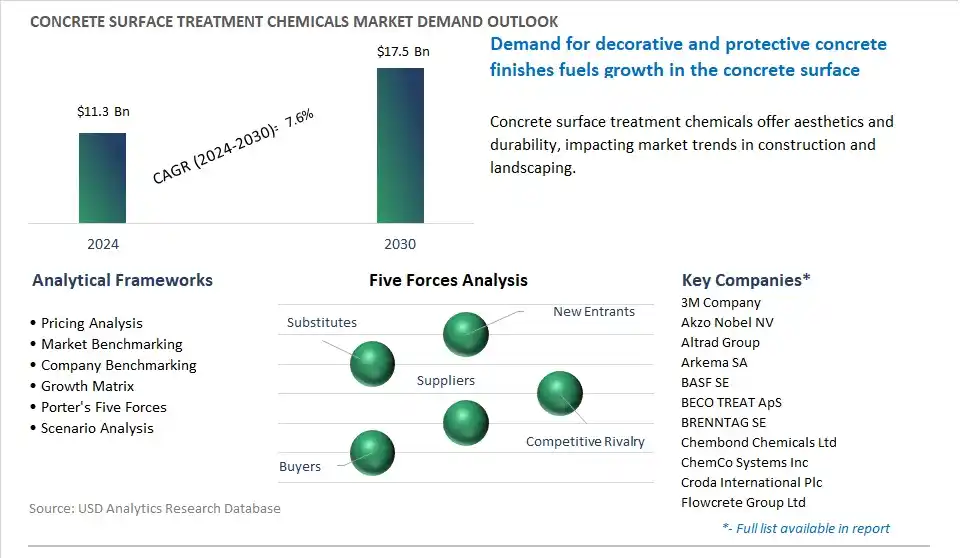
The global Concrete Surface Treatment Chemicals Market is poised to register a 7.6% CAGR from $11.3 Billion in 2024 to $17.5 Billion in 2030.
The global Concrete Surface Treatment Chemicals Market Study analyzes and forecasts the market size across 6 regions and 24 countries for diverse segments -By Application (Non-residential, Residential), By Product (Mold release agents, Curing compounds, Sealants).
An Introduction to Global Concrete Surface Treatment Chemicals Market in 2024
The concrete surface treatment chemicals market is experiencing growth driven by the increasing demand for concrete protection, durability enhancement, and aesthetics improvement in construction projects. Key trends shaping the future of the industry include innovations in surface treatment chemicals, curing compounds, sealers, and decorative coatings to address specific performance requirements and project specifications. Advanced concrete surface treatment chemicals offer solutions for various concrete surfaces, including floors, walls, pavements, and bridges, providing protection against abrasion, chemical attack, moisture ingress, and UV degradation. Moreover, the integration of nanotechnology, self-healing agents, and hydrophobic coatings enhances surface properties, prolongs service life, and reduces maintenance costs for concrete structures. Additionally, the growing trend towards decorative concrete finishes, stamped concrete, and exposed aggregate surfaces drives market demand for surface treatment chemicals that offer customization options, color enhancement, and architectural aesthetics. As architects, engineers, and contractors seek to enhance the durability, functionality, and visual appeal of concrete structures, the concrete surface treatment chemicals market is poised for continued growth and innovation as a key enabler of modern construction practices and infrastructure development.
Concrete Surface Treatment Chemicals Market Competitive Landscape
The market report analyses the leading companies in the industry including 3M Company, Akzo Nobel NV, Altrad Group, Arkema SA, BASF SE, BECO TREAT ApS, BRENNTAG SE, Chembond Chemicals Ltd, ChemCo Systems Inc, Croda International Plc, Flowcrete Group Ltd, Fosroc International Ltd, Henkel AG and Co. KGaA, LATICRETE International Inc, Lion Specialty Chemicals Co. Ltd.
Concrete Surface Treatment Chemicals Market Dynamics
Concrete Surface Treatment Chemicals Market Trend: Demand for Decorative and Protective Concrete Finishes
The most prominent trend in the concrete surface treatment chemicals market is the increasing demand for decorative and protective concrete finishes, driven by the growing construction industry, urbanization, and architectural trends favoring aesthetically pleasing and durable building materials. Concrete surface treatment chemicals, including sealers, stains, coatings, and decorative overlays, are utilized to enhance the appearance, durability, and performance of concrete surfaces in both residential and commercial applications. With the rise of decorative concrete flooring, stamped concrete patios, and architectural concrete elements, there's a growing need for surface treatment chemicals that offer a wide range of decorative effects, colors, textures, and protective properties, driving market growth and innovation in concrete surface treatment solutions.
Concrete Surface Treatment Chemicals Market Driver: Infrastructure Rehabilitation and Maintenance
A key driver in the concrete surface treatment chemicals market is the demand for infrastructure rehabilitation and maintenance, spurred by aging infrastructure, urbanization, and the need to extend the service life of concrete structures. As existing concrete infrastructure such as bridges, highways, parking structures, and industrial facilities deteriorate over time due to environmental factors, traffic loads, and chemical exposure, there's a growing need for surface treatment chemicals that can repair, protect, and enhance the performance of concrete surfaces. Concrete surface treatments, such as concrete sealers, waterproofing coatings, and corrosion inhibitors, play a critical role in preventing deterioration, reducing maintenance costs, and extending the lifespan of infrastructure assets, driving market demand and investment in concrete surface treatment solutions for infrastructure maintenance and rehabilitation projects.
Concrete Surface Treatment Chemicals Market Opportunity: Development of Environmentally Friendly Formulations
The concrete surface treatment chemicals market presents a potential opportunity for the development of environmentally friendly formulations, addressing concerns over environmental impact, health hazards, and regulatory compliance. Manufacturers can capitalize on this opportunity by innovating concrete surface treatment chemicals that are low in volatile organic compounds (VOCs), free from hazardous chemicals, and compliant with environmental regulations and green building standards. Additionally, incorporating sustainable materials such as bio-based polymers, water-based formulations, and recycled aggregates into surface treatment products can further enhance their eco-friendliness and appeal to environmentally conscious customers. By offering environmentally friendly surface treatment chemicals, manufacturers can differentiate their products, meet sustainability requirements, and capture market share in the growing green building and construction industry, driving growth and competitiveness in the concrete surface treatment chemicals market.
Concrete Surface Treatment Chemicals Market Share Analysis: Non-residential Sector segment generated the highest revenue in the industry
The non-residential sector is the largest segment in the Concrete Surface Treatment Chemicals Market. This can be attributed to the extensive use of concrete surface treatment chemicals in various non-residential applications such as commercial buildings, industrial facilities, infrastructure projects, and public spaces. Non-residential constructions often require specialized concrete surface treatments to meet specific performance criteria such as durability, abrasion resistance, chemical resistance, and aesthetic appeal. Concrete surface treatment chemicals play a crucial role in enhancing the longevity and performance of concrete structures in non-residential settings, thereby driving their widespread adoption. In addition, the increasing investment in infrastructure development, coupled with the growing demand for sustainable construction practices, further amplifies the use of concrete surface treatment chemicals in non-residential projects. As urbanization accelerates and non-residential construction activities proliferate globally, the demand for these chemicals is expected to continue its upward trajectory, consolidating the non-residential sector's position as the largest segment in the Concrete Surface Treatment Chemicals Market.
Concrete Surface Treatment Chemicals Market Share Analysis: Sealants Segment is poised to register the fastest growth rate (CAGR) over the forecast period to 2030
Sealants stand out as the fastest-growing segment in the Concrete Surface Treatment Chemicals Market. This growth can be attributed to the increasing emphasis on enhancing the durability, sustainability, and aesthetics of concrete structures across various industries. Sealants play a crucial role in protecting concrete surfaces from moisture ingress, chemical attack, UV radiation, and other environmental factors, thereby extending their service life and minimizing maintenance costs. With the rising awareness regarding the importance of preserving infrastructure assets and minimizing environmental impact, there is a growing demand for high-performance sealants that offer long-lasting protection and are compatible with sustainable construction practices. Additionally, the proliferation of construction activities in sectors such as transportation, industrial, and commercial, where sealants are indispensable for ensuring structural integrity and safety, further drives the demand for these products. As regulatory requirements become more stringent and the focus on sustainable infrastructure intensifies, the adoption of sealants in the Concrete Surface Treatment Chemicals Market is expected to continue its rapid ascent, positioning it as the fastest-growing segment in the industry.
Concrete Surface Treatment Chemicals Market Report Segmentation
By Application
Non-residential
Residential
By Product
Mold release agents
Curing compounds
Sealants
Regions Included
North America (US, Canada, Mexico)
Europe (Germany, UK, France, Spain, Italy, Russia, Rest of Europe)
Asia Pacific (China, India, Japan, South Korea, Australia, South East Asia, Rest of Asia)
South America (Brazil, Argentina, Rest of South America)
Middle East and Africa (Saudi Arabia, UAE, Rest of Middle East, South Africa, Egypt, Rest of Africa)
Concrete Surface Treatment Chemicals Companies Profiled in the Market Study
3M Company
Akzo Nobel NV
Altrad Group
Arkema SA
BASF SE
BECO TREAT ApS
BRENNTAG SE
Chembond Chemicals Ltd
ChemCo Systems Inc
Croda International Plc
Flowcrete Group Ltd
Fosroc International Ltd
Henkel AG and Co. KGaA
LATICRETE International Inc
Lion Specialty Chemicals Co. Ltd
*- List Not Exhaustive
TABLE OF CONTENTS
1 Introduction to 2024 Concrete Surface Treatment Chemicals Market
1.1 Market Overview
1.2 Quick Facts
1.3 Scope/Objective of the Study
1.4 Market Definition
1.5 Countries and Regions Covered
1.6 Units, Currency, and Conversions
1.7 Industry Value Chain
2 Research Methodology
2.1 Market Size Estimation
2.2 Sources and Research Methodology
2.3 Data Triangulation
2.4 Assumptions and Limitations
3 Executive Summary
3.1 Global Concrete Surface Treatment Chemicals Market Size Outlook, $ Million, 2021 to 2030
3.2 Concrete Surface Treatment Chemicals Market Outlook by Type, $ Million, 2021 to 2030
3.3 Concrete Surface Treatment Chemicals Market Outlook by Product, $ Million, 2021 to 2030
3.4 Concrete Surface Treatment Chemicals Market Outlook by Application, $ Million, 2021 to 2030
3.5 Concrete Surface Treatment Chemicals Market Outlook by Key Countries, $ Million, 2021 to 2030
4 Market Dynamics
4.1 Key Driving Forces of Concrete Surface Treatment Chemicals Industry
4.2 Key Market Trends in Concrete Surface Treatment Chemicals Industry
4.3 Potential Opportunities in Concrete Surface Treatment Chemicals Industry
4.4 Key Challenges in Concrete Surface Treatment Chemicals Industry
5 Market Factor Analysis
5.1 Value Chain Analysis
5.2 Competitive Landscape
5.2.1 Global Concrete Surface Treatment Chemicals Market Share by Company (%), 2023
5.2.2 Product Offerings by Company
5.3 Porter’s Five Forces Analysis
5.4 Pricing Analysis and Outlook
6 Growth Outlook Across Scenarios
6.1 Growth Analysis-Case Scenario Definitions
6.2 Low Growth Scenario Forecasts
6.3 Reference Growth Scenario Forecasts
6.4 High Growth Scenario Forecasts
7 Global Concrete Surface Treatment Chemicals Market Outlook by Segments
7.1 Concrete Surface Treatment Chemicals Market Outlook by Segments, $ Million, 2021- 2030
By Application
Non-residential
Residential
By Product
Mold release agents
Curing compounds
Sealants
8 North America Concrete Surface Treatment Chemicals Market Analysis and Outlook To 2030
8.1 Introduction to North America Concrete Surface Treatment Chemicals Markets in 2024
8.2 North America Concrete Surface Treatment Chemicals Market Size Outlook by Country, 2021-2030
8.2.1 United States
8.2.2 Canada
8.2.3 Mexico
8.3 North America Concrete Surface Treatment Chemicals Market size Outlook by Segments, 2021-2030
By Application
Non-residential
Residential
By Product
Mold release agents
Curing compounds
Sealants
9 Europe Concrete Surface Treatment Chemicals Market Analysis and Outlook To 2030
9.1 Introduction to Europe Concrete Surface Treatment Chemicals Markets in 2024
9.2 Europe Concrete Surface Treatment Chemicals Market Size Outlook by Country, 2021-2030
9.2.1 Germany
9.2.2 France
9.2.3 Spain
9.2.4 United Kingdom
9.2.4 Italy
9.2.5 Russia
9.2.6 Norway
9.2.7 Rest of Europe
9.3 Europe Concrete Surface Treatment Chemicals Market Size Outlook by Segments, 2021-2030
By Application
Non-residential
Residential
By Product
Mold release agents
Curing compounds
Sealants
10 Asia Pacific Concrete Surface Treatment Chemicals Market Analysis and Outlook To 2030
10.1 Introduction to Asia Pacific Concrete Surface Treatment Chemicals Markets in 2024
10.2 Asia Pacific Concrete Surface Treatment Chemicals Market Size Outlook by Country, 2021-2030
10.2.1 China
10.2.2 India
10.2.3 Japan
10.2.4 South Korea
10.2.5 Indonesia
10.2.6 Malaysia
10.2.7 Australia
10.2.8 Rest of Asia Pacific
10.3 Asia Pacific Concrete Surface Treatment Chemicals Market size Outlook by Segments, 2021-2030
By Application
Non-residential
Residential
By Product
Mold release agents
Curing compounds
Sealants
11 South America Concrete Surface Treatment Chemicals Market Analysis and Outlook To 2030
11.1 Introduction to South America Concrete Surface Treatment Chemicals Markets in 2024
11.2 South America Concrete Surface Treatment Chemicals Market Size Outlook by Country, 2021-2030
11.2.1 Brazil
11.2.2 Argentina
11.2.3 Rest of South America
11.3 South America Concrete Surface Treatment Chemicals Market size Outlook by Segments, 2021-2030
By Application
Non-residential
Residential
By Product
Mold release agents
Curing compounds
Sealants
12 Middle East and Africa Concrete Surface Treatment Chemicals Market Analysis and Outlook To 2030
12.1 Introduction to Middle East and Africa Concrete Surface Treatment Chemicals Markets in 2024
12.2 Middle East and Africa Concrete Surface Treatment Chemicals Market Size Outlook by Country, 2021-2030
12.2.1 Saudi Arabia
12.2.2 UAE
12.2.3 Oman
12.2.4 Rest of Middle East
12.2.5 Egypt
12.2.6 Nigeria
12.2.7 South Africa
12.2.8 Rest of Africa
12.3 Middle East and Africa Concrete Surface Treatment Chemicals Market size Outlook by Segments, 2021-2030
By Application
Non-residential
Residential
By Product
Mold release agents
Curing compounds
Sealants
13 Company Profiles
13.1 Company Snapshot
13.2 SWOT Profiles
13.3 Products and Services
13.4 Recent Developments
13.5 Financial Profile
3M Company
Akzo Nobel NV
Altrad Group
Arkema SA
BASF SE
BECO TREAT ApS
BRENNTAG SE
Chembond Chemicals Ltd
ChemCo Systems Inc
Croda International Plc
Flowcrete Group Ltd
Fosroc International Ltd
Henkel AG and Co. KGaA
LATICRETE International Inc
Lion Specialty Chemicals Co. Ltd
14 Appendix
14.1 Customization Offerings
14.2 Subscription Services
14.3 Related Reports
14.4 Publisher Expertise
By Application
Non-residential
Residential
By Product
Mold release agents
Curing compounds
Sealants
Countries Analyzed
North America (US, Canada, Mexico)
Europe (Germany, UK, France, Spain, Italy, Russia, Rest of Europe)
Asia Pacific (China, India, Japan, South Korea, Australia, South East Asia, Rest of Asia)
South America (Brazil, Argentina, Rest of South America)
Middle East and Africa (Saudi Arabia, UAE, Rest of Middle East, South Africa, Egypt, Rest of Africa)
