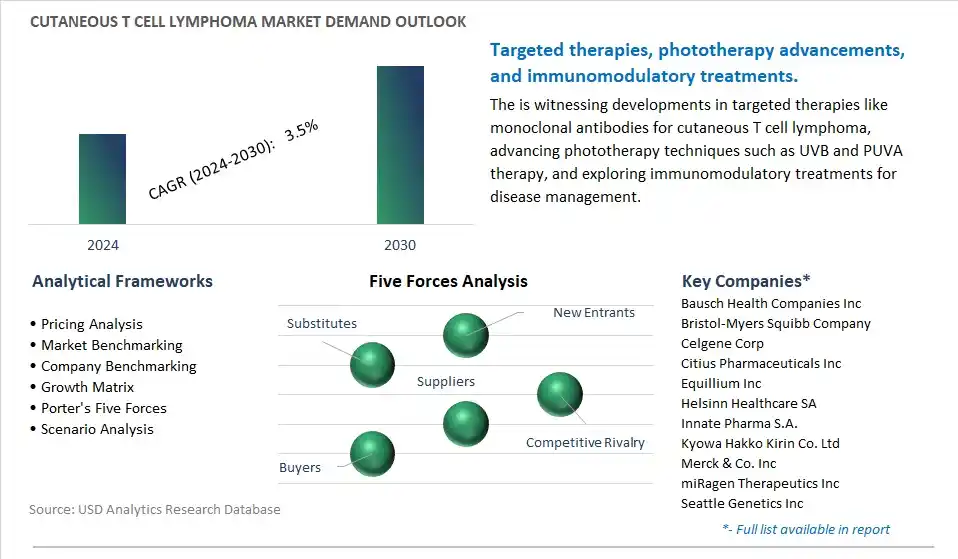
Cutaneous T cell Lymphoma Market is estimated to increase at a Compounded Annual Growth Rate of 3.5% CAGR over the forecast period from 2024 to 2030
The Cutaneous T cell Lymphoma Market study analyzes and forecasts the market size across 6 regions and 24 countries for diverse segments- By Type (Mycosis Fungoides (MF), Sezary Syndrome (SS), Others), By Treatment (Radiation Therapy, Chemotherapy, Immunotherapy, Targeted therapy, Others).
An Introduction to Cutaneous T cell Lymphoma Market in 2024
In 2024, the market for cutaneous T-cell lymphoma (CTCL) addresses the diagnostic and therapeutic needs of patients with rare and heterogeneous lymphoproliferative disorders affecting the skin, offering a comprehensive range of diagnostic tests, imaging modalities, and targeted therapies for disease management and personalized treatment. CTCL encompasses a spectrum of rare non-Hodgkin lymphomas characterized by the proliferation of malignant T-cells in the skin, presenting with various clinical manifestations such as patches, plaques, tumors, and erythroderma. Diagnostic approaches for CTCL include skin biopsies, immunohistochemistry, flow cytometry, and molecular genetic testing to establish accurate diagnosis, subtype classification, and disease staging for guiding treatment decisions. Therapeutic options for CTCL include topical treatments, phototherapy, systemic therapies, and immunomodulatory agents tailored to disease severity, extent of involvement, and individual patient factors to achieve disease control and improve quality of life. With a focus on multidisciplinary care, patient education, and supportive care interventions, the CTCL market aims to optimize treatment outcomes, alleviate symptoms, and enhance patient well-being in individuals affected by these rare and challenging malignancies. Moreover, with advancements in targeted therapies, immunotherapy, and precision medicine approaches, the CTCL market supports ongoing research efforts and clinical trials aimed at developing novel treatment strategies and improving long-term outcomes for patients with CTCL.
Market Trend: Advancements in Targeted Therapies and Immunotherapy
A significant trend in the Cutaneous T cell Lymphoma (CTCL) market is the advancements in targeted therapies and immunotherapy. With increasing understanding of the molecular mechanisms underlying CTCL and the immune system's role in cancer surveillance and control, there's a growing focus on developing targeted therapies and immunomodulatory agents for CTCL treatment. Targeted therapies, such as monoclonal antibodies and small molecule inhibitors, specifically target molecular pathways implicated in CTCL pathogenesis, offering improved efficacy and reduced toxicity compared to conventional chemotherapy. Immunotherapy approaches, including immune checkpoint inhibitors and adoptive T cell therapy, harness the body's immune system to recognize and eliminate cancer cells, leading to durable responses and improved patient outcomes. This trend towards advancements in targeted therapies and immunotherapy reflects a paradigm shift in CTCL treatment towards personalized and precision medicine approaches, offering new hope for patients with this rare and challenging malignancy.
Market Driver: Increasing Incidence and Prevalence of CTCL
An important driver fueling the Cutaneous T cell Lymphoma (CTCL) market is the increasing incidence and prevalence of CTCL. CTCL encompasses a heterogeneous group of rare lymphoproliferative disorders characterized by the infiltration of malignant T cells into the skin, resulting in cutaneous manifestations such as patches, plaques, and tumors. While CTCL represents a small fraction of all lymphomas, its incidence and prevalence have been steadily rising over the past few decades, posing significant challenges for healthcare systems worldwide. Factors contributing to the increasing burden of CTCL include aging populations, environmental exposures, genetic predisposition, and improved diagnostic techniques. The growing incidence and prevalence of CTCL underscore the urgent need for effective treatment options and innovative therapeutic strategies to address the unmet medical needs of patients with this rare and often debilitating disease.
Market Opportunity: Development of Novel Therapeutic Agents and Combination Therapies
A significant opportunity within the Cutaneous T cell Lymphoma (CTCL) market lies in the development of novel therapeutic agents and combination therapies. Despite recent advancements in CTCL treatment, there remains a critical need for more effective and well-tolerated therapies, particularly for advanced-stage or refractory disease. Opportunities exist for pharmaceutical companies and biotechnology firms to invest in research and development initiatives focused on discovering and developing novel therapeutic agents targeting unique molecular pathways and immune checkpoints implicated in CTCL pathogenesis. Additionally, there's potential for exploring combination therapies that synergistically target multiple signaling pathways or modulate the tumor microenvironment to enhance anti-tumor immune responses and overcome treatment resistance. By capitalizing on the opportunity to develop innovative therapeutic agents and combination therapies, stakeholders in the CTCL market can address unmet medical needs, improve patient outcomes, and contribute to advancements in the management of this rare and challenging malignancy.
Cutaneous T-cell Lymphoma Market Share Analysis: Immunotherapy
Among the various treatments for cutaneous T-cell lymphoma (CTCL), immunotherapy is experiencing the fastest growth. Immunotherapy involves the use of medications or substances to stimulate the body's immune system to recognize and destroy cancer cells. The rapid growth of immunotherapy in the CTCL market can be attributed to several factors. Firstly, there has been a paradigm shift in cancer treatment towards immunotherapy, driven by its potential for durable responses and fewer side effects compared to traditional treatments like chemotherapy and radiation therapy. Immunotherapy agents, such as immune checkpoint inhibitors and monoclonal antibodies, target specific molecules on cancer cells or immune cells, enhancing the immune system's ability to recognize and eliminate cancer cells. Secondly, clinical trials and real-world evidence have demonstrated the efficacy of immunotherapy in treating CTCL, particularly in patients with refractory or relapsed disease. Immunotherapeutic agents, such as programmed cell death protein 1 (PD-1) inhibitors and anti-CD30 antibodies, have shown promising results in inducing durable responses and improving overall survival in CTCL patients. Additionally, immunotherapy offers the advantage of systemic treatment, targeting both cutaneous and systemic manifestations of CTCL, which is particularly beneficial for patients with advanced or disseminated disease. Furthermore, ongoing research and development efforts are focused on optimizing immunotherapy approaches for CTCL, including combination therapies and novel immunomodulatory agents. Combination regimens incorporating immunotherapy with other treatment modalities, such as chemotherapy or targeted therapy, aim to enhance treatment efficacy and overcome resistance mechanisms in CTCL. Moreover, advancements in biomarker identification and patient stratification help identify responders to immunotherapy, enabling personalized treatment approaches in CTCL management. As a result, immunotherapy emerges as the fastest growing treatment in the cutaneous T-cell lymphoma market, offering significant opportunities for pharmaceutical companies, clinicians, and patients seeking innovative and effective therapies for CTCL.
Cutaneous T cell Lymphoma Competitive Analysis
The market research study provides in-depth insights into leading companies including the SWOT analyses, product profile, financial details, and recent developments acrossBausch Health Companies Inc, Bristol-Myers Squibb Company, Celgene Corp, Citius Pharmaceuticals Inc, Equillium Inc, Helsinn Healthcare SA, Innate Pharma S.A., Kyowa Hakko Kirin Co. Ltd, Merck & Co. Inc, miRagen Therapeutics Inc, Seattle Genetics Inc, Soligenix Inc
Cutaneous T cell Lymphoma Market Segmentation
By Type
Mycosis Fungoides (MF)
Sezary Syndrome (SS)
Others
By Treatment
Radiation Therapy
Chemotherapy
Immunotherapy
Targeted therapy
Others
Geographical Analysis
North America (United States, Canada, Mexico)
Europe (Germany, France, United Kingdom, Spain, Italy, Rest of Europe)
Asia Pacific (China, India, Japan, South Korea, Rest of Asia Pacific)
South America (Brazil, Argentina, Rest of South America)
Middle East and Africa (Saudi Arabia, UAE, Rest of Middle East, South Africa, Egypt, Rest of Africa)
Cutaneous T cell Lymphoma Market Companies
Bausch Health Companies Inc
Bristol-Myers Squibb Company
Celgene Corp
Citius Pharmaceuticals Inc
Equillium Inc
Helsinn Healthcare SA
Innate Pharma S.A.
Kyowa Hakko Kirin Co. Ltd
Merck & Co. Inc
miRagen Therapeutics Inc
Seattle Genetics Inc
Soligenix Inc
Reasons to Buy the Cutaneous T cell Lymphoma Market Study
• Deepen your industry insights and navigate uncertainties for strategy formulation, CAPEX, and Operational decisions
• Gain access to detailed insights on the Cutaneous T cell Lymphoma Market, encompassing current market size, growth trends, and forecasts till 2030.
• Access detailed competitor analysis, enabling competitive advantage through a thorough understanding of market players, strategies, and potential differentiation opportunities
• Stay ahead of the curve with insights on technological advancements, innovations, and upcoming trends
• Identify lucrative investment avenues and expansion opportunities within the Cutaneous T cell Lymphoma Market industry, guided by robust, data-backed analysis.
• Understand regional and global markets through country-wise analysis, regional market potential, regulatory nuances, and dynamics
• Execute strategies with confidence and speed through information, analytics, and insights on the industry value chain
• Corporate leaders, strategists, financial experts, shareholders, asset managers, and governmental representatives can make long-term planning scenarios and build an integrated and timely understanding of market dynamics
• Benefit from tailored solutions and expert consultation based on report insights, providing personalized strategies aligned with specific business needs.
TABLE OF CONTENTS
1 Introduction to 2024 Cutaneous T cell Lymphoma Market
1.1 Market Overview
1.2 Quick Facts
1.3 Scope/Objective of the Study
1.4 Market Definition
1.5 Countries and Regions Covered
1.6 Units, Currency, and Conversions
1.7 Industry Value Chain
2 Research Methodology
2.1 Market Size Estimation
2.2 Sources and Research Methodology
2.3 Data Triangulation
2.4 Assumptions and Limitations
3 Executive Summary
3.1 Global Cutaneous T cell Lymphoma Market Size Outlook, $ Million, 2021 to 2030
3.2 Cutaneous T cell Lymphoma Market Outlook by Type, $ Million, 2021 to 2030
3.3 Cutaneous T cell Lymphoma Market Outlook by Product, $ Million, 2021 to 2030
3.4 Cutaneous T cell Lymphoma Market Outlook by Application, $ Million, 2021 to 2030
3.5 Cutaneous T cell Lymphoma Market Outlook by Key Countries, $ Million, 2021 to 2030
4 Market Dynamics
4.1 Key Driving Forces of Cutaneous T cell Lymphoma Industry
4.2 Key Market Trends in Cutaneous T cell Lymphoma Industry
4.3 Potential Opportunities in Cutaneous T cell Lymphoma Industry
4.4 Key Challenges in Cutaneous T cell Lymphoma Industry
5 Market Factor Analysis
5.1 Value Chain Analysis
5.2 Competitive Landscape
5.2.1 Global Cutaneous T cell Lymphoma Market Share by Company (%), 2023
5.2.2 Product Offerings by Company
5.3 Porter’s Five Forces Analysis
5.4 Pricing Analysis and Outlook
6 Growth Outlook Across Scenarios
6.1 Growth Analysis-Case Scenario Definitions
6.2 Low Growth Scenario Forecasts
6.3 Reference Growth Scenario Forecasts
6.4 High Growth Scenario Forecasts
7 Global Cutaneous T cell Lymphoma Market Outlook by Segments
7.1 Cutaneous T cell Lymphoma Market Outlook by Segments, $ Million, 2021- 2030
By Type
Mycosis Fungoides (MF)
Sezary Syndrome (SS)
Others
By Treatment
Radiation Therapy
Chemotherapy
Immunotherapy
Targeted therapy
Others
8 North America Cutaneous T cell Lymphoma Market Analysis and Outlook To 2030
8.1 Introduction to North America Cutaneous T cell Lymphoma Markets in 2024
8.2 North America Cutaneous T cell Lymphoma Market Size Outlook by Country, 2021-2030
8.2.1 United States
8.2.2 Canada
8.2.3 Mexico
8.3 North America Cutaneous T cell Lymphoma Market size Outlook by Segments, 2021-2030
By Type
Mycosis Fungoides (MF)
Sezary Syndrome (SS)
Others
By Treatment
Radiation Therapy
Chemotherapy
Immunotherapy
Targeted therapy
Others
9 Europe Cutaneous T cell Lymphoma Market Analysis and Outlook To 2030
9.1 Introduction to Europe Cutaneous T cell Lymphoma Markets in 2024
9.2 Europe Cutaneous T cell Lymphoma Market Size Outlook by Country, 2021-2030
9.2.1 Germany
9.2.2 France
9.2.3 Spain
9.2.4 United Kingdom
9.2.4 Italy
9.2.5 Russia
9.2.6 Norway
9.2.7 Rest of Europe
9.3 Europe Cutaneous T cell Lymphoma Market Size Outlook by Segments, 2021-2030
By Type
Mycosis Fungoides (MF)
Sezary Syndrome (SS)
Others
By Treatment
Radiation Therapy
Chemotherapy
Immunotherapy
Targeted therapy
Others
10 Asia Pacific Cutaneous T cell Lymphoma Market Analysis and Outlook To 2030
10.1 Introduction to Asia Pacific Cutaneous T cell Lymphoma Markets in 2024
10.2 Asia Pacific Cutaneous T cell Lymphoma Market Size Outlook by Country, 2021-2030
10.2.1 China
10.2.2 India
10.2.3 Japan
10.2.4 South Korea
10.2.5 Indonesia
10.2.6 Malaysia
10.2.7 Australia
10.2.8 Rest of Asia Pacific
10.3 Asia Pacific Cutaneous T cell Lymphoma Market size Outlook by Segments, 2021-2030
By Type
Mycosis Fungoides (MF)
Sezary Syndrome (SS)
Others
By Treatment
Radiation Therapy
Chemotherapy
Immunotherapy
Targeted therapy
Others
11 South America Cutaneous T cell Lymphoma Market Analysis and Outlook To 2030
11.1 Introduction to South America Cutaneous T cell Lymphoma Markets in 2024
11.2 South America Cutaneous T cell Lymphoma Market Size Outlook by Country, 2021-2030
11.2.1 Brazil
11.2.2 Argentina
11.2.3 Rest of South America
11.3 South America Cutaneous T cell Lymphoma Market size Outlook by Segments, 2021-2030
By Type
Mycosis Fungoides (MF)
Sezary Syndrome (SS)
Others
By Treatment
Radiation Therapy
Chemotherapy
Immunotherapy
Targeted therapy
Others
12 Middle East and Africa Cutaneous T cell Lymphoma Market Analysis and Outlook To 2030
12.1 Introduction to Middle East and Africa Cutaneous T cell Lymphoma Markets in 2024
12.2 Middle East and Africa Cutaneous T cell Lymphoma Market Size Outlook by Country, 2021-2030
12.2.1 Saudi Arabia
12.2.2 UAE
12.2.3 Oman
12.2.4 Rest of Middle East
12.2.5 Egypt
12.2.6 Nigeria
12.2.7 South Africa
12.2.8 Rest of Africa
12.3 Middle East and Africa Cutaneous T cell Lymphoma Market size Outlook by Segments, 2021-2030
By Type
Mycosis Fungoides (MF)
Sezary Syndrome (SS)
Others
By Treatment
Radiation Therapy
Chemotherapy
Immunotherapy
Targeted therapy
Others
13 Company Profiles
13.1 Company Snapshot
13.2 SWOT Profiles
13.3 Products and Services
13.4 Recent Developments
13.5 Financial Profile
List of Companies
Bausch Health Companies Inc
Bristol-Myers Squibb Company
Celgene Corp
Citius Pharmaceuticals Inc
Equillium Inc
Helsinn Healthcare SA
Innate Pharma S.A.
Kyowa Hakko Kirin Co. Ltd
Merck & Co. Inc
miRagen Therapeutics Inc
Seattle Genetics Inc
Soligenix Inc
14 Appendix
14.1 Customization Offerings
14.2 Subscription Services
14.3 Related Reports
14.4 Publisher Expertise
By Type
Mycosis Fungoides (MF)
Sezary Syndrome (SS)
Others
By Treatment
Radiation Therapy
Chemotherapy
Immunotherapy
Targeted therapy
Others
Countries Analyzed
North America (United States, Canada, Mexico)
Europe (Germany, France, United Kingdom, Spain, Italy, Rest of Europe)
Asia Pacific (China, India, Japan, South Korea, Rest of Asia Pacific)
South America (Brazil, Argentina, Rest of South America)
Middle East and Africa (Saudi Arabia, UAE, Rest of Middle East, South Africa, Egypt, Rest of Africa)
