Dispensing Pumps Market to Reach $7.1 Billion by 2034 at 4.9% CAGR Fueled by Recyclable, Airless and Refillable Systems
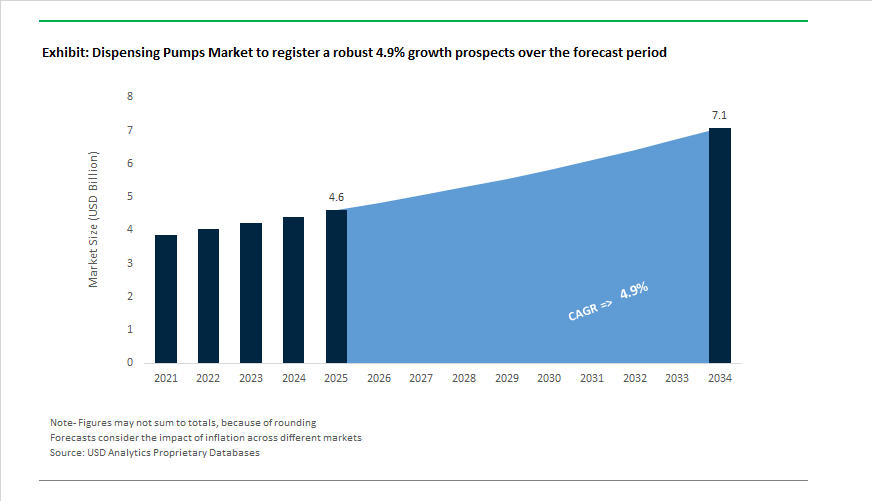
The Dispensing Pumps Market is projected to grow from $4.6 billion in 2025 to $7.1 billion by 2034, registering a CAGR of 4.9%. Market expansion is being driven by rapid innovation in recyclable pump architectures, premium airless systems, and high-precision pharmaceutical dispensing technologies. In August 2024, Coster Group relaunched its ON-OFF mono-component travel dispensing system, integrating pump, collar, and cap into a single mechanism to reduce material intensity and streamline fragrance packaging. Throughout 2024 and 2025, Berry Global scaled its Wave2cc metal-free polyolefin pump platform, achieving RecyClass A certification and announcing 3cc, 4cc, and 0.25ml extensions. The company committed over $100 million in capital expenditure through 2026 to localize circular dispensing solutions across global production sites, reinforcing the transition toward mono-material, polypropylene-based recyclability.
Innovation accelerated across personal care and beauty applications in 2025. In January 2025, TriMas Packaging, through its Rieke brand, launched the Singolo™ fully recyclable foamer featuring a polymeric spring alternative approved by the Association of Plastic Recyclers. In February 2025, Aptar Beauty introduced its High-Dose Pump (HDP) in North America, delivering a 3.5cc dose with a metal-free spring positioned outside the dosage chamber to prevent formula contamination and improve recyclability in standard PP streams. In May 2025, Rieke Packaging showcased its Linfa pump incorporating up to 50% post-consumer recycled resin, addressing brand mandates to reduce virgin plastic consumption by 30% by 2025. The refill movement also gained traction; in April 2025, U.K.-based Mighty Mouthcare launched a durable refillable toothpaste dispensing pump aimed at replacing billions of single-use laminate tubes entering landfills annually.
Strategic consolidation and pharmaceutical-grade precision are reshaping competitive positioning. Silgan Holdings completed the acquisition of Weener Packaging in October 2025, strengthening its footprint across Europe and Asia in fragrance, food, and personal care dispensing systems. In January 2025, Silgan Dispensing earned the EcoVadis Gold Medal, ranking in the top 3% globally for ESG performance, and in February 2026 extended its ERA™ cosmetic engine to include airless packaging formats for premium brands. Aptar Pharma inaugurated a 3,000-square-meter R&D center in France in September 2025, integrating AI-driven simulation to accelerate high-precision drug delivery pump development. Financially, AptarGroup was upgraded to ‘BBB’ by S&P Global in November 2025, reflecting strong leverage metrics and resilience in injectables and prestige fragrance dispensing. These developments indicate a structural shift toward recyclable mono-material systems, airless cosmetic pumps, and connected pharmaceutical dispensing platforms that are redefining performance benchmarks in the global dispensing pumps market.
Transformative Trends and High-Growth Opportunities Reshaping the Dispensing Pumps Market
GLP-1 Drug Commercialization Surge Accelerating Demand for High-Precision Multi-Dose Dispensing Pumps
The explosive growth of GLP-1 receptor agonists for obesity and type 2 diabetes has fundamentally reshaped the global dispensing pumps market, shifting demand toward high-precision, multi-dose injectable systems capable of supporting large-scale chronic therapy administration. As of early 2026, GLP-1 therapies have reached a commercial inflection point. Eli Lilly reported that Mounjaro and Zepbound together generated $36.5 billion in 2025, accounting for over 50% of the company’s total revenue. Real-world evidence from HealthVerity in 2025 indicates that more than 6 million U.S. patients had an active GLP-1 prescription by mid-2024, with injectable delivery systems commanding an 83% share of the total GLP-1 administration market. This recurring demand has created a massive installed base for precision-engineered multi-dose pens and wearable dispensing pumps.
To address unprecedented volume requirements, major pharmaceutical players are expanding supply chains and securing advanced drug delivery platforms. AbbVie entered the high-volume injectable delivery segment in January 2026 by acquiring manufacturing rights for the SmartDose 3.5 mL On-Body Delivery System from West Pharmaceutical Services for $112.5 million. Meanwhile, Novo Nordisk and Eli Lilly are executing multi-billion-dollar manufacturing expansions to scale GLP-1 production. This blockbuster drug cycle is structurally increasing demand for high-accuracy, low dead-volume dispensing pumps with consistent dose delivery, positioning pharmaceutical-grade precision pumps as a core growth engine within the global dispensing pumps industry.
EU PPWR Compliance and Mono-Material Pump Innovation Driving Circular Packaging Transformation
Sustainability regulations are compelling a material redesign across the beauty, personal care, and homecare dispensing pumps segment. Under the EU Packaging and Packaging Waste Regulation, all packaging placed on the EU market must be recyclable by 2030, triggering a decisive shift away from multi-material pumps containing metal springs toward mono-material, all-plastic alternatives. In March 2025, Aptar Beauty launched its GSA Advance and PZ Advance collections, engineered using 100% polyolefin constructions such as polyethylene and polypropylene to ensure compatibility with standard recycling streams.
Corporate sustainability commitments are accelerating adoption. In 2025, Dermalogica transitioned to 100% recyclable bottles incorporating mono-material pumps that achieved an A rating from RecyClass, replacing metal springs with plastic equivalents to enable full recyclability without disassembly. By 2025, polyethylene emerged as the dominant resin in mono-material dispensing pumps, holding a 42% market share, supported by Extended Producer Responsibility frameworks mandating 10% to 30% post-consumer recycled content in sensitive packaging by 2030. This structural material shift is redefining competitive differentiation across sustainable dispensing pump manufacturers.
Micro-Dosing and Closed-System Pumps Unlocking Opportunities in Biologics and Gene Therapy Delivery
The rapid expansion of biologics, cell therapies, and gene therapies is creating a specialized growth opportunity for micro-dosing and high-precision dispensing pumps capable of handling ultra-high-value payloads with minimal waste. The European NANOSPRESSO initiative, highlighted in June 2025, developed a portable manufacturing and dosing platform that enables hospitals to mix and dispense lipid nanoparticle gene therapies at the point of care, bypassing centralized industrial filling processes and reducing formulation waste. This innovation underscores the need for cartridge-based, sterile closed-system dispensing technologies optimized for fragile viral vectors and nucleic acid therapeutics.
Manufacturing breakthroughs are reinforcing the economic case for advanced pump systems. In October 2025, research from MIT demonstrated new crystallization and purification techniques capable of reducing gene therapy production costs by 5 to 10 times when integrated with specialized dispensing systems. At Pharmapack 2025, Gerresheimer presented its EZ-fill Smart platform engineered for sensitive biologics, focusing on minimizing break-loose and gliding forces to achieve 100% dosage accuracy even for high-viscosity formulations. These developments position microfluidic, closed-loop dispensing pumps as a critical enabler in the fast-expanding biologics and advanced therapeutics ecosystem.
Smart and Connected Dispensing Pumps Enabling Digital Adherence Monitoring and Closed-Loop Therapy
Digital transformation within healthcare is accelerating the adoption of smart, connected dispensing pumps integrated with Internet of Medical Things sensors. The connected drug delivery market is experiencing strong investment momentum, particularly within smart wearable injectors. In September 2025, ViCentra secured $85 million in Series D funding to scale production of its Kaleido 2 insulin patch pump, featuring integrated digital monitoring for real-time adherence tracking. Such connectivity is becoming essential for chronic disease management and decentralized clinical trial execution.
In January 2025, Gerresheimer introduced the Gx Cap, a digitally connected closure system for multi-dose containers that records every dispensing event and supports remote therapeutic monitoring programs. Further advancing closed-loop drug delivery, Beta Bionics and Abbott announced a June 2025 integration linking the iLet bionic pancreas with continuous glucose-ketone sensors, enabling automated dose adjustment based on real-time biometric data. These smart dispensing pump innovations are transforming adherence monitoring, data-driven dosing optimization, and patient-centric care models, positioning connected pump technologies as a high-growth frontier within the global dispensing pumps market.
Dispensing Pumps Market Share and Segmentation Insights
Market Share by Type: Lotion Pumps Lead High-Volume Packaging While Foam Pumps Accelerate Premium Adoption
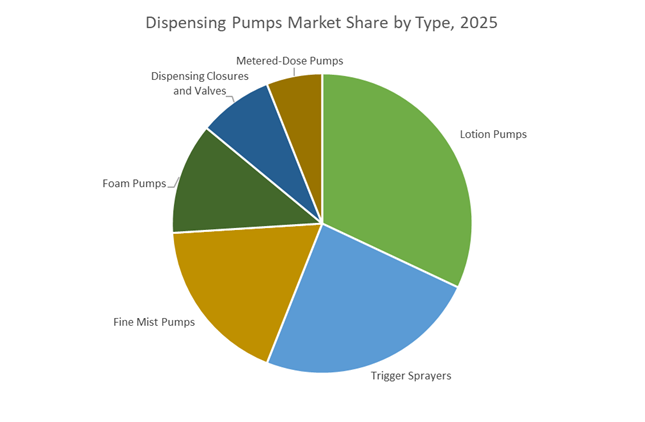
The dispensing pumps market by type in 2025 is led by lotion pumps, accounting for 32% market share, driven by their dominant use in skincare lotions, body washes, sunscreens, and liquid soaps. Lotion pumps offer reliable dispensing, multiple dosage options, and compatibility with low- to high-viscosity formulations, making them the industry standard for personal care packaging. Trigger sprayers hold a significant share due to widespread adoption in household cleaners, garden care, and automotive chemicals, supported by ergonomic designs and adjustable spray patterns. Fine mist pumps play a critical role in fragrances, hair care, and pharmaceutical nasal sprays, where uniform atomization and dosing consistency are essential. Foam pumps represent the fastest-growing segment, fueled by consumer preference for foaming hand soaps and facial cleansers that enhance sensory appeal and reduce product consumption. Dispensing closures, valves, and metered-dose pumps serve steady and niche demand in food, industrial, and pharmaceutical applications requiring controlled or precision dispensing.
Market Share by Application: Cosmetics and Personal Care Dominate as Pharmaceuticals and Food Packaging Expand Usage
The dispensing pumps market by application is dominated by cosmetics and personal care, capturing 48% of total demand in 2025, supported by rising consumption of skincare, haircare, and fragrance products globally. Brand differentiation through premium pump aesthetics, sustainability-focused designs, and consumer convenience continues to drive innovation in this segment. Household and home care represents a major application area, utilizing trigger sprayers, foam pumps, and lotion pumps for surface cleaners, laundry liquids, and air care products where controlled dispensing enhances usability. Pharmaceuticals and healthcare form a high-value segment, relying on metered-dose and fine mist pumps for nasal sprays, topical drugs, and oral liquids that require dosage accuracy, sterility, and regulatory compliance. Food and beverage applications are growing steadily, particularly in condiments and sauces, driven by portion control and convenience trends. Industrial and automotive applications remain niche but stable, requiring chemically resistant and durable pump systems for lubricants and maintenance fluids.
Competitive Landscape of the Dispensing Pumps Market
The dispensing pumps market is defined by rapid innovation in airless pump systems, pharma-grade dosing technologies, sustainable packaging, and e-commerce–ready dispensing formats, with competition centered on regulatory compliance, recyclability, digital health integration, and global manufacturing scale across pharmaceutical, beauty, FMCG, and industrial end-use segments.
AptarGroup drives pharma-grade dispensing with digital health integration and recyclable nasal pumps
AptarGroup, Inc. leads the high-value pharmaceutical dispensing pumps and prestige beauty packaging segments through its deep regulatory expertise and science-led product design. In February 2026, Aptar Pharma earned the P&G Supplier Excellence Award, reinforcing its reputation for manufacturing reliability. The company is aggressively expanding into digital health, collaborating with ŌURA in January 2026 to connect Migraine Buddy® insights with Oura Ring data for predictive care. Product innovation remains core, highlighted by APF Futurity™, a recyclable multi-dose nasal spray pump now featured in Phase II intranasal COVID-19 vaccine trials. Aptar’s “Pharma-First” strategy ensures sterile, preservative-free dispensing compliance, strengthening its dominance in drug delivery systems and advanced healthcare packaging.
Silgan Dispensing strengthens luxury pump customization through Weener acquisition and mono-material designs
Silgan Holdings Inc., via Silgan Dispensing, has positioned itself as the customization leader in fragrance and skincare pumps, combining visual branding with high-performance evacuation systems. At Paris Packaging Week 2026, Silgan showcased the DNA 35ERA airless pump, delivering over 95% formula evacuation to reduce product waste. Its late-2025 acquisition of Weener Packaging significantly expanded Silgan’s European personal care footprint. Flagship offerings like the Aspire® Chroma collection integrate Pirouette™ twist-off technology for refillable beauty packaging. Silgan’s proprietary LifeCycle™ mono-material platform, replacing metal springs with plastic equivalents, supports full recyclability within the polyolefin stream, aligning strongly with circular economy packaging trends.
Berry Global scales FMCG pump production with near-shoring and e-commerce–optimized designs
Berry Global Group, Inc. dominates high-volume lotion pumps, trigger sprayers, and foam dispensers for FMCG, healthcare, and food service markets. In February 2026, Berry expanded manufacturing hubs across Mexico and Southeast Asia, supporting North American near-shoring strategies and improving supply resilience. The company is heavily targeting e-commerce packaging, redesigning dispensing systems to meet “Amazon Frustration-Free” standards and prevent leakage during transit. Berry also leads in high-output commercial pumps, delivering up to 4 oz per stroke for sanitation stations and industrial kitchens. Processing millions of tons of resin annually, Berry leverages unmatched vertical integration to offer cost-competitive, mass-market dispensing solutions across household chemicals and personal care.
Guala Closures accelerates pharma and luxury dispensing through tamper-evident pump technologies
Guala Closures S.p.A. has rapidly diversified from spirits closures into pharmaceutical and luxury dispensing pumps via targeted acquisitions and ESG-driven innovation. In January 2026, Guala debuted at Pharmapack Paris, formally integrating Kunststoffwerk Kremsmünster into its pharma dispensing platform. The company also announced manufacturing expansion in Mexico to serve the premium U.S. wine and spirits segment. Its Above Spirits range embeds non-refillable (NRF) and tamper-evident mechanisms directly into pump designs, combating counterfeiting. Awarded an EcoVadis Gold Medal in early 2026, Guala now ranks among the global top 3% for sustainability, strengthening its appeal to luxury and regulated packaging customers.
TriMas Rieke advances industrial dispensing with PCR pumps and e-commerce-ready sealing systems
TriMas Corporation, through its Rieke Packaging division, specializes in industrial-grade dispensing pumps and agrochemical dosing systems requiring extreme chemical resistance and precision output. In 2026, Rieke launched the Linfa pump, incorporating up to 50% post-consumer recycled (PCR) plastic while preserving its “No Metal Contact” architecture. Its RS-3e Lotion Pump, engineered specifically for e-commerce, features a patented sliding seal that eliminates secondary packaging during shipment. Rieke leads in high-accuracy dosing solutions (1 cc to 125 ml) for corrosive formulations. A company-wide ERP rollout in February 2026 further enhances just-in-time delivery and global supply chain visibility for automotive and chemical customers.
United States Dispensing Pumps Market: Sustainable M&A, Accessible Premiumization, and E-commerce Locking Innovation
The United States Dispensing Pumps Market continues to set the global pace for premium beauty, personal care, and pharmaceutical dispensing technologies, supported by consolidation and sustainability-led product development. In February 2026, AptarGroup reported a 14% increase in Q4 2025 sales, with its Beauty segment delivering double-digit growth driven by fragrance pumps, airless dispensing systems, and high-performance skin care actuators. In January 2026, Aptar’s Board approved a $600 million share repurchase authorization, reinforcing capital flexibility for further R&D investment in drug delivery systems and consumer dispensing innovation.
On the product side, Silgan Dispensing introduced Aspire Chroma, enabling endless color customization in fragrance pumps, and expanded its ERA all-plastic dispensing system into airless packaging formats. Berry Global advanced its Wave2cc atmospheric dispenser platform, a 100% polyolefin and metal-free pump that achieved a RecyClass A rating when paired with PET bottles, positioning it as a benchmark for recyclable dispensing pumps. U.S. manufacturers are also integrating NFC-enabled smart packaging and laser engraving for brand authentication. A major growth driver is ISTA6-certified e-commerce dispensing pumps featuring advanced clockwise and counter-clockwise locking systems to prevent leakage during transit, addressing the surge in online beauty and personal care sales.
China Dispensing Pumps Market: 15th Five-Year Plan Modernization and Mono-Material Export Readiness
China’s Dispensing Pumps Market is transitioning toward high-tech, quality-focused manufacturing aligned with the 15th Five-Year Plan for 2026 to 2030. In September 2025, the Ministry of Industry and Information Technology of China announced a policy framework targeting over 3.5% annual growth in machinery and equipment operating revenue through 2026. The broader industrial modernization strategy prioritizes innovation-led upgrades, supply chain resilience, and advanced injection molding technologies for precision dispensing components.
Expansion at Huizhou Dayawan Petrochemical Industrial Park is securing localized supply of high-purity polyethylene and polypropylene resins, critical for high-dispersion color and additive-intensive pump components. China aims to scale machinery sector revenue to 10 trillion yuan by the end of 2026, encouraging specialty industrial clusters for competitive SMEs producing fine mist sprayers, trigger pumps, and lotion dispensers. Sustainability mandates introduced in 2025 promote digital manufacturing tools and low-global-warming-potential refrigerants in production facilities. To meet strict EU packaging waste regulations, Chinese exporters are accelerating development of mono-material all-PE dispensing pumps designed for recyclability and compliance with European circular economy standards.
Germany Dispensing Pumps Market: ESG Compliance, Circular Design, and Oil-Free Medical Pump Engineering
Germany represents the global benchmark for regulatory compliance and circular economy integration within the Dispensing Pumps Market. In January 2026, trilateral negotiations concluded amendments to the EU Corporate Sustainability Due Diligence Directive, reinforcing risk-based due diligence across the entire activity chain, including downstream pump disposal and recyclability. Concurrently, Germany is replacing its national Supply Chain Due Diligence Act with a new Law on International Corporate Responsibility by 2026, harmonizing ESG obligations with EU frameworks.
NETZSCH Pumps & Systems reported in its 2025 Environmental Report that its Waldkraiburg facility sources 100% green electricity, reducing Scope 2 emissions while producing up to 120 specialized pumps daily. Adoption of ISO 14001 and ISO 50001 standards has become standard practice among Tier-1 suppliers serving cosmetics and pharmaceutical sectors, accelerating the use of post-consumer recycled content in pump shrouds and collars. German manufacturers are also pioneering oil-free, medical-grade dispensing pumps using precision injection molding to eliminate metal springs, enhancing recyclability and ensuring compliance with stringent pharmaceutical packaging standards.
India Dispensing Pumps Market: PLI-Fueled Medical Device Expansion and High Domestic Value Addition
India’s Dispensing Pumps Market is rapidly evolving into a high-value manufacturing hub supported by the Production Linked Incentive Scheme. By December 2025, realized investments under the PLI framework reached ₹2.16 lakh crore, exceeding $26 billion, with 836 applications approved across 14 strategic sectors including medical devices and white goods. This investment surge is directly increasing domestic production of pharmaceutical-grade dosing pumps, nasal spray actuators, and precision lotion dispensers.
PLI support for bulk drugs and medical devices contributed to a net trade surplus of ₹2,280 crore in FY 2024 to 2025, strengthening local demand for compliant dispensing systems. Dedicated Medical Device Parks in Andhra Pradesh and Tamil Nadu are centralizing high-precision dosing system production for export markets. Domestic Value Addition in pharma and medical devices reached 83.7% as of March 2025, significantly reducing reliance on imported pump components. Enhanced budget allocations for 2025 to 2026 aim to further accelerate advanced injection molding, automation, and high-barrier packaging integration, positioning India as a competitive supplier of medical and cosmetic dispensing pumps across Asia and Europe.
Mexico Dispensing Pumps Market: Nearshoring Momentum and North American Closure Integration
Mexico has emerged as a strategic nearshoring hub within the North American Dispensing Pumps Market, serving the U.S. wine, spirits, and personal care sectors. In February 2026, Guala Closures acquired a state-of-the-art screwcap and closure facility in Rosarito with a capacity of 200 million units annually, strengthening supply capabilities for U.S. beverage markets. Integration with its San José Iturbide operations enhances regional manufacturing synergies and reduces lead times for spray pumps, trigger sprayers, and closure-dispensing systems.
Guala Closures also showcased its fully integrated KWK pharmaceutical closure and dispensing portfolio at Pharmapack 2026, signaling expansion into medical-grade packaging solutions. Mexico’s proximity to the U.S. border enables favorable logistics economics and trade advantages under regional agreements, particularly for high-volume trigger pumps and fine mist sprayers. As brands prioritize supply chain resilience and shorter delivery cycles, Mexico’s role as a North American export gateway for dispensing pumps and closures continues to strengthen.
Dispensing Pumps Market Report Scope
Dispensing Pumps Market
Parameter
Details
Market Size (2025)
$4.6 Billion
Market Size (2034)
$7.1 Billion
Market Growth Rate
4.9%
Segments
By Type (Lotion Pumps, Trigger Sprayers, Foam Pumps, Fine Mist Pumps, Dispensing Closures and Valves, Metered-Dose Pumps), By Material (Plastic, Metal, Glass, Mono-Material), By Application (Cosmetics and Personal Care, Pharmaceuticals and Healthcare, Household and Home Care, Food and Beverage, Industrial and Automotive), By Dosage Capacity (Small Dose, Standard Dose, High Dose)
Study Period
2019- 2025 and 2026-2034
Units
Revenue (USD)
Qualitative Analysis
Porter’s Five Forces, SWOT Profile, Market Share, Scenario Forecasts, Market Ecosystem, Company Ranking, Market Dynamics, Industry Benchmarking
US, Canada, Mexico, Germany, France, Spain, Italy, UK, Russia, China, India, Japan, South Korea, Australia, South East Asia, Brazil, Argentina, Middle East, Africa
Dispensing Pumps Market Segmentation
By Type
Lotion Pumps
Trigger Sprayers
Foam Pumps
Fine Mist Pumps
Dispensing Closures and Valves
Metered-Dose Pumps
By Material
Plastic
Metal
Glass
Mono-Material
By Application
Cosmetics and Personal Care
Pharmaceuticals and Healthcare
Household and Home Care
Food and Beverage
Industrial and Automotive
By Dosage Capacity
Small Dose
Standard Dose
High Dose
By Region
North America (United States, Canada, Mexico)
Europe (Germany, France, United Kingdom, Spain, Italy, Rest of Europe)
Asia Pacific (China, India, Japan, South Korea, Australia, Rest of APAC)
South and Central America (Brazil, Argentina, Rest of SCA)
Middle East and Africa (Saudi Arabia, UAE, South Africa, Rest of Middle East, Rest of Africa)
2. Dispensing Pumps Market Landscape and Outlook (2026–2034)
2.1. Introduction to Dispensing Pumps
2.2. Market Size and Growth Forecast (2026–2034)
2.3. Key Growth Drivers: Recyclable, Airless and Refillable Systems
2.4. Impact of GLP-1 Drug Commercialization on Precision Pump Demand
2.5. Regulatory Landscape: EU PPWR, EPR and Sustainable Packaging Mandates
2.6. Technology Evolution: Airless, Mono-Material and Connected Pump Platforms
2.7. Supply Chain Trends: Nearshoring, Capacity Localization and M&A Activity
3. Transformative Trends and High-Growth Opportunities
3.1. Trend: GLP-1 and Multi-Dose Injectable Pump Expansion
3.2. Trend: EU PPWR-Driven Mono-Material Pump Redesign
3.3. Opportunity: Micro-Dosing Pumps for Biologics and Gene Therapy
3.4. Opportunity: Smart and Connected Dispensing Systems for Digital Adherence
3.5. Opportunity: Refillable and Circular Personal Care Dispensing Formats
4. Competitive Landscape and Strategic Developments
4.1. Industry Structure and Market Concentration
4.2. Strategic Acquisitions and Consolidation Trends
4.3. ESG and Recyclability as Competitive Differentiators
4.4. Airless Technology and High-Evacuation Performance Benchmarking
4.5. Digital Health and Connected Pump Innovation
5. Market Share and Segmentation Analysis
5.1. By Type
5.1.1. Lotion Pumps
5.1.2. Trigger Sprayers
5.1.3. Foam Pumps
5.1.4. Fine Mist Pumps
5.1.5. Dispensing Closures and Valves
5.1.6. Metered-Dose Pumps
5.2. By Material
5.2.1. Plastic
5.2.2. Metal
5.2.3. Glass
5.2.4. Mono-Material
5.3. By Application
5.3.1. Cosmetics and Personal Care
5.3.2. Pharmaceuticals and Healthcare
5.3.3. Household and Home Care
5.3.4. Food and Beverage
5.3.5. Industrial and Automotive
5.4. By Dosage Capacity
5.4.1. Small Dose
5.4.2. Standard Dose
5.4.3. High Dose
5.5. By Region
5.5.1. North America
5.5.2. Europe
5.5.3. Asia Pacific
5.5.4. South and Central America
5.5.5. Middle East and Africa
6. Country-Level Analysis and Outlook
6.1. United States
6.2. Canada
6.3. Mexico
6.4. Germany
6.5. France
6.6. United Kingdom
6.7. Italy
6.8. Spain
6.9. China
6.10. India
6.11. Japan
6.12. South Korea
6.13. Australia
6.14. Brazil
6.15. Argentina
6.16. Saudi Arabia
6.17. UAE
6.18. South Africa
7. Regional Market Size Outlook (2026–2034)
7.1. North America Dispensing Pumps Market Size Outlook
7.1.1. By Type
7.1.2. By Material
7.1.3. By Application
7.1.4. By Dosage Capacity
7.1.5. By Country
7.2. Europe Dispensing Pumps Market Size Outlook
7.2.1. By Type
7.2.2. By Material
7.2.3. By Application
7.2.4. By Dosage Capacity
7.2.5. By Country
7.3. Asia Pacific Dispensing Pumps Market Size Outlook
7.3.1. By Type
7.3.2. By Material
7.3.3. By Application
7.3.4. By Dosage Capacity
7.3.5. By Country
7.4. South and Central America Dispensing Pumps Market Size Outlook
7.4.1. By Type
7.4.2. By Material
7.4.3. By Application
7.4.4. By Dosage Capacity
7.4.5. By Country
7.5. Middle East and Africa Dispensing Pumps Market Size Outlook
7.5.1. By Type
7.5.2. By Material
7.5.3. By Application
7.5.4. By Dosage Capacity
7.5.5. By Country
8. Company Profiles
8.1. AptarGroup Inc.
8.2. Silgan Dispensing Systems
8.3. Berry Global Group Inc.
8.4. Albéa Group
8.5. Coster Group
8.6. Guala Closures S.p.A.
8.7. TriMas Packaging
8.8. Mitani Valve Co. Ltd.
8.9. Yoshino Kogyosho Co. Ltd.
8.10. Raepak Ltd.
8.11. Weener Plastics Group B.V.
8.12. Precision Valve Corporation
8.13. Xingyuan Holding Co. Ltd.
8.14. Goldrain Packaging Co. Ltd.
8.15. HCP Packaging
9. Methodology
9.1. Research Scope
9.2. Data Collection and Validation
9.3. Market Estimation and Forecast Model
9.4. Assumptions and Limitations
9.5. Currency and Pricing Analysis
10. Appendix
10.1. Abbreviations
10.2. List of Tables
10.3. List of Figures
Dispensing Pumps Market Segmentation
By Type
Lotion Pumps
Trigger Sprayers
Foam Pumps
Fine Mist Pumps
Dispensing Closures and Valves
Metered-Dose Pumps
By Material
Plastic
Metal
Glass
Mono-Material
By Application
Cosmetics and Personal Care
Pharmaceuticals and Healthcare
Household and Home Care
Food and Beverage
Industrial and Automotive
By Dosage Capacity
Small Dose
Standard Dose
High Dose
By Region
North America (United States, Canada, Mexico)
Europe (Germany, France, United Kingdom, Spain, Italy, Rest of Europe)
Asia Pacific (China, India, Japan, South Korea, Australia, Rest of APAC)
South and Central America (Brazil, Argentina, Rest of SCA)
Middle East and Africa (Saudi Arabia, UAE, South Africa, Rest of Middle East, Rest of Africa)
The Dispensing Pumps Market is expected to grow from $4.6 billion in 2025 to $7.1 billion by 2034, registering a CAGR of 4.9%. Growth is supported by pharmaceutical precision dosing systems, recyclable mono-material pump innovation, and premium airless packaging demand in cosmetics and personal care. Expansion in GLP-1 injectable therapies and connected drug delivery devices further strengthens long-term demand visibility.
Cosmetics and personal care dominate with 48% market share in 2025, led by lotion pumps and airless systems for skincare and fragrance. Pharmaceuticals and healthcare represent the highest value-add segment, driven by metered-dose pumps, nasal spray systems, and wearable injectors. Foam pumps are the fastest-growing type, while mono-material polypropylene pumps are gaining traction under EU PPWR recyclability mandates.
The rapid adoption of GLP-1 therapies for obesity and diabetes is structurally increasing demand for multi-dose, high-accuracy dispensing pens and wearable pumps. Injectable formats account for over 80% of GLP-1 administration, creating a recurring installed base for precision-engineered pump systems. Pharmaceutical manufacturers are scaling capacity, reinforcing demand for low dead-volume, digitally connected dispensing technologies.
EU Packaging and Packaging Waste Regulation requires full recyclability by 2030, accelerating the shift toward mono-material, metal-free pump architectures. Extended Producer Responsibility frameworks are mandating 10% to 30% recycled content integration. In parallel, digital health integration and ESG reporting standards are pushing manufacturers to embed smart sensors, traceability features, and carbon footprint transparency into dispensing platforms.
Key industry leaders include AptarGroup Inc., Silgan Holdings Inc., Berry Global Group Inc., Guala Closures S.p.A., and TriMas Corporation. Competition centers on airless innovation, recyclable pump engineering, pharma-grade precision dosing, smart connected devices, and regional manufacturing expansion across North America, Europe, and Asia-Pacific.
More Equipment, Services and End-use Products Reports