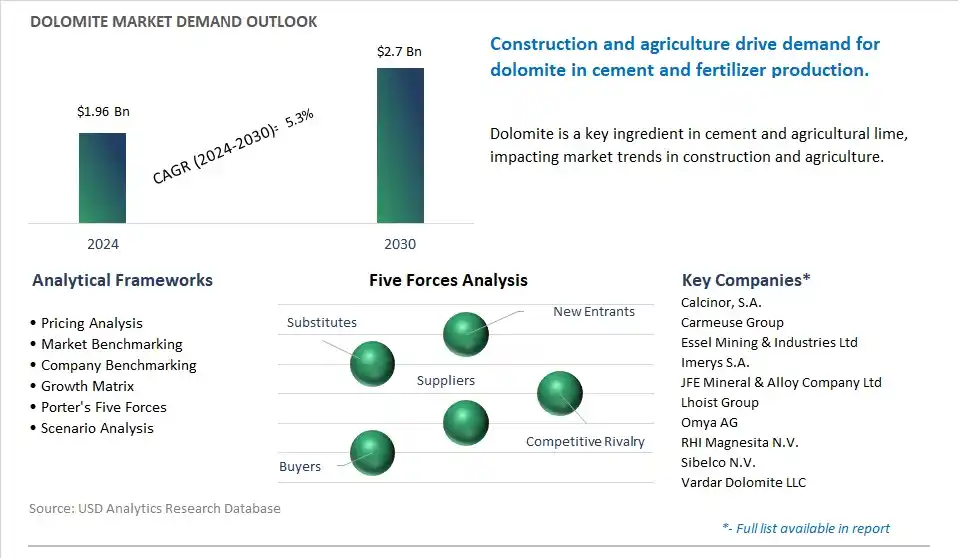
The global Dolomite Market is poised to register a 5.3% CAGR from $1.96 Billion in 2024 to $2.7 Billion in 2030.
The global Dolomite Market Study analyzes and forecasts the market size across 6 regions and 24 countries for diverse segments -By Product (Calcined, Sintered, Agglomerated), By End-User (Construction, Iron & Steel, Agriculture, Glass & Ceramics, Water Treatment, Others).
An Introduction to Global Dolomite Market in 2024
The dolomite market is witnessing steady growth driven by its applications in construction materials, iron and steel production, and agriculture. Key trends shaping the future of the industry include the increasing demand for dolomite as a versatile mineral filler, fluxing agent, and soil amendment, driven by infrastructure development, steelmaking, and soil pH management practices. As industries seek cost-effective and sustainable materials, there's a growing need for high-quality dolomite products that offer purity, uniformity, and performance consistency. Moreover, advancements in dolomite mining, processing technologies, and particle size control are driving market expansion by improving quality, yield, and suitability of dolomite for various applications. Additionally, the growing applications of dolomite in cement and concrete production, as well as in magnesium smelting and refining, are fueling demand for specialized dolomite grades with specific chemical and physical properties. Furthermore, the integration of dolomite-based materials in environmental remediation, water treatment, and renewable energy sectors is driving innovation and market growth in the dolomite industry, enabling the development of sustainable and value-added solutions to address evolving market needs.
Dolomite Market Competitive Landscape
The market report analyses the leading companies in the industry including Calcinor, S.A., Carmeuse Group, Essel Mining & Industries Ltd, Imerys S.A., JFE Mineral & Alloy Company Ltd, Lhoist Group, Omya AG, RHI Magnesita N.V., Sibelco N.V., Vardar Dolomite LLC.
Dolomite Market Dynamics
Dolomite Market Trend: Increasing Demand for Dolomite in Construction Sector
The construction industry is witnessing a surge in the demand for dolomite due to its versatile properties. Dolomite is being extensively used as a construction material for its high strength, durability, and resistance to weathering. Its application ranges from road construction to the production of concrete and asphalt. Moreover, the growing focus on sustainable construction practices has further fueled the demand for dolomite, as it can be used as a substitute for limestone and other materials, thereby reducing carbon emissions. This trend is expected to continue as infrastructure development projects gain momentum globally, especially in emerging economies where urbanization is rapidly increasing.
Dolomite Market Driver: Growth in Steel Production Driving Dolomite Consumption
The steel industry is a major driver for the dolomite market, as dolomite is an essential ingredient in the production of steel. Dolomite acts as a fluxing agent in steelmaking, aiding in the removal of impurities and improving the quality of steel produced. With the global demand for steel on the rise, driven by infrastructure development, automotive manufacturing, and industrial growth, the demand for dolomite is also expected to grow substantially. Additionally, technological advancements in steelmaking processes are further enhancing the efficiency of dolomite utilization, driving its consumption in the steel industry.
Dolomite Market Opportunity: Expansion of Dolomite Applications in Agriculture
The agriculture sector presents a significant opportunity for the dolomite market. Dolomite is widely used in agriculture as a soil conditioner to neutralize acidic soils and provide essential nutrients such as calcium and magnesium. As farmers increasingly adopt modern agricultural practices to improve crop yields and soil health, the demand for dolomite-based soil amendments is expected to rise. Furthermore, the growing trend towards organic farming and sustainable agriculture is likely to boost the adoption of dolomite, as it offers a natural and environmentally friendly solution for soil improvement. Expanding into the agriculture sector presents a lucrative opportunity for dolomite producers to diversify their customer base and increase their market presence.
Dolomite Market Share Analysis: Calcined Dolomite segment generated the highest revenue in the industry
The calcined dolomite segment is the largest in the dolomite market, primarily due to diverse key factors. The calcined dolomite exhibits enhanced properties compared to its sintered and agglomerated counterparts, making it suitable for a wide range of applications across various industries. Calcination involves heating dolomite to high temperatures, resulting in the decomposition of carbonates and the formation of oxides, which increases the magnesium oxide (MgO) content while reducing the calcium oxide (CaO) content. This process results in a material with improved refractory properties, high thermal stability, and excellent resistance to heat and corrosion. As a result, calcined dolomite finds extensive use in refractory linings for steelmaking furnaces, cement kilns, and glass melting tanks, where it serves as a fluxing agent, providing slag conditioning and enhancing refractory performance. Additionally, calcined dolomite is utilized in the production of magnesium metal, magnesium-based chemicals, and agricultural fertilizers, further driving its demand. With its superior properties and wide-ranging applications in critical industries such as steel, cement, and agriculture, the calcined dolomite segment maintains its position as the largest in the dolomite market.
Dolomite Market Share Analysis: Water Treatment Segment is poised to register the fastest growth rate (CAGR) over the forecast period to 2030
The water treatment segment is the fastest-growing segment in the dolomite market due to diverse key factors. The there is an increasing global focus on water quality and environmental sustainability, driving the demand for effective water treatment solutions. Dolomite is utilized in water treatment processes primarily for its ability to neutralize acidity and remove impurities such as heavy metals from water sources. Dolomite acts as a buffering agent, helping to maintain the pH balance of water and prevent acidic conditions that can lead to corrosion of pipes and infrastructure. In addition, dolomite's high surface area and porosity make it effective for adsorbing contaminants and improving water clarity. Additionally, advancements in water treatment technologies and regulations mandating stricter water quality standards contribute to the growing adoption of dolomite-based solutions in water treatment applications. With increasing concerns about water scarcity and pollution, the water treatment segment experiences rapid growth in the dolomite market as governments, industries, and communities invest in sustainable water management practices and infrastructure.
Dolomite Market Report Segmentation
By Product
Calcined
Sintered
Agglomerated
By End-User
Construction
Iron & Steel
Agriculture
Glass & Ceramics
Water Treatment
Others
Regions Included
North America (US, Canada, Mexico)
Europe (Germany, UK, France, Spain, Italy, Russia, Rest of Europe)
Asia Pacific (China, India, Japan, South Korea, Australia, South East Asia, Rest of Asia)
South America (Brazil, Argentina, Rest of South America)
Middle East and Africa (Saudi Arabia, UAE, Rest of Middle East, South Africa, Egypt, Rest of Africa)
Dolomite Companies Profiled in the Market Study
Calcinor, S.A.
Carmeuse Group
Essel Mining & Industries Ltd
Imerys S.A.
JFE Mineral & Alloy Company Ltd
Lhoist Group
Omya AG
RHI Magnesita N.V.
Sibelco N.V.
Vardar Dolomite LLC
*- List Not Exhaustive
TABLE OF CONTENTS
1 Introduction to 2024 Dolomite Market
1.1 Market Overview
1.2 Quick Facts
1.3 Scope/Objective of the Study
1.4 Market Definition
1.5 Countries and Regions Covered
1.6 Units, Currency, and Conversions
1.7 Industry Value Chain
2 Research Methodology
2.1 Market Size Estimation
2.2 Sources and Research Methodology
2.3 Data Triangulation
2.4 Assumptions and Limitations
3 Executive Summary
3.1 Global Dolomite Market Size Outlook, $ Million, 2021 to 2030
3.2 Dolomite Market Outlook by Type, $ Million, 2021 to 2030
3.3 Dolomite Market Outlook by Product, $ Million, 2021 to 2030
3.4 Dolomite Market Outlook by Application, $ Million, 2021 to 2030
3.5 Dolomite Market Outlook by Key Countries, $ Million, 2021 to 2030
4 Market Dynamics
4.1 Key Driving Forces of Dolomite Industry
4.2 Key Market Trends in Dolomite Industry
4.3 Potential Opportunities in Dolomite Industry
4.4 Key Challenges in Dolomite Industry
5 Market Factor Analysis
5.1 Value Chain Analysis
5.2 Competitive Landscape
5.2.1 Global Dolomite Market Share by Company (%), 2023
5.2.2 Product Offerings by Company
5.3 Porter’s Five Forces Analysis
5.4 Pricing Analysis and Outlook
6 Growth Outlook Across Scenarios
6.1 Growth Analysis-Case Scenario Definitions
6.2 Low Growth Scenario Forecasts
6.3 Reference Growth Scenario Forecasts
6.4 High Growth Scenario Forecasts
7 Global Dolomite Market Outlook by Segments
7.1 Dolomite Market Outlook by Segments, $ Million, 2021- 2030
By Product
Calcined
Sintered
Agglomerated
By End-User
Construction
Iron & Steel
Agriculture
Glass & Ceramics
Water Treatment
Others
8 North America Dolomite Market Analysis and Outlook To 2030
8.1 Introduction to North America Dolomite Markets in 2024
8.2 North America Dolomite Market Size Outlook by Country, 2021-2030
8.2.1 United States
8.2.2 Canada
8.2.3 Mexico
8.3 North America Dolomite Market size Outlook by Segments, 2021-2030
By Product
Calcined
Sintered
Agglomerated
By End-User
Construction
Iron & Steel
Agriculture
Glass & Ceramics
Water Treatment
Others
9 Europe Dolomite Market Analysis and Outlook To 2030
9.1 Introduction to Europe Dolomite Markets in 2024
9.2 Europe Dolomite Market Size Outlook by Country, 2021-2030
9.2.1 Germany
9.2.2 France
9.2.3 Spain
9.2.4 United Kingdom
9.2.4 Italy
9.2.5 Russia
9.2.6 Norway
9.2.7 Rest of Europe
9.3 Europe Dolomite Market Size Outlook by Segments, 2021-2030
By Product
Calcined
Sintered
Agglomerated
By End-User
Construction
Iron & Steel
Agriculture
Glass & Ceramics
Water Treatment
Others
10 Asia Pacific Dolomite Market Analysis and Outlook To 2030
10.1 Introduction to Asia Pacific Dolomite Markets in 2024
10.2 Asia Pacific Dolomite Market Size Outlook by Country, 2021-2030
10.2.1 China
10.2.2 India
10.2.3 Japan
10.2.4 South Korea
10.2.5 Indonesia
10.2.6 Malaysia
10.2.7 Australia
10.2.8 Rest of Asia Pacific
10.3 Asia Pacific Dolomite Market size Outlook by Segments, 2021-2030
By Product
Calcined
Sintered
Agglomerated
By End-User
Construction
Iron & Steel
Agriculture
Glass & Ceramics
Water Treatment
Others
11 South America Dolomite Market Analysis and Outlook To 2030
11.1 Introduction to South America Dolomite Markets in 2024
11.2 South America Dolomite Market Size Outlook by Country, 2021-2030
11.2.1 Brazil
11.2.2 Argentina
11.2.3 Rest of South America
11.3 South America Dolomite Market size Outlook by Segments, 2021-2030
By Product
Calcined
Sintered
Agglomerated
By End-User
Construction
Iron & Steel
Agriculture
Glass & Ceramics
Water Treatment
Others
12 Middle East and Africa Dolomite Market Analysis and Outlook To 2030
12.1 Introduction to Middle East and Africa Dolomite Markets in 2024
12.2 Middle East and Africa Dolomite Market Size Outlook by Country, 2021-2030
12.2.1 Saudi Arabia
12.2.2 UAE
12.2.3 Oman
12.2.4 Rest of Middle East
12.2.5 Egypt
12.2.6 Nigeria
12.2.7 South Africa
12.2.8 Rest of Africa
12.3 Middle East and Africa Dolomite Market size Outlook by Segments, 2021-2030
By Product
Calcined
Sintered
Agglomerated
By End-User
Construction
Iron & Steel
Agriculture
Glass & Ceramics
Water Treatment
Others
13 Company Profiles
13.1 Company Snapshot
13.2 SWOT Profiles
13.3 Products and Services
13.4 Recent Developments
13.5 Financial Profile
Calcinor, S.A.
Carmeuse Group
Essel Mining & Industries Ltd
Imerys S.A.
JFE Mineral & Alloy Company Ltd
Lhoist Group
Omya AG
RHI Magnesita N.V.
Sibelco N.V.
Vardar Dolomite LLC
14 Appendix
14.1 Customization Offerings
14.2 Subscription Services
14.3 Related Reports
14.4 Publisher Expertise
By Product
Calcined
Sintered
Agglomerated
By End-User
Construction
Iron & Steel
Agriculture
Glass & Ceramics
Water Treatment
Others
Countries Analyzed
North America (US, Canada, Mexico)
Europe (Germany, UK, France, Spain, Italy, Russia, Rest of Europe)
Asia Pacific (China, India, Japan, South Korea, Australia, South East Asia, Rest of Asia)
South America (Brazil, Argentina, Rest of South America)
Middle East and Africa (Saudi Arabia, UAE, Rest of Middle East, South Africa, Egypt, Rest of Africa)
