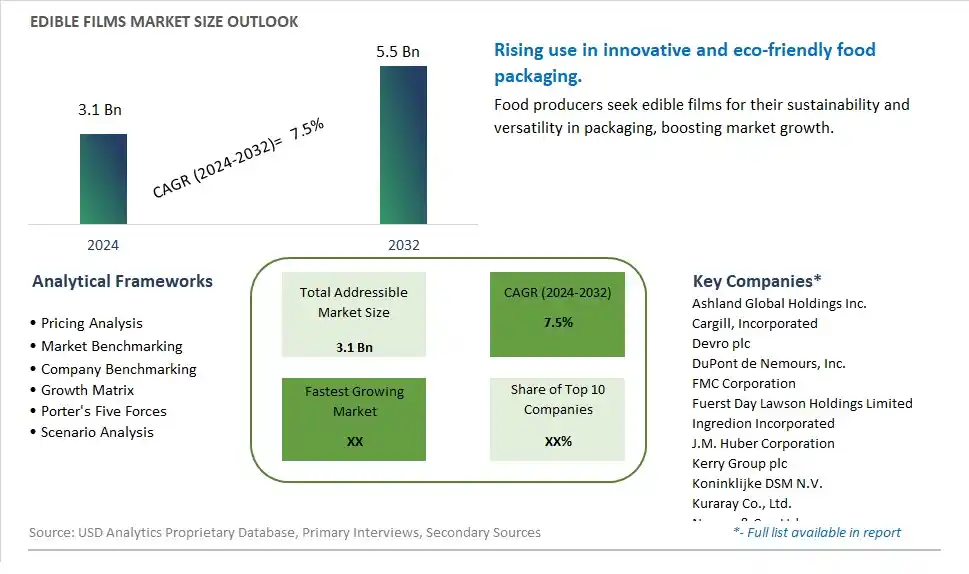
Global Edible Films Market Size is valued at $3.1 Billion in 2024 and is forecast to register a growth rate (CAGR) of 7.5% to reach $5.5 Billion by 2032.
The global Edible Films Market Comprehensive Study analyzes and forecasts the market size across 6 regions and 24 countries for diverse segments -By Type (Protein, Polysaccharides, Lipids, Others), By Application (Dairy Products, Nutritional Products, Bakery and Confectionary, Fruits & Vegetables, Meat, Poultry & Fish, Others)
An Introduction to Edible Films Market
In 2024, the Edible Films market is witnessing robust growth, driven by the increasing demand for sustainable and biodegradable packaging solutions. Edible films, made from proteins, polysaccharides, and lipids, are used to wrap food items, extending their shelf life and maintaining quality. The market benefits from the rising trend of eco-friendly packaging, the growing awareness of plastic waste reduction, and the expansion of the food industry's focus on sustainability. Additionally, innovations in film formulations and applications are enhancing product performance and versatility.
Edible Films Competitive Landscape
The market report analyses the leading companies in the industry including Ashland Global Holdings Inc., Cargill, Incorporated, Devro plc, DuPont de Nemours, Inc., FMC Corporation, Fuerst Day Lawson Holdings Limited, Ingredion Incorporated, J.M. Huber Corporation, Kerry Group plc, Koninklijke DSM N.V., Kuraray Co., Ltd., Nagase & Co., Ltd., Production and Innovation on Edible Coatings, S.L., RPM International Inc., Takikawa Oblate Corp Ltd., Tate & Lyle PLC, Valent BioSciences LLC, W Hydrocolloids Inc., Watson Foods Co., Inc., WikiFoods, Inc., and Others.
Edible Films Market Dynamics
Edible Films Market Trend: Growing Demand for Sustainable and Biodegradable Packaging
The edible films market is experiencing a significant trend towards sustainable and biodegradable packaging solutions. As environmental concerns and regulatory pressures increase, consumers and manufacturers alike are seeking alternatives to traditional plastic packaging. Edible films, made from natural and renewable resources, offer an eco-friendly solution that reduces waste and supports sustainability goals. This trend is driven by the rising awareness of the environmental impact of plastic waste and the growing consumer preference for products with minimal ecological footprints. The adoption of edible films aligns with the broader movement towards sustainable practices in the food and beverage industry.
Edible Films Market Driver: Increasing Focus on Food Safety and Shelf Life Extension
A major driver for the edible films market is the increasing focus on food safety and the need to extend the shelf life of perishable products. Edible films can enhance food safety by providing an additional barrier against contamination and spoilage. They can also be infused with antimicrobial agents, antioxidants, and other preservatives to further protect food products and prolong their freshness. As consumers demand safer and longer-lasting food products, manufacturers are turning to edible films as a versatile and effective packaging solution. The ability of edible films to maintain food quality and safety throughout the supply chain drives their adoption in various food segments.
Edible Films Market Opportunity: Innovation in Functional and Nutrient-Enriched Edible Films
The edible films market holds significant opportunities for innovation in functional and nutrient-enriched products. Companies can explore the development of edible films that offer additional health benefits, such as those fortified with vitamins, minerals, probiotics, or functional ingredients like antioxidants and fiber. These nutrient-enriched films can enhance the nutritional profile of packaged foods and beverages, appealing to health-conscious consumers. Additionally, there is potential for creating flavored edible films that can improve the sensory experience of food products. Expanding applications beyond food packaging to include pharmaceutical and nutraceutical industries can also drive market growth. Collaborating with food scientists and technologists to develop innovative and multifunctional edible films can further enhance market penetration and consumer acceptance.
Edible Films Market Share Analysis: Polysaccharides segment generated the highest revenue share in the industry
The largest segment in the Edible Films Market is Polysaccharides-based films. Polysaccharides are natural polymers derived from carbohydrates like starch, cellulose, and chitosan. These films are widely used in the food industry due to their biodegradability, non-toxic nature, and ability to form strong and flexible films. Polysaccharide-based edible films are commonly used for food packaging applications, where they act as barriers against moisture, oxygen, and microbial contamination, extending the shelf life of perishable food products. Additionally, they can be incorporated with active ingredients like antioxidants or antimicrobials to enhance food quality and safety.
Edible Films Market Share Analysis: Dairy Products is the fastest growing segment over the forecast period to 2032
The fastest-growing segment in the Edible Films Market is the Dairy Products application sector. Edible films find extensive use in dairy product packaging, where they provide a protective barrier against external factors, maintain product freshness, and prevent contamination. With the rising demand for convenience and eco-friendly packaging solutions in the dairy industry, the adoption of edible films is experiencing significant growth. These films offer advantages such as reduced plastic waste, improved product visibility, and enhanced consumer appeal due to their biodegradable and sustainable nature. As consumers prioritize health and environmental sustainability, the demand for edible films in dairy product packaging is expected to continue increasing rapidly.
Edible Films Market Segmentation
By Type
Protein
Polysaccharides
Lipids
Others
By Application
Dairy Products
Nutritional Products
Bakery and Confectionary
Fruits & Vegetables
Meat
Poultry & Fish
Others
Countries Analyzed
North America (US, Canada, Mexico)
Europe (Germany, UK, France, Spain, Italy, Russia, Rest of Europe)
Asia Pacific (China, India, Japan, South Korea, Australia, South East Asia, Rest of Asia)
South America (Brazil, Argentina, Rest of South America)
Middle East and Africa (Saudi Arabia, UAE, Rest of Middle East, South Africa, Egypt, Rest of Africa)
Edible Films Companies Profiled in the Study
Ashland Global Holdings Inc.
Cargill, Incorporated
Devro plc
DuPont de Nemours, Inc.
FMC Corporation
Fuerst Day Lawson Holdings Limited
Ingredion Incorporated
J.M. Huber Corporation
Kerry Group plc
Koninklijke DSM N.V.
Kuraray Co., Ltd.
Nagase & Co., Ltd.
Production and Innovation on Edible Coatings, S.L.
RPM International Inc.
Takikawa Oblate Corp Ltd.
Tate & Lyle PLC
Valent BioSciences LLC
W Hydrocolloids Inc.
Watson Foods Co., Inc.
WikiFoods, Inc.
*- List Not Exhaustive
Chapter 1. TABLE OF CONTENTS
Chapter 2. Introduction to Edible Films Market
2.1. Market Overview
2.2. Key Statistics and Report Highlights
2.3. Scope of the Comprehensive Study
2.3.1. Market Definition
2.3.2 Countries and Regions Covered
2.3.3 Research Objective
2.3.4 Units, Currency, and Conversions
2.3.5 Industry Value Chain
2.4. Key Market Segments
2.5. Key Companies
2.6. Study Period
Chapter 3. Strategic Analysis Review
3.1. Edible Films Pricing Analysis and Forecast
3.2. Porter’s Five Forces
3.3. Market Ecosystem
3.4. SWOT Analysis
3.5. Regulatory Scenario
3.3. Effects of Inflation, Russia-Ukraine War, moderating economic growth, and other macroeconomic factors
Chapter 4. Competitive Landscape
4.1. Market Share Analysis
4.1.1. Global Edible Films Market Share by Company, 2023
4.1.2. Product Offerings of Leading Edible Films Companies
4.2. Market Entropy
4.2.1. New Product Launches in the Industry
4.2.2. Mergers, Acquisitions, Joint ventures, and Partnerships
4.3. Key Strategies and Best Practices
Chapter 5. Global Market Projections: Best, Reference, and Low Case Scenarios
5.1. Growth Analysis- Case Scenario Definitions
5.2. Low Growth Case Scenario Forecasts
5.3. Reference Growth Case Scenario Forecasts
5.4. High Growth Case Scenario Forecasts
Chapter 6. Market Dynamics
6.1. Edible Films Market Drivers
6.2. Edible Films Market Challenges
6.6. Edible Films Market Opportunities
6.4. Edible Films Market Trends
Chapter 7. Global Edible Films Market Outlook Trends
7.1. Global Edible Films Revenue (USD Million) and CAGR (%) by Type (2021-2032)
7.2. Global Edible Films Revenue (USD Million) and CAGR (%) by Application (2021-2032)
7.3. Global Edible Films Revenue (USD Million) and CAGR (%) by Product (2021-2032)
By Type
Protein
Polysaccharides
Lipids
Others
By Application
Dairy Products
Nutritional Products
Bakery and Confectionary
Fruits & Vegetables
Meat
Poultry & Fish
Others
Chapter 8. Global Edible Films Regional Analysis and Outlook
8.1. Global Edible Films Revenue (USD Million) By Regions (2021- 2032)
8.2. North America Edible Films Revenue (USD Million) by Country (2021-2032)
8.2.1. United States Edible Films Regional Analysis and Outlook
8.2.2. Canada Edible Films Regional Analysis and Outlook
8.2.3. Mexico Edible Films Regional Analysis and Outlook
8.3. Europe Edible Films Revenue (USD Million), by Country (2021-2032)
8.3.1. Germany Edible Films Regional Analysis and Outlook
8.3.2. France Edible Films Regional Analysis and Outlook
8.3.3. United Kingdom Edible Films Regional Analysis and Outlook
8.3.4. Spain Edible Films Regional Analysis and Outlook
8.3.5. Italy Edible Films Regional Analysis and Outlook
8.3.6. Russia Edible Films Regional Analysis and Outlook
8.3.7. Rest of Europe Edible Films Regional Analysis and Outlook
8.4. Asia Pacific Edible Films Revenue (USD Million) by Country (2021-2032)
8.4.1. China Edible Films Regional Analysis and Outlook
8.4.2. Japan Edible Films Regional Analysis and Outlook
8.4.3. India Edible Films Regional Analysis and Outlook
8.4.4. South Korea Edible Films Regional Analysis and Outlook
8.4.5. Australia Edible Films Regional Analysis and Outlook
8.4.6. South East Asia Edible Films Regional Analysis and Outlook
8.4.7. Rest of Asia Pacific Edible Films Regional Analysis and Outlook
8.5. South America Edible Films Revenue (USD Million), by Country (2021-2032)
8.5.1. Brazil Edible Films Regional Analysis and Outlook
8.5.2. Argentina Edible Films Regional Analysis and Outlook
8.5.3. Rest of South America Edible Films Regional Analysis and Outlook
8.6. Middle East and Africa Edible Films Revenue (USD Million) by Country (2021-2032)
8.6.1. Middle East Edible Films Regional Analysis and Outlook
8.6.2. Africa Edible Films Regional Analysis and Outlook
Chapter 9. North America Edible Films Analysis and Outlook
9.1. North America Edible Films Revenue (USD Million) by Segments (2021-2032)
9.1.1. North America Edible Films Revenue (USD Million) by Type (2021-2032)
9.1.2. North America Edible Films Revenue (USD Million) by Application (2021-2032)
9.1.3. North America Edible Films Revenue (USD Million) by Product (2021-2032)
By Type
Protein
Polysaccharides
Lipids
Others
By Application
Dairy Products
Nutritional Products
Bakery and Confectionary
Fruits & Vegetables
Meat
Poultry & Fish
Others
Chapter 10. Europe Edible Films Analysis and Outlook
10.1. Europe Edible Films Revenue (USD Million), by Segments (USD Million) (2021-2032)
10.1.1. Europe Edible Films Revenue (USD Million) by Type (2021-2032)
10.1.2. Europe Edible Films Revenue (USD Million) by Application (2021-2032)
10.1.3. Europe Edible Films Revenue (USD Million) by Product (2021-2032)
By Type
Protein
Polysaccharides
Lipids
Others
By Application
Dairy Products
Nutritional Products
Bakery and Confectionary
Fruits & Vegetables
Meat
Poultry & Fish
Others
Chapter 11. Asia Pacific Edible Films Analysis and Outlook
11.1. Asia Pacific Edible Films Revenue (USD Million), and Revenue (USD Million) by Segments (2021-2032)
11.1.1. Asia Pacific Edible Films Revenue (USD Million) by Type (2021-2032)
11.1.2. Asia Pacific Edible Films Revenue (USD Million) by Application (2021-2032)
11.1.3. Asia Pacific Edible Films Revenue (USD Million) by Product (2021-2032)
By Type
Protein
Polysaccharides
Lipids
Others
By Application
Dairy Products
Nutritional Products
Bakery and Confectionary
Fruits & Vegetables
Meat
Poultry & Fish
Others
Chapter 12. South America Edible Films Analysis and Outlook
12.1. South America Edible Films Revenue (USD Million), by Segments (2021-2032)
12.1.1. South America Edible Films Revenue (USD Million) by Type (2021-2032)
12.1.2. South America Edible Films Revenue (USD Million) by Application (2021-2032)
12.1.3. South America Edible Films Revenue (USD Million) by Product (2021-2032)
By Type
Protein
Polysaccharides
Lipids
Others
By Application
Dairy Products
Nutritional Products
Bakery and Confectionary
Fruits & Vegetables
Meat
Poultry & Fish
Others
Chapter 13. Middle East and Africa Edible Films Analysis and Outlook
13.1. Middle East and Africa Edible Films Revenue (USD Million), by Segments (2021-2032)
13.1.1. Middle East and Africa Edible Films Revenue (USD Million) by Type (2021-2032)
13.1.2. Middle East and Africa Edible Films Revenue (USD Million) by Application (2021-2032)
13.1.3. Middle East and Africa Edible Films Revenue (USD Million) by Product (2021-2032)
By Type
Protein
Polysaccharides
Lipids
Others
By Application
Dairy Products
Nutritional Products
Bakery and Confectionary
Fruits & Vegetables
Meat
Poultry & Fish
Others
Chapter 14. Edible Films Company Profiles
14.1 Business Overview
14.2 Product Profiles
14.3 SWOT Profiles
14.5 Recent Developments
14.6 Financial Profile
List of Companies
Ashland Global Holdings Inc.
Cargill, Incorporated
Devro plc
DuPont de Nemours, Inc.
FMC Corporation
Fuerst Day Lawson Holdings Limited
Ingredion Incorporated
J.M. Huber Corporation
Kerry Group plc
Koninklijke DSM N.V.
Kuraray Co., Ltd.
Nagase & Co., Ltd.
Production and Innovation on Edible Coatings, S.L.
RPM International Inc.
Takikawa Oblate Corp Ltd.
Tate & Lyle PLC
Valent BioSciences LLC
W Hydrocolloids Inc.
Watson Foods Co., Inc.
WikiFoods, Inc.
15. Methodology and Data Sources
15.1 Customization Offerings
15.2 Subscription Services
15.3 Related Reports
15.4 Publisher Expertise
LIST OF TABLES
Table 1 Market Segmentation Analysis
Table 2 Global Edible Films Market Share of Leading Companies, 2023
Table 3 Product Offerings of Leading Companies
Table 4 Low Growth Scenario Forecasts
Table 5 Reference Case Growth Scenario
Table 6 High Growth Case Scenario
Table 7 Global Edible Films Revenue (USD Million) And CAGR (%) By Type (2021-2032)
Table 8 Global Edible Films Revenue (USD Million) And CAGR (%) By Application (2021-2032)
Table 9 Global Edible Films Revenue (USD Million) And CAGR (%) By Product (2021-2032)
Table 10 Global Edible Films Market Revenue (USD Million) By Regions (2021-2032)
Table 11 Global Edible Films Market Share (%) By Regions (2021-2032)
Table 12 North America Edible Films Revenue (USD Million) By Country (2021-2032)
Table 13 Europe Edible Films Revenue (USD Million) By Country (2021-2032)
Table 14 Asia Pacific Edible Films Revenue (USD Million) By Country (2021-2032)
Table 15 South America Edible Films Revenue (USD Million) By Country (2021-2032)
Table 16 Middle East and Africa Edible Films Revenue (USD Million) By Region (2021-2032)
Table 17 North America Edible Films Revenue (USD Million) By Type (2021-2032)
Table 18 North America Edible Films Revenue (USD Million) By Application (2021-2032)
Table 19 North America Edible Films Revenue (USD Million) By Product (2021-2032)
Table 20 Europe Edible Films Revenue (USD Million) By Type (2021-2032)
Table 21 Europe Edible Films Revenue (USD Million) By Application (2021-2032)
Table 22 Europe Edible Films Revenue (USD Million) By Product (2021-2032)
Table 23 Asia Pacific Edible Films Revenue (USD Million) By Type (2021-2032)
Table 24 Asia Pacific Edible Films Revenue (USD Million) By Application (2021-2032)
Table 25 Asia Pacific Edible Films Revenue (USD Million) By Product (2021-2032)
Table 26 South America Edible Films Revenue (USD Million) By Type (2021-2032)
Table 27 South America Edible Films Revenue (USD Million) By Application (2021-2032)
Table 28 South America Edible Films Revenue (USD Million) By Product (2021-2032)
Table 29 Middle East and Africa Edible Films Revenue (USD Million) By Type (2021-2032)
Table 30 Middle East and Africa Edible Films Revenue (USD Million) By Application (2021-2032)
Table 31 Middle East and Africa Edible Films Revenue (USD Million) By Product (2021-2032)
LIST OF FIGURES
Figure 1. Market Scope
Figure 2. Pricing Forecasts Per Unit, 2023- 2032
Figure 3. Porter’s Five Forces
Figure 4. Global Edible Films Market Revenue (USD Million) By Regions (2021-2032)
Figure 5. Global Edible Films Market Share (%) By Regions (2023)
Figure 6. North America Edible Films Revenue (USD Million) By Country (2021-2032)
Figure 7. United States Edible Films Revenue (USD Million) By Country (2021-2032)
Figure 8. Canada Edible Films Revenue (USD Million) By Country (2021-2032)
Figure 9. Mexico Edible Films Revenue (USD Million) By Country (2021-2032)
Figure 10. Europe Edible Films Revenue (USD Million) By Country (2021-2032)
Figure 11. Germany Edible Films Revenue (USD Million) By Country (2021-2032)
Figure 12. France Edible Films Revenue (USD Million) By Country (2021-2032)
Figure 13. United Kingdom Edible Films Revenue (USD Million) By Country (2021-2032)
Figure 14. Spain Edible Films Revenue (USD Million) By Country (2021-2032)
Figure 15. Italy Edible Films Revenue (USD Million) By Country (2021-2032)
Figure 16. Russia Edible Films Revenue (USD Million) By Country (2021-2032)
Figure 17. Rest of Europe Edible Films Revenue (USD Million) By Country (2021-2032)
Figure 11. Asia Pacific Edible Films Revenue (USD Million) By Country (2021-2032)
Figure 12. China Edible Films Revenue (USD Million) By Country (2021-2032)
Figure 13. Japan Edible Films Revenue (USD Million) By Country (2021-2032)
Figure 14. India Edible Films Revenue (USD Million) By Country (2021-2032)
Figure 15. South Korea Edible Films Revenue (USD Million) By Country (2021-2032)
Figure 16. Australia Edible Films Revenue (USD Million) By Country (2021-2032)
Figure 17. South East Asia Edible Films Revenue (USD Million) By Country (2021-2032)
Figure 18. South America Edible Films Revenue (USD Million) By Country (2021-2032)
Figure 19. Brazil Edible Films Revenue (USD Million) By Country (2021-2032)
Figure 20. Argentina Edible Films Revenue (USD Million) By Country (2021-2032)
Figure 21. Rest of Asia Pacific Edible Films Revenue (USD Million) By Country (2021-2032)
Figure 22. Middle East and Africa Edible Films Revenue (USD Million) By Region (2021-2032)
Figure 23. Saudi Arabia Edible Films Revenue (USD Million) By Region (2021-2032)
Figure 24. The UAE Edible Films Revenue (USD Million) By Region (2021-2032)
Figure 25. Rest of Middle East Edible Films Revenue (USD Million) By Region (2021-2032)
Figure 26. South Africa Edible Films Revenue (USD Million) By Region (2021-2032)
Figure 27. Africa Edible Films Revenue (USD Million) By Region (2021-2032)
Figure 28. North America Edible Films Revenue (USD Million) By Type (2021-2032)
Figure 29. North America Edible Films Revenue (USD Million) By Application (2021-2032)
Figure 30. North America Edible Films Revenue (USD Million) By Product (2021-2032)
Figure 31. Europe Edible Films Revenue (USD Million) By Type (2021-2032)
Figure 32. Europe Edible Films Revenue (USD Million) By Application (2021-2032)
Figure 33. Europe Edible Films Revenue (USD Million) By Product (2021-2032)
Figure 34. Asia Pacific Edible Films Revenue (USD Million) By Type (2021-2032)
Figure 35. Asia Pacific Edible Films Revenue (USD Million) By Application (2021-2032)
Figure 36. Asia Pacific Edible Films Revenue (USD Million) By Product (2021-2032)
Figure 37. South America Edible Films Revenue (USD Million) By Type (2021-2032)
Figure 38. South America Edible Films Revenue (USD Million) By Application (2021-2032)
Figure 39. South America Edible Films Revenue (USD Million) By Product (2021-2032)
Figure 40. Middle East and Africa Edible Films Revenue (USD Million) By Type (2021-2032)
Figure 41. Middle East and Africa Edible Films Revenue (USD Million) By Application (2021-2032)
Figure 42. Middle East and Africa Edible Films Revenue (USD Million) By Product (2021-2032)
By Type
Protein
Polysaccharides
Lipids
Others
By Application
Dairy Products
Nutritional Products
Bakery and Confectionary
Fruits & Vegetables
Meat
Poultry & Fish
Others
Countries Analyzed
North America (US, Canada, Mexico)
Europe (Germany, UK, France, Spain, Italy, Russia, Rest of Europe)
Asia Pacific (China, India, Japan, South Korea, Australia, South East Asia, Rest of Asia)
South America (Brazil, Argentina, Rest of South America)
Middle East and Africa (Saudi Arabia, UAE, Rest of Middle East, South Africa, Egypt, Rest of Africa)
