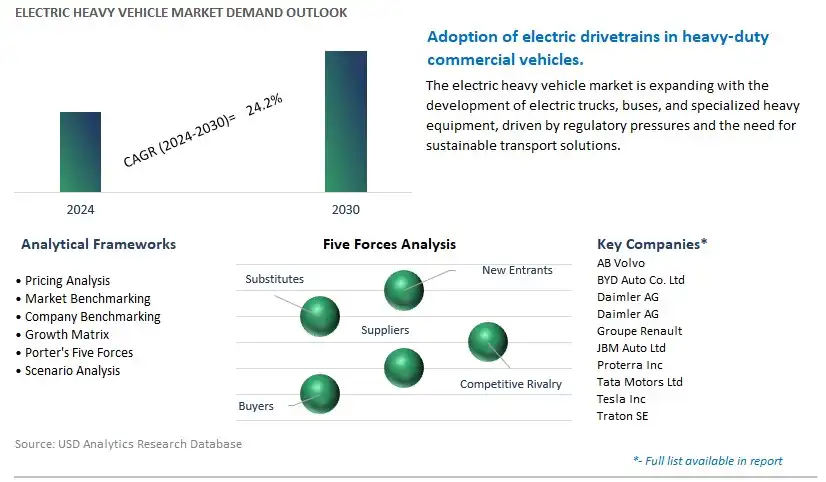
Electric Heavy Vehicle Market is estimated to increase at a growth rate of 24.2% CAGR over the forecast period from 2024 to 2030.
The global Electric Heavy Vehicle Market study analyzes and forecasts the market size across 6 regions and 24 countries for diverse segments including By Type (Battery Electric Vehicle (BEV), Plug-in Hybrid Electric Vehicle (PHEV), Hybrid Electric Vehicle (HEV), Hydrogen Electric Vehicle (Fuel Cell)), By Application (Refuse Services, Logistics, Industrial, Others), By Battery Capacity (Up to 150 Kwh, 150 to 250 Kwh, Above 250 Kwh).
An Introduction to Global Electric Heavy Vehicle Market, 2024
The Electric Heavy Vehicle Market is experiencing significant growth and transformation in 2024, driven by technological advancements, regulatory pressures, and the global push towards decarbonization in the transportation sector. Electric heavy vehicles, including trucks, buses, and commercial vehicles, offer a sustainable alternative to diesel-powered counterparts, reducing emissions, noise pollution, and operating costs. As governments implement stricter emissions regulations and incentivize the adoption of electric vehicles, manufacturers are investing in electric heavy vehicle technology, including high-capacity batteries, powerful electric motors, and advanced powertrain systems. With innovations in range, charging infrastructure, and payload capacity, electric heavy vehicles are increasingly suitable for a wide range of applications, from urban delivery fleets to long-haul transportation and construction. Moreover, the integration of telematics, autonomous driving technology, and fleet management solutions further enhances the efficiency, safety, and productivity of electric heavy vehicles, driving market adoption and reshaping the future of freight and logistics.
Electric Heavy Vehicle Competitive Landscape
The global Electric Heavy Vehicle market is highly competitive with a large number of companies focusing on niche market segments. Amidst intense competitive conditions, Electric Heavy Vehicle Companies are investing in new product launches and strengthening distribution channels. Key companies operating in the Electric Heavy Vehicle Market Industry include- AB Volvo, BYD Auto Co. Ltd, Daimler AG, Daimler AG, Groupe Renault, JBM Auto Ltd, Proterra Inc, Tata Motors Ltd, Tesla Inc, Traton SE.
Electric Heavy Vehicle Market Trend: Advancements in Battery Technology for Extended Range
A significant trend in the Electric Heavy Vehicle Market is the continual advancements in battery technology to provide extended range capabilities. As the demand for electric heavy vehicles grows, manufacturers are focusing on developing high-capacity batteries that can store more energy and enable longer driving distances on a single charge. These advancements include improvements in energy density, battery chemistry, and charging infrastructure compatibility, allowing electric heavy vehicles to achieve greater range and operational flexibility. With the increasing emphasis on reducing carbon emissions and transitioning towards sustainable transportation solutions, the development of advanced battery technology is driving the adoption of electric heavy vehicles across various sectors such as freight transportation, construction, and mining.
Electric Heavy Vehicle Market Driver: Government Regulations and Emission Standards
A key driver in the Electric Heavy Vehicle Market is the stringent government regulations and emission standards aimed at reducing greenhouse gas emissions and air pollution from heavy-duty vehicles. Governments around the world are implementing stringent emission standards and regulations to curb carbon emissions and improve air quality, particularly in urban areas where heavy vehicles contribute significantly to pollution levels. These regulations incentivize fleet operators and logistics companies to transition from conventional diesel-powered vehicles to electric heavy vehicles that produce zero tailpipe emissions. Additionally, government incentives, subsidies, and mandates further drive the adoption of electric heavy vehicles, creating a favorable market environment for manufacturers and operators to invest in electrification technologies and infrastructure.
Electric Heavy Vehicle Market Opportunity: Integration of Vehicle-to-Grid (V2G) Technology
An enticing opportunity within the Electric Heavy Vehicle Market lies in the integration of Vehicle-to-Grid (V2G) technology. V2G technology enables electric vehicles, including heavy trucks and buses, to not only consume electricity but also return excess energy stored in their batteries back to the grid when needed. This bidirectional energy flow provides an opportunity for electric heavy vehicle operators to participate in demand response programs, grid stabilization, and energy trading, potentially generating additional revenue streams and offsetting operational costs. By leveraging V2G technology, fleet operators can optimize the use of their electric heavy vehicles, maximize the value of their investment in battery storage, and contribute to grid stability and renewable energy integration. Furthermore, the integration of V2G technology supports the overall transition towards a more resilient and sustainable energy ecosystem.
Electric Heavy Vehicle Market Segmentation
By Type
Battery Electric Vehicle (BEV)
Plug-in Hybrid Electric Vehicle (PHEV)
Hybrid Electric Vehicle (HEV)
Hydrogen Electric Vehicle (Fuel Cell)
By Application
Refuse Services
Logistics
Industrial
Others
By Battery Capacity
Up to 150 Kwh
150 to 250 Kwh
Above 250 KwhGeographical Analysis
North America (United States, Canada, Mexico)
Europe (Germany, France, United Kingdom, Spain, Italy, Rest of Europe)
Asia Pacific (China, India, Japan, South Korea, Rest of Asia Pacific)
South America (Brazil, Argentina, Rest of South America)
Middle East and Africa (Saudi Arabia, UAE, Rest of Middle East, South Africa, Egypt, Rest of Africa
Electric Heavy Vehicle Companies
AB Volvo
BYD Auto Co. Ltd
Daimler AG
Daimler AG
Groupe Renault
JBM Auto Ltd
Proterra Inc
Tata Motors Ltd
Tesla Inc
Traton SE
*- List not Exhaustive
TABLE OF CONTENTS
1 Introduction to 2024 Electric Heavy Vehicle Market
1.1 Market Overview
1.2 Quick Facts
1.3 Scope/Objective of the Study
1.4 Market Definition
1.5 Countries and Regions Analyzed
1.6 Units, Currency, and Conversions
1.7 Industry Value Chain
2 Research Methodology
2.1 Market Size Estimation
2.2 Sources and Research Methodology
2.3 Data Triangulation
2.4 Assumptions and Limitations
3 Executive Summary
3.1 Global Electric Heavy Vehicle Market Size Outlook, $ Million, 2021 to 2030
3.2 Electric Heavy Vehicle Market Outlook by Type, $ Million, 2021 to 2030
3.3 Electric Heavy Vehicle Market Outlook by Product, $ Million, 2021 to 2030
3.4 Electric Heavy Vehicle Market Outlook by Application, $ Million, 2021 to 2030
3.5 Electric Heavy Vehicle Market Outlook by Key Countries, $ Million, 2021 to 2030
4 Market Dynamics
4.1 Key Driving Forces of Electric Heavy Vehicle Industry
4.2 Key Market Trends in Electric Heavy Vehicle Industry
4.3 Potential Opportunities in Electric Heavy Vehicle Industry
4.4 Key Challenges in Electric Heavy Vehicle Industry
5 Market Factor Analysis
5.1 Value Chain Analysis
5.2 Competitive Landscape
5.2.1 Global Electric Heavy Vehicle Market Share by Company (%), 2023
5.2.2 Product Offerings by Company
5.3 Porter’s Five Forces Analysis
5.4 Pricing Analysis and Outlook
6 Growth Outlook Across Scenarios
6.1 Growth Analysis-Case Scenario Definitions
6.2 Low Growth Scenario Forecasts
6.3 Reference Growth Scenario Forecasts
6.4 High Growth Scenario Forecasts
7 Global Electric Heavy Vehicle Market Outlook by Segments
7.1 Electric Heavy Vehicle Market Outlook by Segments, $ Million, 2021- 2030
By Type
Battery Electric Vehicle (BEV)
Plug-in Hybrid Electric Vehicle (PHEV)
Hybrid Electric Vehicle (HEV)
Hydrogen Electric Vehicle (Fuel Cell)
By Application
Refuse Services
Logistics
Industrial
Others
By Battery Capacity
Up to 150 Kwh
150 to 250 Kwh
Above 250 Kwh
8 North America Electric Heavy Vehicle Market Analysis and Outlook To 2030
8.1 Introduction to North America Electric Heavy Vehicle Markets in 2024
8.2 North America Electric Heavy Vehicle Market Size Outlook by Country, 2021-2030
8.2.1 United States
8.2.2 Canada
8.2.3 Mexico
8.3 North America Electric Heavy Vehicle Market size Outlook by Segments, 2021-2030
By Type
Battery Electric Vehicle (BEV)
Plug-in Hybrid Electric Vehicle (PHEV)
Hybrid Electric Vehicle (HEV)
Hydrogen Electric Vehicle (Fuel Cell)
By Application
Refuse Services
Logistics
Industrial
Others
By Battery Capacity
Up to 150 Kwh
150 to 250 Kwh
Above 250 Kwh
9 Europe Electric Heavy Vehicle Market Analysis and Outlook To 2030
9.1 Introduction to Europe Electric Heavy Vehicle Markets in 2024
9.2 Europe Electric Heavy Vehicle Market Size Outlook by Country, 2021-2030
9.2.1 Germany
9.2.2 France
9.2.3 Spain
9.2.4 United Kingdom
9.2.4 Italy
9.2.5 Russia
9.2.6 Norway
9.2.7 Rest of Europe
9.3 Europe Electric Heavy Vehicle Market Size Outlook by Segments, 2021-2030
By Type
Battery Electric Vehicle (BEV)
Plug-in Hybrid Electric Vehicle (PHEV)
Hybrid Electric Vehicle (HEV)
Hydrogen Electric Vehicle (Fuel Cell)
By Application
Refuse Services
Logistics
Industrial
Others
By Battery Capacity
Up to 150 Kwh
150 to 250 Kwh
Above 250 Kwh
10 Asia Pacific Electric Heavy Vehicle Market Analysis and Outlook To 2030
10.1 Introduction to Asia Pacific Electric Heavy Vehicle Markets in 2024
10.2 Asia Pacific Electric Heavy Vehicle Market Size Outlook by Country, 2021-2030
10.2.1 China
10.2.2 India
10.2.3 Japan
10.2.4 South Korea
10.2.5 Indonesia
10.2.6 Malaysia
10.2.7 Australia
10.2.8 Rest of Asia Pacific
10.3 Asia Pacific Electric Heavy Vehicle Market size Outlook by Segments, 2021-2030
By Type
Battery Electric Vehicle (BEV)
Plug-in Hybrid Electric Vehicle (PHEV)
Hybrid Electric Vehicle (HEV)
Hydrogen Electric Vehicle (Fuel Cell)
By Application
Refuse Services
Logistics
Industrial
Others
By Battery Capacity
Up to 150 Kwh
150 to 250 Kwh
Above 250 Kwh
11 South America Electric Heavy Vehicle Market Analysis and Outlook To 2030
11.1 Introduction to South America Electric Heavy Vehicle Markets in 2024
11.2 South America Electric Heavy Vehicle Market Size Outlook by Country, 2021-2030
11.2.1 Brazil
11.2.2 Argentina
11.2.3 Rest of South America
11.3 South America Electric Heavy Vehicle Market size Outlook by Segments, 2021-2030
By Type
Battery Electric Vehicle (BEV)
Plug-in Hybrid Electric Vehicle (PHEV)
Hybrid Electric Vehicle (HEV)
Hydrogen Electric Vehicle (Fuel Cell)
By Application
Refuse Services
Logistics
Industrial
Others
By Battery Capacity
Up to 150 Kwh
150 to 250 Kwh
Above 250 Kwh
12 Middle East and Africa Electric Heavy Vehicle Market Analysis and Outlook To 2030
12.1 Introduction to Middle East and Africa Electric Heavy Vehicle Markets in 2024
12.2 Middle East and Africa Electric Heavy Vehicle Market Size Outlook by Country, 2021-2030
12.2.1 Saudi Arabia
12.2.2 UAE
12.2.3 Oman
12.2.4 Rest of Middle East
12.2.5 Egypt
12.2.6 Nigeria
12.2.7 South Africa
12.2.8 Rest of Africa
12.3 Middle East and Africa Electric Heavy Vehicle Market size Outlook by Segments, 2021-2030
By Type
Battery Electric Vehicle (BEV)
Plug-in Hybrid Electric Vehicle (PHEV)
Hybrid Electric Vehicle (HEV)
Hydrogen Electric Vehicle (Fuel Cell)
By Application
Refuse Services
Logistics
Industrial
Others
By Battery Capacity
Up to 150 Kwh
150 to 250 Kwh
Above 250 Kwh
13 Company Profiles
13.1 Company Snapshot
13.2 SWOT Profiles
13.3 Products and Services
13.4 Recent Developments
13.5 Financial Profile
List of Companies
AB Volvo
BYD Auto Co. Ltd
Daimler AG
Daimler AG
Groupe Renault
JBM Auto Ltd
Proterra Inc
Tata Motors Ltd
Tesla Inc
Traton SE
14 Appendix
14.1 Customization Offerings
14.2 Subscription Services
14.3 Related Reports
14.4 Publisher Expertise
By Type
Battery Electric Vehicle (BEV)
Plug-in Hybrid Electric Vehicle (PHEV)
Hybrid Electric Vehicle (HEV)
Hydrogen Electric Vehicle (Fuel Cell)
By Application
Refuse Services
Logistics
Industrial
Others
By Battery Capacity
Up to 150 Kwh
150 to 250 Kwh
Above 250 Kwh
