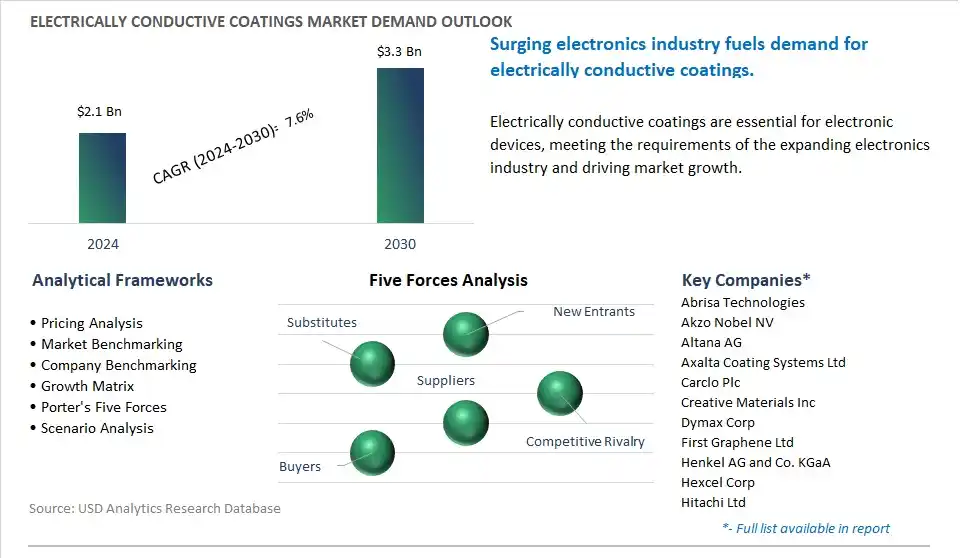
The global Electrically Conductive Coatings Market is poised to register a 7.6% CAGR from $2.1 Billion in 2024 to $3.3 Billion in 2030.
The global Electrically Conductive Coatings Market Study analyzes and forecasts the market size across 6 regions and 24 countries for diverse segments -By Material (Epoxy, Polyesters, Acrylics, Polyurethanes, Others), By Application (Consumer Electronic Displays, Solar Industry, Automotive, Aerospace, Bioscience, Others).
An Introduction to Global Electrically Conductive Coatings Market in 2024
The market for electrically conductive coatings is witnessing steady growth, driven by the increasing demand for coatings that provide electromagnetic interference (EMI) shielding, static dissipation, and electrical conductivity in various electronic, automotive, aerospace, and industrial applications. Key trends shaping the future of the industry include advancements in coating materials, deposition techniques, and performance testing methods to meet the evolving needs of manufacturers for coatings that offer high conductivity, adhesion, and corrosion resistance while maintaining mechanical and thermal stability. Manufacturers of electrically conductive coatings are focusing on developing products with tailored electrical properties, surface finishes, and environmental durability to meet the stringent requirements of different applications such as printed circuit boards (PCBs), sensors, touchscreens, and smart surfaces. Additionally, there is a growing emphasis on customization, miniaturization, and integration of electrically conductive coatings into multifunctional materials and devices, driven by the need for compact, lightweight, and high-performance electronic components and systems. Moreover, advancements in nanomaterials, carbon-based composites, and conductive polymers are driving innovation in electrically conductive coating technology, enabling the development of solutions that offer improved conductivity, flexibility, and transparency for emerging applications such as flexible electronics, wearable devices, and transparent conductive films. Furthermore, collaborations between coating suppliers, electronics manufacturers, and research institutions are shaping the development of standardized testing protocols, quality assurance measures, and performance validation methods that ensure the reliability, compatibility, and safety of electrically conductive coatings in diverse applications and environments. Overall, the future of electrically conductive coatings lies in continuous innovation, collaboration, and technology adoption to address emerging market needs, technological challenges, and regulatory requirements while providing manufacturers with versatile and reliable solutions for enabling the next generation of electronic and smart devices.
Electrically Conductive Coatings Market Competitive Landscape
The market report analyses the leading companies in the industry including Abrisa Technologies, Akzo Nobel NV, Altana AG, Axalta Coating Systems Ltd, Carclo Plc, Creative Materials Inc, Dymax Corp, First Graphene Ltd, Henkel AG and Co. KGaA, Hexcel Corp, Hitachi Ltd, Holland Shielding Systems BV, Indium Corp, MG Chemicals Ltd, Parker Hannifin Corp, PPG Industries Inc, PTFE Applied Coatings, RS Coatings, Sika AG, The Sherwin Williams Co..
Electrically Conductive Coatings Market Dynamics
Electrically Conductive Coatings Market Trend: Increasing Demand for Electronic Devices with Enhanced Functionality
A prominent trend in the Electrically Conductive Coatings market is the increasing demand for electronic devices with enhanced functionality. As technology advances, there's a growing need for coatings that provide reliable electrical conductivity while offering additional features such as corrosion resistance, thermal management, and electromagnetic shielding. Electrically conductive coatings play a crucial role in various applications, including printed circuit boards (PCBs), touchscreens, sensors, and automotive electronics, where they enable efficient electrical connectivity and signal transmission. This trend is driven by the proliferation of smart devices, Internet of Things (IoT) technologies, and the development of advanced electronic components requiring precise and stable electrical performance.
Electrically Conductive Coatings Market Driver: Growth in Automotive and Electronics Industries
A significant driver in the Electrically Conductive Coatings market is the growth in automotive and electronics industries. The automotive sector increasingly relies on electrically conductive coatings for applications such as anti-static coatings, EMI shielding, and electrostatic dissipation (ESD) protection in vehicle components and electronic systems. Similarly, the electronics industry utilizes electrically conductive coatings for PCBs, connectors, flexible circuits, and electronic displays to ensure reliable electrical connections and performance. As the automotive and electronics sectors continue to expand globally, driven by technological advancements, consumer demand for advanced features, and regulatory requirements, the demand for electrically conductive coatings is expected to grow steadily, propelling market growth.
Electrically Conductive Coatings Market Opportunity: Development of High-Performance and Environmentally Friendly Formulations
A promising opportunity within the Electrically Conductive Coatings market lies in the development of high-performance and environmentally friendly formulations. There is a growing emphasis on the development of coatings that offer superior electrical conductivity, adhesion, and durability while minimizing environmental impact and meeting regulatory standards. Manufacturers have an opportunity to innovate and formulate electrically conductive coatings using eco-friendly materials, such as water-based or solvent-free formulations, and incorporating conductive nanoparticles or polymers. Additionally, there's an opportunity to develop coatings with multi-functional properties, such as anti-corrosion or thermal management capabilities, to address the evolving needs of end-users across various industries. By focusing on sustainability and performance, companies can capitalize on the growing demand for electrically conductive coatings and establish a competitive advantage in the market.
Electrically Conductive Coatings Market Share Analysis: The Polyurethanes generated the highest revenue in 2024
The largest segment in the Electrically Conductive Coatings Market is the Polyurethanes material category. Polyurethane coatings dominate the market due to their exceptional combination of electrical conductivity, durability, and versatility. Polyurethane coatings offer high conductivity levels, making them suitable for various applications requiring electrostatic discharge (ESD) protection, electromagnetic interference (EMI) shielding, and electrical grounding. Additionally, polyurethane coatings provide excellent adhesion to a wide range of substrates, including metals, plastics, and composites, ensuring reliable and long-lasting performance in diverse environments. Further, polyurethane coatings exhibit superior chemical and abrasion resistance, making them suitable for harsh industrial and automotive applications where exposure to chemicals, solvents, and mechanical stress is common. Furthermore, advancements in polyurethane formulation technology have led to the development of water-borne and solvent-free options, addressing environmental concerns and regulatory requirements while maintaining high-performance standards. As a result of these factors, the polyurethanes segment maintains its dominance in the Electrically Conductive Coatings Market, offering unmatched electrical conductivity, durability, and compatibility with various substrates for a wide range of applications.
Electrically Conductive Coatings Market Share Analysis: The Solar Industry segment is poised to register the fastest growth rate (CAGR) over the forecast period to 2030
The Solar Industry segment is witnessing remarkable growth in the Electrically Conductive Coatings Market. With the increasing emphasis on renewable energy sources, the demand for solar panels and related technologies has surged globally. Electrically conductive coatings play a pivotal role in enhancing the efficiency and performance of solar panels by ensuring better conductivity and corrosion resistance. Additionally, advancements in solar technology, such as thin-film solar cells, have further boosted the demand for electrically conductive coatings in this sector. The push towards sustainable energy solutions, coupled with government incentives and policies promoting solar power adoption, has propelled the growth of the Solar Industry segment in the Electrically Conductive Coatings Market. As more countries transition towards clean energy, the demand for electrically conductive coatings in the solar sector is expected to continue its rapid expansion in the foreseeable future.
Electrically Conductive Coatings Market Share Analysis: The Automotive segment is poised to register the fastest growth rate (CAGR) over the forecast period to 2030
The Automotive segment is the fastest-growing segment in the Electrically Conductive Coatings Market. The automotive industry is undergoing a significant transformation with the increasing adoption of electric and hybrid vehicles. These vehicles rely heavily on advanced electronic components and systems, creating a substantial demand for electrically conductive coatings to ensure reliable performance and connectivity. Further, the growing trend towards autonomous driving technologies necessitates robust electronic systems within vehicles, further driving the need for electrically conductive coatings to protect sensitive components from electromagnetic interference (EMI) and electrostatic discharge (ESD). Additionally, as automotive manufacturers prioritize lightweighting to improve fuel efficiency and reduce emissions, electrically conductive coatings offer a viable solution for replacing traditional metal parts with lighter composite materials while maintaining conductivity and structural integrity. With the automotive industry poised for continued innovation and electrification, the demand for electrically conductive coatings in this sector is expected to experience sustained growth in the coming years.
Electrically Conductive Coatings Market Report Segmentation
By Material
Epoxy
Polyesters
Acrylics
Polyurethanes
Others
By Application
Consumer Electronic Displays
Solar Industry
Automotive
Aerospace
Bioscience
Others
Regions Included
North America (US, Canada, Mexico)
Europe (Germany, UK, France, Spain, Italy, Russia, Rest of Europe)
Asia Pacific (China, India, Japan, South Korea, Australia, South East Asia, Rest of Asia)
South America (Brazil, Argentina, Rest of South America)
Middle East and Africa (Saudi Arabia, UAE, Rest of Middle East, South Africa, Egypt, Rest of Africa)
Electrically Conductive Coatings Companies Profiled in the Market Study
Abrisa Technologies
Akzo Nobel NV
Altana AG
Axalta Coating Systems Ltd
Carclo Plc
Creative Materials Inc
Dymax Corp
First Graphene Ltd
Henkel AG and Co. KGaA
Hexcel Corp
Hitachi Ltd
Holland Shielding Systems BV
Indium Corp
MG Chemicals Ltd
Parker Hannifin Corp
PPG Industries Inc
PTFE Applied Coatings
RS Coatings
Sika AG
The Sherwin Williams Co.
*- List Not Exhaustive
TABLE OF CONTENTS
1 Introduction to 2024 Electrically Conductive Coatings Market
1.1 Market Overview
1.2 Quick Facts
1.3 Scope/Objective of the Study
1.4 Market Definition
1.5 Countries and Regions Covered
1.6 Units, Currency, and Conversions
1.7 Industry Value Chain
2 Research Methodology
2.1 Market Size Estimation
2.2 Sources and Research Methodology
2.3 Data Triangulation
2.4 Assumptions and Limitations
3 Executive Summary
3.1 Global Electrically Conductive Coatings Market Size Outlook, $ Million, 2021 to 2030
3.2 Electrically Conductive Coatings Market Outlook by Type, $ Million, 2021 to 2030
3.3 Electrically Conductive Coatings Market Outlook by Product, $ Million, 2021 to 2030
3.4 Electrically Conductive Coatings Market Outlook by Application, $ Million, 2021 to 2030
3.5 Electrically Conductive Coatings Market Outlook by Key Countries, $ Million, 2021 to 2030
4 Market Dynamics
4.1 Key Driving Forces of Electrically Conductive Coatings Industry
4.2 Key Market Trends in Electrically Conductive Coatings Industry
4.3 Potential Opportunities in Electrically Conductive Coatings Industry
4.4 Key Challenges in Electrically Conductive Coatings Industry
5 Market Factor Analysis
5.1 Value Chain Analysis
5.2 Competitive Landscape
5.2.1 Global Electrically Conductive Coatings Market Share by Company (%), 2023
5.2.2 Product Offerings by Company
5.3 Porter’s Five Forces Analysis
5.4 Pricing Analysis and Outlook
6 Growth Outlook Across Scenarios
6.1 Growth Analysis-Case Scenario Definitions
6.2 Low Growth Scenario Forecasts
6.3 Reference Growth Scenario Forecasts
6.4 High Growth Scenario Forecasts
7 Global Electrically Conductive Coatings Market Outlook by Segments
7.1 Electrically Conductive Coatings Market Outlook by Segments, $ Million, 2021- 2030
By Material
Epoxy
Polyesters
Acrylics
Polyurethanes
Others
By Application
Consumer Electronic Displays
Solar Industry
Automotive
Aerospace
Bioscience
Others
8 North America Electrically Conductive Coatings Market Analysis and Outlook To 2030
8.1 Introduction to North America Electrically Conductive Coatings Markets in 2024
8.2 North America Electrically Conductive Coatings Market Size Outlook by Country, 2021-2030
8.2.1 United States
8.2.2 Canada
8.2.3 Mexico
8.3 North America Electrically Conductive Coatings Market size Outlook by Segments, 2021-2030
By Material
Epoxy
Polyesters
Acrylics
Polyurethanes
Others
By Application
Consumer Electronic Displays
Solar Industry
Automotive
Aerospace
Bioscience
Others
9 Europe Electrically Conductive Coatings Market Analysis and Outlook To 2030
9.1 Introduction to Europe Electrically Conductive Coatings Markets in 2024
9.2 Europe Electrically Conductive Coatings Market Size Outlook by Country, 2021-2030
9.2.1 Germany
9.2.2 France
9.2.3 Spain
9.2.4 United Kingdom
9.2.4 Italy
9.2.5 Russia
9.2.6 Norway
9.2.7 Rest of Europe
9.3 Europe Electrically Conductive Coatings Market Size Outlook by Segments, 2021-2030
By Material
Epoxy
Polyesters
Acrylics
Polyurethanes
Others
By Application
Consumer Electronic Displays
Solar Industry
Automotive
Aerospace
Bioscience
Others
10 Asia Pacific Electrically Conductive Coatings Market Analysis and Outlook To 2030
10.1 Introduction to Asia Pacific Electrically Conductive Coatings Markets in 2024
10.2 Asia Pacific Electrically Conductive Coatings Market Size Outlook by Country, 2021-2030
10.2.1 China
10.2.2 India
10.2.3 Japan
10.2.4 South Korea
10.2.5 Indonesia
10.2.6 Malaysia
10.2.7 Australia
10.2.8 Rest of Asia Pacific
10.3 Asia Pacific Electrically Conductive Coatings Market size Outlook by Segments, 2021-2030
By Material
Epoxy
Polyesters
Acrylics
Polyurethanes
Others
By Application
Consumer Electronic Displays
Solar Industry
Automotive
Aerospace
Bioscience
Others
11 South America Electrically Conductive Coatings Market Analysis and Outlook To 2030
11.1 Introduction to South America Electrically Conductive Coatings Markets in 2024
11.2 South America Electrically Conductive Coatings Market Size Outlook by Country, 2021-2030
11.2.1 Brazil
11.2.2 Argentina
11.2.3 Rest of South America
11.3 South America Electrically Conductive Coatings Market size Outlook by Segments, 2021-2030
By Material
Epoxy
Polyesters
Acrylics
Polyurethanes
Others
By Application
Consumer Electronic Displays
Solar Industry
Automotive
Aerospace
Bioscience
Others
12 Middle East and Africa Electrically Conductive Coatings Market Analysis and Outlook To 2030
12.1 Introduction to Middle East and Africa Electrically Conductive Coatings Markets in 2024
12.2 Middle East and Africa Electrically Conductive Coatings Market Size Outlook by Country, 2021-2030
12.2.1 Saudi Arabia
12.2.2 UAE
12.2.3 Oman
12.2.4 Rest of Middle East
12.2.5 Egypt
12.2.6 Nigeria
12.2.7 South Africa
12.2.8 Rest of Africa
12.3 Middle East and Africa Electrically Conductive Coatings Market size Outlook by Segments, 2021-2030
By Material
Epoxy
Polyesters
Acrylics
Polyurethanes
Others
By Application
Consumer Electronic Displays
Solar Industry
Automotive
Aerospace
Bioscience
Others
13 Company Profiles
13.1 Company Snapshot
13.2 SWOT Profiles
13.3 Products and Services
13.4 Recent Developments
13.5 Financial Profile
Abrisa Technologies
Akzo Nobel NV
Altana AG
Axalta Coating Systems Ltd
Carclo Plc
Creative Materials Inc
Dymax Corp
First Graphene Ltd
Henkel AG and Co. KGaA
Hexcel Corp
Hitachi Ltd
Holland Shielding Systems BV
Indium Corp
MG Chemicals Ltd
Parker Hannifin Corp
PPG Industries Inc
PTFE Applied Coatings
RS Coatings
Sika AG
The Sherwin Williams Co.
14 Appendix
14.1 Customization Offerings
14.2 Subscription Services
14.3 Related Reports
14.4 Publisher Expertise
By Material
Epoxy
Polyesters
Acrylics
Polyurethanes
Others
By Application
Consumer Electronic Displays
Solar Industry
Automotive
Aerospace
Bioscience
Others
Countries Analyzed
North America (US, Canada, Mexico)
Europe (Germany, UK, France, Spain, Italy, Russia, Rest of Europe)
Asia Pacific (China, India, Japan, South Korea, Australia, South East Asia, Rest of Asia)
South America (Brazil, Argentina, Rest of South America)
Middle East and Africa (Saudi Arabia, UAE, Rest of Middle East, South Africa, Egypt, Rest of Africa)
