
The global Electroactive Polymers Market Study analyzes and forecasts the market size across 6 regions and 24 countries for diverse segments -By Type (Conductive Plastics, Inherently Conductive Polymers, Inherently Dissipative Polymers), By Application (Electrostatic Discharge Protection, Electromagnetic Interference Shielding, Actuators, Capacitors, Batteries, Sensors, Others).
In the electroactive polymers market, the future is driven by trends such as smart materials, wearable technology, and soft robotics driving innovation in polymer chemistry, processing techniques, and application development. Electroactive polymers (EAPs) are a class of materials that exhibit reversible deformation or changes in shape, size, or conductivity in response to electrical stimulation, making them ideal for actuation, sensing, and energy harvesting applications. Key trends shaping this market include advancements in EAP formulations with improved mechanical properties, flexibility, and biocompatibility for wearable devices and biomedical applications, the development of stretchable and self-healing EAP materials for soft robotics and prosthetics, and the integration of EAPs into emerging technologies such as haptic feedback systems, artificial muscles, and energy harvesters. As industries seek innovative solutions for human-machine interfaces, medical devices, and renewable energy generation, the demand for electroactive polymers that offer versatility, responsiveness, and scalability is expected to drive market growth and stimulate further innovation in EAP materials and applications.
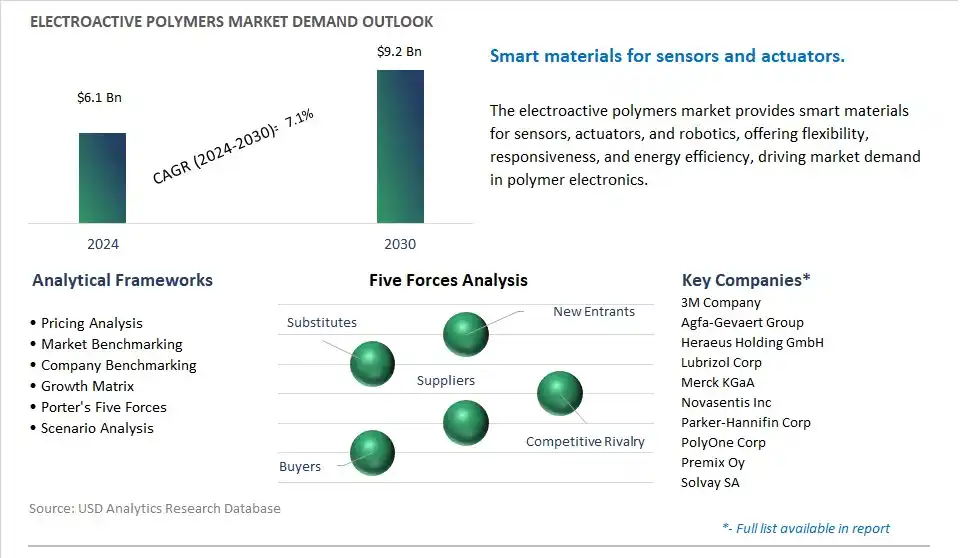
The market report analyses the leading companies in the industry including 3M Company, Agfa-Gevaert Group, Heraeus Holding GmbH, Lubrizol Corp, Merck KGaA, Novasentis Inc, Parker-Hannifin Corp, PolyOne Corp, Premix Oy, Solvay SA.
One prominent market trend in the electroactive polymers industry is the growing demand for flexible and lightweight materials. Electroactive polymers (EAPs) are gaining traction across various industries due to their unique properties, including flexibility, low weight, and ability to change shape or size in response to electrical stimulation. As industries such as robotics, aerospace, healthcare, and consumer electronics seek innovative solutions for flexible sensors, actuators, artificial muscles, and wearable devices, there is an increasing demand for electroactive polymers that offer versatility, durability, and adaptability to diverse applications. The trend fuels the shift towards the use of advanced materials that enable the development of flexible, lightweight, and multifunctional products with enhanced performance capabilities.
A key driver in the electroactive polymers market is technological advancements and research investments. Ongoing research and development activities in materials science, polymer chemistry, and electromechanical engineering are driving innovations in electroactive polymers, leading to the development of new formulations, manufacturing processes, and applications. Advancements in materials synthesis, polymer processing techniques, and electroactive materials integration are expanding the capabilities and functionalities of electroactive polymers, enabling their use in emerging technologies such as soft robotics, wearable electronics, smart textiles, and medical devices. Additionally, investments from government agencies, academic institutions, and private companies in research initiatives and collaborative partnerships are fueling the growth of the electroactive polymers industry, driving market expansion and technological advancement.
One potential opportunity in the electroactive polymers market lies in the adoption of electroactive polymers in healthcare and biomedical applications. Electroactive polymers offer unique advantages for medical devices and biomedical technologies due to their biocompatibility, flexibility, and responsiveness to electrical stimuli. There is an opportunity to leverage electroactive polymers for applications such as smart implants, drug delivery systems, wearable sensors, tissue engineering scaffolds, and prosthetics. By developing electroactive polymer-based solutions tailored to the specific needs of the healthcare industry, manufacturers can address challenges such as chronic diseases, aging populations, and personalized medicine, while improving patient outcomes, enhancing medical diagnostics, and advancing healthcare technologies. Additionally, partnerships with healthcare providers, research institutions, and regulatory agencies can facilitate the translation of electroactive polymer technologies from the laboratory to commercial applications, unlocking new opportunities for growth and innovation in the healthcare sector.
The electroactive polymers (EAP) market operates through a comprehensive Market Ecosystem, spanning from raw material acquisition to end-user applications, facilitating the development and utilization of materials capable of converting electrical energy into mechanical motion or vice versa. Beginning with Raw Material Suppliers including Dow and Merck KGaA, which provide monomers, conductive materials, and solvents, Material Development and Research entities including MIT and NIST conduct fundamental research and innovate new EAP materials.
EAP Manufacturers including BASF and Takimi GmbH utilize these materials to manufacture various EAP types, while Processing and Fabrication, handled by Contract Manufacturers including Plextronics and in-house facilities, ensure the production of EAP components. Distribution channels, including Specialty Material Distributors Mouser Electronics, and direct sales facilitated by EAP manufacturers, ensure accessibility to EAPs for researchers, developers, and companies. Further, End Users including Boeing, Medtronic, and Samsung integrate EAPs into aerospace and defense, medical devices, consumer electronics, and research and development applications, driving innovation and advancement within the electroactive polymers Industry
The largest segment in the Electroactive Polymers Market is the "Conductive Plastics" type. This dominance can be attributed to diverse key factors. Firstly, conductive plastics offer a combination of electrical conductivity and the lightweight and versatile properties of conventional polymers. This makes them suitable for a wide range of applications where both electrical conductivity and mechanical flexibility are required, such as in electronics, automotive components, and industrial equipment. Additionally, conductive plastics are relatively easy to process and can be molded into complex shapes, allowing for cost-effective manufacturing and design flexibility. In addition, the growing demand for lightweight and durable materials in various industries drives the adoption of conductive plastics for applications such as electromagnetic interference (EMI) shielding, electrostatic discharge (ESD) protection, and sensing technologies. Further, advancements in polymer science and additive technologies have led to the development of innovative conductive plastic formulations with enhanced conductivity, thermal stability, and mechanical properties, further expanding their applications and market penetration. As a result, the Conductive Plastics segment remains the largest in the electroactive polymers market due to its versatility, cost-effectiveness, and suitability for a wide range of electrical and electronic applications.
The fastest-growing segment in the Electroactive Polymers Market is the "Actuators" application category. This growth can be attributed to diverse key factors. Firstly, actuators made from electroactive polymers offer significant advantages over traditional mechanical actuators, including lightweight, compactness, and flexibility. Electroactive polymers can undergo significant deformation or change in shape in response to an external stimulus such as an electric field, enabling precise and controllable movement in various applications. Additionally, the increasing demand for miniaturization and integration of actuators in robotics, medical devices, consumer electronics, and automotive systems drives the adoption of electroactive polymer actuators. In addition, advancements in polymer science and manufacturing techniques have led to the development of new electroactive polymer materials with improved performance characteristics, such as higher actuation strains, faster response times, and enhanced durability. Further, the growing focus on automation, smart technologies, and wearable devices further accelerates the demand for electroactive polymer actuators in various industries, driving their rapid growth in the market. As a result, the Actuators application segment is experiencing significant growth in the electroactive polymers market due to its unique capabilities, versatility, and increasing adoption across diverse applications and industries.
By Type
Conductive Plastics
Inherently Conductive Polymers
Inherently Dissipative Polymers
By Application
Electrostatic Discharge Protection
Electromagnetic Interference Shielding
Actuators
Capacitors
Batteries
Sensors
Others
3M Company
Agfa-Gevaert Group
Heraeus Holding GmbH
Lubrizol Corp
Merck KGaA
Novasentis Inc
Parker-Hannifin Corp
PolyOne Corp
Premix Oy
Solvay SA
*- List Not Exhaustive
TABLE OF CONTENTS
1 Introduction to 2024 Electroactive Polymers Market
1.1 Market Overview
1.2 Quick Facts
1.3 Scope/Objective of the Study
1.4 Market Definition
1.5 Countries and Regions Covered
1.6 Units, Currency, and Conversions
1.7 Industry Value Chain
2 Research Methodology
2.1 Market Size Estimation
2.2 Sources and Research Methodology
2.3 Data Triangulation
2.4 Assumptions and Limitations
3 Executive Summary
3.1 Global Electroactive Polymers Market Size Outlook, $ Million, 2021 to 2030
3.2 Electroactive Polymers Market Outlook by Type, $ Million, 2021 to 2030
3.3 Electroactive Polymers Market Outlook by Product, $ Million, 2021 to 2030
3.4 Electroactive Polymers Market Outlook by Application, $ Million, 2021 to 2030
3.5 Electroactive Polymers Market Outlook by Key Countries, $ Million, 2021 to 2030
4 Market Dynamics
4.1 Key Driving Forces of Electroactive Polymers Industry
4.2 Key Market Trends in Electroactive Polymers Industry
4.3 Potential Opportunities in Electroactive Polymers Industry
4.4 Key Challenges in Electroactive Polymers Industry
5 Market Factor Analysis
5.1 Value Chain Analysis
5.2 Competitive Landscape
5.2.1 Global Electroactive Polymers Market Share by Company (%), 2023
5.2.2 Product Offerings by Company
5.3 Porter’s Five Forces Analysis
5.4 Pricing Analysis and Outlook
6 Growth Outlook Across Scenarios
6.1 Growth Analysis-Case Scenario Definitions
6.2 Low Growth Scenario Forecasts
6.3 Reference Growth Scenario Forecasts
6.4 High Growth Scenario Forecasts
7 Global Electroactive Polymers Market Outlook by Segments
7.1 Electroactive Polymers Market Outlook by Segments, $ Million, 2021- 2030
By Type
Conductive Plastics
Inherently Conductive Polymers
Inherently Dissipative Polymers
By Application
Electrostatic Discharge Protection
Electromagnetic Interference Shielding
Actuators
Capacitors
Batteries
Sensors
Others
8 North America Electroactive Polymers Market Analysis and Outlook To 2030
8.1 Introduction to North America Electroactive Polymers Markets in 2024
8.2 North America Electroactive Polymers Market Size Outlook by Country, 2021-2030
8.2.1 United States
8.2.2 Canada
8.2.3 Mexico
8.3 North America Electroactive Polymers Market size Outlook by Segments, 2021-2030
By Type
Conductive Plastics
Inherently Conductive Polymers
Inherently Dissipative Polymers
By Application
Electrostatic Discharge Protection
Electromagnetic Interference Shielding
Actuators
Capacitors
Batteries
Sensors
Others
9 Europe Electroactive Polymers Market Analysis and Outlook To 2030
9.1 Introduction to Europe Electroactive Polymers Markets in 2024
9.2 Europe Electroactive Polymers Market Size Outlook by Country, 2021-2030
9.2.1 Germany
9.2.2 France
9.2.3 Spain
9.2.4 United Kingdom
9.2.4 Italy
9.2.5 Russia
9.2.6 Norway
9.2.7 Rest of Europe
9.3 Europe Electroactive Polymers Market Size Outlook by Segments, 2021-2030
By Type
Conductive Plastics
Inherently Conductive Polymers
Inherently Dissipative Polymers
By Application
Electrostatic Discharge Protection
Electromagnetic Interference Shielding
Actuators
Capacitors
Batteries
Sensors
Others
10 Asia Pacific Electroactive Polymers Market Analysis and Outlook To 2030
10.1 Introduction to Asia Pacific Electroactive Polymers Markets in 2024
10.2 Asia Pacific Electroactive Polymers Market Size Outlook by Country, 2021-2030
10.2.1 China
10.2.2 India
10.2.3 Japan
10.2.4 South Korea
10.2.5 Indonesia
10.2.6 Malaysia
10.2.7 Australia
10.2.8 Rest of Asia Pacific
10.3 Asia Pacific Electroactive Polymers Market size Outlook by Segments, 2021-2030
By Type
Conductive Plastics
Inherently Conductive Polymers
Inherently Dissipative Polymers
By Application
Electrostatic Discharge Protection
Electromagnetic Interference Shielding
Actuators
Capacitors
Batteries
Sensors
Others
11 South America Electroactive Polymers Market Analysis and Outlook To 2030
11.1 Introduction to South America Electroactive Polymers Markets in 2024
11.2 South America Electroactive Polymers Market Size Outlook by Country, 2021-2030
11.2.1 Brazil
11.2.2 Argentina
11.2.3 Rest of South America
11.3 South America Electroactive Polymers Market size Outlook by Segments, 2021-2030
By Type
Conductive Plastics
Inherently Conductive Polymers
Inherently Dissipative Polymers
By Application
Electrostatic Discharge Protection
Electromagnetic Interference Shielding
Actuators
Capacitors
Batteries
Sensors
Others
12 Middle East and Africa Electroactive Polymers Market Analysis and Outlook To 2030
12.1 Introduction to Middle East and Africa Electroactive Polymers Markets in 2024
12.2 Middle East and Africa Electroactive Polymers Market Size Outlook by Country, 2021-2030
12.2.1 Saudi Arabia
12.2.2 UAE
12.2.3 Oman
12.2.4 Rest of Middle East
12.2.5 Egypt
12.2.6 Nigeria
12.2.7 South Africa
12.2.8 Rest of Africa
12.3 Middle East and Africa Electroactive Polymers Market size Outlook by Segments, 2021-2030
By Type
Conductive Plastics
Inherently Conductive Polymers
Inherently Dissipative Polymers
By Application
Electrostatic Discharge Protection
Electromagnetic Interference Shielding
Actuators
Capacitors
Batteries
Sensors
Others
13 Company Profiles
13.1 Company Snapshot
13.2 SWOT Profiles
13.3 Products and Services
13.4 Recent Developments
13.5 Financial Profile
3M Company
Agfa-Gevaert Group
Heraeus Holding GmbH
Lubrizol Corp
Merck KGaA
Novasentis Inc
Parker-Hannifin Corp
PolyOne Corp
Premix Oy
Solvay SA
14 Appendix
14.1 Customization Offerings
14.2 Subscription Services
14.3 Related Reports
14.4 Publisher Expertise
By Type
Conductive Plastics
Inherently Conductive Polymers
Inherently Dissipative Polymers
By Application
Electrostatic Discharge Protection
Electromagnetic Interference Shielding
Actuators
Capacitors
Batteries
Sensors
Others
Countries Analyzed
North America (US, Canada, Mexico)
Europe (Germany, UK, France, Spain, Italy, Russia, Rest of Europe)
Asia Pacific (China, India, Japan, South Korea, Australia, South East Asia, Rest of Asia)
South America (Brazil, Argentina, Rest of South America)
Middle East and Africa (Saudi Arabia, UAE, Rest of Middle East, South Africa, Egypt, Rest of Africa)
Global Electroactive Polymers is forecast to reach $9.2 Billion in 2030 from $6.1 Billion in 2024, registering a CAGR of 7.1% over the outlook period
Emerging Markets across Asia Pacific, Europe, and Americas present robust growth prospects.
3M Company, Agfa-Gevaert Group, Heraeus Holding GmbH, Lubrizol Corp, Merck KGaA, Novasentis Inc, Parker-Hannifin Corp, PolyOne Corp, Premix Oy, Solvay SA
Base Year- 2023; Estimated Year- 2024; Historic Period- 2018-2023; Forecast period- 2024 to 2030; Currency: Revenue (USD); Volume