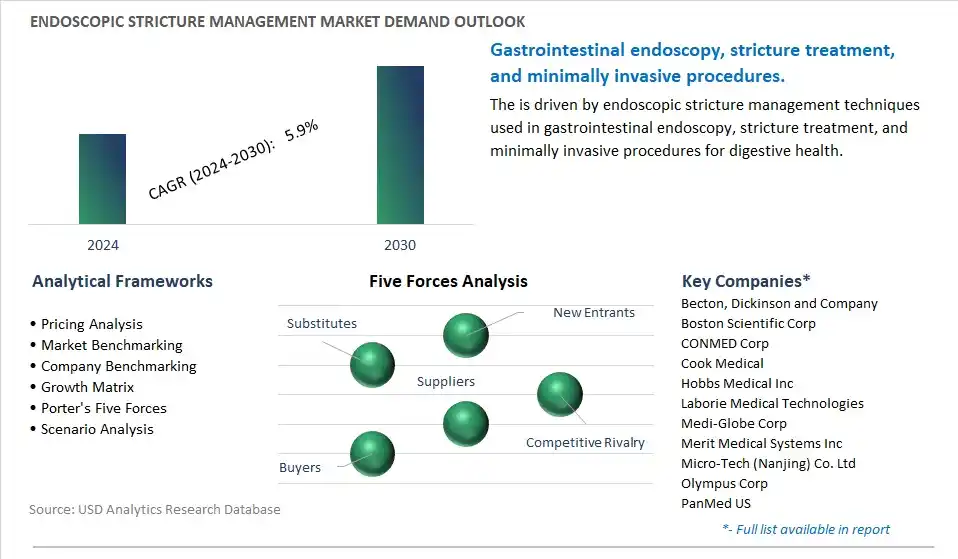
Endoscopic Stricture Management Market is estimated to increase at a Compounded Annual Growth Rate of 5.9% CAGR over the forecast period from 2024 to 2030
The Endoscopic Stricture Management Market study analyzes and forecasts the market size across 6 regions and 24 countries for diverse segments- By Type (Balloon Dilators, Stents, Bougie Dilators), By Application (Esophageal, Biliary, Others), By End-User (Hospitals, Ambulatory Surgical Centers, Others).
An Introduction to Endoscopic Stricture Management Market in 2024
In 2024, the market for endoscopic stricture management addresses the clinical challenges associated with gastrointestinal strictures, offering a range of endoscopic devices, accessories, and techniques for the diagnosis, dilation, and treatment of esophageal, gastric, and colonic strictures resulting from benign or malignant conditions. Gastrointestinal strictures are characterized by abnormal narrowing of the digestive tract due to scar tissue formation, inflammation, tumors, or other pathological processes, which can lead to dysphagia, obstruction, and gastrointestinal symptoms. Endoscopic stricture management involves the use of flexible endoscopes, balloon dilators, stents, and tissue resection devices to assess stricture severity, relieve luminal obstruction, and restore luminal patency while minimizing the need for surgical intervention. Endoscopic techniques such as balloon dilation, bougie dilatation, needle-knife stricturotomy, and stent placement offer minimally invasive alternatives to surgery for managing strictures in the esophagus, stomach, or colon, providing symptomatic relief and improving quality of life for patients with benign or malignant strictures. With a focus on procedural safety, efficacy, and patient outcomes, endoscopic stricture management devices undergo clinical evaluation, procedural training, and quality assurance measures to ensure optimal performance, complication rates, and patient satisfaction. Moreover, with advancements in endoscopic imaging, tissue characterization, and therapeutic interventions, the endoscopic stricture management market continues to evolve, offering innovative solutions, combination therapies, and multidisciplinary approaches for addressing complex strictures, improving treatment outcomes, and optimizing patient care in gastroenterology and gastrointestinal surgery.
Market Trend: Advancements in Endoscopic Technology and Techniques
A prominent trend in the endoscopic stricture management market is the continuous advancements in endoscopic technology and techniques. Endoscopic interventions have become the cornerstone of managing strictures across various anatomical sites, including the esophagus, gastrointestinal tract, and biliary system. Recent innovations in endoscopic instrumentation, such as the development of specialized dilation devices, stents, and accessories, have expanded treatment options and improved procedural outcomes for patients with strictures. Additionally, advanced endoscopic techniques such as balloon dilation, incisional therapy, and stent placement offer minimally invasive alternatives to surgery, reducing patient morbidity and healthcare costs. This trend reflects the ongoing efforts to enhance the efficacy, safety, and accessibility of endoscopic stricture management, driving market growth and adoption of novel endoscopic technologies and techniques.
Market Driver: Growing Incidence of Gastrointestinal Disorders and Cancer
A key driver for the endoscopic stricture management market is the growing incidence of gastrointestinal disorders and cancer worldwide. Strictures, or narrowings of the luminal passages, can arise as a consequence of various conditions such as gastroesophageal reflux disease (GERD), inflammatory bowel disease (IBD), benign strictures, and malignancies such as esophageal, gastric, or colorectal cancer. With the increasing prevalence of these diseases, there is a corresponding rise in the incidence of strictures requiring therapeutic intervention. Endoscopic stricture management techniques play a vital role in relieving symptoms, improving quality of life, and preventing complications associated with strictures, thereby driving demand for endoscopic procedures and devices. The growing burden of gastrointestinal disorders and cancer underscores the importance of effective stricture management strategies, supporting market growth and investment in endoscopic technologies.
Market Opportunity: Personalized Treatment Approaches and Precision Medicine
An opportunity for innovation and market expansion in the endoscopic stricture management market lies in the development of personalized treatment approaches and precision medicine strategies. As our understanding of the underlying mechanisms and molecular pathways driving stricture formation advances, there is an opportunity to tailor therapeutic interventions to individual patient characteristics, disease etiology, and treatment response. By integrating molecular diagnostics, imaging modalities, and biomarker assessments into the diagnostic workup, clinicians can identify patients who are most to benefit from specific endoscopic interventions or targeted therapies. Additionally, there is an opportunity to leverage emerging technologies such as artificial intelligence (AI) and machine learning (ML) to predict treatment outcomes, optimize procedural planning, and enhance patient selection for endoscopic stricture management. This opportunity aligns with the trend towards personalized medicine, precision oncology, and value-based healthcare delivery, driving innovation and market differentiation in the personalized endoscopic stricture management segment.
Endoscopic Stricture Management Market Share Analysis: Stents
The Stents segment within the Endoscopic Stricture Management market is experiencing rapid growth due to several factors driving the demand for effective and minimally invasive treatment options for gastrointestinal strictures. Stents are tubular devices made of metal or polymer materials that are inserted endoscopically to expand strictures and maintain luminal patency in the esophagus, biliary tract, and other gastrointestinal regions. These devices offer advantages such as immediate symptom relief, durable patency, and reduced risk of tissue trauma compared to traditional dilation techniques such as balloon dilators and bougie dilators. With the increasing prevalence of benign and malignant strictures in the gastrointestinal tract, there is a growing need for stent-based interventions that provide long-lasting relief of symptoms and improve patient quality of life. Stents play a crucial role in the management of esophageal strictures caused by conditions such as gastroesophageal reflux disease (GERD), esophageal cancer, and eosinophilic esophagitis, as well as biliary strictures resulting from gallstones, biliary tract infections, and malignancies. Additionally, advancements in stent design, including the development of self-expandable and fully covered stents with anti-migration features, enhance the safety and efficacy of endoscopic stricture management procedures. Hospitals, ambulatory surgical centers, and other healthcare facilities are increasingly adopting stent-based approaches for the treatment of gastrointestinal strictures, driven by the growing demand for minimally invasive and durable solutions. As the prevalence of gastrointestinal strictures continues to rise, particularly in aging populations, the Stents segment is poised for significant growth in the Endoscopic Stricture Management market, offering effective and long-term solutions for patients with luminal narrowing.
Endoscopic Stricture Management Competitive Analysis
The market research study provides in-depth insights into leading companies including the SWOT analyses, product profile, financial details, and recent developments acrossBecton, Dickinson and Company, Boston Scientific Corp, CONMED Corp, Cook Medical, Hobbs Medical Inc, Laborie Medical Technologies, Medi-Globe Corp, Merit Medical Systems Inc, Micro-Tech (Nanjing) Co. Ltd, Olympus Corp, PanMed US, STERIS plc
Endoscopic Stricture Management Market Segmentation
By Type
Balloon Dilators
Stents
Bougie Dilators
By Application
Esophageal
Biliary
Others
By End-User
Hospitals
Ambulatory Surgical Centers
Others
Geographical Analysis
North America (United States, Canada, Mexico)
Europe (Germany, France, United Kingdom, Spain, Italy, Rest of Europe)
Asia Pacific (China, India, Japan, South Korea, Rest of Asia Pacific)
South America (Brazil, Argentina, Rest of South America)
Middle East and Africa (Saudi Arabia, UAE, Rest of Middle East, South Africa, Egypt, Rest of Africa)
Endoscopic Stricture Management Market Companies
Becton, Dickinson and Company
Boston Scientific Corp
CONMED Corp
Cook Medical
Hobbs Medical Inc
Laborie Medical Technologies
Medi-Globe Corp
Merit Medical Systems Inc
Micro-Tech (Nanjing) Co. Ltd
Olympus Corp
PanMed US
STERIS plc
Reasons to Buy the Endoscopic Stricture Management Market Study
• Deepen your industry insights and navigate uncertainties for strategy formulation, CAPEX, and Operational decisions
• Gain access to detailed insights on the Endoscopic Stricture Management Market, encompassing current market size, growth trends, and forecasts till 2030.
• Access detailed competitor analysis, enabling competitive advantage through a thorough understanding of market players, strategies, and potential differentiation opportunities
• Stay ahead of the curve with insights on technological advancements, innovations, and upcoming trends
• Identify lucrative investment avenues and expansion opportunities within the Endoscopic Stricture Management Market industry, guided by robust, data-backed analysis.
• Understand regional and global markets through country-wise analysis, regional market potential, regulatory nuances, and dynamics
• Execute strategies with confidence and speed through information, analytics, and insights on the industry value chain
• Corporate leaders, strategists, financial experts, shareholders, asset managers, and governmental representatives can make long-term planning scenarios and build an integrated and timely understanding of market dynamics
• Benefit from tailored solutions and expert consultation based on report insights, providing personalized strategies aligned with specific business needs.
TABLE OF CONTENTS
1 Introduction to 2024 Endoscopic Stricture Management Market
1.1 Market Overview
1.2 Quick Facts
1.3 Scope/Objective of the Study
1.4 Market Definition
1.5 Countries and Regions Covered
1.6 Units, Currency, and Conversions
1.7 Industry Value Chain
2 Research Methodology
2.1 Market Size Estimation
2.2 Sources and Research Methodology
2.3 Data Triangulation
2.4 Assumptions and Limitations
3 Executive Summary
3.1 Global Endoscopic Stricture Management Market Size Outlook, $ Million, 2021 to 2030
3.2 Endoscopic Stricture Management Market Outlook by Type, $ Million, 2021 to 2030
3.3 Endoscopic Stricture Management Market Outlook by Product, $ Million, 2021 to 2030
3.4 Endoscopic Stricture Management Market Outlook by Application, $ Million, 2021 to 2030
3.5 Endoscopic Stricture Management Market Outlook by Key Countries, $ Million, 2021 to 2030
4 Market Dynamics
4.1 Key Driving Forces of Endoscopic Stricture Management Industry
4.2 Key Market Trends in Endoscopic Stricture Management Industry
4.3 Potential Opportunities in Endoscopic Stricture Management Industry
4.4 Key Challenges in Endoscopic Stricture Management Industry
5 Market Factor Analysis
5.1 Value Chain Analysis
5.2 Competitive Landscape
5.2.1 Global Endoscopic Stricture Management Market Share by Company (%), 2023
5.2.2 Product Offerings by Company
5.3 Porter’s Five Forces Analysis
5.4 Pricing Analysis and Outlook
6 Growth Outlook Across Scenarios
6.1 Growth Analysis-Case Scenario Definitions
6.2 Low Growth Scenario Forecasts
6.3 Reference Growth Scenario Forecasts
6.4 High Growth Scenario Forecasts
7 Global Endoscopic Stricture Management Market Outlook by Segments
7.1 Endoscopic Stricture Management Market Outlook by Segments, $ Million, 2021- 2030
By Type
Balloon Dilators
Stents
Bougie Dilators
By Application
Esophageal
Biliary
Others
By End-User
Hospitals
Ambulatory Surgical Centers
Others
8 North America Endoscopic Stricture Management Market Analysis and Outlook To 2030
8.1 Introduction to North America Endoscopic Stricture Management Markets in 2024
8.2 North America Endoscopic Stricture Management Market Size Outlook by Country, 2021-2030
8.2.1 United States
8.2.2 Canada
8.2.3 Mexico
8.3 North America Endoscopic Stricture Management Market size Outlook by Segments, 2021-2030
By Type
Balloon Dilators
Stents
Bougie Dilators
By Application
Esophageal
Biliary
Others
By End-User
Hospitals
Ambulatory Surgical Centers
Others
9 Europe Endoscopic Stricture Management Market Analysis and Outlook To 2030
9.1 Introduction to Europe Endoscopic Stricture Management Markets in 2024
9.2 Europe Endoscopic Stricture Management Market Size Outlook by Country, 2021-2030
9.2.1 Germany
9.2.2 France
9.2.3 Spain
9.2.4 United Kingdom
9.2.4 Italy
9.2.5 Russia
9.2.6 Norway
9.2.7 Rest of Europe
9.3 Europe Endoscopic Stricture Management Market Size Outlook by Segments, 2021-2030
By Type
Balloon Dilators
Stents
Bougie Dilators
By Application
Esophageal
Biliary
Others
By End-User
Hospitals
Ambulatory Surgical Centers
Others
10 Asia Pacific Endoscopic Stricture Management Market Analysis and Outlook To 2030
10.1 Introduction to Asia Pacific Endoscopic Stricture Management Markets in 2024
10.2 Asia Pacific Endoscopic Stricture Management Market Size Outlook by Country, 2021-2030
10.2.1 China
10.2.2 India
10.2.3 Japan
10.2.4 South Korea
10.2.5 Indonesia
10.2.6 Malaysia
10.2.7 Australia
10.2.8 Rest of Asia Pacific
10.3 Asia Pacific Endoscopic Stricture Management Market size Outlook by Segments, 2021-2030
By Type
Balloon Dilators
Stents
Bougie Dilators
By Application
Esophageal
Biliary
Others
By End-User
Hospitals
Ambulatory Surgical Centers
Others
11 South America Endoscopic Stricture Management Market Analysis and Outlook To 2030
11.1 Introduction to South America Endoscopic Stricture Management Markets in 2024
11.2 South America Endoscopic Stricture Management Market Size Outlook by Country, 2021-2030
11.2.1 Brazil
11.2.2 Argentina
11.2.3 Rest of South America
11.3 South America Endoscopic Stricture Management Market size Outlook by Segments, 2021-2030
By Type
Balloon Dilators
Stents
Bougie Dilators
By Application
Esophageal
Biliary
Others
By End-User
Hospitals
Ambulatory Surgical Centers
Others
12 Middle East and Africa Endoscopic Stricture Management Market Analysis and Outlook To 2030
12.1 Introduction to Middle East and Africa Endoscopic Stricture Management Markets in 2024
12.2 Middle East and Africa Endoscopic Stricture Management Market Size Outlook by Country, 2021-2030
12.2.1 Saudi Arabia
12.2.2 UAE
12.2.3 Oman
12.2.4 Rest of Middle East
12.2.5 Egypt
12.2.6 Nigeria
12.2.7 South Africa
12.2.8 Rest of Africa
12.3 Middle East and Africa Endoscopic Stricture Management Market size Outlook by Segments, 2021-2030
By Type
Balloon Dilators
Stents
Bougie Dilators
By Application
Esophageal
Biliary
Others
By End-User
Hospitals
Ambulatory Surgical Centers
Others
13 Company Profiles
13.1 Company Snapshot
13.2 SWOT Profiles
13.3 Products and Services
13.4 Recent Developments
13.5 Financial Profile
List of Companies
Becton, Dickinson and Company
Boston Scientific Corp
CONMED Corp
Cook Medical
Hobbs Medical Inc
Laborie Medical Technologies
Medi-Globe Corp
Merit Medical Systems Inc
Micro-Tech (Nanjing) Co. Ltd
Olympus Corp
PanMed US
STERIS plc
14 Appendix
14.1 Customization Offerings
14.2 Subscription Services
14.3 Related Reports
14.4 Publisher Expertise
By Type
Balloon Dilators
Stents
Bougie Dilators
By Application
Esophageal
Biliary
Others
By End-User
Hospitals
Ambulatory Surgical Centers
Others
Countries Analyzed
North America (United States, Canada, Mexico)
Europe (Germany, France, United Kingdom, Spain, Italy, Rest of Europe)
Asia Pacific (China, India, Japan, South Korea, Rest of Asia Pacific)
South America (Brazil, Argentina, Rest of South America)
Middle East and Africa (Saudi Arabia, UAE, Rest of Middle East, South Africa, Egypt, Rest of Africa)
