The global Enhanced Gas Recovery Market is poised to register a 6.7% CAGR from $22.1 Billion in 2024 to $32.6 Billion in 2030.
The global Enhanced Gas Recovery Market Study analyzes and forecasts the market size across 6 regions and 24 countries for diverse segments -By Type (Nitrogen-Based EGR, Carbon Dioxide-Based EGR), By Application (Oil and Gas Industry, Construction Industry, Residential, Others).
An Introduction to Global Enhanced Gas Recovery Market in 2024
In the enhanced gas recovery market, the future is driven by trends such as increasing energy demand, maturing gas fields, and advancements in recovery techniques driving innovation in gas extraction, processing, and utilization. Enhanced gas recovery techniques, including hydraulic fracturing, CO2 injection, and gas reinjection, are used to maximize the recovery of natural gas from conventional and unconventional reservoirs. Key trends shaping this market include advancements in reservoir modeling and simulation to optimize recovery strategies and production efficiency, the development of advanced drilling and completion technologies to access previously inaccessible gas reserves, and the integration of enhanced gas recovery methods with carbon capture and storage (CCS) technologies to reduce greenhouse gas emissions and enhance energy sustainability. As global energy demand continues to rise and conventional gas reserves decline, the demand for enhanced gas recovery solutions that offer higher yields, lower costs, and reduced environmental impact is expected to drive market growth and inspire further innovation in gas recovery techniques and technologies.
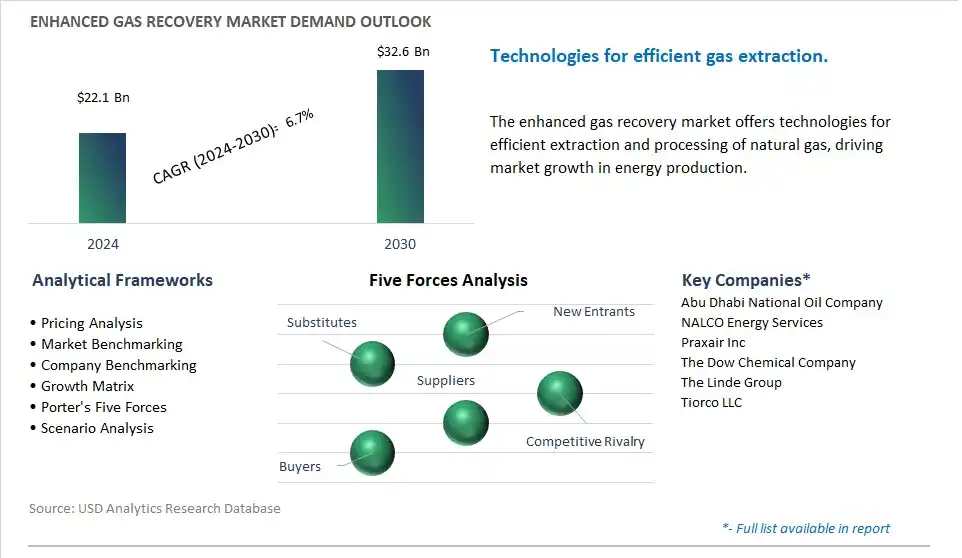
Enhanced Gas Recovery Market Competitive Landscape
The market report analyses the leading companies in the industry including Abu Dhabi National Oil Company, NALCO Energy Services, Praxair Inc, The Dow Chemical Company, The Linde Group, Tiorco LLC.
Enhanced Gas Recovery Market Dynamics
Enhanced Gas Recovery Market Trend: Growing Demand for Energy Security and Sustainability
One prominent market trend in the enhanced gas recovery industry is the growing demand for energy security and sustainability. With increasing global energy consumption and concerns about climate change, there is a heightened focus on maximizing the efficiency of natural gas production while minimizing environmental impact. Enhanced gas recovery techniques, such as hydraulic fracturing (fracking), CO2 injection, and microbial stimulation, are gaining traction as they enable operators to extract more gas from existing reservoirs, increase recovery rates, and extend the productive life of gas fields.
Enhanced Gas Recovery Market Driver: Depletion of Conventional Gas Reserves
A key driver in the enhanced gas recovery market is the depletion of conventional gas reserves. As traditional gas fields mature and production rates decline, operators are increasingly turning to enhanced recovery techniques to access remaining gas resources and maintain production levels. Enhanced gas recovery methods, such as CO2 flooding and nitrogen injection, offer cost-effective solutions to stimulate gas flow, displace trapped hydrocarbons, and improve overall reservoir performance. The need to offset declining production from conventional gas reserves and meet growing energy demand drives market demand for enhanced gas recovery technologies and services, providing opportunities for innovation and investment in the industry.
Enhanced Gas Recovery Market Opportunity: Adoption of Advanced Technologies and Digital Solutions
One potential opportunity in the enhanced gas recovery market lies in the adoption of advanced technologies and digital solutions. Operators have an opportunity to leverage technologies such as advanced reservoir modeling, real-time monitoring systems, and predictive analytics to optimize gas recovery processes, improve operational efficiency, and reduce environmental footprint. Additionally, the integration of automation, robotics, and artificial intelligence (AI) in gas recovery operations can enhance decision-making, streamline workflows, and optimize resource utilization. By embracing digital transformation and investing in innovative solutions, stakeholders in the enhanced gas recovery industry can unlock opportunities to increase gas production, reduce costs, and mitigate environmental risks, contributing to sustainable and responsible gas extraction practices.
Enhanced Gas Recovery Market Ecosystem
The enhanced gas recovery (EGR) market involves a series of interconnected stages, beginning with reservoir evaluation and selection by companies including ExxonMobil and Schlumberger, which assess existing gas reserves for EGR suitability. Further, technology selection and design are crucial, with oilfield service firms including Halliburton, and engineering companies including TechnipFMC offering expertise in designing and engineering EGR systems tailored to specific reservoirs.
Equipment and material suppliers including GE Oil & Gas and Dow play pivotal roles by providing essential components and chemicals for EGR processes. Project implementation and construction are managed by oil and gas contractors including Fluor Corporation and drilling service companies including Helmerich & Payne.
During operation and maintenance phases, both oil and gas E&P companies and service providers including Halliburton and Schlumberger ensure the smooth functioning of EGR systems, while monitoring and optimization stages are facilitated by data analytics firms including Infosys and reservoir management service providers including Schlumberger and Baker Hughes, ensuring continuous improvement in EGR performance.
Enhanced Gas Recovery Market Share Analysis: Carbon Dioxide-Based EGR held the dominant revenue share in 2024
The largest segment in the Enhanced Gas Recovery (EGR) Market is the "Carbon Dioxide-Based EGR" type category. This dominance can be attributed to diverse key factors. Firstly, carbon dioxide (CO2)-based enhanced gas recovery methods involve injecting CO2 into underground reservoirs to displace and mobilize trapped natural gas, enhancing its recovery and extraction efficiency. This method is particularly effective in mature oil and gas fields where conventional extraction techniques have depleted the majority of recoverable reserves. Additionally, CO2-based EGR processes offer diverse advantages, including improved reservoir sweep efficiency, reduced viscosity of hydrocarbons, and enhanced gas-oil displacement ratios, leading to higher ultimate recovery rates and increased production yields. In addition, CO2 is readily available from various industrial processes and natural sources, making it a cost-effective and accessible injection fluid for EGR operations. Further, CO2-based EGR projects often align with carbon capture and storage (CCS) initiatives aimed at mitigating greenhouse gas emissions and reducing environmental impacts by capturing and sequestering CO2 underground, thereby contributing to sustainable energy practices and climate change mitigation efforts. As a result, the Carbon Dioxide-Based EGR type segment remains the largest in the Enhanced Gas Recovery Market due to its effectiveness, versatility, and alignment with sustainable energy objectives, making it a preferred choice for enhancing gas recovery in oil and gas reservoirs.
Enhanced Gas Recovery Market Share Analysis: Oil and Gas Industry is the fastest growing market segment over the forecast period to 2030
The fastest-growing segment in the Enhanced Gas Recovery (EGR) Market is the "Oil and Gas Industry" application category. This growth is primarily driven by the increasing global demand for hydrocarbon fuels and the need to maximize production from existing oil and gas reservoirs. As conventional oil and gas reserves become increasingly depleted, operators are turning to enhanced recovery techniques like EGR to extract remaining hydrocarbons efficiently. EGR methods involve injecting various substances such as carbon dioxide (CO2) or nitrogen into reservoirs to displace and mobilize trapped gas, improving recovery rates. In addition, technological advancements in EGR processes, such as advanced reservoir simulation techniques, horizontal drilling, and hydraulic fracturing, have made EGR more cost-effective and feasible for challenging geological formations. Additionally, environmental regulations and sustainability goals are driving the adoption of CO2-based EGR projects, as they offer the dual benefit of enhanced hydrocarbon recovery and carbon capture and storage (CCS). These factors contribute to the rapid growth of EGR applications in the oil and gas industry as operators seek to maximize production while minimizing environmental impact.
Enhanced Gas Recovery Market Report Scope-
By Type
Nitrogen-Based EGR
Carbon Dioxide-Based EGR
By Application
Oil and Gas Industry
Construction Industry
Residential
Others
Enhanced Gas Recovery Market Companies Profiled
Abu Dhabi National Oil Company
NALCO Energy Services
Praxair Inc
The Dow Chemical Company
The Linde Group
Tiorco LLC
*- List Not Exhaustive
TABLE OF CONTENTS
1 Introduction to 2024 Enhanced Gas Recovery Market
1.1 Market Overview
1.2 Quick Facts
1.3 Scope/Objective of the Study
1.4 Market Definition
1.5 Countries and Regions Covered
1.6 Units, Currency, and Conversions
1.7 Industry Value Chain
2 Research Methodology
2.1 Market Size Estimation
2.2 Sources and Research Methodology
2.3 Data Triangulation
2.4 Assumptions and Limitations
3 Executive Summary
3.1 Global Enhanced Gas Recovery Market Size Outlook, $ Million, 2021 to 2030
3.2 Enhanced Gas Recovery Market Outlook by Type, $ Million, 2021 to 2030
3.3 Enhanced Gas Recovery Market Outlook by Product, $ Million, 2021 to 2030
3.4 Enhanced Gas Recovery Market Outlook by Application, $ Million, 2021 to 2030
3.5 Enhanced Gas Recovery Market Outlook by Key Countries, $ Million, 2021 to 2030
4 Market Dynamics
4.1 Key Driving Forces of Enhanced Gas Recovery Industry
4.2 Key Market Trends in Enhanced Gas Recovery Industry
4.3 Potential Opportunities in Enhanced Gas Recovery Industry
4.4 Key Challenges in Enhanced Gas Recovery Industry
5 Market Factor Analysis
5.1 Value Chain Analysis
5.2 Competitive Landscape
5.2.1 Global Enhanced Gas Recovery Market Share by Company (%), 2023
5.2.2 Product Offerings by Company
5.3 Porter’s Five Forces Analysis
5.4 Pricing Analysis and Outlook
6 Growth Outlook Across Scenarios
6.1 Growth Analysis-Case Scenario Definitions
6.2 Low Growth Scenario Forecasts
6.3 Reference Growth Scenario Forecasts
6.4 High Growth Scenario Forecasts
7 Global Enhanced Gas Recovery Market Outlook by Segments
7.1 Enhanced Gas Recovery Market Outlook by Segments, $ Million, 2021- 2030
By Type
Nitrogen-Based EGR
Carbon Dioxide-Based EGR
By Application
Oil and Gas Industry
Construction Industry
Residential
Others
8 North America Enhanced Gas Recovery Market Analysis and Outlook To 2030
8.1 Introduction to North America Enhanced Gas Recovery Markets in 2024
8.2 North America Enhanced Gas Recovery Market Size Outlook by Country, 2021-2030
8.2.1 United States
8.2.2 Canada
8.2.3 Mexico
8.3 North America Enhanced Gas Recovery Market size Outlook by Segments, 2021-2030
By Type
Nitrogen-Based EGR
Carbon Dioxide-Based EGR
By Application
Oil and Gas Industry
Construction Industry
Residential
Others
9 Europe Enhanced Gas Recovery Market Analysis and Outlook To 2030
9.1 Introduction to Europe Enhanced Gas Recovery Markets in 2024
9.2 Europe Enhanced Gas Recovery Market Size Outlook by Country, 2021-2030
9.2.1 Germany
9.2.2 France
9.2.3 Spain
9.2.4 United Kingdom
9.2.4 Italy
9.2.5 Russia
9.2.6 Norway
9.2.7 Rest of Europe
9.3 Europe Enhanced Gas Recovery Market Size Outlook by Segments, 2021-2030
By Type
Nitrogen-Based EGR
Carbon Dioxide-Based EGR
By Application
Oil and Gas Industry
Construction Industry
Residential
Others
10 Asia Pacific Enhanced Gas Recovery Market Analysis and Outlook To 2030
10.1 Introduction to Asia Pacific Enhanced Gas Recovery Markets in 2024
10.2 Asia Pacific Enhanced Gas Recovery Market Size Outlook by Country, 2021-2030
10.2.1 China
10.2.2 India
10.2.3 Japan
10.2.4 South Korea
10.2.5 Indonesia
10.2.6 Malaysia
10.2.7 Australia
10.2.8 Rest of Asia Pacific
10.3 Asia Pacific Enhanced Gas Recovery Market size Outlook by Segments, 2021-2030
By Type
Nitrogen-Based EGR
Carbon Dioxide-Based EGR
By Application
Oil and Gas Industry
Construction Industry
Residential
Others
11 South America Enhanced Gas Recovery Market Analysis and Outlook To 2030
11.1 Introduction to South America Enhanced Gas Recovery Markets in 2024
11.2 South America Enhanced Gas Recovery Market Size Outlook by Country, 2021-2030
11.2.1 Brazil
11.2.2 Argentina
11.2.3 Rest of South America
11.3 South America Enhanced Gas Recovery Market size Outlook by Segments, 2021-2030
By Type
Nitrogen-Based EGR
Carbon Dioxide-Based EGR
By Application
Oil and Gas Industry
Construction Industry
Residential
Others
12 Middle East and Africa Enhanced Gas Recovery Market Analysis and Outlook To 2030
12.1 Introduction to Middle East and Africa Enhanced Gas Recovery Markets in 2024
12.2 Middle East and Africa Enhanced Gas Recovery Market Size Outlook by Country, 2021-2030
12.2.1 Saudi Arabia
12.2.2 UAE
12.2.3 Oman
12.2.4 Rest of Middle East
12.2.5 Egypt
12.2.6 Nigeria
12.2.7 South Africa
12.2.8 Rest of Africa
12.3 Middle East and Africa Enhanced Gas Recovery Market size Outlook by Segments, 2021-2030
By Type
Nitrogen-Based EGR
Carbon Dioxide-Based EGR
By Application
Oil and Gas Industry
Construction Industry
Residential
Others
13 Company Profiles
13.1 Company Snapshot
13.2 SWOT Profiles
13.3 Products and Services
13.4 Recent Developments
13.5 Financial Profile
Abu Dhabi National Oil Company
NALCO Energy Services
Praxair Inc
The Dow Chemical Company
The Linde Group
Tiorco LLC
14 Appendix
14.1 Customization Offerings
14.2 Subscription Services
14.3 Related Reports
14.4 Publisher Expertise
By Type
Nitrogen-Based EGR
Carbon Dioxide-Based EGR
By Application
Oil and Gas Industry
Construction Industry
Residential
Others
Countries Analyzed
North America (US, Canada, Mexico)
Europe (Germany, UK, France, Spain, Italy, Russia, Rest of Europe)
Asia Pacific (China, India, Japan, South Korea, Australia, South East Asia, Rest of Asia)
South America (Brazil, Argentina, Rest of South America)
Middle East and Africa (Saudi Arabia, UAE, Rest of Middle East, South Africa, Egypt, Rest of Africa)
