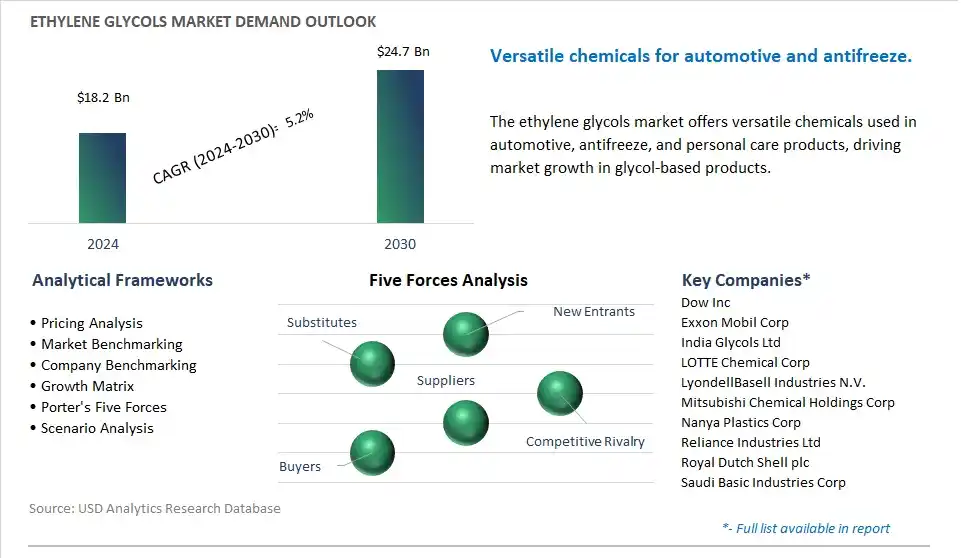
The global Ethylene Glycols Market is poised to register a 5.2% CAGR from $18.2 Billion in 2024 to $24.7 Billion in 2030.
The global Ethylene Glycols Market Study analyzes and forecasts the market size across 6 regions and 24 countries for diverse segments -By Type (Mono Ethylene Glycol, Di Ethylene Glycol, Tri Ethylene Glycol), By Application (PET, Polyester Fibers, Anti-Freeze, Films, Others).
An Introduction to Global Ethylene Glycols Market in 2024
In the ethylene glycols market, the future is driven by trends such as industrial demand, sustainability initiatives, and technological advancements driving innovation in production processes, applications, and product diversification. Ethylene glycols, including monoethylene glycol (MEG), diethylene glycol (DEG), and triethylene glycol (TEG), are versatile chemicals used in various industries such as textiles, automotive, and antifreeze manufacturing. Key trends shaping this market include advancements in ethylene glycol production technologies such as catalytic oxidation and hydration processes to improve efficiency, yield, and environmental performance, the development of specialty grades and derivatives of ethylene glycols for specific applications such as polyester production, gas dehydration, and solvent formulations, and the adoption of sustainable practices such as carbon capture and utilization, renewable feedstock utilization, and waste heat recovery to reduce environmental impact and carbon footprint. As industries seek safer, more efficient, and environmentally friendly solutions, the demand for ethylene glycols and their derivatives is expected to drive market growth and inspire further innovation in ethylene glycol chemistry and applications.
Ethylene Glycols Market Competitive Landscape
The market report analyses the leading companies in the industry including Dow Inc, Exxon Mobil Corp, India Glycols Ltd, LOTTE Chemical Corp, LyondellBasell Industries N.V., Mitsubishi Chemical Holdings Corp, Nanya Plastics Corp, Reliance Industries Ltd, Royal Dutch Shell plc, Saudi Basic Industries Corp.
Ethylene Glycols Market Dynamics
Ethylene Glycols Market Trend: Shift towards Sustainable and Bio-based Ethylene Glycols
One prominent market trend for Ethylene Glycols is the increasing shift towards sustainable and bio-based alternatives. With growing environmental concerns and regulations aimed at reducing carbon footprints, industries are seeking greener solutions. The trend is driving the demand for ethylene glycols derived from renewable feedstocks such as bioethanol or glycerol. Manufacturers are investing in research and development to innovate sustainable production processes, thereby aligning with the global push towards sustainability and offering eco-friendly options to consumers across various sectors.
Ethylene Glycols Market Driver: Growing Demand from End-Use Industries
A key driver fueling the Ethylene Glycols market is the rising demand from diverse end-use industries such as automotive, textiles, and packaging. Ethylene glycols, particularly monoethylene glycol (MEG), are essential components in the production of polyester fibers, polyethylene terephthalate (PET) resins, antifreeze solutions, and various other industrial applications. The expanding global population, coupled with increasing urbanization and industrialization, is driving the consumption of products reliant on ethylene glycols. Additionally, advancements in manufacturing processes and product formulations are further stimulating market growth, as industries continue to innovate and optimize their operations.
Ethylene Glycols Market Opportunity: Expansion in Emerging Markets
An enticing opportunity for Ethylene Glycols lies in expanding its presence in emerging markets across regions like Asia-Pacific, Latin America, and Africa. Rapid economic development, urbanization, and industrial growth in these regions are driving the demand for ethylene glycols in various applications, including automotive coolants, textile processing, and packaging materials. By leveraging strategic partnerships, investing in local production facilities, and adapting to regional preferences and regulations, companies can tap into the vast potential of these markets. Moreover, initiatives promoting infrastructure development and sustainable practices present avenues for ethylene glycols to play a vital role in supporting the growth and development of emerging economies, thereby fostering long-term market expansion and profitability.
Ethylene Glycols Market Ecosystem
The Ethylene Glycol (EG) market Ecosystem begins with raw material sourcing, primarily ethylene oxide, sourced from producers including Dow, Shell Chemicals, and ExxonMobil Chemical. These raw materials are then utilized in EG production by chemical manufacturers including BASF, LyondellBasell, Sabic, and Sinopec. Following production, EG undergoes purification and storage processes to meet specific purity requirements, typically managed by the chemical manufacturers themselves.
EG serves diverse applications, with coolant and antifreeze being the largest segment, where it is a key component in vehicle and industrial coolants and antifreeze solutions, utilized by companies including BASF, Dow, and Valvoline. Additionally, EG is crucial in polyester production, serving as a vital raw material for polyethylene terephthalate (PET), used in plastic bottles, fibers for clothing, and other applications, with major players including The Coca-Cola Company, PepsiCo, and DuPont de Nemours. Further, EG derivatives find limited roles in pharmaceuticals and personal care products due to potential health concerns, with companies including Pfizer, Johnson & Johnson, and L'Oreal involved.
Ethylene Glycols Market Share Analysis: Mono Ethylene Glycol (MEG) held the dominant market share in 2024
Mono Ethylene Glycol (MEG) is the largest sector in the Ethylene Glycols Market due to its widespread use in various industries, particularly in the production of polyester fibers, resins, and antifreeze solutions. MEG is a key raw material in the manufacturing of polyethylene terephthalate (PET) resins, which are extensively used in the packaging industry for the production of bottles, containers, and films. The packaging industry's continuous growth, driven by increasing consumer demand for packaged goods and beverages, ensures a steady demand for MEG as a feedstock in PET resin production. Additionally, MEG's use as a coolant and antifreeze agent in automotive applications further contributes to its large market share. With the automotive industry experiencing steady growth globally, particularly in emerging economies, the demand for MEG-based antifreeze solutions is expected to remain robust. In addition, ongoing innovations and developments in the polyester fiber industry, driven by factors such as changing consumer preferences and sustainability concerns, continue to bolster the demand for MEG. As a result, MEG maintains its position as the largest segment in the Ethylene Glycols Market, supported by its versatile applications and consistent demand across multiple industries.
Ethylene Glycols Market Share Analysis: Polyester Fibers is the fastest growing market segment over the forecast period to 2030
The Polyester Fibers segment is the fastest-growing sector in the Ethylene Glycols Market due to diverse key factors driving its expansion. Polyester fibers, derived from ethylene glycol as a primary raw material, find extensive applications in the textile and apparel industry for manufacturing clothing, home textiles, and industrial fabrics. The growing global population, rising disposable incomes, and changing consumer lifestyles contribute to the increasing demand for textiles and apparel, thereby driving the demand for polyester fibers. Additionally, polyester fibers offer diverse advantages over natural fibers, including durability, wrinkle resistance, and ease of care, making them preferred materials for a wide range of applications. In addition, the sustainability and recyclability of polyester fibers align with growing environmental concerns and consumer preferences for eco-friendly products. As textile manufacturers continue to innovate and develop new polyester fiber blends to meet evolving market demands, the Polyester Fibers segment is expected to witness rapid growth in the Ethylene Glycols Market, solidifying its position as the fastest-growing sector.
Ethylene Glycols Market Report Scope-
By Type
Mono Ethylene Glycol
Di Ethylene Glycol
Tri Ethylene Glycol
By Application
PET
Polyester Fibers
Anti-Freeze
Films
Others
Ethylene Glycols Market Companies Profiled
Dow Inc
Exxon Mobil Corp
India Glycols Ltd
LOTTE Chemical Corp
LyondellBasell Industries N.V.
Mitsubishi Chemical Holdings Corp
Nanya Plastics Corp
Reliance Industries Ltd
Royal Dutch Shell plc
Saudi Basic Industries Corp
*- List Not Exhaustive
TABLE OF CONTENTS
1 Introduction to 2024 Ethylene Glycols Market
1.1 Market Overview
1.2 Quick Facts
1.3 Scope/Objective of the Study
1.4 Market Definition
1.5 Countries and Regions Covered
1.6 Units, Currency, and Conversions
1.7 Industry Value Chain
2 Research Methodology
2.1 Market Size Estimation
2.2 Sources and Research Methodology
2.3 Data Triangulation
2.4 Assumptions and Limitations
3 Executive Summary
3.1 Global Ethylene Glycols Market Size Outlook, $ Million, 2021 to 2030
3.2 Ethylene Glycols Market Outlook by Type, $ Million, 2021 to 2030
3.3 Ethylene Glycols Market Outlook by Product, $ Million, 2021 to 2030
3.4 Ethylene Glycols Market Outlook by Application, $ Million, 2021 to 2030
3.5 Ethylene Glycols Market Outlook by Key Countries, $ Million, 2021 to 2030
4 Market Dynamics
4.1 Key Driving Forces of Ethylene Glycols Industry
4.2 Key Market Trends in Ethylene Glycols Industry
4.3 Potential Opportunities in Ethylene Glycols Industry
4.4 Key Challenges in Ethylene Glycols Industry
5 Market Factor Analysis
5.1 Value Chain Analysis
5.2 Competitive Landscape
5.2.1 Global Ethylene Glycols Market Share by Company (%), 2023
5.2.2 Product Offerings by Company
5.3 Porter’s Five Forces Analysis
5.4 Pricing Analysis and Outlook
6 Growth Outlook Across Scenarios
6.1 Growth Analysis-Case Scenario Definitions
6.2 Low Growth Scenario Forecasts
6.3 Reference Growth Scenario Forecasts
6.4 High Growth Scenario Forecasts
7 Global Ethylene Glycols Market Outlook by Segments
7.1 Ethylene Glycols Market Outlook by Segments, $ Million, 2021- 2030
By Type
Mono Ethylene Glycol
Di Ethylene Glycol
Tri Ethylene Glycol
By Application
PET
Polyester Fibers
Anti-Freeze
Films
Others
8 North America Ethylene Glycols Market Analysis and Outlook To 2030
8.1 Introduction to North America Ethylene Glycols Markets in 2024
8.2 North America Ethylene Glycols Market Size Outlook by Country, 2021-2030
8.2.1 United States
8.2.2 Canada
8.2.3 Mexico
8.3 North America Ethylene Glycols Market size Outlook by Segments, 2021-2030
By Type
Mono Ethylene Glycol
Di Ethylene Glycol
Tri Ethylene Glycol
By Application
PET
Polyester Fibers
Anti-Freeze
Films
Others
9 Europe Ethylene Glycols Market Analysis and Outlook To 2030
9.1 Introduction to Europe Ethylene Glycols Markets in 2024
9.2 Europe Ethylene Glycols Market Size Outlook by Country, 2021-2030
9.2.1 Germany
9.2.2 France
9.2.3 Spain
9.2.4 United Kingdom
9.2.4 Italy
9.2.5 Russia
9.2.6 Norway
9.2.7 Rest of Europe
9.3 Europe Ethylene Glycols Market Size Outlook by Segments, 2021-2030
By Type
Mono Ethylene Glycol
Di Ethylene Glycol
Tri Ethylene Glycol
By Application
PET
Polyester Fibers
Anti-Freeze
Films
Others
10 Asia Pacific Ethylene Glycols Market Analysis and Outlook To 2030
10.1 Introduction to Asia Pacific Ethylene Glycols Markets in 2024
10.2 Asia Pacific Ethylene Glycols Market Size Outlook by Country, 2021-2030
10.2.1 China
10.2.2 India
10.2.3 Japan
10.2.4 South Korea
10.2.5 Indonesia
10.2.6 Malaysia
10.2.7 Australia
10.2.8 Rest of Asia Pacific
10.3 Asia Pacific Ethylene Glycols Market size Outlook by Segments, 2021-2030
By Type
Mono Ethylene Glycol
Di Ethylene Glycol
Tri Ethylene Glycol
By Application
PET
Polyester Fibers
Anti-Freeze
Films
Others
11 South America Ethylene Glycols Market Analysis and Outlook To 2030
11.1 Introduction to South America Ethylene Glycols Markets in 2024
11.2 South America Ethylene Glycols Market Size Outlook by Country, 2021-2030
11.2.1 Brazil
11.2.2 Argentina
11.2.3 Rest of South America
11.3 South America Ethylene Glycols Market size Outlook by Segments, 2021-2030
By Type
Mono Ethylene Glycol
Di Ethylene Glycol
Tri Ethylene Glycol
By Application
PET
Polyester Fibers
Anti-Freeze
Films
Others
12 Middle East and Africa Ethylene Glycols Market Analysis and Outlook To 2030
12.1 Introduction to Middle East and Africa Ethylene Glycols Markets in 2024
12.2 Middle East and Africa Ethylene Glycols Market Size Outlook by Country, 2021-2030
12.2.1 Saudi Arabia
12.2.2 UAE
12.2.3 Oman
12.2.4 Rest of Middle East
12.2.5 Egypt
12.2.6 Nigeria
12.2.7 South Africa
12.2.8 Rest of Africa
12.3 Middle East and Africa Ethylene Glycols Market size Outlook by Segments, 2021-2030
By Type
Mono Ethylene Glycol
Di Ethylene Glycol
Tri Ethylene Glycol
By Application
PET
Polyester Fibers
Anti-Freeze
Films
Others
13 Company Profiles
13.1 Company Snapshot
13.2 SWOT Profiles
13.3 Products and Services
13.4 Recent Developments
13.5 Financial Profile
Dow Inc
Exxon Mobil Corp
India Glycols Ltd
LOTTE Chemical Corp
LyondellBasell Industries N.V.
Mitsubishi Chemical Holdings Corp
Nanya Plastics Corp
Reliance Industries Ltd
Royal Dutch Shell plc
Saudi Basic Industries Corp
14 Appendix
14.1 Customization Offerings
14.2 Subscription Services
14.3 Related Reports
14.4 Publisher Expertise
By Type
Mono Ethylene Glycol
Di Ethylene Glycol
Tri Ethylene Glycol
By Application
PET
Polyester Fibers
Anti-Freeze
Films
Others
Countries Analyzed
North America (US, Canada, Mexico)
Europe (Germany, UK, France, Spain, Italy, Russia, Rest of Europe)
Asia Pacific (China, India, Japan, South Korea, Australia, South East Asia, Rest of Asia)
South America (Brazil, Argentina, Rest of South America)
Middle East and Africa (Saudi Arabia, UAE, Rest of Middle East, South Africa, Egypt, Rest of Africa)
