Extra Virgin Avocado Oil Market Valued at $234.5 Million in 2025 with 4.6% CAGR Driven by Purity Standards and Premiumization
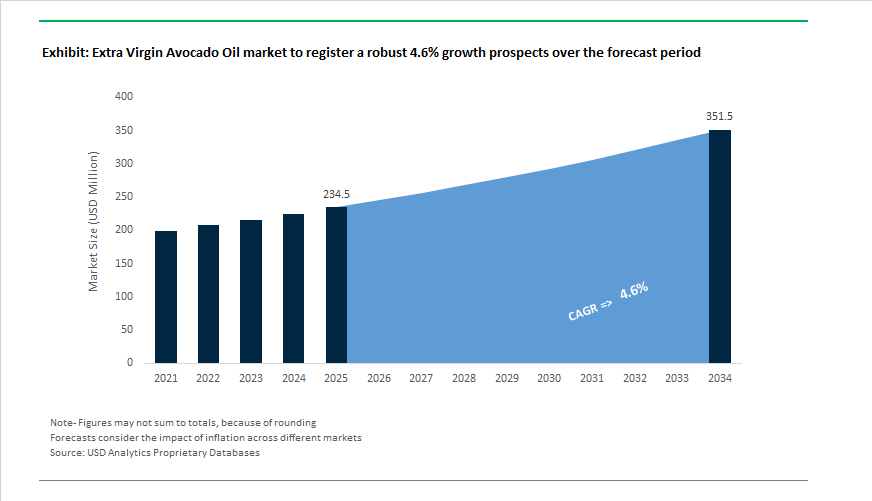
The Extra Virgin Avocado Oil Market is projected to grow from $234.5 Million in 2025 to $351.5 Million by 2034, registering a CAGR of 4.6%. Market expansion is anchored in rising demand for cold-pressed edible oils, high-smoke-point cooking oils, regenerative organic certified fats, and functional lipid-based wellness products. Extra virgin avocado oil has transitioned from a niche gourmet product to a mainstream premium edible oil category across North America, Europe, and emerging Asia-Pacific markets. Its high monounsaturated fatty acid content, oxidative stability, and 260°C smoke point are increasingly positioning it as a substitute for refined seed oils in health-conscious households and professional kitchens.
Regulatory alignment is shaping the competitive framework. In February 2024, the Kenya Bureau of Standards published Draft KS 2995:2024, defining test methods and purity requirements for virgin and extra virgin avocado oil. Kenya’s move signals the formalization of export-grade compliance as East Africa scales production for European and North American buyers. In January 2026, the Codex Committee on Fats and Oils initiated a review to include avocado oil under CXS 210-1999 vegetable oil standards. This harmonization effort is expected to reduce adulteration risks and strengthen global trade transparency.
Supply-side volatility also influenced pricing dynamics between late 2024 and 2025. Drought conditions in Peru caused a 9% drop in Hass avocado harvests, tightening raw material availability and prompting multinational brands to diversify sourcing into Mexico, South Africa, and Kenya. This climate-driven supply fluctuation elevated the importance of vertically integrated sourcing strategies and multi-origin procurement models in the extra virgin avocado oil value chain.
Brand positioning in 2024–2026 reflects a shift toward purity validation and premium branding. Marianne’s launched its nationwide avocado oil portfolio via Amazon in January 2026, including Regenerative Organic Certified® Avocado Oil. The brand highlights its 100% purity validation in the UC Davis avocado oil study, strengthening its purity-first positioning in a market historically challenged by adulteration concerns.
In parallel, Westfalia Fruit debuted 100% avocado oils in the United States in July 2024, offering Plain, Garlic, and Lemon variants. These oils are extracted from South African avocados and marketed for high-heat cooking applications. In May 2025, Westfalia’s Lemon-flavored oil received a Gold Certificate at the South African Food and Beverage Awards, reinforcing premium branding. The company further strengthened European distribution by acquiring Greenpoint Trading B.V. in July 2025 to expand its presence in Western European retail and foodservice channels.
Sustainability initiatives are emerging as a secondary revenue lever. In February 2025, Westfalia introduced a byproduct valorization process to extract natural dyes from avocado skins and seeds, utilizing the remaining 30% of fruit biomass. This zero-waste initiative reduces overall carbon intensity and creates cross-industry value streams in textiles and specialty materials.
Product innovation is broadening category penetration. Chosen Foods expanded aggressively into functional condiments between 2024 and 2025, introducing garlic-infused squeeze bottles, pumpkin spice variants, chocolate hazelnut spreads, and personal care formulations such as hair serums. In May 2024, its private equity owner Butterfly Equity restructured Bolthouse Farms into Bolthouse Fresh Foods and Generous Brands, creating a focused platform for premium avocado-derived functional oils and beverages.
Premium cold-press positioning continues to gain traction globally. AvoPure intensified its international marketing in 2024, emphasizing low-temperature extraction to preserve chlorophyll and carotenoids in Hass extra virgin avocado oil. This messaging aligns with consumer demand for minimally processed, emerald-green oils with strong antioxidant credentials.
Trends and Opportunities in the Extra Virgin Avocado Oil Market
Codification of Standards to Address Economically Motivated Adulteration in Avocado Oils
Economically motivated adulteration has emerged as the single largest structural risk to the Extra Virgin Avocado Oil category, triggering a coordinated regulatory and scientific response. By mid-2025, the American Oil Chemists' Society Avocado Oil Expert Panel accelerated efforts to formalize a global Standard of Identity. This initiative aims to clearly define compositional, sensory, and oxidative thresholds that distinguish authentic extra virgin avocado oil from refined, blended, or degraded products.
The urgency of this move is underscored by follow-up research from University of California Davis, updated in 2024, which found that roughly 70% of private-label avocado oils sold in the United States were either adulterated with lower-cost seed oils or significantly oxidized prior to expiration. These findings have reshaped procurement behavior among retailers, accelerating delisting of unverified brands and driving demand for scientifically validated products.
In response, legitimate producers are investing heavily in advanced chemical fingerprinting. Tandem Triacylglycerol profiling combined with Principal Component Analysis is now capable of detecting adulteration at levels as low as 5%. Emerging biomarkers such as cis-vaccenic acid are increasingly used to differentiate avocado mesocarp oil from illicit seed oil blends. Retailers and food service buyers are now routinely demanding batch-level Certificates of Analysis, reflecting a structural shift toward audit-ready supply chains.
A visible outcome of this trend was the August 2024 launch of an ultra-premium avocado oil line in the United States by Westfalia Fruit, built on a vertically integrated, farm-to-bottle traceability model. This move reflects a broader industry pivot where authenticity assurance is becoming a prerequisite for market access rather than a premium differentiator.
Premiumization Through Regenerative Agriculture and Deforestation-Free Sourcing
Sustainability credentials in the Extra Virgin Avocado Oil market have moved decisively from voluntary claims to enforceable trade conditions. Mexico, which remains the world’s largest avocado exporter, is at the center of this transition as importing regions tighten environmental due diligence requirements.
In August 2025, the Association of Avocado Exporting Producers and Packers of Mexico in coordination with the Mexican government launched a mandatory deforestation-free certification program. Under this framework, all export-bound avocados must originate from orchards verified through satellite-based Guardián Forestal monitoring, with land cleared after 2018 excluded from international trade eligibility by 2026. This program directly impacts oil producers sourcing from Michoacán and is reshaping orchard-level investment priorities.
Regenerative agriculture models are gaining traction as a response to climate and water stress. In March 2025, Westfalia Fruit received international recognition for its Chilean regenerative sourcing alliance, which operates a zero-waste circular system. Avocado skins and seeds are reintegrated into orchards as organic mulch, improving soil structure and water retention. These practices have become commercially relevant as climate variability reduced productivity in some Mexican growing regions by close to 10% during 2025.
Carbon accountability is reinforcing this trend. Leading producers are targeting net-zero pathways toward 2035, supported by precision agriculture tools such as drip irrigation and drone-based NDVI mapping. These technologies are now decisive factors in securing long-term supply contracts with European and North American retailers that are embedding Scope 3 emissions into supplier scorecards.
High-Stability, Clean-Label Oils for Professional Food Service and Gourmet Applications
The global food service sector is rapidly re-evaluating its reliance on refined seed oils, creating a strong opportunity for Extra Virgin Avocado Oil positioned around thermal stability and clean-label credentials. With a natural smoke point above 250°C, EVAO offers operational advantages for high-temperature frying and baking without the formation of oxidative byproducts commonly associated with polyunsaturated seed oils.
Research published in 2025 demonstrated that oxidative stability can be enhanced by 1.1 to 1.6 times through ultrasound-assisted maceration using avocado leaves, an upcycling approach that increases natural α-tocopherol levels by up to 3.7 times. These naturally fortified oils maintain stability under prolonged heat exposure while preserving a short, recognizable ingredient list, aligning with clean-label procurement standards in commercial kitchens.
Product innovation is reinforcing premium positioning. Flavored extra virgin avocado oils infused with garlic, citrus, and herbs are gaining traction in gourmet and functional CPG segments. Industry recognition in 2025 for infused avocado oil variants highlights how EVAO is transitioning from a cooking medium into a value-added culinary ingredient for chefs and premium food manufacturers.
Therapeutic and Clinical Nutrition Applications for Lipid Malabsorption
A high-margin opportunity is emerging in medical nutrition, where the lipid structure of avocado oil is being leveraged for therapeutic outcomes rather than general consumption. Clinical evidence continues to validate avocado oil’s role in lipid metabolism. A 2025 systematic review confirmed that higher intake levels were associated with statistically significant reductions in total cholesterol and LDL cholesterol, reinforcing its relevance in cardiometabolic nutrition protocols.
Beyond cholesterol management, avocado oil is increasingly utilized in medical foods targeting lipid malabsorption. Its high monounsaturated oleic acid content and favorable sn-2 fatty acid positioning improve tolerance and absorption of fat-soluble vitamins. This makes high-purity avocado oil a preferred carrier in nutritional formulations for patients with pancreatic insufficiency and short bowel syndrome, where conventional fats often trigger digestive distress.
The scientific pipeline supporting these applications is expanding rapidly. More than 195 specialized publications examining avocado oil’s physiological and therapeutic properties have been released over the past decade, with publication intensity accelerating between 2014 and 2024. This growing body of evidence is positioning Extra Virgin Avocado Oil as a clinically relevant lipid ingredient rather than solely a premium culinary oil.
Extra Virgin Avocado Oil Market Share and Segmentation Insights
Cold-Pressed Extraction Dominates Premium Quality and Nutrient Retention
Cold-pressed extra virgin avocado oil accounts for 68% of total market share in 2025, reflecting strong consumer preference for minimally processed, nutrient-rich oils. By maintaining processing temperatures below 50°C, cold pressing preserves natural antioxidants, vitamins, and flavor compounds, positioning this method as the standard for premium culinary and cosmetic-grade products. Expeller pressing holds a meaningful secondary share, serving volume-driven markets where slightly lower production costs balance with maintaining a chemical-free, “natural” positioning. While expeller-pressed oil may experience marginal thermal exposure from mechanical friction, it remains attractive to health-conscious consumers seeking affordable alternatives to cold-pressed products. The dominance of cold-pressed extraction underscores the market’s shift toward clean-label, raw, and unrefined oils that command higher margins across food retail and personal care formulations.
Culinary Applications Drive Volume While Cosmetics Accelerate Value Growth
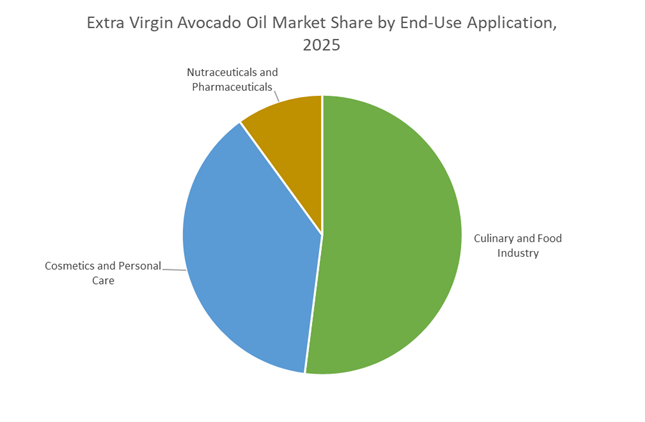
The culinary and food industry represents 52% of global extra virgin avocado oil demand in 2025, supported by rising consumer adoption of avocado oil as a high–smoke point, monounsaturated-fat-rich cooking medium. Usage spans sautéing, salad dressings, marinades, and premium finishing oils across restaurants and home kitchens, with expanding penetration in retail grocery channels. Cosmetics and personal care form a rapidly growing secondary segment, leveraging avocado oil’s vitamin A, D, and E content alongside oleic acid and sterolins for moisturizers, serums, lip balms, hair masks, and anti-aging formulations. Nutraceuticals and pharmaceuticals maintain an important niche, incorporating extra virgin avocado oil into dietary supplements for cardiovascular and joint health, as well as topical preparations for dermatological support. This dual demand profile positions extra virgin avocado oil at the intersection of functional nutrition and clean beauty, sustaining long-term market expansion.
Competitive Landscape of the Extra Virgin Avocado Oil (EVAO) Market
The Extra Virgin Avocado Oil market in 2026 is shaped by vertically integrated growers, premium cold-pressed specialists, and fast-scaling consumer brands competing across clean-label food, nutraceuticals, and beauty applications, with sustainability, smoke-point performance, and traceable sourcing driving differentiation.
Westfalia Fruit drives zero-waste EVAO production through full orchard-to-oil integration
Westfalia Fruit operates one of the world’s most vertically integrated avocado platforms, spanning 17 countries across five continents. In February 2026, the company launched a Middle East hub in Dubai, marking a strategic entry into the premium GCC retail channel. Its “Whole Tree” approach redirects off-spec fruit into Extra Virgin Avocado Oil while converting skins and stones into sustainable packaging inputs. Westfalia also introduced GEM® Gourmet Avocado Oil in early 2026, leveraging its proprietary GEM variety for higher oil yield and creamier texture. Backed by Westfalia Technological Services, the largest private subtropical fruit R&D unit, the company ensures disease-resistant orchards and long-term EVAO supply stability.
Chosen Foods LLC dominates North America with high-smoke-point EVAO and beauty extensions
Chosen Foods LLC leads the US Extra Virgin Avocado Oil segment, benefiting from a domestic market valued above $200 million in 2026 and adoption across more than 6.7 million households. The brand positions EVAO as a high smoke point health leader at ≥250°C, targeting consumers seeking alternatives to seed oils and traditional olive oil for searing and roasting. In late 2025, Chosen Foods launched squeeze-bottle EVAO formats to reduce oxidation and improve culinary precision. Its January 2025 avocado oil hair serum reflects expansion into beauty-from-within positioning, reinforcing cross-category growth spanning cooking oils, personal care, and functional wellness.
Sesajal S.A. de C.V. scales organic EVAO with circular processing and bulk export leadership
Sesajal S.A. de C.V. holds the largest individual EVAO market share by volume at roughly 26.6%, driven by bulk supply contracts with global food manufacturers. Leveraging proximity to Michoacán avocado groves, Sesajal secured a $50 million IDB Invest loan during 2025 to 2026 to expand capacity across Mexico, Peru, and Colombia. The company supplies organic-certified Extra Virgin Avocado Oil to meet clean-label retail demand in Europe and North America. Its circular processing model converts avocado waste into animal feed and biofuels, lowering export carbon intensity while reinforcing Sesajal’s position as a high-volume, sustainability-oriented EVAO producer.
Olivado pioneers cold-pressed EVAO with regenerative and fair-trade sourcing
Olivado is recognized as the originator of cold-pressed avocado oil extraction, maintaining processing temperatures below 50°C to preserve CoQ10 and Vitamin E. Its portfolio spans Extra Virgin and infused avocado oils, including garlic, lime, and chili variants. Olivado operates a dual-continent supply chain across New Zealand and Kenya, supporting more than 10,000 smallholder Kenyan farmers under fair-trade certification. In late 2025, the company achieved regenerative agriculture certification for its New Zealand orchards, appealing to climate-conscious consumers. Strategically, Olivado is targeting nutraceutical markets, positioning EVAO as a cardiovascular-friendly source of monounsaturated fats.
Grove Avocado Oil builds premium single-origin EVAO for personal care and DTC growth
Grove Avocado Oil, operating under the AvoPure brand, focuses on single-origin Extra Virgin Avocado Oil sourced from New Zealand Hass avocados grown in nutrient-rich volcanic soils. Marketed as terroir-based “Emerald Quality” oil, its products target premium culinary and personal care segments. In 2026, Grove launched a Silky Rich Citrus hybrid condiment combining lime-infused EVAO with avocado mayonnaise, entering the fast-growing functional sauce category. Its ultra-pure grade is widely used in luxury face oils due to superior skin penetration. The company also expanded e-commerce operations in 2026, aiming for a 27% increase in direct-to-consumer sales across Asia-Pacific.
Mexico remains the structural anchor of the global extra virgin avocado oil ecosystem, underpinned by unmatched raw material availability and rapid upstream modernization. According to the USDA Foreign Agricultural Service April 2025 outlook, avocado production is projected to reach 2.75 million metric tons in 2025, marking a 3% year-on-year increase. This volume surplus is critical for cold-pressed extra virgin avocado oil production, where high fruit-to-oil conversion losses demand scale to remain economically viable. The availability of mature Hass fruit enables processors to prioritize oil quality metrics such as peroxide value, free fatty acid levels, and antioxidant retention rather than yield maximization alone.
Strategic repositioning toward ethical sourcing is reinforcing Mexico’s dominance in premium export channels. In mid-2025, the Mexican Avocado Institute launched its Route to Sustainability framework, mandating deforestation-free certification for all export-bound avocado derivatives by 2026. This policy directly enhances the competitiveness of Mexican extra virgin avocado oil in European and North American clean-label markets. Complementing this shift, processors in Michoacán invested in AI-driven malaxation controls during 2025, optimizing temperature and oxygen exposure to preserve heat-sensitive compounds such as vitamin E and lutein. Export pricing data from late 2024 already reflects this premiumization, with oil values reaching approximately USD 14,220 per metric ton. Looking ahead, federal subsidies announced for early 2026 to convert packing houses into integrated oil-pressing facilities signal a decisive move toward value-added exports across nutraceutical and cosmetic segments.
Kenya: Regulatory Discipline and Traceability-Driven Quality Control
Kenya’s extra virgin avocado oil trajectory is being shaped less by volume expansion and more by regulatory enforcement aimed at protecting long-term brand equity. In October 2025, the Agriculture and Food Authority suspended avocado sea exports for the 2025–2026 fiscal year to curb the harvesting of immature fruit. This intervention directly safeguards oil quality, as premature avocados yield inferior lipid profiles that compromise extra virgin classification. While disruptive in the short term, the measure reinforces Kenya’s positioning as a source of high-integrity oil rather than bulk commodity output.
From January 2026, mandatory traceability protocols further tightened market access. Export permits are now issued only when processors can verify farm-level origin through audited records, aligning Kenyan supply chains with European due diligence expectations. To maintain market presence, regulators allowed limited air freight of premium Hass and Fuerte varieties in late 2025, targeting high-end European culinary buyers. Parallel to regulatory tightening, private equity investments flowed into regional processing hubs during 2025, funding second-generation centrifugal extraction lines designed to double cosmetic-grade oil output for East Asian markets. Collectively, these measures position Kenya as a quality-first exporter with strong compliance credentials.
United States: Onshoring, Brand-Led Differentiation, and Clean Beauty Pull
The U.S. extra virgin avocado oil market is increasingly defined by vertical integration and brand-driven demand rather than primary agriculture scale. In March 2025, Fresh Del Monte completed the acquisition of a majority stake in Avolio, a premium avocado oil producer. This transaction integrates global sourcing with domestic processing, accelerating the onshoring of high-purity oil for the U.S. specialty food sector and reducing reliance on refined imports.
At the same time, the California Avocado Commission announced a strategic pivot in Fall 2025 toward reinforcing California-origin brand equity. Marketing investments now emphasize agronomy support, traceability, and freshness to differentiate domestic extra virgin oil from imports. Demand-side momentum is strongest in clean beauty and functional foods. Brands such as Glow Recipe and Vital Farms expanded EVAO-based formulations during 2024–2025, citing superior moisture-barrier recovery and oxidative stability. Anticipated 2026 USMCA renegotiations are further encouraging U.S. stakeholders to advocate for stricter phytosanitary and quality thresholds on imported crude avocado oil, which could structurally favor domestically refined extra virgin grades.
Tanzania: Industrial-Scale Entry and Inclusive Sourcing Models
Tanzania emerged as a new industrial-scale player with the commissioning of a world-scale processing facility in Njombe Region in January 2026. Backed by Avo Africa, the Sh20 billion investment includes two plants capable of handling 600 tonnes of fruit per day, with expansion plans to reach 1,200 tonnes by June 2026. This capacity fundamentally shifts Tanzania from a marginal supplier to a structurally relevant exporter of extra virgin avocado oil.
Beyond scale, the Njombe project emphasizes inclusive sourcing. By employing over 400 workers and integrating smallholder supply networks, the facility creates a stable offtake for reject-grade fruit unsuitable for fresh export but ideal for oil extraction. This model improves farmer incomes while ensuring consistent feedstock flow for oil processors. Tanzania’s entry adds competitive pressure in bulk cosmetic-grade oil segments while laying the groundwork for future premium positioning as processing expertise matures.
Spain: Institutionalization and Dedicated Oil Plantations
Spain is playing a coordination and standard-setting role in the global extra virgin avocado oil market rather than competing on volume alone. At Fruit Attraction 2025 in Madrid, the Avocado Oil Manufacturers Association was formally launched, with headquarters in Seville. The association aims to harmonize global quality and sustainability benchmarks, drawing explicit parallels to the governance model of the olive oil sector.
On the production side, Spanish growers forecast a 20 to 25% increase in avocado output for the 2025–2026 season. Notably, a portion of this growth is coming from plantations dedicated exclusively to oil production, a first for Europe. This structural shift allows producers to optimize harvest timing, varietal selection, and oil yield characteristics without the cosmetic constraints of fresh fruit markets. Spain’s strategy positions it as a reference point for quality assurance and regulatory alignment within Europe’s expanding EVAO ecosystem.
Strategic Snapshot: Extra Virgin Avocado Oil Market by Country (2025–2026)
Extra Virgin Avocado Oil Market County Level Snapshot
Country
Structural Driver
Strategic Focus
Market Implication
Mexico
Feedstock surplus and sustainability mandates
Premium, deforestation-free EVAO
Global price and quality leadership
Kenya
Export controls and traceability enforcement
Quality protection and compliance
High-integrity niche positioning
United States
Onshoring and brand-led demand
Clean beauty and specialty foods
Margin-led domestic growth
Tanzania
Industrial-scale processing
Inclusive sourcing and volume ramp-up
New competitive supply base
Spain
Institutional coordination
Standards and oil-dedicated farming
European quality benchmark
Extra Virgin Avocado Oil Market Report Scope
Extra Virgin Avocado Oil market
Parameter
Details
Market Size (2025)
$234.5 Million
Market Size (2034)
$351.5 Million
Market Growth Rate
4.6%
Segments
By Nature (Organic Extra Virgin Avocado Oil, Conventional Extra Virgin Avocado Oil), By Extraction Method (Cold-Pressed, Expeller Pressed), By End-Use Application (Culinary and Food Industry, Cosmetics and Personal Care, Nutraceuticals and Pharmaceuticals), By Distribution Channel (B2B, B2C), By Variety (Hass, Fuerte, Pinkerton, Others)
Study Period
2019- 2025 and 2026-2034
Units
Revenue (USD)
Qualitative Analysis
Porter’s Five Forces, SWOT Profile, Market Share, Scenario Forecasts, Market Ecosystem, Company Ranking, Market Dynamics, Industry Benchmarking
Companies
Chosen Foods LLC, Sesajal S.A. de C.V., Olivado, Grupo Industrial Batellero, Khuush, La Tourangelle, Inc., Spectrum Organics Products, LLC, Bella Vado Inc., Calavo Growers, Inc., Westfalia Fruit, The Village Press, Cibaria International, Proteco Gold Pty Ltd., Avolio, Avo Africa
Countries
US, Canada, Mexico, Germany, France, Spain, Italy, UK, Russia, China, India, Japan, South Korea, Australia, South East Asia, Brazil, Argentina, Middle East, Africa
Extra Virgin Avocado Oil Market Segmentation
By Nature
Organic Extra Virgin Avocado Oil
Conventional Extra Virgin Avocado Oil
By Extraction Method
Cold-Pressed
Expeller Pressed
By End-Use Application
Culinary and Food Industry
Cosmetics and Personal Care
Nutraceuticals and Pharmaceuticals
By Distribution Channel
B2B
B2C
By Variety
Hass
Fuerte
Pinkerton
Others
By Region
North America (United States, Canada, Mexico)
Europe (Germany, France, United Kingdom, Spain, Italy, Rest of Europe)
Asia Pacific (China, India, Japan, South Korea, Australia, Rest of APAC)
South and Central America (Brazil, Argentina, Rest of SCA)
Middle East and Africa (Saudi Arabia, UAE, South Africa, Rest of Middle East, Rest of Africa)
Top Companies in the Extra Virgin Avocado Oil Industry
Chosen Foods LLC
Sesajal S.A. de C.V.
Olivado
Grupo Industrial Batellero
Khuush
La Tourangelle, Inc.
Spectrum Organics Products, LLC
Bella Vado Inc.
Calavo Growers, Inc.
Westfalia Fruit
The Village Press
Cibaria International
Proteco Gold Pty Ltd.
Avolio
Avo Africa
*- List not Exhaustive
Table of Contents: Extra Virgin Avocado Oil Market
2. Extra Virgin Avocado Oil Market Landscape & Outlook (2026–2034)
2.1. Introduction to Extra Virgin Avocado Oil Market
2.2. Market Valuation and Growth Projections (2026–2034)
2.3. Regulatory Harmonization and Purity Standardization
2.4. Climate Volatility, Multi-Origin Sourcing, and Supply Chain Resilience
2.5. Premiumization, Functional Lipids, and Clean-Label Positioning
3. Innovations Reshaping the Extra Virgin Avocado Oil Market
3.1. Trend: Codification of Global Standards to Combat Adulteration
3.2. Trend: Regenerative Agriculture and Deforestation-Free Certification
3.3. Opportunity: High-Stability Oils for Professional Foodservice and Gourmet Applications
3.4. Opportunity: Clinical Nutrition and Therapeutic Lipid Formulations
4. Competitive Landscape and Strategic Initiatives
4.1. Mergers and Acquisitions
4.2. R&D and Cold-Press Extraction Optimization
4.3. Sustainability and ESG Strategies
4.4. Market Expansion and Multi-Channel Distribution Focus
5. Market Share and Segmentation Insights: Extra Virgin Avocado Oil Market
5.1. By Nature
5.1.1. Organic Extra Virgin Avocado Oil
5.1.2. Conventional Extra Virgin Avocado Oil
5.2. By Extraction Method
5.2.1. Cold-Pressed
5.2.2. Expeller Pressed
5.3. By End-Use Application
5.3.1. Culinary and Food Industry
5.3.2. Cosmetics and Personal Care
5.3.3. Nutraceuticals and Pharmaceuticals
5.4. By Distribution Channel
5.4.1. B2B
5.4.2. B2C
5.5. By Variety
5.5.1. Hass
5.5.2. Fuerte
5.5.3. Pinkerton
5.5.4. Others
6. Country Analysis and Outlook of Extra Virgin Avocado Oil Market
6.1. United States
6.2. Canada
6.3. Mexico
6.4. Germany
6.5. France
6.6. Spain
6.7. Italy
6.8. UK
6.9. Russia
6.10. China
6.11. India
6.12. Japan
6.13. South Korea
6.14. Australia
6.15. South East Asia
6.16. Brazil
6.17. Argentina
6.18. Middle East
6.19. Africa
7. Extra Virgin Avocado Oil Market Size Outlook by Region (2026–2034)
7.1. North America Extra Virgin Avocado Oil Market Size Outlook to 2034
7.1.1. By Nature
7.1.2. By Extraction Method
7.1.3. By End-Use Application
7.1.4. By Distribution Channel
7.1.5. By Variety
7.2. Europe Extra Virgin Avocado Oil Market Size Outlook to 2034
7.2.1. By Nature
7.2.2. By Extraction Method
7.2.3. By End-Use Application
7.2.4. By Distribution Channel
7.2.5. By Variety
7.3. Asia Pacific Extra Virgin Avocado Oil Market Size Outlook to 2034
7.3.1. By Nature
7.3.2. By Extraction Method
7.3.3. By End-Use Application
7.3.4. By Distribution Channel
7.3.5. By Variety
7.4. South America Extra Virgin Avocado Oil Market Size Outlook to 2034
7.4.1. By Nature
7.4.2. By Extraction Method
7.4.3. By End-Use Application
7.4.4. By Distribution Channel
7.4.5. By Variety
7.5. Middle East and Africa Extra Virgin Avocado Oil Market Size Outlook to 2034
7.5.1. By Nature
7.5.2. By Extraction Method
7.5.3. By End-Use Application
7.5.4. By Distribution Channel
7.5.5. By Variety
8. Company Profiles: Leading Players in the Extra Virgin Avocado Oil Market
8.1. Chosen Foods LLC
8.2. Sesajal S.A. de C.V.
8.3. Olivado
8.4. Grupo Industrial Batellero
8.5. Khuush
8.6. La Tourangelle, Inc.
8.7. Spectrum Organics Products, LLC
8.8. Bella Vado Inc.
8.9. Calavo Growers, Inc.
8.10. Westfalia Fruit
8.11. The Village Press
8.12. Cibaria International
8.13. Proteco Gold Pty Ltd.
8.14. Avolio
8.15. Avo Africa
9. Methodology
9.1. Research Scope
9.2. Market Research Approach
9.3. Market Sizing and Forecasting Model
9.4. Research Coverage
9.5. Data Horizon
9.6. Deliverables
10. Appendix
10.1. Acronyms and Abbreviations
10.2. List of Tables
10.3. List of Figures
Extra Virgin Avocado Oil Market Segmentation
By Nature
Organic Extra Virgin Avocado Oil
Conventional Extra Virgin Avocado Oil
By Extraction Method
Cold-Pressed
Expeller Pressed
By End-Use Application
Culinary and Food Industry
Cosmetics and Personal Care
Nutraceuticals and Pharmaceuticals
By Distribution Channel
B2B
B2C
By Variety
Hass
Fuerte
Pinkerton
Others
By Region
North America (United States, Canada, Mexico)
Europe (Germany, France, United Kingdom, Spain, Italy, Rest of Europe)
Asia Pacific (China, India, Japan, South Korea, Australia, Rest of APAC)
South and Central America (Brazil, Argentina, Rest of SCA)
Middle East and Africa (Saudi Arabia, UAE, South Africa, Rest of Middle East, Rest of Africa)
The Extra Virgin Avocado Oil Market is forecast to grow from $234.5 million in 2025 to $351.5 million by 2034, registering a CAGR of 4.6%. Growth is supported by cold-pressed premiumization, regenerative organic certification, and rising substitution of refined seed oils. Demand remains strong across North America and Europe, with Asia-Pacific emerging as a high-margin expansion corridor.
The Kenya Bureau of Standards Draft KS 2995:2024 and the Codex review under CXS 210-1999 are formalizing compositional benchmarks for extra virgin classification. Stricter peroxide, FFA, and oxidative limits are reducing adulteration risk and increasing compliance costs. Exporters in Mexico and Kenya are investing in traceability and chemical fingerprinting to secure access to EU and U.S. retail contracts.
Cold-pressed oil dominates with roughly 68% share, reflecting demand for minimally processed, antioxidant-rich formats. Culinary applications account for about 52% of total consumption, particularly in high-smoke-point cooking and gourmet applications. Cosmetics and personal care represent the fastest value-growth segment, leveraging vitamin E retention and oleic acid concentration for premium skincare formulations.
Climate volatility in Peru and Mexico has tightened Hass avocado supply, reinforcing the need for multi-origin procurement models spanning South Africa, Kenya, and Tanzania. Vertically integrated orchard-to-oil models are reducing feedstock risk and improving margin control. Deforestation-free mandates and regenerative agriculture programs are increasingly decisive in securing long-term B2B contracts.