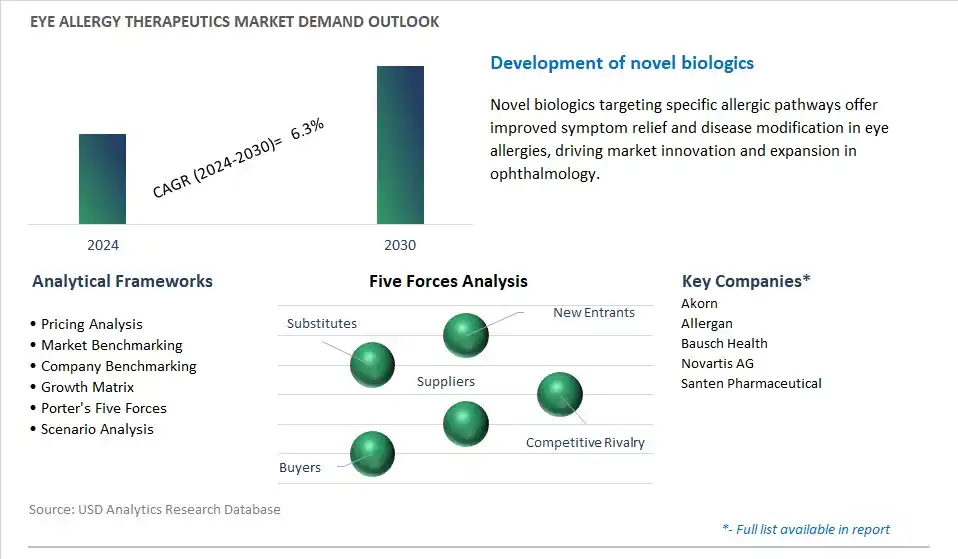
Eye Allergy Therapeutics Market is estimated to increase at a growth rate of 6.3% CAGR over the forecast period from 2024 to 2030.
The global Eye Allergy Therapeutics Market Study analyzes and forecasts the market size across 6 regions and 24 countries for diverse segments including By Type (Antihistamines, Corticosteroids, Immunomodulators), By Application (Hospital, Pharmacy, Others).
An Introduction to Eye Allergy Therapeutics Market in 2024
The Eye Allergy Therapeutics Market includes pharmaceuticals, antihistamines, mast cell stabilizers, and immunomodulators used in the management and treatment of eye allergies, allergic conjunctivitis, and ocular allergic reactions. These therapeutics alleviate symptoms such as itching, redness, tearing, and discomfort associated with allergic eye conditions, providing relief and improving ocular health. With a focus on topical formulations, preservative-free options, and allergy-specific therapies, the eye allergy therapeutics market supports ophthalmologists, optometrists, and allergy specialists in addressing ocular allergy symptoms, enhancing patient comfort, and maintaining eye wellness.
Eye Allergy Therapeutics Market Competitive Landscape
The global Eye Allergy Therapeutics Industry is highly competitive with a large number of companies focusing on niche market segments. Amidst intense competitive conditions, Eye Allergy Therapeutics Companies are investing in new product launches and strengthening distribution channels. Key companies operating in the Eye Allergy Therapeutics Industry include- Akorn, Allergan, Bausch Health, Novartis AG, Santen Pharmaceutical.
Eye Allergy Therapeutics Market Trend: Increasing Adoption of Advanced Diagnostic Techniques
A prominent trend in the Eye Allergy Therapeutics market is the increasing adoption of advanced diagnostic techniques for the precise identification and management of allergic eye conditions. Eye allergies, including allergic conjunctivitis and seasonal allergic rhinitis, are common ocular disorders characterized by itching, redness, tearing, and swelling of the eyes. Traditional diagnostic methods such as patient history, symptom assessment, and slit-lamp examination may lack specificity and sensitivity in distinguishing allergic from non-allergic eye conditions. However, recent advancements in diagnostic technologies such as in vivo confocal microscopy, tear film analysis, and specific IgE testing have enabled clinicians to accurately diagnose and subtype allergic eye diseases, identify triggering allergens, and tailor treatment strategies accordingly. Additionally, point-of-care diagnostic devices and telemedicine platforms facilitate remote monitoring and management of eye allergies, improving patient access to specialized care and optimizing treatment outcomes. This trend reflects the growing emphasis on personalized medicine and evidence-based practice in ophthalmology, as well as the integration of innovative diagnostic tools into routine clinical practice to enhance precision and efficacy in allergic eye disease management.
Eye Allergy Therapeutics Market Driver: Rising Prevalence of Allergic Eye Conditions and Environmental Allergens
The primary driver for the Eye Allergy Therapeutics market is the rising prevalence of allergic eye conditions and environmental allergens contributing to ocular inflammation and discomfort. Allergic conjunctivitis is one of the most common ocular disorders worldwide, affecting millions of individuals each year and significantly impairing quality of life due to its chronic and recurrent nature. Environmental factors such as pollen, dust mites, pet dander, and air pollutants play a major role in triggering allergic reactions in susceptible individuals, exacerbating symptoms of eye allergies and necessitating prompt and effective treatment interventions. As urbanization, climate change, and industrialization continue to drive changes in environmental allergen exposure patterns, there is a corresponding increase in the incidence and severity of allergic eye diseases, leading to greater demand for therapeutics that provide symptomatic relief, reduce inflammation, and modulate immune responses in the ocular surface. Healthcare providers, allergists, and ophthalmologists play a crucial role in educating patients about eye allergy triggers, implementing preventive measures, and prescribing appropriate therapeutics to manage allergic eye conditions effectively.
Eye Allergy Therapeutics Market Opportunity: Development of Novel Therapeutic Modalities and Targeted Therapies
An opportunity exists in the development of novel therapeutic modalities and targeted therapies for the treatment of allergic eye conditions, including innovative biologic agents, gene therapies, and immunomodulatory drugs that address underlying pathophysiological mechanisms of ocular inflammation and allergic response. While antihistamines, mast cell stabilizers, and corticosteroids remain the mainstay of pharmacological treatment for allergic conjunctivitis, there is growing interest in exploring alternative therapeutic targets and pathways involved in allergic eye diseases, such as eosinophils, T-helper cells, cytokines, and prostaglandins. Companies involved in the Eye Allergy Therapeutics market can capitalize on this opportunity by investing in research and development of next-generation therapeutics that offer superior efficacy, safety, and durability compared to conventional treatments, as well as targeted delivery systems that optimize drug penetration and bioavailability in the ocular tissues. By leveraging advances in biotechnology, pharmacology, and ocular drug delivery, companies can expand their product pipelines and address the unmet needs of patients with allergic eye conditions, offering innovative solutions that improve symptom control, reduce disease burden, and enhance quality of life for affected individuals.
Eye Allergy Therapeutics Market Share Analysis: Immunomodulators is the fastest growing market segment over the forecast period to 2030
Within the eye allergy therapeutics market, immunomodulators are experiencing the fastest growth. This growth can be attributed to several factors. Immunomodulators work by modifying the immune response in the eye, providing relief from allergic reactions and inflammation. As awareness of eye allergies increases among healthcare professionals and patients, there is a growing demand for treatments that target the underlying immune mechanisms involved in allergic reactions. Additionally, immunomodulators offer advantages such as prolonged duration of action and reduced risk of systemic side effects compared to other classes of medications like corticosteroids. With the rising incidence of eye allergies due to environmental factors and changing lifestyles, there is a greater need for effective and safe long-term treatment options, further driving the demand for immunomodulators. Furthermore, the expansion of healthcare infrastructure, including the availability of specialized eye clinics and the incorporation of immunomodulators into treatment protocols, is contributing to the growth of this segment. As pharmaceutical companies continue to innovate and develop new formulations and delivery methods for immunomodulators, the market for these eye allergy therapeutics is expected to expand rapidly in the coming years.
Eye Allergy Therapeutics Market Segmentation
By Type
Antihistamines
Corticosteroids
Immunomodulators
By Application
Hospital
Pharmacy
Others
Geographical Analysis
North America (United States, Canada, Mexico)
Europe (Germany, France, United Kingdom, Spain, Italy, Rest of Europe)
Asia Pacific (China, India, Japan, South Korea, Rest of Asia Pacific)
South America (Brazil, Argentina, Rest of South America)
Middle East and Africa (Saudi Arabia, UAE, Rest of Middle East, South Africa, Egypt, Rest of Africa)
Eye Allergy Therapeutics Companies
Akorn
Allergan
Bausch Health
Novartis AG
Santen Pharmaceutical
* List not Exhaustive
Reasons to Buy the Eye Allergy Therapeutics Market Study
• Deepen your industry insights and navigate uncertainties for strategy formulation, CAPEX, and Operational decisions
• Gain access to detailed insights on the Eye Allergy Therapeutics Market, encompassing current market size, growth trends, and forecasts till 2030.
• Access detailed competitor analysis, enabling competitive advantage through a thorough understanding of market players, strategies, and potential differentiation opportunities
• Stay ahead of the curve with insights on technological advancements, innovations, and upcoming trends
• Identify lucrative investment avenues and expansion opportunities within the Eye Allergy Therapeutics Industry, guided by robust, data-backed analysis.
• Understand regional and global markets through country-wise analysis, regional market potential, regulatory nuances, and dynamics
• Execute strategies with confidence and speed through information, analytics, and insights on the industry value chain
• Corporate leaders, strategists, financial experts, shareholders, asset managers, and governmental representatives can make long-term planning scenarios and build an integrated and timely understanding of market dynamics
• Benefit from tailored solutions and expert consultation based on report insights, providing personalized strategies aligned with specific business needs.
TABLE OF CONTENTS
1 Introduction to 2024 Eye Allergy Therapeutics Market
1.1 Market Overview
1.2 Quick Facts
1.3 Scope/Objective of the Study
1.4 Market Definition
1.5 Countries and Regions Analyzed
1.6 Units, Currency, and Conversions
1.7 Industry Value Chain
2 Research Methodology
2.1 Market Size Estimation
2.2 Sources and Research Methodology
2.3 Data Triangulation
2.4 Assumptions and Limitations
3 Executive Summary
3.1 Global Eye Allergy Therapeutics Market Size Outlook, $ Million, 2021 to 2030
3.2 Eye Allergy Therapeutics Market Outlook by Type, $ Million, 2021 to 2030
3.3 Eye Allergy Therapeutics Market Outlook by Product, $ Million, 2021 to 2030
3.4 Eye Allergy Therapeutics Market Outlook by Application, $ Million, 2021 to 2030
3.5 Eye Allergy Therapeutics Market Outlook by Key Countries, $ Million, 2021 to 2030
4 Market Dynamics
4.1 Key Driving Forces of Eye Allergy Therapeutics Industry
4.2 Key Market Trends in Eye Allergy Therapeutics Industry
4.3 Potential Opportunities in Eye Allergy Therapeutics Industry
4.4 Key Challenges in Eye Allergy Therapeutics Industry
5 Market Factor Analysis
5.1 Value Chain Analysis
5.2 Competitive Landscape
5.2.1 Global Eye Allergy Therapeutics Market Share by Company (%), 2023
5.2.2 Product Offerings by Company
5.3 Porter’s Five Forces Analysis
5.4 Pricing Analysis and Outlook
6 Growth Outlook Across Scenarios
6.1 Growth Analysis-Case Scenario Definitions
6.2 Low Growth Scenario Forecasts
6.3 Reference Growth Scenario Forecasts
6.4 High Growth Scenario Forecasts
7 Global Eye Allergy Therapeutics Market Outlook by Segments
7.1 Eye Allergy Therapeutics Market Outlook by Segments, $ Million, 2021- 2030
By Type
Antihistamines
Corticosteroids
Immunomodulators
By Application
Hospital
Pharmacy
Others
8 North America Eye Allergy Therapeutics Market Analysis and Outlook To 2030
8.1 Introduction to North America Eye Allergy Therapeutics Markets in 2024
8.2 North America Eye Allergy Therapeutics Market Size Outlook by Country, 2021-2030
8.2.1 United States
8.2.2 Canada
8.2.3 Mexico
8.3 North America Eye Allergy Therapeutics Market size Outlook by Segments, 2021-2030
By Type
Antihistamines
Corticosteroids
Immunomodulators
By Application
Hospital
Pharmacy
Others
9 Europe Eye Allergy Therapeutics Market Analysis and Outlook To 2030
9.1 Introduction to Europe Eye Allergy Therapeutics Markets in 2024
9.2 Europe Eye Allergy Therapeutics Market Size Outlook by Country, 2021-2030
9.2.1 Germany
9.2.2 France
9.2.3 Spain
9.2.4 United Kingdom
9.2.4 Italy
9.2.5 Russia
9.2.6 Norway
9.2.7 Rest of Europe
9.3 Europe Eye Allergy Therapeutics Market Size Outlook by Segments, 2021-2030
By Type
Antihistamines
Corticosteroids
Immunomodulators
By Application
Hospital
Pharmacy
Others
10 Asia Pacific Eye Allergy Therapeutics Market Analysis and Outlook To 2030
10.1 Introduction to Asia Pacific Eye Allergy Therapeutics Markets in 2024
10.2 Asia Pacific Eye Allergy Therapeutics Market Size Outlook by Country, 2021-2030
10.2.1 China
10.2.2 India
10.2.3 Japan
10.2.4 South Korea
10.2.5 Indonesia
10.2.6 Malaysia
10.2.7 Australia
10.2.8 Rest of Asia Pacific
10.3 Asia Pacific Eye Allergy Therapeutics Market size Outlook by Segments, 2021-2030
By Type
Antihistamines
Corticosteroids
Immunomodulators
By Application
Hospital
Pharmacy
Others
11 South America Eye Allergy Therapeutics Market Analysis and Outlook To 2030
11.1 Introduction to South America Eye Allergy Therapeutics Markets in 2024
11.2 South America Eye Allergy Therapeutics Market Size Outlook by Country, 2021-2030
11.2.1 Brazil
11.2.2 Argentina
11.2.3 Rest of South America
11.3 South America Eye Allergy Therapeutics Market size Outlook by Segments, 2021-2030
By Type
Antihistamines
Corticosteroids
Immunomodulators
By Application
Hospital
Pharmacy
Others
12 Middle East and Africa Eye Allergy Therapeutics Market Analysis and Outlook To 2030
12.1 Introduction to Middle East and Africa Eye Allergy Therapeutics Markets in 2024
12.2 Middle East and Africa Eye Allergy Therapeutics Market Size Outlook by Country, 2021-2030
12.2.1 Saudi Arabia
12.2.2 UAE
12.2.3 Oman
12.2.4 Rest of Middle East
12.2.5 Egypt
12.2.6 Nigeria
12.2.7 South Africa
12.2.8 Rest of Africa
12.3 Middle East and Africa Eye Allergy Therapeutics Market size Outlook by Segments, 2021-2030
By Type
Antihistamines
Corticosteroids
Immunomodulators
By Application
Hospital
Pharmacy
Others
13 Company Profiles
13.1 Company Snapshot
13.2 SWOT Profiles
13.3 Products and Services
13.4 Recent Developments
13.5 Financial Profile
List of Companies
Akorn
Allergan
Bausch Health
Novartis AG
Santen Pharmaceutical
14 Appendix
14.1 Customization Offerings
14.2 Subscription Services
14.3 Related Reports
14.4 Publisher Expertise
