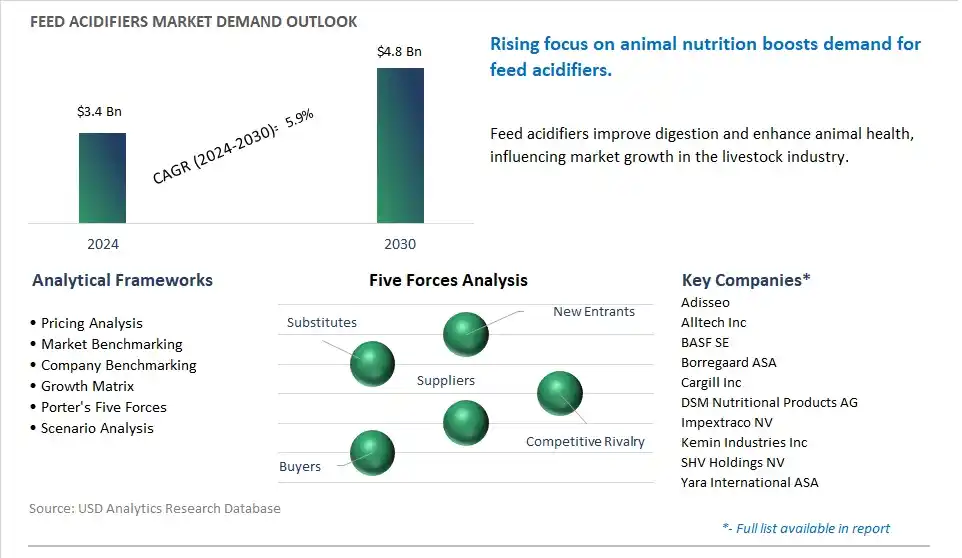
The global Feed Acidifiers Market is poised to register a 5.9% CAGR from $3.4 Billion in 2024 to $4.8 Billion in 2030.
The global Feed Acidifiers Market Study analyzes and forecasts the market size across 6 regions and 24 countries for diverse segments -By Type (Propionic Acid, Formic Acid, Lactic Acid, Citric Acid, Malic Acid, Sorbic Acid, Others), By Form (Dry, Liquid), By Compound (Blended, Single), By Livestock (Poultry, Swine, Ruminants, Aquaculture, Pets, Others).
An Introduction to Global Feed Acidifiers Market in 2024
The feed acidifiers market is experiencing robust growth driven by the increasing demand for animal nutrition solutions that improve feed efficiency, digestive health, and performance in livestock and poultry production. Key trends shaping the future of the industry include the rising awareness of the importance of gut health, microbial balance, and feed hygiene in animal nutrition, as well as the growing concerns about antibiotic resistance, feed contamination, and regulatory restrictions on antibiotic use in animal feed. As producers seek alternatives to antibiotic growth promoters (AGPs) and antimicrobial additives, there's a growing need for feed acidifiers such as organic acids, salts, and essential oils that promote beneficial gut microflora, inhibit pathogenic bacteria, and enhance nutrient utilization in animals while supporting immunity and disease resistance. Moreover, advancements in feed acidifier formulations, encapsulation technologies, and delivery systems are driving market expansion by improving product stability, palatability, and efficacy in various feed applications and production environments. Additionally, the growing adoption of feed acidifiers in aquaculture, swine production, and poultry farming is fueling demand for innovative solutions that address specific nutritional and health challenges faced by different species and production systems. Furthermore, the integration of feed acidifiers with precision nutrition, feed management software, and farm management practices is driving innovation and market growth in the feed acidifiers industry, enabling the development of customized, targeted, and sustainable nutrition solutions for modern animal production and welfare.
Feed Acidifiers Market Competitive Landscape
The market report analyses the leading companies in the industry including Adisseo, Alltech Inc, BASF SE, Borregaard ASA, Cargill Inc, DSM Nutritional Products AG, Impextraco NV, Kemin Industries Inc, SHV Holdings NV, Yara International ASA.
Feed Acidifiers Market Dynamics
Feed Acidifiers Market Trend: Increasing Focus on Livestock Health and Performance Drives Demand for Feed Acidifiers
One prominent trend in the feed acidifiers market is the increasing focus on livestock health and performance, which is driving the demand for feed acidifiers. Feed acidifiers are additives used in animal nutrition to improve feed efficiency, enhance nutrient utilization, and maintain gut health in livestock and poultry. With growing concerns about antibiotic resistance, food safety, and environmental sustainability, there is a shift towards natural and preventive approaches to animal health management. Feed acidifiers offer a sustainable solution by promoting digestive health, reducing pathogen colonization in the gastrointestinal tract, and supporting immune function in animals. The trend towards holistic animal nutrition strategies and disease prevention drives the adoption of feed acidifiers as key components of modern livestock production systems.
Feed Acidifiers Market Driver: Regulatory Restrictions on Antibiotic Growth Promoters Stimulate Feed Acidifier Market Growth
The growth of the feed acidifiers market is driven by regulatory restrictions on antibiotic growth promoters (AGPs) in animal feed. Governments worldwide are implementing regulations and guidelines to limit the use of AGPs in livestock and poultry production due to concerns about antimicrobial resistance and public health risks. As a result, there is a growing need for alternative feed additives that can maintain animal health, improve performance, and enhance feed efficiency without relying on antibiotics. Feed acidifiers, which have demonstrated antimicrobial properties and beneficial effects on gut health, emerge as viable substitutes for AGPs in animal nutrition. Regulatory pressures to reduce antibiotic usage in agriculture create opportunities for feed acidifier manufacturers to meet compliance requirements and address market demand for safer and sustainable animal feed solutions.
Feed Acidifiers Market Opportunity: Development of Specialty Acidifier Formulations for Targeted Applications
A potential opportunity in the feed acidifiers market lies in the development of specialty acidifier formulations tailored to specific livestock species, production systems, and health challenges. Different animal species, such as poultry, swine, cattle, and aquaculture, have unique dietary requirements, digestive physiologies, and susceptibility to digestive disorders. Manufacturers can capitalize on this opportunity by formulating customized feed acidifiers with optimized blends of organic acids, essential oils, botanical extracts, and other functional ingredients to address the specific needs of different animal species and production stages. Additionally, there is an opportunity to develop acidifier products with enhanced stability, palatability, and ease of use to facilitate integration into existing feed formulations and feeding programs. By offering specialized acidifier solutions for targeted applications, manufacturers can cater to the diverse needs of livestock producers and optimize animal health, performance, and productivity in various agricultural settings.
Feed Acidifiers Market Share Analysis: Propionic Acid segment generated the highest revenue in the industry
Propionic acid is the largest segment in the Feed Acidifiers market due to diverse key reasons. Propionic acid is widely used in animal feed formulations as a mold inhibitor and preservative, particularly in grain-based diets prone to fungal contamination and spoilage. Its antimicrobial properties help inhibit the growth of mold and fungi in feed ingredients, thereby extending the shelf life and maintaining the nutritional quality of feedstuffs. Additionally, propionic acid acts as an effective acidifier in the digestive tract of livestock, lowering the pH levels and creating an environment unfavorable for the proliferation of pathogenic bacteria such as Salmonella and E. coli. This helps promote digestive health, reduce the risk of digestive disorders, and improve nutrient absorption and feed efficiency in animals. In addition, propionic acid is known for its safety, regulatory approval, and compatibility with various feed ingredients, making it a preferred choice for feed manufacturers seeking reliable and cost-effective solutions to improve feed quality and animal performance. With its proven efficacy in feed preservation and gut health promotion, propionic acid maintains its dominance as the largest segment in the Feed Acidifiers market.
Feed Acidifiers Market Share Analysis: Liquid Segment is poised to register the fastest growth rate (CAGR) over the forecast period to 2030
The liquid segment is the fastest-growing segment in the Feed Acidifiers market due to diverse key factors propelling its rapid expansion. Liquid feed acidifiers offer distinct advantages over dry formulations in terms of ease of handling, mixing, and application in feed manufacturing processes. Liquid acidifiers can be easily incorporated into feed formulations using standard mixing equipment, ensuring uniform distribution and consistent dosage throughout the feed batch. Additionally, liquid acidifiers offer greater flexibility in terms of dosage adjustment and formulation customization, allowing for precise control over acidification levels based on specific dietary requirements and production conditions. In addition, liquid acidifiers provide enhanced solubility and dispersion in feed matrices, resulting in improved bioavailability and efficacy of active ingredients in the digestive tract of animals. Further, the growing trend towards liquid feeding systems and automated dosing technologies in modern livestock production facilities drives the demand for liquid acidifiers, as they offer seamless integration with existing feeding systems and enable precise and efficient delivery of additives to animals. With the increasing focus on feed quality, animal health, and performance optimization in the livestock industry, the liquid segment is poised for significant growth in the Feed Acidifiers market.
Feed Acidifiers Market Share Analysis: Blended Segment is poised to register the fastest growth rate (CAGR) over the forecast period to 2030
The blended segment is the fastest-growing segment in the Feed Acidifiers market due to diverse key factors propelling its rapid expansion. Blended feed acidifiers offer the advantage of combining multiple active compounds into a single formulation, providing a comprehensive solution to address various challenges associated with feed preservation, pathogen control, and gut health management in livestock production. By synergistically incorporating different acidifiers, such as organic acids, their salts, and their esters, blended formulations offer enhanced efficacy and versatility compared to single compound acidifiers. This allows for a broader spectrum of antimicrobial activity and pH modulation in the digestive tract, targeting a wider range of pathogens and optimizing nutrient utilization in animals. In addition, blended acidifiers offer greater flexibility in formulation customization, allowing feed manufacturers to tailor blends to meet specific dietary requirements, animal species, and production systems. Additionally, blended acidifiers may include buffering agents or performance-enhancing additives to optimize stability, palatability, and Over the forecast period effectiveness in feed applications. Further, as livestock producers seek integrated solutions to improve feed quality, animal health, and performance while reducing reliance on antibiotics and chemical additives, the demand for blended feed acidifiers is expected to grow rapidly, positioning it as the fastest-growing segment in the Feed Acidifiers market.
Feed Acidifiers Market Report Segmentation
By Type
Propionic Acid
Formic Acid
Lactic Acid
Citric Acid
Malic Acid
Sorbic Acid
Others
By Form
Dry
Liquid
By Compound
Blended
Single
By Livestock
Poultry
Swine
Ruminants
Aquaculture
Pets
Others
Regions Included
North America (US, Canada, Mexico)
Europe (Germany, UK, France, Spain, Italy, Russia, Rest of Europe)
Asia Pacific (China, India, Japan, South Korea, Australia, South East Asia, Rest of Asia)
South America (Brazil, Argentina, Rest of South America)
Middle East and Africa (Saudi Arabia, UAE, Rest of Middle East, South Africa, Egypt, Rest of Africa)
Feed Acidifiers Companies Profiled in the Market Study
Adisseo
Alltech Inc
BASF SE
Borregaard ASA
Cargill Inc
DSM Nutritional Products AG
Impextraco NV
Kemin Industries Inc
SHV Holdings NV
Yara International ASA
*- List Not Exhaustive
TABLE OF CONTENTS
1 Introduction to 2024 Feed Acidifiers Market
1.1 Market Overview
1.2 Quick Facts
1.3 Scope/Objective of the Study
1.4 Market Definition
1.5 Countries and Regions Covered
1.6 Units, Currency, and Conversions
1.7 Industry Value Chain
2 Research Methodology
2.1 Market Size Estimation
2.2 Sources and Research Methodology
2.3 Data Triangulation
2.4 Assumptions and Limitations
3 Executive Summary
3.1 Global Feed Acidifiers Market Size Outlook, $ Million, 2021 to 2030
3.2 Feed Acidifiers Market Outlook by Type, $ Million, 2021 to 2030
3.3 Feed Acidifiers Market Outlook by Product, $ Million, 2021 to 2030
3.4 Feed Acidifiers Market Outlook by Application, $ Million, 2021 to 2030
3.5 Feed Acidifiers Market Outlook by Key Countries, $ Million, 2021 to 2030
4 Market Dynamics
4.1 Key Driving Forces of Feed Acidifiers Industry
4.2 Key Market Trends in Feed Acidifiers Industry
4.3 Potential Opportunities in Feed Acidifiers Industry
4.4 Key Challenges in Feed Acidifiers Industry
5 Market Factor Analysis
5.1 Value Chain Analysis
5.2 Competitive Landscape
5.2.1 Global Feed Acidifiers Market Share by Company (%), 2023
5.2.2 Product Offerings by Company
5.3 Porter’s Five Forces Analysis
5.4 Pricing Analysis and Outlook
6 Growth Outlook Across Scenarios
6.1 Growth Analysis-Case Scenario Definitions
6.2 Low Growth Scenario Forecasts
6.3 Reference Growth Scenario Forecasts
6.4 High Growth Scenario Forecasts
7 Global Feed Acidifiers Market Outlook by Segments
7.1 Feed Acidifiers Market Outlook by Segments, $ Million, 2021- 2030
By Type
Propionic Acid
Formic Acid
Lactic Acid
Citric Acid
Malic Acid
Sorbic Acid
Others
By Form
Dry
Liquid
By Compound
Blended
Single
By Livestock
Poultry
Swine
Ruminants
Aquaculture
Pets
Others
8 North America Feed Acidifiers Market Analysis and Outlook To 2030
8.1 Introduction to North America Feed Acidifiers Markets in 2024
8.2 North America Feed Acidifiers Market Size Outlook by Country, 2021-2030
8.2.1 United States
8.2.2 Canada
8.2.3 Mexico
8.3 North America Feed Acidifiers Market size Outlook by Segments, 2021-2030
By Type
Propionic Acid
Formic Acid
Lactic Acid
Citric Acid
Malic Acid
Sorbic Acid
Others
By Form
Dry
Liquid
By Compound
Blended
Single
By Livestock
Poultry
Swine
Ruminants
Aquaculture
Pets
Others
9 Europe Feed Acidifiers Market Analysis and Outlook To 2030
9.1 Introduction to Europe Feed Acidifiers Markets in 2024
9.2 Europe Feed Acidifiers Market Size Outlook by Country, 2021-2030
9.2.1 Germany
9.2.2 France
9.2.3 Spain
9.2.4 United Kingdom
9.2.4 Italy
9.2.5 Russia
9.2.6 Norway
9.2.7 Rest of Europe
9.3 Europe Feed Acidifiers Market Size Outlook by Segments, 2021-2030
By Type
Propionic Acid
Formic Acid
Lactic Acid
Citric Acid
Malic Acid
Sorbic Acid
Others
By Form
Dry
Liquid
By Compound
Blended
Single
By Livestock
Poultry
Swine
Ruminants
Aquaculture
Pets
Others
10 Asia Pacific Feed Acidifiers Market Analysis and Outlook To 2030
10.1 Introduction to Asia Pacific Feed Acidifiers Markets in 2024
10.2 Asia Pacific Feed Acidifiers Market Size Outlook by Country, 2021-2030
10.2.1 China
10.2.2 India
10.2.3 Japan
10.2.4 South Korea
10.2.5 Indonesia
10.2.6 Malaysia
10.2.7 Australia
10.2.8 Rest of Asia Pacific
10.3 Asia Pacific Feed Acidifiers Market size Outlook by Segments, 2021-2030
By Type
Propionic Acid
Formic Acid
Lactic Acid
Citric Acid
Malic Acid
Sorbic Acid
Others
By Form
Dry
Liquid
By Compound
Blended
Single
By Livestock
Poultry
Swine
Ruminants
Aquaculture
Pets
Others
11 South America Feed Acidifiers Market Analysis and Outlook To 2030
11.1 Introduction to South America Feed Acidifiers Markets in 2024
11.2 South America Feed Acidifiers Market Size Outlook by Country, 2021-2030
11.2.1 Brazil
11.2.2 Argentina
11.2.3 Rest of South America
11.3 South America Feed Acidifiers Market size Outlook by Segments, 2021-2030
By Type
Propionic Acid
Formic Acid
Lactic Acid
Citric Acid
Malic Acid
Sorbic Acid
Others
By Form
Dry
Liquid
By Compound
Blended
Single
By Livestock
Poultry
Swine
Ruminants
Aquaculture
Pets
Others
12 Middle East and Africa Feed Acidifiers Market Analysis and Outlook To 2030
12.1 Introduction to Middle East and Africa Feed Acidifiers Markets in 2024
12.2 Middle East and Africa Feed Acidifiers Market Size Outlook by Country, 2021-2030
12.2.1 Saudi Arabia
12.2.2 UAE
12.2.3 Oman
12.2.4 Rest of Middle East
12.2.5 Egypt
12.2.6 Nigeria
12.2.7 South Africa
12.2.8 Rest of Africa
12.3 Middle East and Africa Feed Acidifiers Market size Outlook by Segments, 2021-2030
By Type
Propionic Acid
Formic Acid
Lactic Acid
Citric Acid
Malic Acid
Sorbic Acid
Others
By Form
Dry
Liquid
By Compound
Blended
Single
By Livestock
Poultry
Swine
Ruminants
Aquaculture
Pets
Others
13 Company Profiles
13.1 Company Snapshot
13.2 SWOT Profiles
13.3 Products and Services
13.4 Recent Developments
13.5 Financial Profile
Adisseo
Alltech Inc
BASF SE
Borregaard ASA
Cargill Inc
DSM Nutritional Products AG
Impextraco NV
Kemin Industries Inc
SHV Holdings NV
Yara International ASA
14 Appendix
14.1 Customization Offerings
14.2 Subscription Services
14.3 Related Reports
14.4 Publisher Expertise
By Type
Propionic Acid
Formic Acid
Lactic Acid
Citric Acid
Malic Acid
Sorbic Acid
Others
By Form
Dry
Liquid
By Compound
Blended
Single
By Livestock
Poultry
Swine
Ruminants
Aquaculture
Pets
Others
Countries Analyzed
North America (US, Canada, Mexico)
Europe (Germany, UK, France, Spain, Italy, Russia, Rest of Europe)
Asia Pacific (China, India, Japan, South Korea, Australia, South East Asia, Rest of Asia)
South America (Brazil, Argentina, Rest of South America)
Middle East and Africa (Saudi Arabia, UAE, Rest of Middle East, South Africa, Egypt, Rest of Africa)
