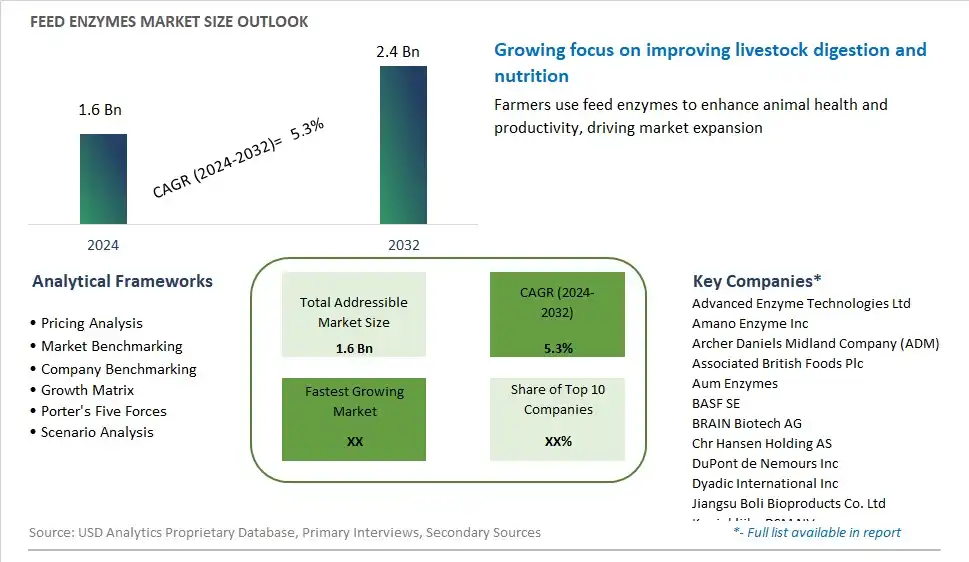
Global Feed Enzymes Market Size is valued at $1.6 Billion in 2024 and is forecast to register a growth rate (CAGR) of 5.3% to reach $2.4 Billion by 2032.
The global Feed Enzymes Market Comprehensive Study analyzes and forecasts the market size across 6 regions and 24 countries for diverse segments -By Type (Phytase, Carbohydrase, Protease, Others), By Livestock (Poultry, Swine, Ruminants, Aquatic animals, Others), By Source (Microorganism, Plant, Animal), By Form (Dry, Liquid)
An Introduction to Feed Enzymes Market
Feed enzymes play a crucial role in optimizing animal nutrition and improving feed efficiency, thereby driving growth in the global livestock industry. In 2024, the market for feed enzymes is witnessing steady expansion, propelled by the increasing demand for meat and dairy products, coupled with a growing focus on animal welfare and environmental sustainability. Enzymes, such as phytases, carbohydrases, and proteases, are utilized to enhance nutrient utilization, reduce feed costs, and minimize environmental impact by mitigating nutrient wastage and improving digestibility. Moreover, advancements in enzyme technology, including enzyme stabilization and encapsulation, are enabling their widespread application across different animal species and feed formulations. As the global population continues to rise, driving demand for protein-rich diets, feed enzymes are expected to play a crucial role in meeting the growing need for sustainable animal protein production.
Feed Enzymes Competitive Landscape
The market report analyses the leading companies in the industry including Advanced Enzyme Technologies Ltd, Amano Enzyme Inc, Archer Daniels Midland Company (ADM), Associated British Foods Plc, Aum Enzymes, BASF SE, BRAIN Biotech AG, Chr Hansen Holding AS, DuPont de Nemours Inc, Dyadic International Inc, Jiangsu Boli Bioproducts Co. Ltd, Koninklijke DSM NV, Lumis Biotech Pvt. Ltd, Maps Enzymes Ltd, Nagase and Co. Ltd, Noor Enzymes Pvt. Ltd, Novozymes AS, Puratos Group NV, Sunson Industry Group Co. Ltd, VTT Technical Research Centre of Finland Ltd , and Others.
Feed Enzymes Market Dynamics
Feed Enzymes Market Trend: Increasing Demand for Animal Protein and Feed Efficiency
A prominent trend in the feed enzymes market is the increasing demand for animal protein and feed efficiency. With the global population rising and dietary preferences shifting towards protein-rich diets, there is a growing need to optimize animal feed formulations to meet the nutritional requirements of livestock efficiently. Feed enzymes play a crucial role in enhancing feed digestibility, nutrient absorption, and overall animal performance, leading to improved growth rates, feed conversion ratios, and production efficiency in livestock operations. This trend is driven by factors such as the growing demand for meat, dairy, and poultry products worldwide, the pressure to reduce environmental footprint and resource consumption in animal agriculture, and the emphasis on sustainable and efficient feed practices. As livestock producers seek to maximize productivity and profitability while minimizing input costs and environmental impact, the demand for feed enzymes continues to grow, driving market expansion and innovation in the animal nutrition industry.
Market Driver: Rising Focus on Animal Health and Nutritional Optimization
A significant driver behind the demand for feed enzymes is the rising focus on animal health and nutritional optimization in livestock production systems. With increasing concerns about animal welfare, disease prevention, and antibiotic resistance, there is a growing emphasis on promoting digestive health, immune function, and overall well-being in livestock through optimized nutrition and feed management practices. Feed enzymes play a critical role in breaking down complex carbohydrates, proteins, and fibers in feed ingredients, allowing animals to extract maximum nutrients and energy from their diet. This driver is fueled by factors such as the tightening regulations on antibiotic use in animal agriculture, the increasing awareness of the importance of gut health in animal performance and disease resistance, and the adoption of precision nutrition strategies to meet the specific nutritional needs of different animal species and production stages. As livestock producers prioritize animal health and performance, the demand for feed enzymes as a cost-effective and sustainable solution for enhancing feed quality and nutrient utilization continues to rise, driving market growth and innovation in the animal nutrition sector.
Market Opportunity: Expansion into Specialized Enzyme Solutions and Value-Added Services
An opportunity for the feed enzymes market lies in expansion into specialized enzyme solutions and value-added services to address specific challenges and opportunities in livestock production. Manufacturers can explore opportunities to develop enzyme blends tailored to the nutritional needs and digestive physiology of different animal species, breeds, and production systems. Additionally, offering value-added services such as technical support, formulation assistance, and on-farm consultancy helps to differentiate products and build customer loyalty by providing comprehensive solutions to livestock producers. Furthermore, embracing innovation in enzyme technology, such as encapsulation, microencapsulation, and enzyme immobilization, enhances enzyme stability, activity, and efficacy in different feed formulations and environmental conditions. By leveraging specialized enzyme solutions and value-added services, manufacturers can meet the evolving needs and preferences of livestock producers, drive adoption of feed enzymes in diverse markets and applications, and capitalize on opportunities for growth and market expansion in the competitive animal nutrition industry.
Feed Enzymes Market Share Analysis: Phytase held the dominant market share in 2024
In the Feed Enzymes Market segmented by type, the phytase segment is the largest, driven by its crucial role in improving phosphorus utilization and enhancing nutrient absorption in animal feed. Phytase enzymes facilitate the release of phosphorus bound to phytate, a form of phosphorus found in plant-based feed ingredients, making it more bioavailable to animals. This improves phosphorus utilization efficiency, reduces the need for inorganic phosphorus supplementation, and mitigates phosphorus excretion, thereby minimizing environmental pollution. Additionally, phytase enzymes can enhance the digestibility of other nutrients, including calcium, amino acids, and energy, further optimizing feed efficiency and animal performance. As livestock and poultry producers seek sustainable and cost-effective solutions to improve feed utilization, the demand for phytase enzymes continues to grow, driving its dominance in the Feed Enzymes Market. Further, regulatory pressures to reduce phosphorus emissions and the increasing focus on eco-friendly feed additives further support the adoption of phytase enzymes in animal nutrition formulations.
Feed Enzymes Market Share Analysis: Poultry market is poised to register the fastest growth rae over the forecast period to 2032
Poultry is the fastest-growing segment in the feed enzymes market due to several factors driving its expansion. With the increasing demand for poultry meat and eggs globally, producers are increasingly turning to feed enzymes to enhance the efficiency of feed utilization, thereby improving poultry performance and profitability. Further, stringent regulations regarding antibiotic use in poultry feed have prompted the adoption of feed enzymes as a viable alternative for improving digestive health and nutrient absorption in poultry. Additionally, rising consumer awareness regarding food safety and quality has led to a growing preference for enzyme-enhanced poultry products. Furthermore, advancements in enzyme technology, coupled with ongoing research and development initiatives, are continuously introducing innovative enzyme formulations tailored specifically for poultry diets, further fueling market growth. Consequently, the poultry segment is expected to maintain its rapid expansion trajectory, driving significant revenue growth within the feed enzymes market in the foreseeable future.
Feed Enzymes Market Share Analysis: Microorganism held the dominant market share in 2024
The microorganism segment stands out as the largest segment in the feed enzymes market, owing to several key factors driving its dominance. Microorganisms, particularly fungi and bacteria, are prolific producers of enzymes with diverse applications in animal nutrition. These enzymes play a crucial role in breaking down complex carbohydrates, proteins, and fibers present in feed ingredients, thereby improving nutrient digestibility and absorption in animals. Additionally, microorganism-derived enzymes exhibit high specificity and stability under a wide range of environmental conditions, making them well-suited for various feed formulations and animal diets. Furthermore, advancements in biotechnology have facilitated the development of novel enzyme strains with enhanced catalytic efficiency and specificity, further bolstering the market dominance of microorganism-sourced feed enzymes. Further, the widespread availability of cost-effective production processes for microbial enzymes has contributed to their widespread adoption by feed manufacturers worldwide. As a result, the microorganism segment continues to command a significant share of the feed enzymes market, with sustained growth anticipated in the coming years.
Feed Enzymes Market Segmentation
By Type
Phytase
Carbohydrase
Protease
Others
By Livestock
Poultry
Swine
Ruminants
Aquatic animals
Others
By Source
Microorganism
Plant
Animal
By Form
Dry
Liquid
Countries Analyzed
North America (US, Canada, Mexico)
Europe (Germany, UK, France, Spain, Italy, Russia, Rest of Europe)
Asia Pacific (China, India, Japan, South Korea, Australia, South East Asia, Rest of Asia)
South America (Brazil, Argentina, Rest of South America)
Middle East and Africa (Saudi Arabia, UAE, Rest of Middle East, South Africa, Egypt, Rest of Africa)
Feed Enzymes Companies Profiled in the Study
Advanced Enzyme Technologies Ltd
Amano Enzyme Inc
Archer Daniels Midland Company (ADM)
Associated British Foods Plc
Aum Enzymes
BASF SE
BRAIN Biotech AG
Chr Hansen Holding AS
DuPont de Nemours Inc
Dyadic International Inc
Jiangsu Boli Bioproducts Co. Ltd
Koninklijke DSM NV
Lumis Biotech Pvt. Ltd
Maps Enzymes Ltd
Nagase and Co. Ltd
Noor Enzymes Pvt. Ltd
Novozymes AS
Puratos Group NV
Sunson Industry Group Co. Ltd
VTT Technical Research Centre of Finland Ltd
*- List Not Exhaustive
Chapter 1. TABLE OF CONTENTS
Chapter 2. Introduction to Feed Enzymes Market
2.1. Market Overview
2.2. Key Statistics and Report Highlights
2.3. Scope of the Comprehensive Study
2.3.1. Market Definition
2.3.2 Countries and Regions Covered
2.3.3 Research Objective
2.3.4 Units, Currency, and Conversions
2.3.5 Industry Value Chain
2.4. Key Market Segments
2.5. Key Companies
2.6. Study Period
Chapter 3. Strategic Analysis Review
3.1. Feed Enzymes Pricing Analysis and Forecast
3.2. Porter’s Five Forces
3.3. Market Ecosystem
3.4. SWOT Analysis
3.5. Regulatory Scenario
3.3. Effects of Inflation, Russia-Ukraine War, moderating economic growth, and other macroeconomic factors
Chapter 4. Competitive Landscape
4.1. Market Share Analysis
4.1.1. Global Feed Enzymes Market Share by Company, 2023
4.1.2. Product Offerings of Leading Feed Enzymes Companies
4.2. Market Entropy
4.2.1. New Product Launches in the Industry
4.2.2. Mergers, Acquisitions, Joint ventures, and Partnerships
4.3. Key Strategies and Best Practices
Chapter 5. Global Market Projections: Best, Reference, and Low Case Scenarios
5.1. Growth Analysis- Case Scenario Definitions
5.2. Low Growth Case Scenario Forecasts
5.3. Reference Growth Case Scenario Forecasts
5.4. High Growth Case Scenario Forecasts
Chapter 6. Market Dynamics
6.1. Feed Enzymes Market Drivers
6.2. Feed Enzymes Market Challenges
6.6. Feed Enzymes Market Opportunities
6.4. Feed Enzymes Market Trends
Chapter 7. Global Feed Enzymes Market Outlook Trends
7.1. Global Feed Enzymes Revenue (USD Million) and CAGR (%) by Type (2021-2032)
7.2. Global Feed Enzymes Revenue (USD Million) and CAGR (%) by Application (2021-2032)
7.3. Global Feed Enzymes Revenue (USD Million) and CAGR (%) by Product (2021-2032)
By Type
Phytase
Carbohydrase
Protease
Others
By Livestock
Poultry
Swine
Ruminants
Aquatic animals
Others
By Source
Microorganism
Plant
Animal
By Form
Dry
Liquid
Chapter 8. Global Feed Enzymes Regional Analysis and Outlook
8.1. Global Feed Enzymes Revenue (USD Million) By Regions (2021- 2032)
8.2. North America Feed Enzymes Revenue (USD Million) by Country (2021-2032)
8.2.1. United States Feed Enzymes Regional Analysis and Outlook
8.2.2. Canada Feed Enzymes Regional Analysis and Outlook
8.2.3. Mexico Feed Enzymes Regional Analysis and Outlook
8.3. Europe Feed Enzymes Revenue (USD Million), by Country (2021-2032)
8.3.1. Germany Feed Enzymes Regional Analysis and Outlook
8.3.2. France Feed Enzymes Regional Analysis and Outlook
8.3.3. United Kingdom Feed Enzymes Regional Analysis and Outlook
8.3.4. Spain Feed Enzymes Regional Analysis and Outlook
8.3.5. Italy Feed Enzymes Regional Analysis and Outlook
8.3.6. Russia Feed Enzymes Regional Analysis and Outlook
8.3.7. Rest of Europe Feed Enzymes Regional Analysis and Outlook
8.4. Asia Pacific Feed Enzymes Revenue (USD Million) by Country (2021-2032)
8.4.1. China Feed Enzymes Regional Analysis and Outlook
8.4.2. Japan Feed Enzymes Regional Analysis and Outlook
8.4.3. India Feed Enzymes Regional Analysis and Outlook
8.4.4. South Korea Feed Enzymes Regional Analysis and Outlook
8.4.5. Australia Feed Enzymes Regional Analysis and Outlook
8.4.6. South East Asia Feed Enzymes Regional Analysis and Outlook
8.4.7. Rest of Asia Pacific Feed Enzymes Regional Analysis and Outlook
8.5. South America Feed Enzymes Revenue (USD Million), by Country (2021-2032)
8.5.1. Brazil Feed Enzymes Regional Analysis and Outlook
8.5.2. Argentina Feed Enzymes Regional Analysis and Outlook
8.5.3. Rest of South America Feed Enzymes Regional Analysis and Outlook
8.6. Middle East and Africa Feed Enzymes Revenue (USD Million) by Country (2021-2032)
8.6.1. Middle East Feed Enzymes Regional Analysis and Outlook
8.6.2. Africa Feed Enzymes Regional Analysis and Outlook
Chapter 9. North America Feed Enzymes Analysis and Outlook
9.1. North America Feed Enzymes Revenue (USD Million) by Segments (2021-2032)
9.1.1. North America Feed Enzymes Revenue (USD Million) by Type (2021-2032)
9.1.2. North America Feed Enzymes Revenue (USD Million) by Application (2021-2032)
9.1.3. North America Feed Enzymes Revenue (USD Million) by Product (2021-2032)
By Type
Phytase
Carbohydrase
Protease
Others
By Livestock
Poultry
Swine
Ruminants
Aquatic animals
Others
By Source
Microorganism
Plant
Animal
By Form
Dry
Liquid
Chapter 10. Europe Feed Enzymes Analysis and Outlook
10.1. Europe Feed Enzymes Revenue (USD Million), by Segments (USD Million) (2021-2032)
10.1.1. Europe Feed Enzymes Revenue (USD Million) by Type (2021-2032)
10.1.2. Europe Feed Enzymes Revenue (USD Million) by Application (2021-2032)
10.1.3. Europe Feed Enzymes Revenue (USD Million) by Product (2021-2032)
By Type
Phytase
Carbohydrase
Protease
Others
By Livestock
Poultry
Swine
Ruminants
Aquatic animals
Others
By Source
Microorganism
Plant
Animal
By Form
Dry
Liquid
Chapter 11. Asia Pacific Feed Enzymes Analysis and Outlook
11.1. Asia Pacific Feed Enzymes Revenue (USD Million), and Revenue (USD Million) by Segments (2021-2032)
11.1.1. Asia Pacific Feed Enzymes Revenue (USD Million) by Type (2021-2032)
11.1.2. Asia Pacific Feed Enzymes Revenue (USD Million) by Application (2021-2032)
11.1.3. Asia Pacific Feed Enzymes Revenue (USD Million) by Product (2021-2032)
By Type
Phytase
Carbohydrase
Protease
Others
By Livestock
Poultry
Swine
Ruminants
Aquatic animals
Others
By Source
Microorganism
Plant
Animal
By Form
Dry
Liquid
Chapter 12. South America Feed Enzymes Analysis and Outlook
12.1. South America Feed Enzymes Revenue (USD Million), by Segments (2021-2032)
12.1.1. South America Feed Enzymes Revenue (USD Million) by Type (2021-2032)
12.1.2. South America Feed Enzymes Revenue (USD Million) by Application (2021-2032)
12.1.3. South America Feed Enzymes Revenue (USD Million) by Product (2021-2032)
By Type
Phytase
Carbohydrase
Protease
Others
By Livestock
Poultry
Swine
Ruminants
Aquatic animals
Others
By Source
Microorganism
Plant
Animal
By Form
Dry
Liquid
Chapter 13. Middle East and Africa Feed Enzymes Analysis and Outlook
13.1. Middle East and Africa Feed Enzymes Revenue (USD Million), by Segments (2021-2032)
13.1.1. Middle East and Africa Feed Enzymes Revenue (USD Million) by Type (2021-2032)
13.1.2. Middle East and Africa Feed Enzymes Revenue (USD Million) by Application (2021-2032)
13.1.3. Middle East and Africa Feed Enzymes Revenue (USD Million) by Product (2021-2032)
By Type
Phytase
Carbohydrase
Protease
Others
By Livestock
Poultry
Swine
Ruminants
Aquatic animals
Others
By Source
Microorganism
Plant
Animal
By Form
Dry
Liquid
Chapter 14. Feed Enzymes Company Profiles
14.1 Business Overview
14.2 Product Profiles
14.3 SWOT Profiles
14.5 Recent Developments
14.6 Financial Profile
List of Companies
Advanced Enzyme Technologies Ltd
Amano Enzyme Inc
Archer Daniels Midland Company (ADM)
Associated British Foods Plc
Aum Enzymes
BASF SE
BRAIN Biotech AG
Chr Hansen Holding AS
DuPont de Nemours Inc
Dyadic International Inc
Jiangsu Boli Bioproducts Co. Ltd
Koninklijke DSM NV
Lumis Biotech Pvt. Ltd
Maps Enzymes Ltd
Nagase and Co. Ltd
Noor Enzymes Pvt. Ltd
Novozymes AS
Puratos Group NV
Sunson Industry Group Co. Ltd
VTT Technical Research Centre of Finland Ltd
15. Methodology and Data Sources
15.1 Customization Offerings
15.2 Subscription Services
15.3 Related Reports
15.4 Publisher Expertise
LIST OF TABLES
Table 1 Market Segmentation Analysis
Table 2 Global Feed Enzymes Market Share of Leading Companies, 2023
Table 3 Product Offerings of Leading Companies
Table 4 Low Growth Scenario Forecasts
Table 5 Reference Case Growth Scenario
Table 6 High Growth Case Scenario
Table 7 Global Feed Enzymes Revenue (USD Million) And CAGR (%) By Type (2021-2032)
Table 8 Global Feed Enzymes Revenue (USD Million) And CAGR (%) By Application (2021-2032)
Table 9 Global Feed Enzymes Revenue (USD Million) And CAGR (%) By Product (2021-2032)
Table 10 Global Feed Enzymes Market Revenue (USD Million) By Regions (2021-2032)
Table 11 Global Feed Enzymes Market Share (%) By Regions (2021-2032)
Table 12 North America Feed Enzymes Revenue (USD Million) By Country (2021-2032)
Table 13 Europe Feed Enzymes Revenue (USD Million) By Country (2021-2032)
Table 14 Asia Pacific Feed Enzymes Revenue (USD Million) By Country (2021-2032)
Table 15 South America Feed Enzymes Revenue (USD Million) By Country (2021-2032)
Table 16 Middle East and Africa Feed Enzymes Revenue (USD Million) By Region (2021-2032)
Table 17 North America Feed Enzymes Revenue (USD Million) By Type (2021-2032)
Table 18 North America Feed Enzymes Revenue (USD Million) By Application (2021-2032)
Table 19 North America Feed Enzymes Revenue (USD Million) By Product (2021-2032)
Table 20 Europe Feed Enzymes Revenue (USD Million) By Type (2021-2032)
Table 21 Europe Feed Enzymes Revenue (USD Million) By Application (2021-2032)
Table 22 Europe Feed Enzymes Revenue (USD Million) By Product (2021-2032)
Table 23 Asia Pacific Feed Enzymes Revenue (USD Million) By Type (2021-2032)
Table 24 Asia Pacific Feed Enzymes Revenue (USD Million) By Application (2021-2032)
Table 25 Asia Pacific Feed Enzymes Revenue (USD Million) By Product (2021-2032)
Table 26 South America Feed Enzymes Revenue (USD Million) By Type (2021-2032)
Table 27 South America Feed Enzymes Revenue (USD Million) By Application (2021-2032)
Table 28 South America Feed Enzymes Revenue (USD Million) By Product (2021-2032)
Table 29 Middle East and Africa Feed Enzymes Revenue (USD Million) By Type (2021-2032)
Table 30 Middle East and Africa Feed Enzymes Revenue (USD Million) By Application (2021-2032)
Table 31 Middle East and Africa Feed Enzymes Revenue (USD Million) By Product (2021-2032)
LIST OF FIGURES
Figure 1. Market Scope
Figure 2. Pricing Forecasts Per Unit, 2023- 2032
Figure 3. Porter’s Five Forces
Figure 4. Global Feed Enzymes Market Revenue (USD Million) By Regions (2021-2032)
Figure 5. Global Feed Enzymes Market Share (%) By Regions (2023)
Figure 6. North America Feed Enzymes Revenue (USD Million) By Country (2021-2032)
Figure 7. United States Feed Enzymes Revenue (USD Million) By Country (2021-2032)
Figure 8. Canada Feed Enzymes Revenue (USD Million) By Country (2021-2032)
Figure 9. Mexico Feed Enzymes Revenue (USD Million) By Country (2021-2032)
Figure 10. Europe Feed Enzymes Revenue (USD Million) By Country (2021-2032)
Figure 11. Germany Feed Enzymes Revenue (USD Million) By Country (2021-2032)
Figure 12. France Feed Enzymes Revenue (USD Million) By Country (2021-2032)
Figure 13. United Kingdom Feed Enzymes Revenue (USD Million) By Country (2021-2032)
Figure 14. Spain Feed Enzymes Revenue (USD Million) By Country (2021-2032)
Figure 15. Italy Feed Enzymes Revenue (USD Million) By Country (2021-2032)
Figure 16. Russia Feed Enzymes Revenue (USD Million) By Country (2021-2032)
Figure 17. Rest of Europe Feed Enzymes Revenue (USD Million) By Country (2021-2032)
Figure 11. Asia Pacific Feed Enzymes Revenue (USD Million) By Country (2021-2032)
Figure 12. China Feed Enzymes Revenue (USD Million) By Country (2021-2032)
Figure 13. Japan Feed Enzymes Revenue (USD Million) By Country (2021-2032)
Figure 14. India Feed Enzymes Revenue (USD Million) By Country (2021-2032)
Figure 15. South Korea Feed Enzymes Revenue (USD Million) By Country (2021-2032)
Figure 16. Australia Feed Enzymes Revenue (USD Million) By Country (2021-2032)
Figure 17. South East Asia Feed Enzymes Revenue (USD Million) By Country (2021-2032)
Figure 18. South America Feed Enzymes Revenue (USD Million) By Country (2021-2032)
Figure 19. Brazil Feed Enzymes Revenue (USD Million) By Country (2021-2032)
Figure 20. Argentina Feed Enzymes Revenue (USD Million) By Country (2021-2032)
Figure 21. Rest of Asia Pacific Feed Enzymes Revenue (USD Million) By Country (2021-2032)
Figure 22. Middle East and Africa Feed Enzymes Revenue (USD Million) By Region (2021-2032)
Figure 23. Saudi Arabia Feed Enzymes Revenue (USD Million) By Region (2021-2032)
Figure 24. The UAE Feed Enzymes Revenue (USD Million) By Region (2021-2032)
Figure 25. Rest of Middle East Feed Enzymes Revenue (USD Million) By Region (2021-2032)
Figure 26. South Africa Feed Enzymes Revenue (USD Million) By Region (2021-2032)
Figure 27. Africa Feed Enzymes Revenue (USD Million) By Region (2021-2032)
Figure 28. North America Feed Enzymes Revenue (USD Million) By Type (2021-2032)
Figure 29. North America Feed Enzymes Revenue (USD Million) By Application (2021-2032)
Figure 30. North America Feed Enzymes Revenue (USD Million) By Product (2021-2032)
Figure 31. Europe Feed Enzymes Revenue (USD Million) By Type (2021-2032)
Figure 32. Europe Feed Enzymes Revenue (USD Million) By Application (2021-2032)
Figure 33. Europe Feed Enzymes Revenue (USD Million) By Product (2021-2032)
Figure 34. Asia Pacific Feed Enzymes Revenue (USD Million) By Type (2021-2032)
Figure 35. Asia Pacific Feed Enzymes Revenue (USD Million) By Application (2021-2032)
Figure 36. Asia Pacific Feed Enzymes Revenue (USD Million) By Product (2021-2032)
Figure 37. South America Feed Enzymes Revenue (USD Million) By Type (2021-2032)
Figure 38. South America Feed Enzymes Revenue (USD Million) By Application (2021-2032)
Figure 39. South America Feed Enzymes Revenue (USD Million) By Product (2021-2032)
Figure 40. Middle East and Africa Feed Enzymes Revenue (USD Million) By Type (2021-2032)
Figure 41. Middle East and Africa Feed Enzymes Revenue (USD Million) By Application (2021-2032)
Figure 42. Middle East and Africa Feed Enzymes Revenue (USD Million) By Product (2021-2032)
By Type
Phytase
Carbohydrase
Protease
Others
By Livestock
Poultry
Swine
Ruminants
Aquatic animals
Others
By Source
Microorganism
Plant
Animal
By Form
Dry
Liquid
Countries Analyzed
North America (US, Canada, Mexico)
Europe (Germany, UK, France, Spain, Italy, Russia, Rest of Europe)
Asia Pacific (China, India, Japan, South Korea, Australia, South East Asia, Rest of Asia)
South America (Brazil, Argentina, Rest of South America)
Middle East and Africa (Saudi Arabia, UAE, Rest of Middle East, South Africa, Egypt, Rest of Africa)
