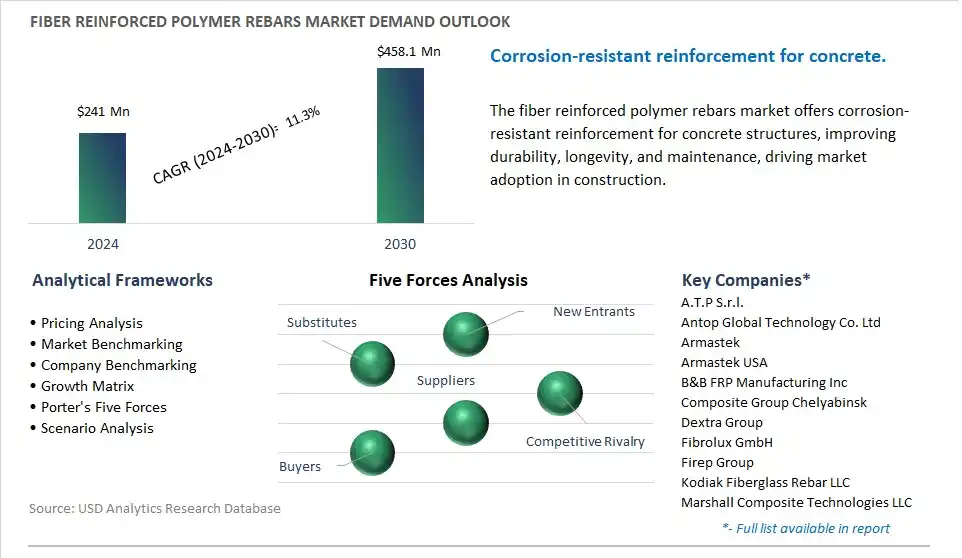
The global Fiber Reinforced Polymer Rebars Market is poised to register a 11.3% CAGR from $241 Million in 2024 to $458.1 Million in 2030.
The global Fiber Reinforced Polymer Rebars Market Study analyzes and forecasts the market size across 6 regions and 24 countries for diverse segments -By Type (Glass Fiber, Carbon Fiber, Basalt Fiber), By Resin (Vinyl Easter, Epoxy, Others), By Application (Highway, Bridges & Buildings, Marine Structurers & Waterfronts, Water Treatment Plant, Others).
An Introduction to Global Fiber Reinforced Polymer Rebars Market in 2024
The future of the fiber reinforced polymer (FRP) rebars market is influenced by trends such as infrastructure development, durability requirements, and sustainability driving innovation in reinforcement materials, manufacturing techniques, and construction practices. Fiber reinforced polymer rebars, also known as FRP rebars or composite rebars, offer superior corrosion resistance, high tensile strength, and lightweight properties compared to traditional steel rebars, making them ideal for reinforced concrete structures in harsh environments. Key trends shaping this market include advancements in FRP materials such as carbon fibers, glass fibers, and basalt fibers to optimize mechanical properties, durability, and cost-effectiveness of rebars, the development of innovative manufacturing processes such as pultrusion, filament winding, and continuous manufacturing to produce rebars with uniform properties and dimensional stability, and the adoption of sustainable construction practices such as corrosion-resistant reinforcements, lightweight structures, and reduced maintenance requirements to enhance lifecycle performance and reduce environmental impact. As governments invest in infrastructure renewal, resilient construction, and sustainable development, the demand for fiber reinforced polymer rebars that offer long-term durability, cost efficiency, and environmental sustainability is expected to drive market growth and stimulate further innovation in FRP rebar technology and applications.
Fiber Reinforced Polymer Rebars Market Competitive Landscape
The market report analyses the leading companies in the industry including A.T.P S.r.l., Antop Global Technology Co. Ltd, Armastek, Armastek USA, B&B FRP Manufacturing Inc, Composite Group Chelyabinsk, Dextra Group, Fibrolux GmbH, Firep Group, Kodiak Fiberglass Rebar LLC, Marshall Composite Technologies LLC, Owens Corning, Pultrall Inc, Pultron Composites, Sanskriti Composites Private Ltd, Schöck Bauteile GmbH, Sireg Geotech S.R.L., Tuf-Bar.
Fiber Reinforced Polymer Rebars Market Dynamics
Fiber Reinforced Polymer Rebars Market Trend: Growing Adoption of Fiber Reinforced Polymer Rebars in Construction Projects
A significant trend in the fiber reinforced polymer rebars market is the increasing adoption of these materials in construction projects. As the construction industry seeks innovative solutions to address challenges such as corrosion, durability, and sustainability, fiber reinforced polymer rebars offer a compelling alternative to traditional steel reinforcement. With superior corrosion resistance, high strength-to-weight ratio, and non-conductive properties, fiber reinforced polymer rebars are being increasingly used in applications such as bridges, highways, marine structures, and buildings. This drives the growing recognition of the benefits of fiber reinforced polymer rebars in enhancing the longevity and performance of concrete structures while reducing maintenance costs and environmental impact.
Fiber Reinforced Polymer Rebars Market Driver: Demand for Corrosion-Resistant and Durable Reinforcement Solutions
The primary driver for the fiber reinforced polymer rebars market is the demand for corrosion-resistant and durable reinforcement solutions in construction. Traditional steel rebars are susceptible to corrosion when exposed to harsh environmental conditions, leading to structural degradation, safety risks, and costly repairs. Fiber reinforced polymer rebars, on the other hand, offer excellent corrosion resistance and long-term durability, making them ideal for applications in corrosive environments such as coastal regions, chemical plants, and wastewater treatment facilities. This demand for corrosion-resistant reinforcement solutions drives the adoption of fiber reinforced polymer rebars as a reliable and cost-effective alternative to steel rebars, particularly in infrastructure projects where durability is paramount.
Fiber Reinforced Polymer Rebars Market Opportunity: Penetration into Emerging Markets and Sustainable Infrastructure Projects
An opportunity exists for companies operating in the fiber reinforced polymer rebars market to penetrate emerging markets and capitalize on sustainable infrastructure projects. With rapid urbanization, population growth, and increasing investments in infrastructure development worldwide, there is a growing demand for construction materials that offer durability, resilience, and sustainability. Fiber reinforced polymer rebars align with these requirements by providing superior performance, longevity, and environmental benefits compared to traditional reinforcement materials. Additionally, as governments and businesses prioritize sustainable development goals and green building initiatives, there is a rising opportunity for fiber reinforced polymer rebars to be incorporated into sustainable infrastructure projects such as green buildings, renewable energy facilities, and resilient urban infrastructure. By targeting these emerging markets and sustainable projects, companies can expand their market presence and capture new growth opportunities in the evolving construction industry landscape.
Fiber Reinforced Polymer Rebars Market Ecosystem
In the fiber-reinforced polymer (FRP) rebar market, the Market Ecosystem begins with raw material sourcing, where companies including Owens Corning and BASF supply fibers and resins, respectively, essential for reinforcement. Additive suppliers including Evonik Industries contribute specialized additives to enhance rebar properties.
The manufacturing stage involves FRP rebar manufacturers including Pultrall Inc. and Hughes Brothers, utilizing pultrusion processes to produce rebars meeting industry standards. Distribution channels, including building material distributors and direct sales by manufacturers, facilitate access to FRP rebars for construction companies and architects. These end-users consider factors including weight and corrosion resistance, integrating FRP rebars into concrete structures during construction, thereby completing the Market Ecosystem.
Owens Corning, BASF, and Pultrall Inc. play pivotal roles across different stages of the FRP rebar Market Ecosystem, ensuring the availability of quality raw materials and manufacturing expertise. Building material distributors including Builders FirstSource and direct sales by FRP rebar manufacturers facilitate market access, while architects, construction companies, and building owners serve as end-users, incorporating FRP rebars into concrete structures for enhanced durability and performance.
Fiber Reinforced Polymer Rebars Market Share Analysis: Glass Fiber held the dominant revenue share in 2024
In the Fiber Reinforced Polymer (FRP) Rebars Market, the Glass Fiber segment is the largest segment, primarily due to diverse key factors driving its dominance in this market. Glass fiber-reinforced polymer (GFRP) rebars offer a cost-effective and corrosion-resistant alternative to traditional steel rebars in construction applications. As a material, glass fiber offers adequate strength and stiffness properties while providing excellent resistance to corrosion, making it particularly suitable for applications in aggressive environments such as marine structures, chemical plants, and coastal infrastructure. Additionally, glass fiber-reinforced polymer rebars are lightweight, which simplifies handling, transportation, and installation processes compared to steel rebars. Further, the non-conductive nature of glass fiber makes it ideal for use in electrical and electromagnetic-sensitive environments. In addition, advancements in manufacturing technologies have led to improvements in the mechanical properties and performance characteristics of glass fiber-reinforced polymer rebars, further enhancing their suitability for a wide range of construction applications. With ongoing investments in infrastructure development, particularly in sectors such as transportation, utilities, and commercial construction, the demand for corrosion-resistant and durable reinforcement solutions like GFRP rebars continues to rise, driving the growth of the Glass Fiber segment in the FRP Rebars Market.
Fiber Reinforced Polymer Rebars Market Share Analysis: Epoxy Resin is the fastest growing market segment over the forecast period to 2030
In the Fiber Reinforced Polymer (FRP) Rebars Market, the Epoxy Resin segment is the fastest-growing segment, primarily due to its superior mechanical properties, versatility, and wide range of applications. Epoxy resin is renowned for its excellent adhesion, high strength-to-weight ratio, and resistance to chemicals, moisture, and environmental degradation, making it an ideal choice for reinforcing structures in harsh and corrosive environments. Epoxy-based FRP rebars offer exceptional durability, longevity, and corrosion resistance, outperforming traditional steel rebars in many applications. In addition, epoxy resin can be easily customized to meet specific engineering requirements, allowing for the development of tailored solutions for various construction projects. The increasing awareness of the benefits offered by epoxy-based FRP rebars, coupled with stringent regulations promoting the use of corrosion-resistant materials in infrastructure projects, has fueled the demand for epoxy resin in the FRP Rebars Market. Additionally, ongoing advancements in epoxy resin formulations and manufacturing processes have further enhanced the performance and cost-effectiveness of epoxy-based FRP rebars, driving their adoption across diverse end-user industries such as construction, transportation, and utilities. As a result, the Epoxy Resin segment is experiencing rapid growth and is poised to continue expanding in the foreseeable future.
Fiber Reinforced Polymer Rebars Market Share Analysis: Highway is the fastest growing market segment over the forecast period to 2030
In the Fiber Reinforced Polymer (FRP) Rebars Market, the Highway segment is the fastest-growing segment, driven by diverse key factors. Firstly, the increasing focus on infrastructure development, particularly in the transportation sector, has led to a surge in highway construction projects globally. FRP rebars offer significant advantages over traditional steel rebars in highway construction due to their lightweight nature, superior corrosion resistance, and high tensile strength. These properties translate to enhanced durability, reduced maintenance costs, and extended service life for highway structures, making FRP rebars an attractive choice for reinforcing concrete pavements, bridge decks, and other critical highway components. In addition, the growing emphasis on sustainability and environmental conservation has propelled the adoption of FRP rebars in highway construction, as they offer eco-friendly alternatives to conventional materials and contribute to the overall sustainability of infrastructure projects. Additionally, advancements in FRP manufacturing technologies and the development of innovative composite materials have further boosted the performance and cost-effectiveness of FRP rebars, driving their widespread acceptance in highway applications. As governments worldwide continue to invest in infrastructure modernization and expansion projects, the demand for FRP rebars in the highway segment is expected to witness robust growth in the coming years.
Fiber Reinforced Polymer Rebars Market Report Scope-
By Type
Glass Fiber
Carbon Fiber
Basalt Fiber
By Resin
Vinyl Easter
Epoxy
Others
By Application
Highway
Bridges & Buildings
Marine Structurers & Waterfronts
Water Treatment Plant
Others
Fiber Reinforced Polymer Rebars Market Companies Profiled
A.T.P S.r.l.
Antop Global Technology Co. Ltd
Armastek
Armastek USA
B&B FRP Manufacturing Inc
Composite Group Chelyabinsk
Dextra Group
Fibrolux GmbH
Firep Group
Kodiak Fiberglass Rebar LLC
Marshall Composite Technologies LLC
Owens Corning
Pultrall Inc
Pultron Composites
Sanskriti Composites Private Ltd
Schöck Bauteile GmbH
Sireg Geotech S.R.L.
Tuf-Bar
*- List Not Exhaustive
TABLE OF CONTENTS
1 Introduction to 2024 Fiber Reinforced Polymer Rebars Market
1.1 Market Overview
1.2 Quick Facts
1.3 Scope/Objective of the Study
1.4 Market Definition
1.5 Countries and Regions Covered
1.6 Units, Currency, and Conversions
1.7 Industry Value Chain
2 Research Methodology
2.1 Market Size Estimation
2.2 Sources and Research Methodology
2.3 Data Triangulation
2.4 Assumptions and Limitations
3 Executive Summary
3.1 Global Fiber Reinforced Polymer Rebars Market Size Outlook, $ Million, 2021 to 2030
3.2 Fiber Reinforced Polymer Rebars Market Outlook by Type, $ Million, 2021 to 2030
3.3 Fiber Reinforced Polymer Rebars Market Outlook by Product, $ Million, 2021 to 2030
3.4 Fiber Reinforced Polymer Rebars Market Outlook by Application, $ Million, 2021 to 2030
3.5 Fiber Reinforced Polymer Rebars Market Outlook by Key Countries, $ Million, 2021 to 2030
4 Market Dynamics
4.1 Key Driving Forces of Fiber Reinforced Polymer Rebars Industry
4.2 Key Market Trends in Fiber Reinforced Polymer Rebars Industry
4.3 Potential Opportunities in Fiber Reinforced Polymer Rebars Industry
4.4 Key Challenges in Fiber Reinforced Polymer Rebars Industry
5 Market Factor Analysis
5.1 Value Chain Analysis
5.2 Competitive Landscape
5.2.1 Global Fiber Reinforced Polymer Rebars Market Share by Company (%), 2023
5.2.2 Product Offerings by Company
5.3 Porter’s Five Forces Analysis
5.4 Pricing Analysis and Outlook
6 Growth Outlook Across Scenarios
6.1 Growth Analysis-Case Scenario Definitions
6.2 Low Growth Scenario Forecasts
6.3 Reference Growth Scenario Forecasts
6.4 High Growth Scenario Forecasts
7 Global Fiber Reinforced Polymer Rebars Market Outlook by Segments
7.1 Fiber Reinforced Polymer Rebars Market Outlook by Segments, $ Million, 2021- 2030
By Type
Glass Fiber
Carbon Fiber
Basalt Fiber
By Resin
Vinyl Easter
Epoxy
Others
By Application
Highway
Bridges & Buildings
Marine Structurers & Waterfronts
Water Treatment Plant
Others
8 North America Fiber Reinforced Polymer Rebars Market Analysis and Outlook To 2030
8.1 Introduction to North America Fiber Reinforced Polymer Rebars Markets in 2024
8.2 North America Fiber Reinforced Polymer Rebars Market Size Outlook by Country, 2021-2030
8.2.1 United States
8.2.2 Canada
8.2.3 Mexico
8.3 North America Fiber Reinforced Polymer Rebars Market size Outlook by Segments, 2021-2030
By Type
Glass Fiber
Carbon Fiber
Basalt Fiber
By Resin
Vinyl Easter
Epoxy
Others
By Application
Highway
Bridges & Buildings
Marine Structurers & Waterfronts
Water Treatment Plant
Others
9 Europe Fiber Reinforced Polymer Rebars Market Analysis and Outlook To 2030
9.1 Introduction to Europe Fiber Reinforced Polymer Rebars Markets in 2024
9.2 Europe Fiber Reinforced Polymer Rebars Market Size Outlook by Country, 2021-2030
9.2.1 Germany
9.2.2 France
9.2.3 Spain
9.2.4 United Kingdom
9.2.4 Italy
9.2.5 Russia
9.2.6 Norway
9.2.7 Rest of Europe
9.3 Europe Fiber Reinforced Polymer Rebars Market Size Outlook by Segments, 2021-2030
By Type
Glass Fiber
Carbon Fiber
Basalt Fiber
By Resin
Vinyl Easter
Epoxy
Others
By Application
Highway
Bridges & Buildings
Marine Structurers & Waterfronts
Water Treatment Plant
Others
10 Asia Pacific Fiber Reinforced Polymer Rebars Market Analysis and Outlook To 2030
10.1 Introduction to Asia Pacific Fiber Reinforced Polymer Rebars Markets in 2024
10.2 Asia Pacific Fiber Reinforced Polymer Rebars Market Size Outlook by Country, 2021-2030
10.2.1 China
10.2.2 India
10.2.3 Japan
10.2.4 South Korea
10.2.5 Indonesia
10.2.6 Malaysia
10.2.7 Australia
10.2.8 Rest of Asia Pacific
10.3 Asia Pacific Fiber Reinforced Polymer Rebars Market size Outlook by Segments, 2021-2030
By Type
Glass Fiber
Carbon Fiber
Basalt Fiber
By Resin
Vinyl Easter
Epoxy
Others
By Application
Highway
Bridges & Buildings
Marine Structurers & Waterfronts
Water Treatment Plant
Others
11 South America Fiber Reinforced Polymer Rebars Market Analysis and Outlook To 2030
11.1 Introduction to South America Fiber Reinforced Polymer Rebars Markets in 2024
11.2 South America Fiber Reinforced Polymer Rebars Market Size Outlook by Country, 2021-2030
11.2.1 Brazil
11.2.2 Argentina
11.2.3 Rest of South America
11.3 South America Fiber Reinforced Polymer Rebars Market size Outlook by Segments, 2021-2030
By Type
Glass Fiber
Carbon Fiber
Basalt Fiber
By Resin
Vinyl Easter
Epoxy
Others
By Application
Highway
Bridges & Buildings
Marine Structurers & Waterfronts
Water Treatment Plant
Others
12 Middle East and Africa Fiber Reinforced Polymer Rebars Market Analysis and Outlook To 2030
12.1 Introduction to Middle East and Africa Fiber Reinforced Polymer Rebars Markets in 2024
12.2 Middle East and Africa Fiber Reinforced Polymer Rebars Market Size Outlook by Country, 2021-2030
12.2.1 Saudi Arabia
12.2.2 UAE
12.2.3 Oman
12.2.4 Rest of Middle East
12.2.5 Egypt
12.2.6 Nigeria
12.2.7 South Africa
12.2.8 Rest of Africa
12.3 Middle East and Africa Fiber Reinforced Polymer Rebars Market size Outlook by Segments, 2021-2030
By Type
Glass Fiber
Carbon Fiber
Basalt Fiber
By Resin
Vinyl Easter
Epoxy
Others
By Application
Highway
Bridges & Buildings
Marine Structurers & Waterfronts
Water Treatment Plant
Others
13 Company Profiles
13.1 Company Snapshot
13.2 SWOT Profiles
13.3 Products and Services
13.4 Recent Developments
13.5 Financial Profile
A.T.P S.r.l.
Antop Global Technology Co. Ltd
Armastek
Armastek USA
B&B FRP Manufacturing Inc
Composite Group Chelyabinsk
Dextra Group
Fibrolux GmbH
Firep Group
Kodiak Fiberglass Rebar LLC
Marshall Composite Technologies LLC
Owens Corning
Pultrall Inc
Pultron Composites
Sanskriti Composites Private Ltd
Schöck Bauteile GmbH
Sireg Geotech S.R.L.
Tuf-Bar
14 Appendix
14.1 Customization Offerings
14.2 Subscription Services
14.3 Related Reports
14.4 Publisher Expertise
By Type
Glass Fiber
Carbon Fiber
Basalt Fiber
By Resin
Vinyl Easter
Epoxy
Others
By Application
Highway
Bridges & Buildings
Marine Structurers & Waterfronts
Water Treatment Plant
Others
Countries Analyzed
North America (US, Canada, Mexico)
Europe (Germany, UK, France, Spain, Italy, Russia, Rest of Europe)
Asia Pacific (China, India, Japan, South Korea, Australia, South East Asia, Rest of Asia)
South America (Brazil, Argentina, Rest of South America)
Middle East and Africa (Saudi Arabia, UAE, Rest of Middle East, South Africa, Egypt, Rest of Africa)
