
The global Fiberglass Building Products Market Study analyzes and forecasts the market size across 6 regions and 24 countries for diverse segments -By Application (Residential, Non-residential), By Type (Glass Wool, Yarn, Roving, Chopped Strands).
The fiberglass building products market is experiencing steady growth driven by the construction industry's demand for lightweight, durable, and cost-effective materials. Fiberglass offers several advantages over traditional building materials such as wood, steel, and concrete, including high strength-to-weight ratio, resistance to corrosion, and ease of installation. These properties make fiberglass an ideal choice for a wide range of building applications, including roofing, insulation, windows, doors, and facades. With increasing emphasis on energy efficiency and sustainability in building design, fiberglass building products are gaining popularity due to their thermal insulation properties, which help reduce heating and cooling costs and minimize environmental impact. Moreover, advancements in fiberglass manufacturing technologies, such as pultrusion, filament winding, and compression molding, are expanding the range of applications and improving the performance characteristics of fiberglass building products. Additionally, the growing trend towards prefabrication and modular construction methods is driving demand for off-site manufactured fiberglass components, enabling faster construction timelines and reduced labor costs. Collaboration between fiberglass manufacturers, architects, engineers, and construction firms is essential to promote innovation, ensure product quality, and address the evolving needs of the construction industry in the fiberglass building products market.
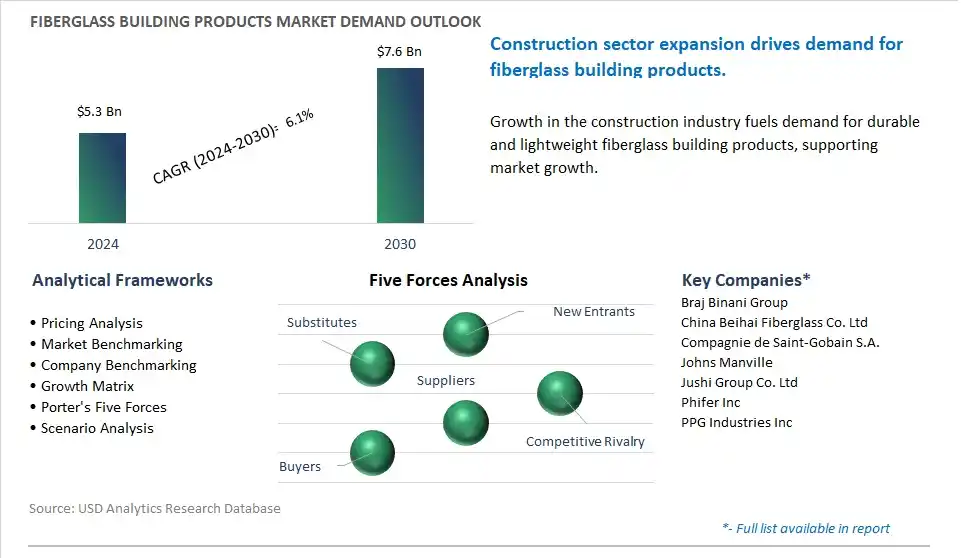
The market report analyses the leading companies in the industry including Braj Binani Group, China Beihai Fiberglass Co. Ltd, Compagnie de Saint-Gobain S.A., Johns Manville, Jushi Group Co. Ltd, Phifer Inc, PPG Industries Inc.
A prominent trend in the fiberglass building products market is the growing emphasis on energy efficiency and sustainability in construction. As environmental concerns and regulatory requirements continue to drive the building industry towards more sustainable practices, there is an increasing demand for building materials that offer superior energy performance and environmental benefits. Fiberglass building products, such as insulation, windows, doors, and composite panels, are gaining traction due to their excellent thermal insulation properties, durability, and recyclability. This trend is fueled by initiatives aimed at reducing carbon emissions, improving indoor air quality, and enhancing building energy efficiency standards worldwide.
A key driver in the fiberglass building products market is the rising construction activities and infrastructure development globally. With rapid urbanization, population growth, and economic expansion in emerging markets, there is a growing demand for residential, commercial, and industrial construction projects. Fiberglass building products are favored by architects, builders, and contractors for their versatility, performance, and cost-effectiveness in various applications, including insulation, structural components, cladding, and façade systems. The increasing investments in infrastructure projects, including transportation, utilities, and public facilities, further drive the demand for fiberglass building products as they offer durable and sustainable solutions for modern construction requirements.
An opportunity within the fiberglass building products market lies in innovation in lightweight and high-performance fiberglass solutions. Manufacturers and suppliers have the opportunity to capitalize on emerging trends and market demands by developing innovative fiberglass products that offer enhanced performance, durability, and ease of installation. This includes the development of advanced fiberglass composites with improved strength-to-weight ratios, fire resistance, acoustic properties, and thermal insulation capabilities. Additionally, opportunities exist for the integration of smart technologies and sustainable materials into fiberglass building products to meet the evolving needs of architects, engineers, and building owners for efficient and eco-friendly construction solutions. By investing in research and development and collaborating with industry stakeholders, companies can seize opportunities to differentiate their offerings and gain a competitive edge in the dynamic fiberglass building products market.
The largest segment in the Fiberglass Building Products Market is the Non-residential segment. This is because fiberglass building products are extensively used in various non-residential applications due to their versatility, durability, and performance characteristics. Non-residential applications include commercial buildings, industrial facilities, institutional buildings, and infrastructure projects such as bridges, tunnels, and utilities. Fiberglass building products offer numerous advantages in non-residential construction, including high strength-to-weight ratio, corrosion resistance, fire resistance, thermal insulation properties, and design flexibility. These properties make fiberglass an attractive choice for architects, engineers, and contractors seeking reliable and cost-effective building materials that can withstand harsh environmental conditions, heavy loads, and frequent use in commercial and industrial settings. Additionally, fiberglass building products can be customized to meet specific project requirements, including size, shape, color, and surface finish, allowing for creative design solutions and architectural expressions in non-residential construction projects. Further, regulatory requirements for energy efficiency, sustainability, and green building practices have further contributed to the adoption of fiberglass building products in non-residential applications, as fiberglass materials offer excellent thermal performance, recyclability, and LEED (Leadership in Energy and Environmental Design) certification potential. Over the forecast period, the combination of performance attributes, design versatility, and regulatory compliance solidifies the Non-residential segment as the largest in the Fiberglass Building Products Market.
The fastest-growing segment in the Fiberglass Building Products Market is the Glass Wool segment. glass wool products, also known as fiberglass insulation, are widely used in the construction industry for thermal and acoustic insulation in both residential and non-residential buildings. As awareness of energy efficiency and sustainability continues to grow, there is an increasing demand for insulation materials that can improve building envelope performance, reduce energy consumption, and enhance indoor comfort levels. Glass wool insulation offers excellent thermal insulation properties, fire resistance, sound absorption capabilities, and moisture resistance, making it a preferred choice for builders, contractors, and homeowners seeking effective and affordable insulation solutions. Further, government initiatives and building energy codes aimed at promoting energy-efficient building practices and reducing greenhouse gas emissions have driven the adoption of insulation materials such as glass wool in construction projects. Incentives, rebates, and tax credits for energy-efficient upgrades and green building certifications further incentivize the use of glass wool insulation in new construction and retrofit projects. Additionally, advancements in glass wool manufacturing processes, product formulations, and installation techniques have improved the performance, durability, and ease of use of glass wool insulation, making it a competitive alternative to other insulation materials such as mineral wool, foam boards, and natural fibers. Further, the growing trend towards sustainable construction and green building certifications, such as LEED (Leadership in Energy and Environmental Design), favors the use of insulation materials with high recycled content and low embodied energy, further driving the demand for glass wool insulation in the construction industry. Over the forecast period, the combination of energy efficiency requirements, regulatory drivers, technological advancements, and sustainability considerations positions the Glass Wool segment as the fastest-growing in the Fiberglass Building Products Market.
By Application
Residential
Non-residential
By Type
Glass Wool
Yarn
Roving
Chopped Strands
Regions Included
North America (US, Canada, Mexico)
Europe (Germany, UK, France, Spain, Italy, Russia, Rest of Europe)
Asia Pacific (China, India, Japan, South Korea, Australia, South East Asia, Rest of Asia)
South America (Brazil, Argentina, Rest of South America)
Middle East and Africa (Saudi Arabia, UAE, Rest of Middle East, South Africa, Egypt, Rest of Africa)
Braj Binani Group
China Beihai Fiberglass Co. Ltd
Compagnie de Saint-Gobain S.A.
Johns Manville
Jushi Group Co. Ltd
Phifer Inc
PPG Industries Inc
*- List Not Exhaustive
TABLE OF CONTENTS
1 Introduction to 2024 Fiberglass Building Products Market
1.1 Market Overview
1.2 Quick Facts
1.3 Scope/Objective of the Study
1.4 Market Definition
1.5 Countries and Regions Covered
1.6 Units, Currency, and Conversions
1.7 Industry Value Chain
2 Research Methodology
2.1 Market Size Estimation
2.2 Sources and Research Methodology
2.3 Data Triangulation
2.4 Assumptions and Limitations
3 Executive Summary
3.1 Global Fiberglass Building Products Market Size Outlook, $ Million, 2021 to 2030
3.2 Fiberglass Building Products Market Outlook by Type, $ Million, 2021 to 2030
3.3 Fiberglass Building Products Market Outlook by Product, $ Million, 2021 to 2030
3.4 Fiberglass Building Products Market Outlook by Application, $ Million, 2021 to 2030
3.5 Fiberglass Building Products Market Outlook by Key Countries, $ Million, 2021 to 2030
4 Market Dynamics
4.1 Key Driving Forces of Fiberglass Building Products Industry
4.2 Key Market Trends in Fiberglass Building Products Industry
4.3 Potential Opportunities in Fiberglass Building Products Industry
4.4 Key Challenges in Fiberglass Building Products Industry
5 Market Factor Analysis
5.1 Value Chain Analysis
5.2 Competitive Landscape
5.2.1 Global Fiberglass Building Products Market Share by Company (%), 2023
5.2.2 Product Offerings by Company
5.3 Porter’s Five Forces Analysis
5.4 Pricing Analysis and Outlook
6 Growth Outlook Across Scenarios
6.1 Growth Analysis-Case Scenario Definitions
6.2 Low Growth Scenario Forecasts
6.3 Reference Growth Scenario Forecasts
6.4 High Growth Scenario Forecasts
7 Global Fiberglass Building Products Market Outlook by Segments
7.1 Fiberglass Building Products Market Outlook by Segments, $ Million, 2021- 2030
By Application
Residential
Non-residential
By Type
Glass Wool
Yarn
Roving
Chopped Strands
8 North America Fiberglass Building Products Market Analysis and Outlook To 2030
8.1 Introduction to North America Fiberglass Building Products Markets in 2024
8.2 North America Fiberglass Building Products Market Size Outlook by Country, 2021-2030
8.2.1 United States
8.2.2 Canada
8.2.3 Mexico
8.3 North America Fiberglass Building Products Market size Outlook by Segments, 2021-2030
By Application
Residential
Non-residential
By Type
Glass Wool
Yarn
Roving
Chopped Strands
9 Europe Fiberglass Building Products Market Analysis and Outlook To 2030
9.1 Introduction to Europe Fiberglass Building Products Markets in 2024
9.2 Europe Fiberglass Building Products Market Size Outlook by Country, 2021-2030
9.2.1 Germany
9.2.2 France
9.2.3 Spain
9.2.4 United Kingdom
9.2.4 Italy
9.2.5 Russia
9.2.6 Norway
9.2.7 Rest of Europe
9.3 Europe Fiberglass Building Products Market Size Outlook by Segments, 2021-2030
By Application
Residential
Non-residential
By Type
Glass Wool
Yarn
Roving
Chopped Strands
10 Asia Pacific Fiberglass Building Products Market Analysis and Outlook To 2030
10.1 Introduction to Asia Pacific Fiberglass Building Products Markets in 2024
10.2 Asia Pacific Fiberglass Building Products Market Size Outlook by Country, 2021-2030
10.2.1 China
10.2.2 India
10.2.3 Japan
10.2.4 South Korea
10.2.5 Indonesia
10.2.6 Malaysia
10.2.7 Australia
10.2.8 Rest of Asia Pacific
10.3 Asia Pacific Fiberglass Building Products Market size Outlook by Segments, 2021-2030
By Application
Residential
Non-residential
By Type
Glass Wool
Yarn
Roving
Chopped Strands
11 South America Fiberglass Building Products Market Analysis and Outlook To 2030
11.1 Introduction to South America Fiberglass Building Products Markets in 2024
11.2 South America Fiberglass Building Products Market Size Outlook by Country, 2021-2030
11.2.1 Brazil
11.2.2 Argentina
11.2.3 Rest of South America
11.3 South America Fiberglass Building Products Market size Outlook by Segments, 2021-2030
By Application
Residential
Non-residential
By Type
Glass Wool
Yarn
Roving
Chopped Strands
12 Middle East and Africa Fiberglass Building Products Market Analysis and Outlook To 2030
12.1 Introduction to Middle East and Africa Fiberglass Building Products Markets in 2024
12.2 Middle East and Africa Fiberglass Building Products Market Size Outlook by Country, 2021-2030
12.2.1 Saudi Arabia
12.2.2 UAE
12.2.3 Oman
12.2.4 Rest of Middle East
12.2.5 Egypt
12.2.6 Nigeria
12.2.7 South Africa
12.2.8 Rest of Africa
12.3 Middle East and Africa Fiberglass Building Products Market size Outlook by Segments, 2021-2030
By Application
Residential
Non-residential
By Type
Glass Wool
Yarn
Roving
Chopped Strands
13 Company Profiles
13.1 Company Snapshot
13.2 SWOT Profiles
13.3 Products and Services
13.4 Recent Developments
13.5 Financial Profile
Braj Binani Group
China Beihai Fiberglass Co. Ltd
Compagnie de Saint-Gobain S.A.
Johns Manville
Jushi Group Co. Ltd
Phifer Inc
PPG Industries Inc
14 Appendix
14.1 Customization Offerings
14.2 Subscription Services
14.3 Related Reports
14.4 Publisher Expertise
By Application
Residential
Non-residential
By Type
Glass Wool
Yarn
Roving
Chopped Strands
Countries Analyzed
North America (US, Canada, Mexico)
Europe (Germany, UK, France, Spain, Italy, Russia, Rest of Europe)
Asia Pacific (China, India, Japan, South Korea, Australia, South East Asia, Rest of Asia)
South America (Brazil, Argentina, Rest of South America)
Middle East and Africa (Saudi Arabia, UAE, Rest of Middle East, South Africa, Egypt, Rest of Africa)
Global Fiberglass Building Products is forecast to reach $7.6 Billion in 2030 from $5.3 Billion in 2024, registering a CAGR of 6.1%
Emerging Markets across Asia Pacific, Europe, and Americas present robust growth prospects.
Braj Binani Group, China Beihai Fiberglass Co. Ltd, Compagnie de Saint-Gobain S.A., Johns Manville, Jushi Group Co. Ltd, Phifer Inc, PPG Industries Inc
Base Year- 2023; Estimated Year- 2024; Historic Period- 2018-2023; Forecast period- 2024 to 2030; Currency: Revenue (USD); Volume