The global Fiberglass for Aerospace Market is poised to register a 7.3% CAGR from $2.8 Billion in 2024 to $4.3 Billion in 2030.
The global Fiberglass for Aerospace Market Study analyzes and forecasts the market size across 6 regions and 24 countries for diverse segments -By Type (E-glass, ECR-glass, S-glass, AR-glass, H-glass, Specialty), By Resin (Thermoset Resins, Thermoplastic Resins), By Product (Glass Wool, Roving, Yarn, Chopped Strand, Others).
An Introduction to Global Fiberglass for Aerospace Market in 2024
The fiberglass for aerospace market is experiencing robust growth driven by the aerospace industry's demand for lightweight, high-strength materials that can withstand extreme operating conditions. Fiberglass composites offer significant weight savings compared to traditional materials such as aluminum and steel, making them ideal for aerospace applications where every kilogram counts. Fiberglass-reinforced composites exhibit excellent mechanical properties, including high tensile strength, stiffness, and fatigue resistance, making them suitable for a wide range of aerospace components such as fuselage panels, wings, empennage structures, and interior fittings. Moreover, fiberglass composites offer design flexibility and ease of manufacturing, enabling complex geometries and integrated structures that optimize aerodynamic performance and fuel efficiency. With the increasing demand for fuel-efficient aircraft and the growing trend towards electric propulsion and urban air mobility, there's a heightened focus on lightweight materials that can help reduce emissions and operating costs. This has led to increased adoption of fiberglass composites in next-generation aircraft programs and aerospace innovations. Collaboration between fiberglass suppliers, aerospace manufacturers, and regulatory agencies is essential to ensure compliance with stringent safety and performance standards and drive further innovation in the fiberglass for aerospace market.
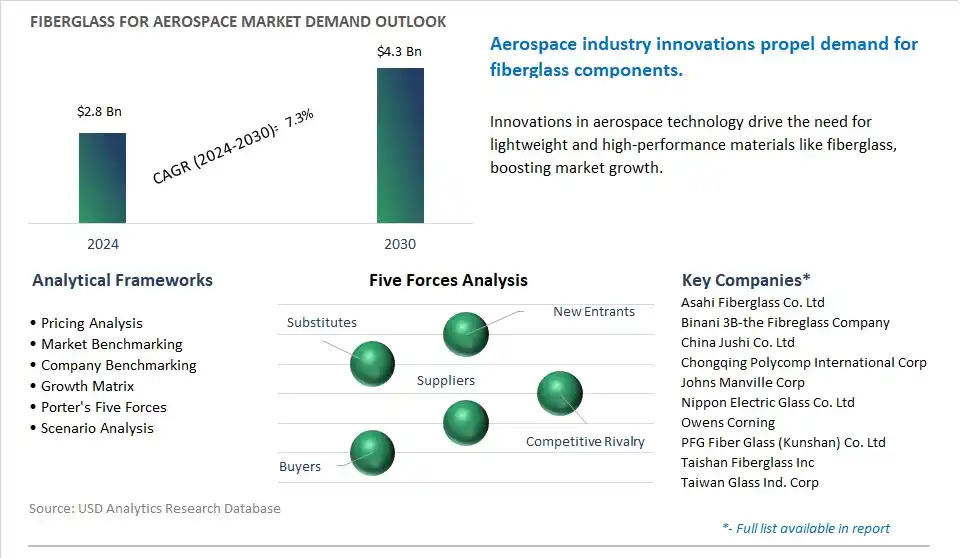
Fiberglass for Aerospace Market Competitive Landscape
The market report analyses the leading companies in the industry including Asahi Fiberglass Co. Ltd, Binani 3B-the Fibreglass Company, China Jushi Co. Ltd, Chongqing Polycomp International Corp, Johns Manville Corp, Nippon Electric Glass Co. Ltd, Owens Corning, PFG Fiber Glass (Kunshan) Co. Ltd, Taishan Fiberglass Inc, Taiwan Glass Ind. Corp.
Fiberglass for Aerospace Market Dynamics
Fiberglass for Aerospace Market Trend: Increased Adoption of Lightweight Materials in Aircraft Design
A prominent trend in the fiberglass for aerospace market is the increased adoption of lightweight materials in aircraft design. With the aerospace industry focusing on fuel efficiency, reduced emissions, and enhanced performance, there is a growing demand for materials that offer high strength-to-weight ratios while maintaining durability and structural integrity. Fiberglass, renowned for its lightweight properties and excellent mechanical performance, is increasingly being utilized in various aerospace applications, including aircraft fuselages, interiors, engine components, and structural reinforcements. This trend is driven by the aerospace sector's continuous pursuit of innovative solutions to meet stringent regulatory standards, improve fuel economy, and optimize aircraft performance.
Fiberglass for Aerospace Market Driver: Stringent Regulations and Performance Standards
A key driver in the fiberglass for aerospace market is the presence of stringent regulations and performance standards governing aircraft design, construction, and operation. Regulatory bodies, such as the Federal Aviation Administration (FAA) and the European Aviation Safety Agency (EASA), impose strict requirements on the materials used in aerospace applications to ensure aircraft safety, reliability, and compliance with airworthiness standards. Fiberglass, known for its exceptional mechanical properties, fire resistance, and resistance to corrosion and fatigue, enables manufacturers to meet these stringent regulatory requirements while offering significant weight savings compared to traditional materials like aluminum and steel. The demand for fiberglass in aerospace is further fueled by the industry's focus on lightweighting strategies, composite materials innovation, and the development of next-generation aircraft platforms.
Fiberglass for Aerospace Market Opportunity: Expansion into Emerging Aerospace Segments
An opportunity within the fiberglass for aerospace market lies in the expansion into emerging aerospace segments. As the aerospace industry evolves to address emerging market trends and technological advancements, there is a growing demand for fiberglass-based solutions tailored to specific aerospace applications and segments. Manufacturers and suppliers have the opportunity to capitalize on this demand by diversifying their product offerings and entering niche markets, such as unmanned aerial vehicles (UAVs), urban air mobility (UAM), space exploration vehicles, and electric aircraft. By leveraging their expertise in fiberglass manufacturing, collaborating with aerospace OEMs and tier suppliers, and investing in research and development, companies can explore new opportunities to provide innovative fiberglass solutions that address the evolving needs of the aerospace industry and contribute to the advancement of aviation technology.
Fiberglass for Aerospace Market Share Analysis: The E-glass generated the highest revenue in 2024
The largest segment in the Fiberglass for Aerospace Market is the E-glass segment. E-glass, or electrical-grade glass, is one of the most widely used types of fiberglass due to its excellent electrical insulation properties, mechanical strength, and cost-effectiveness. In the aerospace industry, where weight reduction, performance, and safety are paramount, E-glass fibers are extensively used in the production of composite materials for various aerospace applications such as aircraft fuselages, wings, empennages, interior components, and structural reinforcements. The inherent properties of E-glass fibers, including high tensile strength, stiffness, and fatigue resistance, make them suitable for aerospace structures requiring lightweight yet durable materials capable of withstanding extreme aerodynamic forces, vibrations, and temperature variations encountered during flight operations. Further, E-glass fibers offer good compatibility with resin systems commonly used in aerospace composite manufacturing processes such as epoxy, polyester, vinylester, and phenolic resins. This compatibility enables efficient impregnation, wet-out, and consolidation of E-glass fiber reinforcements into composite laminates, resulting in uniform distribution of fibers and optimized mechanical properties in the final aerospace components. Additionally, E-glass fibers are readily available in various forms such as rovings, fabrics, mats, and prepregs, offering flexibility in composite layup designs and manufacturing techniques to meet specific aerospace engineering requirements and performance standards. Further, E-glass fibers are relatively inexpensive compared to other specialty glass fibers such as S-glass, AR-glass, and H-glass, making them the preferred choice for cost-sensitive aerospace applications without compromising on performance or quality. Furthermore, E-glass fibers are well-established in the aerospace industry, with a long history of successful use in aircraft manufacturing, maintenance, and repair operations, providing confidence to aerospace engineers, designers, and manufacturers in their reliability, consistency, and performance under demanding aerospace environments. Over the forecast period, the combination of excellent mechanical properties, compatibility with resin systems, availability, cost-effectiveness, and proven track record solidifies the E-glass segment as the largest in the Fiberglass for Aerospace Market.
Fiberglass for Aerospace Market Share Analysis: The Thermoplastic Resins segment is poised to register the fastest growth rate (CAGR) over the forecast period to 2030
The fastest-growing segment in the Fiberglass for Aerospace Market is the Thermoplastic Resins segment. Thermoplastic resins offer potential advantages over thermoset resins in aerospace composite applications, driving their increasing adoption. Thermoplastic composites provide superior impact resistance, toughness, damage tolerance, and fatigue performance compared to thermoset composites, making them well-suited for aerospace structures subjected to high stress, dynamic loads, and impact events. Additionally, thermoplastic composites offer shorter processing times, lower curing temperatures, and greater recyclability compared to thermoset composites, leading to reduced manufacturing cycle times, energy consumption, and production costs in aerospace composite fabrication. This efficiency gains significance in aerospace manufacturing, where stringent production schedules, cost constraints, and environmental considerations are paramount. Further, advancements in thermoplastic resin formulations, processing technologies, and composite material systems have expanded the application range and performance capabilities of thermoplastic composites in aerospace engineering. New generations of high-performance thermoplastic resins, such as polyetheretherketone (PEEK), polyetherimide (PEI), polyphenylene sulfide (PPS), and polyamide (PA), offer enhanced mechanical properties, fire resistance, chemical resistance, and thermal stability, meeting the demanding requirements of aerospace structural components, interior panels, and secondary structures. Further, innovations in composite manufacturing processes, including automated fiber placement (AFP), automated tape laying (ATL), and out-of-autoclave (OoA) processing techniques, enable efficient fabrication of complex-shaped thermoplastic composite parts with high precision, repeatability, and quality control, further driving the adoption of thermoplastic composites in aerospace applications. Additionally, growing interest in sustainable aviation and environmental stewardship motivates aerospace manufacturers to explore thermoplastic composites as eco-friendly alternatives to traditional materials, given their potential for recyclability, reusability, and reduced environmental impact over the product lifecycle. Over the forecast period, the combination of superior mechanical properties, processing advantages, material innovations, and sustainability benefits positions the Thermoplastic Resins segment as the fastest-growing in the Fiberglass for Aerospace Market.
Fiberglass for Aerospace Market Share Analysis: The Roving segment is poised to register the fastest growth rate (CAGR) over the forecast period to 2030
The fastest-growing segment in the Fiberglass for Aerospace Market is the Roving segment. rovings are continuous strands of fiberglass with high tensile strength and stiffness, making them ideal reinforcements for aerospace composite materials. Rovings are commonly used as primary reinforcements in composite laminates and structures for aerospace applications such as aircraft fuselages, wings, empennages, and interior components. The demand for rovings in aerospace composite manufacturing is driven by the need for lightweight yet durable materials capable of withstanding extreme operating conditions, including aerodynamic forces, temperature variations, and mechanical stresses encountered during flight operations. Further, advancements in composite manufacturing processes, such as resin infusion, vacuum-assisted resin transfer molding (VARTM), and automated fiber placement (AFP), have increased the efficiency, precision, and scalability of roving-based composite fabrication in aerospace applications. These manufacturing techniques enable the production of complex-shaped composite parts with optimized fiber architectures, minimizing material waste, reducing labor costs, and enhancing production throughput in aerospace manufacturing facilities. Additionally, the development of high-performance resin systems, bonding agents, and surface treatments compatible with rovings further enhances the mechanical properties, durability, and adhesion of roving-based composite materials in aerospace structures. Further, the growing trend towards electric propulsion, unmanned aerial vehicles (UAVs), urban air mobility (UAM), and space exploration drives the demand for lightweight and high-strength materials like rovings to meet the performance requirements of next-generation aerospace platforms and missions. Furthermore, the increasing adoption of composite materials in aircraft interiors, cabin components, and cargo systems for weight savings, noise reduction, and passenger comfort further boosts the demand for rovings as key reinforcements in aerospace composite applications. Over the forecast period, the combination of superior mechanical properties, manufacturing advancements, industry trends, and aerospace innovation initiatives positions the Roving segment as the fastest-growing in the Fiberglass for Aerospace Market.
Fiberglass for Aerospace Market Report Segmentation
By Type
E-glass
ECR-glass
S-glass
AR-glass
H-glass
Specialty
By Resin
Thermoset Resins
Thermoplastic Resins
By Product
Glass Wool
Roving
Yarn
Chopped Strand
Others
Regions Included
North America (US, Canada, Mexico)
Europe (Germany, UK, France, Spain, Italy, Russia, Rest of Europe)
Asia Pacific (China, India, Japan, South Korea, Australia, South East Asia, Rest of Asia)
South America (Brazil, Argentina, Rest of South America)
Middle East and Africa (Saudi Arabia, UAE, Rest of Middle East, South Africa, Egypt, Rest of Africa)
Fiberglass for Aerospace Companies Profiled in the Market Study
Asahi Fiberglass Co. Ltd
Binani 3B-the Fibreglass Company
China Jushi Co. Ltd
Chongqing Polycomp International Corp
Johns Manville Corp
Nippon Electric Glass Co. Ltd
Owens Corning
PFG Fiber Glass (Kunshan) Co. Ltd
Taishan Fiberglass Inc
Taiwan Glass Ind. Corp
*- List Not Exhaustive
