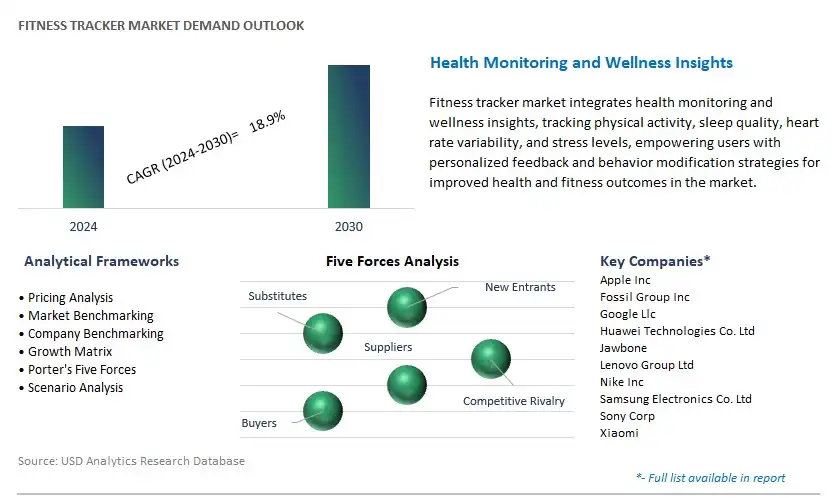
Fitness Tracker Market is estimated to increase at a growth rate of 18.9% CAGR over the forecast period from 2024 to 2030.
The Fitness Tracker Market study analyzes and forecasts the market size across 6 regions and 24 countries for diverse segments including By Type (Smart Watches, Smart Bands, Smart Clothing, Others), By Application (Heart Rate Tracking, Sleep Monitoring, Glucose Monitoring, Sports, Running Tracking, Cycling Tracking, Others), By Distribution Channel (Online, Offline).
An Introduction to Fitness Tracker Market in 2024
The fitness tracker market in 2024 serves the demand for wearable devices and activity monitors designed to track and analyze physical activity, exercise, sleep patterns, and overall health and fitness metrics for individuals seeking to monitor and improve their lifestyle behaviors and wellness outcomes. Fitness trackers, also known as activity trackers or wearable fitness devices, utilize sensors, accelerometers, gyroscopes, and heart rate monitors to collect data on steps taken, distance traveled, calories burned, heart rate, sleep quality, and other biometric parameters, providing real-time feedback, goal setting, and performance tracking for users. Market dynamics are driven by factors such as the increasing adoption of digital health technologies and personal health tracking devices, the growing emphasis on preventive health and wellness management, and advancements in sensor technology, data analytics, and mobile health applications for personalized fitness coaching and behavior change interventions. Collaboration between fitness tracker manufacturers, health and wellness coaches, and digital health platforms drives innovation and market expansion in fitness trackers, supporting healthier lifestyles, physical activity promotion, and chronic disease prevention in consumer wellness and healthcare settings.
Fitness Tracker Market Trend: Integration of Advanced Health Monitoring Features
A prominent trend in the Fitness Tracker market is the integration of advanced health monitoring features. Modern fitness trackers are evolving beyond basic activity tracking to incorporate advanced sensors and technology capable of monitoring various health metrics such as heart rate variability, blood oxygen saturation levels, sleep patterns, and stress levels. This trend reflects the growing consumer demand for comprehensive health monitoring solutions that provide actionable insights for improving overall well-being. Manufacturers are continuously innovating to incorporate more sophisticated health monitoring capabilities into fitness trackers, aligning with the rising interest in holistic health management among consumers.
Fitness Tracker Market Driver: Increasing Focus on Health and Fitness Awareness
A key driver in the Fitness Tracker market is the increasing focus on health and fitness awareness among consumers. With rising concerns about sedentary lifestyles, obesity, and chronic diseases, individuals are becoming more proactive about monitoring and managing their health. Fitness trackers serve as valuable tools for tracking physical activity, setting fitness goals, and measuring progress, thereby motivating users to adopt healthier habits and lifestyles. The growing emphasis on preventive healthcare and the desire for personalized wellness solutions drive the demand for fitness trackers as essential companions for health-conscious consumers seeking to lead active and balanced lives.
Fitness Tracker Market Opportunity: Expansion into Healthcare and Corporate Wellness Programs
An opportunity for growth in the Fitness Tracker market lies in the expansion into healthcare and corporate wellness programs. As healthcare providers and employers increasingly prioritize preventive healthcare initiatives and employee wellness programs, there is a growing demand for wearable devices, including fitness trackers, to promote health monitoring and physical activity among populations. Fitness tracker manufacturers can capitalize on this opportunity by partnering with healthcare organizations, insurance companies, and corporate wellness providers to integrate their devices into wellness programs, incentivize healthy behaviors, and facilitate remote health monitoring. By expanding into these sectors, fitness tracker companies can access new customer segments and establish themselves as integral components of comprehensive health and wellness ecosystems.
Fitness Tracker Market Segmentation
By Type
Smart Watches
Smart Bands
Smart Clothing
Others
By Application
Heart Rate Tracking
Sleep Monitoring
Glucose Monitoring
Sports
Running Tracking
Cycling Tracking
Others
By Distribution channel
Online
Offline
Geographical Analysis
North America (United States, Canada, Mexico)
Europe (Germany, France, United Kingdom, Spain, Italy, Rest of Europe)
Asia Pacific (China, India, Japan, South Korea, Rest of Asia Pacific)
South America (Brazil, Argentina, Rest of South America)
Middle East and Africa (Saudi Arabia, UAE, Rest of Middle East, South Africa, Egypt, Rest of Africa)
Fitness Tracker Market Companies
Apple Inc
Fossil Group Inc
Google Llc
Huawei Technologies Co. Ltd
Jawbone
Lenovo Group Ltd
Nike Inc
Samsung Electronics Co. Ltd
Sony Corp
Xiaomi
*- List Not Exhaustive
Reasons to Buy the Fitness Tracker Market Study
• Deepen your industry insights and navigate uncertainties for strategy formulation, CAPEX, and Operational decisions
• Gain access to detailed insights on the Fitness Tracker Market, encompassing current market size, growth trends, and forecasts till 2030.
• Access detailed competitor analysis, enabling competitive advantage through a thorough understanding of market players, strategies, and potential differentiation opportunities
• Stay ahead of the curve with insights on technological advancements, innovations, and upcoming trends
• Identify lucrative investment avenues and expansion opportunities within the Fitness Tracker Market industry, guided by robust, data-backed analysis.
• Understand regional and global markets through country-wise analysis, regional market potential, regulatory nuances, and dynamics
• Execute strategies with confidence and speed through information, analytics, and insights on the industry value chain
• Corporate leaders, strategists, financial experts, shareholders, asset managers, and governmental representatives can make long-term planning scenarios and build an integrated and timely understanding of market dynamics
• Benefit from tailored solutions and expert consultation based on report insights, providing personalized strategies aligned with specific business needs.
TABLE OF CONTENTS
1 Introduction to 2024 Fitness Tracker Market
1.1 Market Overview
1.2 Quick Facts
1.3 Scope/Objective of the Study
1.4 Market Definition
1.5 Countries and Regions Analyzed
1.6 Units, Currency, and Conversions
1.7 Industry Value Chain
2 Research Methodology
2.1 Market Size Estimation
2.2 Sources and Research Methodology
2.3 Data Triangulation
2.4 Assumptions and Limitations
3 Executive Summary
3.1 Global Fitness Tracker Market Size Outlook, $ Million, 2021 to 2030
3.2 Fitness Tracker Market Outlook by Type, $ Million, 2021 to 2030
3.3 Fitness Tracker Market Outlook by Product, $ Million, 2021 to 2030
3.4 Fitness Tracker Market Outlook by Application, $ Million, 2021 to 2030
3.5 Fitness Tracker Market Outlook by Key Countries, $ Million, 2021 to 2030
4 Market Dynamics
4.1 Key Driving Forces of Fitness Tracker Market Industry
4.2 Key Market Trends in Fitness Tracker Market Industry
4.3 Potential Opportunities in Fitness Tracker Market Industry
4.4 Key Challenges in Fitness Tracker Market Industry
5 Market Factor Analysis
5.1 Competitive Landscape
5.1.1 Global Fitness Tracker Market Share by Company (%), 2023
5.1.2 Product Offerings by Company
5.2 Porter’s Five Forces Analysis
6 Growth Outlook Across Scenarios
6.1 Growth Analysis-Case Scenario Definitions
6.2 Low Growth Scenario Forecasts
6.3 Reference Growth Scenario Forecasts
6.4 High Growth Scenario Forecasts
7 Global Fitness Tracker Market Outlook By Segments
7.1 Fitness Tracker Market Outlook by Segments
By Type
Smart Watches
Smart Bands
Smart Clothing
Others
By Application
Heart Rate Tracking
Sleep Monitoring
Glucose Monitoring
Sports
Running Tracking
Cycling Tracking
Others
By Distribution channel
Online
Offline
8 North America Fitness Tracker Market Analysis And Outlook To 2030
8.1 Introduction to North America Fitness Tracker Markets in 2024
8.2 North America Fitness Tracker Market Size Outlook by Country, 2021-2030
8.2.1 United States
8.2.2 Canada
8.2.3 Mexico
8.3 North America Fitness Tracker Market size Outlook by Segments, 2021-2030
By Type
Smart Watches
Smart Bands
Smart Clothing
Others
By Application
Heart Rate Tracking
Sleep Monitoring
Glucose Monitoring
Sports
Running Tracking
Cycling Tracking
Others
By Distribution channel
Online
Offline
9 Europe Fitness Tracker Market Analysis And Outlook To 2030
9.1 Introduction to Europe Fitness Tracker Markets in 2024
9.2 Europe Fitness Tracker Market Size Outlook by Country, 2021-2030
9.2.1 Germany
9.2.2 France
9.2.3 Spain
9.2.4 United Kingdom
9.2.4 Italy
9.2.5 Russia
9.2.6 Norway
9.2.7 Rest of Europe
9.3 Europe Fitness Tracker Market Size Outlook By Segments, 2021-2030
By Type
Smart Watches
Smart Bands
Smart Clothing
Others
By Application
Heart Rate Tracking
Sleep Monitoring
Glucose Monitoring
Sports
Running Tracking
Cycling Tracking
Others
By Distribution channel
Online
Offline
10 Asia Pacific Fitness Tracker Market Analysis And Outlook To 2030
10.1 Introduction to Asia Pacific Fitness Tracker Markets in 2024
10.2 Asia Pacific Fitness Tracker Market Size Outlook by Country, 2021-2030
10.2.1 China
10.2.2 India
10.2.3 Japan
10.2.4 South Korea
10.2.5 Indonesia
10.2.6 Malaysia
10.2.7 Australia
10.2.8 Rest of Asia Pacific
10.3 Asia Pacific Fitness Tracker Market size Outlook by Segments, 2021-2030
By Type
Smart Watches
Smart Bands
Smart Clothing
Others
By Application
Heart Rate Tracking
Sleep Monitoring
Glucose Monitoring
Sports
Running Tracking
Cycling Tracking
Others
By Distribution channel
Online
Offline
11 South America Fitness Tracker Market Analysis And Outlook To 2030
11.1 Introduction to South America Fitness Tracker Markets in 2024
11.2 South America Fitness Tracker Market Size Outlook by Country, 2021-2030
11.2.1 Brazil
11.2.2 Argentina
11.2.3 Rest of South America
11.3 South America Fitness Tracker Market size Outlook by Segments, 2021-2030
By Type
Smart Watches
Smart Bands
Smart Clothing
Others
By Application
Heart Rate Tracking
Sleep Monitoring
Glucose Monitoring
Sports
Running Tracking
Cycling Tracking
Others
By Distribution channel
Online
Offline
12 Middle East And Africa Fitness Tracker Market Analysis And Outlook To 2030
12.1 Introduction to Middle East and Africa Fitness Tracker Markets in 2024
12.2 Middle East and Africa Fitness Tracker Market Size Outlook by Country, 2021-2030
12.2.1 Saudi Arabia
12.2.2 UAE
12.2.3 Oman
12.2.4 Rest of Middle East
12.2.5 Egypt
12.2.6 Nigeria
12.2.7 South Africa
12.2.8 Rest of Africa
12.3 Middle East and Africa Fitness Tracker Market size Outlook by Segments, 2021-2030
By Type
Smart Watches
Smart Bands
Smart Clothing
Others
By Application
Heart Rate Tracking
Sleep Monitoring
Glucose Monitoring
Sports
Running Tracking
Cycling Tracking
Others
By Distribution channel
Online
Offline
13 Company Profiles
13.1 Company Snapshot
13.2 SWOT Profiles
13.3 Products and Services
13.4 Recent Developments
13.5 Financial Profile
List of Companies
Apple Inc
Fossil Group Inc
Google Llc
Huawei Technologies Co. Ltd
Jawbone
Lenovo Group Ltd
Nike Inc
Samsung Electronics Co. Ltd
Sony Corp
Xiaomi
14 Appendix
14.1 Customization Offerings
14.2 Subscription Services
14.3 Related Reports
14.4 Publisher Expertise
Fitness Tracker Market Segmentation
By Type
Smart Watches
Smart Bands
Smart Clothing
Others
By Application
Heart Rate Tracking
Sleep Monitoring
Glucose Monitoring
Sports
Running Tracking
Cycling Tracking
Others
By Distribution channel
Online
Offline
Geographical Analysis
North America (United States, Canada, Mexico)
Europe (Germany, France, United Kingdom, Spain, Italy, Rest of Europe)
Asia Pacific (China, India, Japan, South Korea, Rest of Asia Pacific)
South America (Brazil, Argentina, Rest of South America)
Middle East and Africa (Saudi Arabia, UAE, Rest of Middle East, South Africa, Egypt, Rest of Africa)
