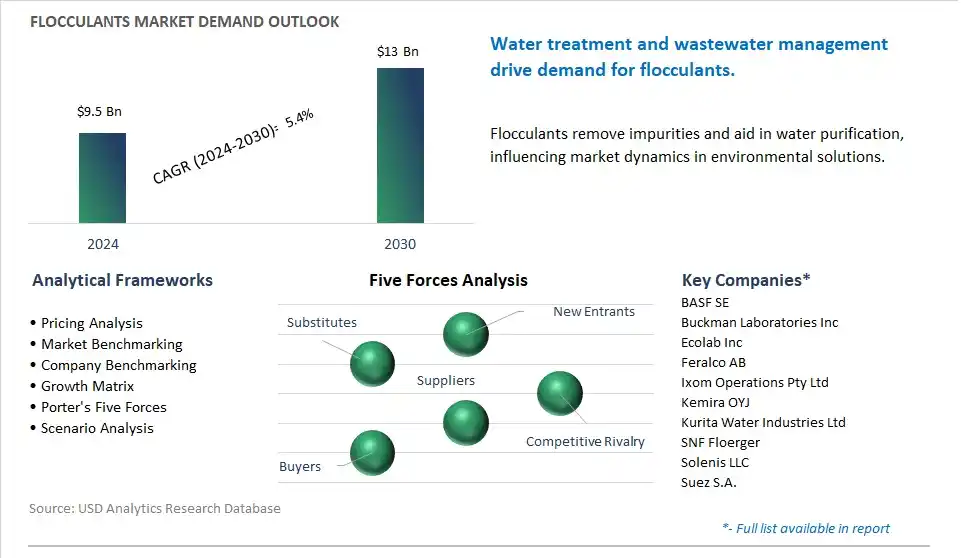
The global Flocculants Market is poised to register a 5.4% CAGR from $9.5 Billion in 2024 to $13 Billion in 2030.
The global Flocculants Market Study analyzes and forecasts the market size across 6 regions and 24 countries for diverse segments -By Type (Anionic, Cationic, Non-Ionic, Others), By End-User (Wastewater Treatment, Pulp & Paper, Textiles, Oil & Gas, Mining, Others).
An Introduction to Global Flocculants Market in 2024
The flocculants market is experiencing robust growth driven by the increasing demand for water and wastewater treatment solutions in municipal, industrial, and environmental remediation applications. Key trends shaping the future of the industry include the development of advanced flocculant formulations and polymer technologies that offer efficient solid-liquid separation, sedimentation, and sludge dewatering while minimizing environmental impact and operational costs. As water utilities, industrial facilities, and environmental agencies seek to comply with water quality regulations, reduce pollution, and optimize resource recovery, there's a growing need for flocculants that provide superior coagulation, flocculation, and clarification performance in diverse water treatment processes such as potable water treatment, wastewater treatment, and industrial effluent treatment. Moreover, advancements in flocculant chemistry, molecular design, and application methods are driving market expansion by improving product efficacy, dosing accuracy, and compatibility with different water matrices and treatment conditions. Additionally, the growing adoption of flocculants in resource recovery, sludge management, and circular economy initiatives is fueling demand for innovative solutions that enable water reuse, nutrient recovery, and energy generation from wastewater streams. Furthermore, the integration of flocculants with digital water management platforms, remote monitoring systems, and predictive analytics is driving innovation and market growth in the water treatment industry, enabling the development of smarter, more efficient, and more sustainable solutions for water and wastewater management challenges worldwide.
Flocculants Market Competitive Landscape
The market report analyses the leading companies in the industry including BASF SE, Buckman Laboratories Inc, Ecolab Inc, Feralco AB, Ixom Operations Pty Ltd, Kemira OYJ, Kurita Water Industries Ltd, SNF Floerger, Solenis LLC, Suez S.A..
Flocculants Market Dynamics
Flocculants Market Trend: Growing Adoption of Water Treatment Solutions Drives Demand for Flocculants
One prominent trend in the flocculants market is the growing adoption of water treatment solutions across various industries. With increasing concerns about water scarcity, pollution, and environmental regulations, there is a rising demand for effective water treatment chemicals such as flocculants to purify and clarify water for industrial, municipal, and agricultural applications. Flocculants play a vital role in wastewater treatment processes by aggregating suspended particles, colloids, and impurities, facilitating their removal through sedimentation or filtration. As industries and municipalities invest in upgrading water treatment infrastructure and complying with regulatory standards, the trend towards water treatment solutions drives market growth and innovation in the flocculants industry.
Flocculants Market Driver: Stringent Environmental Regulations and Water Quality Standards Propel Demand for Flocculants
The growth of the flocculants market is driven by stringent environmental regulations and water quality standards governing wastewater discharge and environmental protection. Regulatory authorities worldwide impose strict limits on pollutant levels in wastewater effluents, requiring industries and municipalities to implement effective treatment methods to meet compliance requirements. Flocculants enable efficient solid-liquid separation and pollutant removal in water treatment plants, helping to achieve regulatory compliance and safeguard aquatic ecosystems. Additionally, the growing emphasis on sustainable water management practices and corporate social responsibility initiatives further propels the demand for flocculants as industries strive to minimize their environmental footprint and mitigate water pollution risks. The need to comply with environmental regulations and water quality standards serves as a key driver fueling the demand for flocculants in the global water treatment market.
Flocculants Market Opportunity: Development of Advanced and Environmentally Friendly Flocculant Formulations
A potential opportunity in the flocculants market lies in the development of advanced and environmentally friendly flocculant formulations to address evolving customer needs and regulatory requirements. Manufacturers can capitalize on this opportunity by investing in research and development to create next-generation flocculants that offer improved performance, efficiency, and environmental sustainability. This includes developing bio-based flocculants derived from renewable sources such as natural polymers, biopolymers, and plant extracts, which offer biodegradability and lower ecological impact compared to conventional synthetic flocculants. Additionally, there is an opportunity to innovate in areas such as polymer chemistry, particle engineering, and nanotechnology to enhance the efficacy and versatility of flocculant products for a wide range of water treatment applications. By offering advanced and environmentally friendly flocculant solutions, manufacturers can differentiate themselves in the competitive market landscape, meet customer demands for sustainable water treatment solutions, and capture new growth opportunities in the global flocculants industry.
Flocculants Market Share Analysis: Anionic segment generated the highest revenue in the industry
The Anionic segment is the largest segment in the Flocculants Market due to diverse key reasons. Anionic flocculants are widely used in various industrial and municipal water treatment applications due to their versatility, effectiveness, and cost-efficiency. These flocculants are formulated with negatively charged polymer chains that interact with positively charged particles, colloids, and suspended solids in water, causing them to aggregate and settle out of solution as flocs. Anionic flocculants are particularly effective in treating water sources containing negatively charged particles, such as clay, silt, organic matter, and industrial pollutants. Additionally, anionic flocculants exhibit excellent flocculation performance across a wide range of pH levels and water temperatures, making them suitable for diverse water treatment processes and environmental conditions. In addition, anionic flocculants are compatible with various coagulants, filtration systems, and dewatering equipment, enabling efficient solids removal and water clarification in wastewater treatment plants, mining operations, pulp and paper mills, and other industrial facilities. Further, advancements in polymer chemistry and the development of high-performance anionic flocculant formulations enhance their flocculation efficiency, stability, and environmental sustainability, further solidifying their dominance as the largest segment in the Flocculants Market.
Flocculants Market Share Analysis: Oil & Gas Segment is poised to register the fastest growth rate (CAGR) over the forecast period to 2030
The Oil & Gas segment is the fastest-growing segment in the Flocculants Market due to diverse key factors propelling its rapid expansion. Flocculants play a crucial role in the oil and gas industry, particularly in the treatment of produced water and wastewater generated during exploration, production, refining, and processing operations. Produced water often contains a complex mixture of hydrocarbons, suspended solids, emulsions, and other contaminants that require efficient separation and removal to meet regulatory requirements and environmental standards. Flocculants are used to facilitate the coagulation and precipitation of suspended solids, emulsified oil droplets, and other impurities, allowing for effective solids-liquid separation and water clarification. Additionally, flocculants aid in the dewatering of sludges and sediments, reducing waste volumes and disposal costs. In addition, the growing global demand for oil and gas resources, coupled with increasing exploration and production activities in challenging environments, drives the need for advanced water treatment solutions to address complex water management challenges in the oil and gas industry. Further, stringent environmental regulations, water scarcity concerns, and corporate sustainability initiatives compel oil and gas companies to invest in innovative technologies and best practices for water reuse, recycling, and discharge compliance, driving the demand for flocculants. As the oil and gas industry continues to evolve and adapt to changing market dynamics and environmental pressures, the demand for flocculants for water treatment applications is expected to continue rising, making the Oil & Gas segment the fastest-growing segment in the Flocculants Market.
Flocculants Market Report Segmentation
By Type
Anionic
Cationic
Non-Ionic
Others
By End-User
Wastewater Treatment
Pulp & Paper
Textiles
Oil & Gas
Mining
Others
Regions Included
North America (US, Canada, Mexico)
Europe (Germany, UK, France, Spain, Italy, Russia, Rest of Europe)
Asia Pacific (China, India, Japan, South Korea, Australia, South East Asia, Rest of Asia)
South America (Brazil, Argentina, Rest of South America)
Middle East and Africa (Saudi Arabia, UAE, Rest of Middle East, South Africa, Egypt, Rest of Africa)
Flocculants Companies Profiled in the Market Study
BASF SE
Buckman Laboratories Inc
Ecolab Inc
Feralco AB
Ixom Operations Pty Ltd
Kemira OYJ
Kurita Water Industries Ltd
SNF Floerger
Solenis LLC
Suez S.A.
*- List Not Exhaustive
TABLE OF CONTENTS
1 Introduction to 2024 Flocculants Market
1.1 Market Overview
1.2 Quick Facts
1.3 Scope/Objective of the Study
1.4 Market Definition
1.5 Countries and Regions Covered
1.6 Units, Currency, and Conversions
1.7 Industry Value Chain
2 Research Methodology
2.1 Market Size Estimation
2.2 Sources and Research Methodology
2.3 Data Triangulation
2.4 Assumptions and Limitations
3 Executive Summary
3.1 Global Flocculants Market Size Outlook, $ Million, 2021 to 2030
3.2 Flocculants Market Outlook by Type, $ Million, 2021 to 2030
3.3 Flocculants Market Outlook by Product, $ Million, 2021 to 2030
3.4 Flocculants Market Outlook by Application, $ Million, 2021 to 2030
3.5 Flocculants Market Outlook by Key Countries, $ Million, 2021 to 2030
4 Market Dynamics
4.1 Key Driving Forces of Flocculants Industry
4.2 Key Market Trends in Flocculants Industry
4.3 Potential Opportunities in Flocculants Industry
4.4 Key Challenges in Flocculants Industry
5 Market Factor Analysis
5.1 Value Chain Analysis
5.2 Competitive Landscape
5.2.1 Global Flocculants Market Share by Company (%), 2023
5.2.2 Product Offerings by Company
5.3 Porter’s Five Forces Analysis
5.4 Pricing Analysis and Outlook
6 Growth Outlook Across Scenarios
6.1 Growth Analysis-Case Scenario Definitions
6.2 Low Growth Scenario Forecasts
6.3 Reference Growth Scenario Forecasts
6.4 High Growth Scenario Forecasts
7 Global Flocculants Market Outlook by Segments
7.1 Flocculants Market Outlook by Segments, $ Million, 2021- 2030
By Type
Anionic
Cationic
Non-Ionic
Others
By End-User
Wastewater Treatment
Pulp & Paper
Textiles
Oil & Gas
Mining
Others
8 North America Flocculants Market Analysis and Outlook To 2030
8.1 Introduction to North America Flocculants Markets in 2024
8.2 North America Flocculants Market Size Outlook by Country, 2021-2030
8.2.1 United States
8.2.2 Canada
8.2.3 Mexico
8.3 North America Flocculants Market size Outlook by Segments, 2021-2030
By Type
Anionic
Cationic
Non-Ionic
Others
By End-User
Wastewater Treatment
Pulp & Paper
Textiles
Oil & Gas
Mining
Others
9 Europe Flocculants Market Analysis and Outlook To 2030
9.1 Introduction to Europe Flocculants Markets in 2024
9.2 Europe Flocculants Market Size Outlook by Country, 2021-2030
9.2.1 Germany
9.2.2 France
9.2.3 Spain
9.2.4 United Kingdom
9.2.4 Italy
9.2.5 Russia
9.2.6 Norway
9.2.7 Rest of Europe
9.3 Europe Flocculants Market Size Outlook by Segments, 2021-2030
By Type
Anionic
Cationic
Non-Ionic
Others
By End-User
Wastewater Treatment
Pulp & Paper
Textiles
Oil & Gas
Mining
Others
10 Asia Pacific Flocculants Market Analysis and Outlook To 2030
10.1 Introduction to Asia Pacific Flocculants Markets in 2024
10.2 Asia Pacific Flocculants Market Size Outlook by Country, 2021-2030
10.2.1 China
10.2.2 India
10.2.3 Japan
10.2.4 South Korea
10.2.5 Indonesia
10.2.6 Malaysia
10.2.7 Australia
10.2.8 Rest of Asia Pacific
10.3 Asia Pacific Flocculants Market size Outlook by Segments, 2021-2030
By Type
Anionic
Cationic
Non-Ionic
Others
By End-User
Wastewater Treatment
Pulp & Paper
Textiles
Oil & Gas
Mining
Others
11 South America Flocculants Market Analysis and Outlook To 2030
11.1 Introduction to South America Flocculants Markets in 2024
11.2 South America Flocculants Market Size Outlook by Country, 2021-2030
11.2.1 Brazil
11.2.2 Argentina
11.2.3 Rest of South America
11.3 South America Flocculants Market size Outlook by Segments, 2021-2030
By Type
Anionic
Cationic
Non-Ionic
Others
By End-User
Wastewater Treatment
Pulp & Paper
Textiles
Oil & Gas
Mining
Others
12 Middle East and Africa Flocculants Market Analysis and Outlook To 2030
12.1 Introduction to Middle East and Africa Flocculants Markets in 2024
12.2 Middle East and Africa Flocculants Market Size Outlook by Country, 2021-2030
12.2.1 Saudi Arabia
12.2.2 UAE
12.2.3 Oman
12.2.4 Rest of Middle East
12.2.5 Egypt
12.2.6 Nigeria
12.2.7 South Africa
12.2.8 Rest of Africa
12.3 Middle East and Africa Flocculants Market size Outlook by Segments, 2021-2030
By Type
Anionic
Cationic
Non-Ionic
Others
By End-User
Wastewater Treatment
Pulp & Paper
Textiles
Oil & Gas
Mining
Others
13 Company Profiles
13.1 Company Snapshot
13.2 SWOT Profiles
13.3 Products and Services
13.4 Recent Developments
13.5 Financial Profile
BASF SE
Buckman Laboratories Inc
Ecolab Inc
Feralco AB
Ixom Operations Pty Ltd
Kemira OYJ
Kurita Water Industries Ltd
SNF Floerger
Solenis LLC
Suez S.A.
14 Appendix
14.1 Customization Offerings
14.2 Subscription Services
14.3 Related Reports
14.4 Publisher Expertise
By Type
Anionic
Cationic
Non-Ionic
Others
By End-User
Wastewater Treatment
Pulp & Paper
Textiles
Oil & Gas
Mining
Others
Countries Analyzed
North America (US, Canada, Mexico)
Europe (Germany, UK, France, Spain, Italy, Russia, Rest of Europe)
Asia Pacific (China, India, Japan, South Korea, Australia, South East Asia, Rest of Asia)
South America (Brazil, Argentina, Rest of South America)
Middle East and Africa (Saudi Arabia, UAE, Rest of Middle East, South Africa, Egypt, Rest of Africa)
