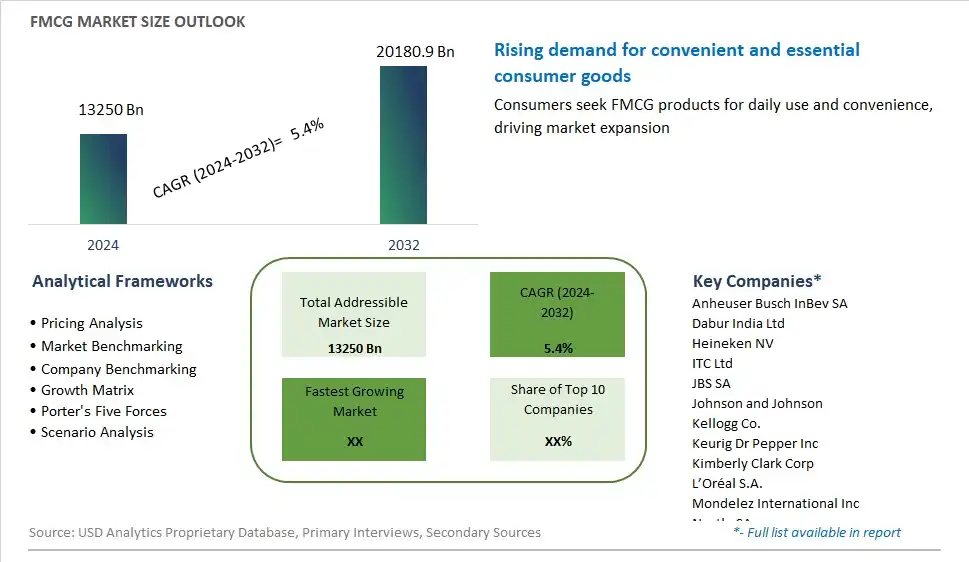
Global FMCG Market Size is valued at $13250 Billion in 2024 and is forecast to register a growth rate (CAGR) of 5.4% to reach $20180.9 Billion by 2032.
The global FMCG Market Comprehensive Study analyzes and forecasts the market size across 6 regions and 24 countries for diverse segments -By Type (Food and Beverage, Personal and Beauty Care, Health and Hygiene Care, Home Care)
An Introduction to FMCG Market
The Fast-Moving Consumer Goods (FMCG) Market involves the production and sale of consumer goods that are sold quickly and at relatively low cost. These include packaged foods, beverages, toiletries, and household products. The market is driven by the rising global population, increasing disposable incomes, and growing consumer demand for convenience and quality. Additionally, advancements in retailing, e-commerce, and supply chain management support market growth.
FMCG Competitive Landscape
The market report analyses the leading companies in the industry including Anheuser Busch InBev SA, Dabur India Ltd, Heineken NV, ITC Ltd, JBS SA, Johnson and Johnson, Kellogg Co., Keurig Dr Pepper Inc, Kimberly Clark Corp, L’Oréal S.A., Mondelez International Inc, Nestle SA, Patanjali Ayurved Ltd, PepsiCo Inc, Tata Sons Pvt. Ltd, The coca cola co., The Kraft Heinz Co., The Procter & Gamble Company (P&G), The Wadia Group, Unilever PLC, and Others.
FMCG Market Dynamics
FMCG Market Trend: Rise of E-Commerce and Direct-to-Consumer Sales
In the fast-moving consumer goods (FMCG) market, a prominent trend is the rapid rise of e-commerce and direct-to-consumer (DTC) sales channels, driven by technological advancements, changing consumer behaviors, and the COVID-19 pandemic. As consumers increasingly prioritize convenience, speed, and contactless shopping experiences, they are turning to online platforms to purchase everyday essentials such as groceries, personal care products, and household items. The convenience of ordering online, coupled with features like home delivery and subscription services, has reshaped the retail landscape, leading FMCG brands to invest in digital marketing strategies, omnichannel distribution networks, and e-commerce platforms to reach and engage with customers effectively. Moreover, the pandemic has accelerated the shift towards online shopping as social distancing measures and lockdown restrictions limited in-person retail interactions, prompting consumers to embrace digital channels for their shopping needs.
Market Driver: Consumer Demand for Health and Wellness Products
A significant driver of the FMCG market is the increasing consumer demand for health and wellness products, fueled by growing awareness of personal health, nutrition, and self-care. As consumers become more health-conscious and proactive about managing their well-being, there's a rising preference for products that offer functional benefits, natural ingredients, and transparency in labeling. Health-focused FMCG categories such as organic foods, plant-based alternatives, vitamins and supplements, and natural personal care products are experiencing strong growth as consumers prioritize products that support their physical, mental, and emotional health goals. Additionally, the COVID-19 pandemic has underscored the importance of hygiene and immunity, leading to heightened demand for products like hand sanitizers, disinfectants, and immune-boosting supplements, driving innovation and market expansion in these segments.
Market Opportunity: Embracing Sustainability and Circular Economy Practices
An opportunity for FMCG companies lies in embracing sustainability and circular economy practices to address environmental concerns, reduce waste, and meet evolving consumer expectations for ethical and eco-friendly products. With increasing scrutiny on environmental impact, resource depletion, and climate change, consumers are seeking brands that demonstrate corporate responsibility and sustainability commitments across their supply chains. FMCG companies can capitalize on this opportunity by adopting sustainable sourcing practices, reducing packaging waste, implementing recycling and reuse initiatives, and investing in eco-friendly production processes. Furthermore, there's potential for FMCG brands to innovate and launch sustainable product lines, including refillable packaging, biodegradable materials, and products with reduced carbon footprints, appealing to environmentally conscious consumers and driving brand loyalty and market differentiation in an increasingly competitive landscape.
FMCG Market Share Analysis: Food and Beverage held the dominant market share in 2024
In the FMCG Market, the Food and Beverage segment is the largest segment due to several factors driving its dominance. Food and beverage products are essential commodities that cater to the basic needs of consumers, making this segment a cornerstone of the fast-moving consumer goods industry. With a diverse range of offerings, including packaged foods, beverages, snacks, and staples, the food and beverage segment enjoys widespread demand across various demographic segments and geographic regions. Further, the FMCG market's stability is bolstered by the consistent consumption patterns of food and beverage products, which are largely unaffected by economic fluctuations. Additionally, innovations in product formulations, packaging, and distribution channels continually refresh and expand the offerings within this segment, maintaining its relevance and appeal to consumers. Furthermore, the increasing emphasis on health, wellness, and convenience drives the demand for healthier food options, functional beverages, and on-the-go snacks, further solidifying the dominance of the Food and Beverage segment in the FMCG Market. Consequently, the Food and Beverage segment maintains its leadership position, supported by its essential nature, broad consumer base, and continuous innovation in product offerings.
FMCG Market Segmentation
By Type
Food and Beverage
Personal and Beauty Care
Health and Hygiene Care
Home Care
Countries Analyzed
North America (US, Canada, Mexico)
Europe (Germany, UK, France, Spain, Italy, Russia, Rest of Europe)
Asia Pacific (China, India, Japan, South Korea, Australia, South East Asia, Rest of Asia)
South America (Brazil, Argentina, Rest of South America)
Middle East and Africa (Saudi Arabia, UAE, Rest of Middle East, South Africa, Egypt, Rest of Africa)
FMCG Companies Profiled in the Study
Anheuser Busch InBev SA
Dabur India Ltd
Heineken NV
ITC Ltd
JBS SA
Johnson and Johnson
Kellogg Co.
Keurig Dr Pepper Inc
Kimberly Clark Corp
L’Oréal S.A.
Mondelez International Inc
Nestle SA
Patanjali Ayurved Ltd
PepsiCo Inc
Tata Sons Pvt. Ltd
The coca cola co.
The Kraft Heinz Co.
The Procter & Gamble Company (P&G)
The Wadia Group
Unilever PLC
*- List Not Exhaustive
Chapter 1. TABLE OF CONTENTS
Chapter 2. Introduction to FMCG Market
2.1. Market Overview
2.2. Key Statistics and Report Highlights
2.3. Scope of the Comprehensive Study
2.3.1. Market Definition
2.3.2 Countries and Regions Covered
2.3.3 Research Objective
2.3.4 Units, Currency, and Conversions
2.3.5 Industry Value Chain
2.4. Key Market Segments
2.5. Key Companies
2.6. Study Period
Chapter 3. Strategic Analysis Review
3.1. FMCG Pricing Analysis and Forecast
3.2. Porter’s Five Forces
3.3. Market Ecosystem
3.4. SWOT Analysis
3.5. Regulatory Scenario
3.3. Effects of Inflation, Russia-Ukraine War, moderating economic growth, and other macroeconomic factors
Chapter 4. Competitive Landscape
4.1. Market Share Analysis
4.1.1. Global FMCG Market Share by Company, 2023
4.1.2. Product Offerings of Leading FMCG Companies
4.2. Market Entropy
4.2.1. New Product Launches in the Industry
4.2.2. Mergers, Acquisitions, Joint ventures, and Partnerships
4.3. Key Strategies and Best Practices
Chapter 5. Global Market Projections: Best, Reference, and Low Case Scenarios
5.1. Growth Analysis- Case Scenario Definitions
5.2. Low Growth Case Scenario Forecasts
5.3. Reference Growth Case Scenario Forecasts
5.4. High Growth Case Scenario Forecasts
Chapter 6. Market Dynamics
6.1. FMCG Market Drivers
6.2. FMCG Market Challenges
6.6. FMCG Market Opportunities
6.4. FMCG Market Trends
Chapter 7. Global FMCG Market Outlook Trends
7.1. Global FMCG Revenue (USD Million) and CAGR (%) by Type (2021-2032)
7.2. Global FMCG Revenue (USD Million) and CAGR (%) by Application (2021-2032)
7.3. Global FMCG Revenue (USD Million) and CAGR (%) by Product (2021-2032)
By Type
Food and Beverage
Personal and Beauty Care
Health and Hygiene Care
Home Care
Chapter 8. Global FMCG Regional Analysis and Outlook
8.1. Global FMCG Revenue (USD Million) By Regions (2021- 2032)
8.2. North America FMCG Revenue (USD Million) by Country (2021-2032)
8.2.1. United States FMCG Regional Analysis and Outlook
8.2.2. Canada FMCG Regional Analysis and Outlook
8.2.3. Mexico FMCG Regional Analysis and Outlook
8.3. Europe FMCG Revenue (USD Million), by Country (2021-2032)
8.3.1. Germany FMCG Regional Analysis and Outlook
8.3.2. France FMCG Regional Analysis and Outlook
8.3.3. United Kingdom FMCG Regional Analysis and Outlook
8.3.4. Spain FMCG Regional Analysis and Outlook
8.3.5. Italy FMCG Regional Analysis and Outlook
8.3.6. Russia FMCG Regional Analysis and Outlook
8.3.7. Rest of Europe FMCG Regional Analysis and Outlook
8.4. Asia Pacific FMCG Revenue (USD Million) by Country (2021-2032)
8.4.1. China FMCG Regional Analysis and Outlook
8.4.2. Japan FMCG Regional Analysis and Outlook
8.4.3. India FMCG Regional Analysis and Outlook
8.4.4. South Korea FMCG Regional Analysis and Outlook
8.4.5. Australia FMCG Regional Analysis and Outlook
8.4.6. South East Asia FMCG Regional Analysis and Outlook
8.4.7. Rest of Asia Pacific FMCG Regional Analysis and Outlook
8.5. South America FMCG Revenue (USD Million), by Country (2021-2032)
8.5.1. Brazil FMCG Regional Analysis and Outlook
8.5.2. Argentina FMCG Regional Analysis and Outlook
8.5.3. Rest of South America FMCG Regional Analysis and Outlook
8.6. Middle East and Africa FMCG Revenue (USD Million) by Country (2021-2032)
8.6.1. Middle East FMCG Regional Analysis and Outlook
8.6.2. Africa FMCG Regional Analysis and Outlook
Chapter 9. North America FMCG Analysis and Outlook
9.1. North America FMCG Revenue (USD Million) by Segments (2021-2032)
9.1.1. North America FMCG Revenue (USD Million) by Type (2021-2032)
9.1.2. North America FMCG Revenue (USD Million) by Application (2021-2032)
9.1.3. North America FMCG Revenue (USD Million) by Product (2021-2032)
By Type
Food and Beverage
Personal and Beauty Care
Health and Hygiene Care
Home Care
Chapter 10. Europe FMCG Analysis and Outlook
10.1. Europe FMCG Revenue (USD Million), by Segments (USD Million) (2021-2032)
10.1.1. Europe FMCG Revenue (USD Million) by Type (2021-2032)
10.1.2. Europe FMCG Revenue (USD Million) by Application (2021-2032)
10.1.3. Europe FMCG Revenue (USD Million) by Product (2021-2032)
By Type
Food and Beverage
Personal and Beauty Care
Health and Hygiene Care
Home Care
Chapter 11. Asia Pacific FMCG Analysis and Outlook
11.1. Asia Pacific FMCG Revenue (USD Million), and Revenue (USD Million) by Segments (2021-2032)
11.1.1. Asia Pacific FMCG Revenue (USD Million) by Type (2021-2032)
11.1.2. Asia Pacific FMCG Revenue (USD Million) by Application (2021-2032)
11.1.3. Asia Pacific FMCG Revenue (USD Million) by Product (2021-2032)
By Type
Food and Beverage
Personal and Beauty Care
Health and Hygiene Care
Home Care
Chapter 12. South America FMCG Analysis and Outlook
12.1. South America FMCG Revenue (USD Million), by Segments (2021-2032)
12.1.1. South America FMCG Revenue (USD Million) by Type (2021-2032)
12.1.2. South America FMCG Revenue (USD Million) by Application (2021-2032)
12.1.3. South America FMCG Revenue (USD Million) by Product (2021-2032)
By Type
Food and Beverage
Personal and Beauty Care
Health and Hygiene Care
Home Care
Chapter 13. Middle East and Africa FMCG Analysis and Outlook
13.1. Middle East and Africa FMCG Revenue (USD Million), by Segments (2021-2032)
13.1.1. Middle East and Africa FMCG Revenue (USD Million) by Type (2021-2032)
13.1.2. Middle East and Africa FMCG Revenue (USD Million) by Application (2021-2032)
13.1.3. Middle East and Africa FMCG Revenue (USD Million) by Product (2021-2032)
By Type
Food and Beverage
Personal and Beauty Care
Health and Hygiene Care
Home Care
Chapter 14. FMCG Company Profiles
14.1 Business Overview
14.2 Product Profiles
14.3 SWOT Profiles
14.5 Recent Developments
14.6 Financial Profile
List of Companies
Anheuser Busch InBev SA
Dabur India Ltd
Heineken NV
ITC Ltd
JBS SA
Johnson and Johnson
Kellogg Co.
Keurig Dr Pepper Inc
Kimberly Clark Corp
L’Oréal S.A.
Mondelez International Inc
Nestle SA
Patanjali Ayurved Ltd
PepsiCo Inc
Tata Sons Pvt. Ltd
The coca cola co.
The Kraft Heinz Co.
The Procter & Gamble Company (P&G)
The Wadia Group
Unilever PLC
15. Methodology and Data Sources
15.1 Customization Offerings
15.2 Subscription Services
15.3 Related Reports
15.4 Publisher Expertise
LIST OF TABLES
Table 1 Market Segmentation Analysis
Table 2 Global FMCG Market Share of Leading Companies, 2023
Table 3 Product Offerings of Leading Companies
Table 4 Low Growth Scenario Forecasts
Table 5 Reference Case Growth Scenario
Table 6 High Growth Case Scenario
Table 7 Global FMCG Revenue (USD Million) And CAGR (%) By Type (2021-2032)
Table 8 Global FMCG Revenue (USD Million) And CAGR (%) By Application (2021-2032)
Table 9 Global FMCG Revenue (USD Million) And CAGR (%) By Product (2021-2032)
Table 10 Global FMCG Market Revenue (USD Million) By Regions (2021-2032)
Table 11 Global FMCG Market Share (%) By Regions (2021-2032)
Table 12 North America FMCG Revenue (USD Million) By Country (2021-2032)
Table 13 Europe FMCG Revenue (USD Million) By Country (2021-2032)
Table 14 Asia Pacific FMCG Revenue (USD Million) By Country (2021-2032)
Table 15 South America FMCG Revenue (USD Million) By Country (2021-2032)
Table 16 Middle East and Africa FMCG Revenue (USD Million) By Region (2021-2032)
Table 17 North America FMCG Revenue (USD Million) By Type (2021-2032)
Table 18 North America FMCG Revenue (USD Million) By Application (2021-2032)
Table 19 North America FMCG Revenue (USD Million) By Product (2021-2032)
Table 20 Europe FMCG Revenue (USD Million) By Type (2021-2032)
Table 21 Europe FMCG Revenue (USD Million) By Application (2021-2032)
Table 22 Europe FMCG Revenue (USD Million) By Product (2021-2032)
Table 23 Asia Pacific FMCG Revenue (USD Million) By Type (2021-2032)
Table 24 Asia Pacific FMCG Revenue (USD Million) By Application (2021-2032)
Table 25 Asia Pacific FMCG Revenue (USD Million) By Product (2021-2032)
Table 26 South America FMCG Revenue (USD Million) By Type (2021-2032)
Table 27 South America FMCG Revenue (USD Million) By Application (2021-2032)
Table 28 South America FMCG Revenue (USD Million) By Product (2021-2032)
Table 29 Middle East and Africa FMCG Revenue (USD Million) By Type (2021-2032)
Table 30 Middle East and Africa FMCG Revenue (USD Million) By Application (2021-2032)
Table 31 Middle East and Africa FMCG Revenue (USD Million) By Product (2021-2032)
LIST OF FIGURES
Figure 1. Market Scope
Figure 2. Pricing Forecasts Per Unit, 2023- 2032
Figure 3. Porter’s Five Forces
Figure 4. Global FMCG Market Revenue (USD Million) By Regions (2021-2032)
Figure 5. Global FMCG Market Share (%) By Regions (2023)
Figure 6. North America FMCG Revenue (USD Million) By Country (2021-2032)
Figure 7. United States FMCG Revenue (USD Million) By Country (2021-2032)
Figure 8. Canada FMCG Revenue (USD Million) By Country (2021-2032)
Figure 9. Mexico FMCG Revenue (USD Million) By Country (2021-2032)
Figure 10. Europe FMCG Revenue (USD Million) By Country (2021-2032)
Figure 11. Germany FMCG Revenue (USD Million) By Country (2021-2032)
Figure 12. France FMCG Revenue (USD Million) By Country (2021-2032)
Figure 13. United Kingdom FMCG Revenue (USD Million) By Country (2021-2032)
Figure 14. Spain FMCG Revenue (USD Million) By Country (2021-2032)
Figure 15. Italy FMCG Revenue (USD Million) By Country (2021-2032)
Figure 16. Russia FMCG Revenue (USD Million) By Country (2021-2032)
Figure 17. Rest of Europe FMCG Revenue (USD Million) By Country (2021-2032)
Figure 11. Asia Pacific FMCG Revenue (USD Million) By Country (2021-2032)
Figure 12. China FMCG Revenue (USD Million) By Country (2021-2032)
Figure 13. Japan FMCG Revenue (USD Million) By Country (2021-2032)
Figure 14. India FMCG Revenue (USD Million) By Country (2021-2032)
Figure 15. South Korea FMCG Revenue (USD Million) By Country (2021-2032)
Figure 16. Australia FMCG Revenue (USD Million) By Country (2021-2032)
Figure 17. South East Asia FMCG Revenue (USD Million) By Country (2021-2032)
Figure 18. South America FMCG Revenue (USD Million) By Country (2021-2032)
Figure 19. Brazil FMCG Revenue (USD Million) By Country (2021-2032)
Figure 20. Argentina FMCG Revenue (USD Million) By Country (2021-2032)
Figure 21. Rest of Asia Pacific FMCG Revenue (USD Million) By Country (2021-2032)
Figure 22. Middle East and Africa FMCG Revenue (USD Million) By Region (2021-2032)
Figure 23. Saudi Arabia FMCG Revenue (USD Million) By Region (2021-2032)
Figure 24. The UAE FMCG Revenue (USD Million) By Region (2021-2032)
Figure 25. Rest of Middle East FMCG Revenue (USD Million) By Region (2021-2032)
Figure 26. South Africa FMCG Revenue (USD Million) By Region (2021-2032)
Figure 27. Africa FMCG Revenue (USD Million) By Region (2021-2032)
Figure 28. North America FMCG Revenue (USD Million) By Type (2021-2032)
Figure 29. North America FMCG Revenue (USD Million) By Application (2021-2032)
Figure 30. North America FMCG Revenue (USD Million) By Product (2021-2032)
Figure 31. Europe FMCG Revenue (USD Million) By Type (2021-2032)
Figure 32. Europe FMCG Revenue (USD Million) By Application (2021-2032)
Figure 33. Europe FMCG Revenue (USD Million) By Product (2021-2032)
Figure 34. Asia Pacific FMCG Revenue (USD Million) By Type (2021-2032)
Figure 35. Asia Pacific FMCG Revenue (USD Million) By Application (2021-2032)
Figure 36. Asia Pacific FMCG Revenue (USD Million) By Product (2021-2032)
Figure 37. South America FMCG Revenue (USD Million) By Type (2021-2032)
Figure 38. South America FMCG Revenue (USD Million) By Application (2021-2032)
Figure 39. South America FMCG Revenue (USD Million) By Product (2021-2032)
Figure 40. Middle East and Africa FMCG Revenue (USD Million) By Type (2021-2032)
Figure 41. Middle East and Africa FMCG Revenue (USD Million) By Application (2021-2032)
Figure 42. Middle East and Africa FMCG Revenue (USD Million) By Product (2021-2032)
By Type
Food and Beverage
Personal and Beauty Care
Health and Hygiene Care
Home Care
Countries Analyzed
North America (US, Canada, Mexico)
Europe (Germany, UK, France, Spain, Italy, Russia, Rest of Europe)
Asia Pacific (China, India, Japan, South Korea, Australia, South East Asia, Rest of Asia)
South America (Brazil, Argentina, Rest of South America)
Middle East and Africa (Saudi Arabia, UAE, Rest of Middle East, South Africa, Egypt, Rest of Africa)
