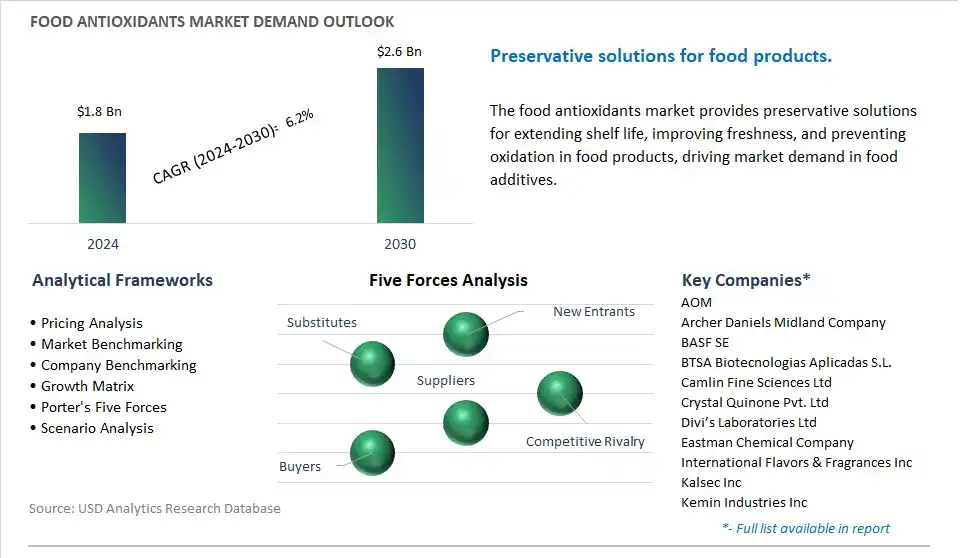
The global Food Antioxidants Market is poised to register a 6.2% CAGR from $1.8 Billion in 2024 to $2.6 Billion in 2030.
The global Food Antioxidants Market Study analyzes and forecasts the market size across 6 regions and 24 countries for diverse segments -By Type (Natural, Synthetic), By Form (Dry, Liquid), By Source (Fruits & Vegetables, Oils, Spices & Herbs, Botanical Extracts, Gallic Acid, Petroleum-Derived), By Application (Fats & Oils, Prepared Foods, Prepared Meat & Poultry, Beverages, Seafood, Bakery & Confectionery, Plant-Based Alternatives, Nutraceuticals, Others).
An Introduction to Global Food Antioxidants Market in 2024
The future of the food antioxidants market is influenced by trends such as clean label ingredients, functional foods, and health-conscious consumers driving innovation in antioxidant sources, extraction methods, and application technologies. Food antioxidants are compounds that inhibit oxidation and prevent spoilage in food products, extending shelf life and maintaining product quality. Key trends shaping this market include advancements in antioxidant sources such as natural extracts, plant-based phenolics, and vitamin derivatives to meet consumer preferences for clean label, natural ingredients with functional health benefits, the development of novel extraction techniques such as supercritical fluid extraction, enzymatic hydrolysis, and nanotechnology-based encapsulation to improve antioxidant bioavailability, stability, and efficacy in food applications, and the adoption of innovative food processing technologies such as high-pressure processing, vacuum packaging, and modified atmosphere packaging to preserve antioxidant activity and nutritional value in finished products. As consumers demand healthier, fresher, and more natural food options, the demand for food antioxidants that offer clean label, functional benefits, and food preservation properties is expected to drive market growth and stimulate further innovation in antioxidant technology and applications.
Food Antioxidants Market Competitive Landscape
The market report analyses the leading companies in the industry including AOM, Archer Daniels Midland Company, BASF SE, BTSA Biotecnologias Aplicadas S.L., Camlin Fine Sciences Ltd, Crystal Quinone Pvt. Ltd, Divi’s Laboratories Ltd, Eastman Chemical Company, International Flavors & Fragrances Inc, Kalsec Inc, Kemin Industries Inc, Nexira SAS, Royal DSM N.V., VDH Chem Tech Pvt. Ltd, Vitablend Nederland B.V..
Food Antioxidants Market Dynamics
Food Antioxidants Market Trend: Growing Consumer Awareness and Demand for Natural Antioxidants in Food Products
A significant trend in the food antioxidants market is the growing consumer awareness and demand for natural antioxidants in food products. With increasing concerns about health and wellness, consumers are seeking foods with natural ingredients that offer health benefits and functional properties. Natural antioxidants derived from fruits, vegetables, herbs, and spices are gaining popularity as consumers perceive them to be safer and more beneficial than synthetic antioxidants. The trend is driving food manufacturers to incorporate natural antioxidants into their product formulations to meet consumer preferences for clean-label, minimally processed foods with added health benefits.
Food Antioxidants Market Driver: Rising Incidence of Food Spoilage and Oxidative Degradation
The primary driver for the food antioxidants market is the rising incidence of food spoilage and oxidative degradation. As food products are exposed to air, light, heat, and other environmental factors during processing, storage, and transportation, they are susceptible to oxidation, leading to quality deterioration, off-flavors, and nutrient loss. Antioxidants play a crucial role in inhibiting oxidation reactions and extending the shelf life of food products by scavenging free radicals and preventing lipid oxidation, enzymatic browning, and color changes. The need to maintain product freshness, stability, and quality drives market demand for antioxidants as essential additives in a wide range of food and beverage applications.
Food Antioxidants Market Opportunity: Development of Innovative Antioxidant Formulations and Delivery Systems
An opportunity exists for companies operating in the food antioxidants market to develop innovative formulations and delivery systems for antioxidants. While traditional antioxidants such as vitamin E, vitamin C, and rosemary extract are widely used in food applications, there is a potential to enhance their efficacy, stability, and bioavailability through novel encapsulation techniques, synergistic blends, and controlled-release formulations. By leveraging advancements in food science, nanotechnology, and ingredient technology, companies can develop antioxidant solutions that offer improved functionality, flavor compatibility, and processing stability, meeting the evolving needs of food manufacturers for effective antioxidant solutions. This opportunity allows companies to differentiate their products, add value for customers, and capture opportunities for growth and market expansion in the competitive food antioxidants market.
Food Antioxidants Market Ecosystem
The food antioxidants Market Ecosystem begins with raw material suppliers including The Dow Chemical Company and BASF SE, which produce base chemicals for synthetic antioxidants including BHA, BHT, and TBHQ. Optionally, botanical extract suppliers including Archer Daniels Midland Company extract antioxidants from natural sources including rosemary and green tea. Food additive manufacturers, typically the same as raw material suppliers, process these chemicals into food-grade antioxidants. These antioxidants are then distributed by food ingredient processors and distributors including Kerry Group plc and Ingredion Incorporated, which further process or package them for easier distribution.
Further, food and beverage manufacturers, including bakery and snack producers, meat processors, and beverage companies, are the end-users of these antioxidants. They incorporate them into various food products to extend shelf life, maintain freshness, and prevent spoilage.
Food Antioxidants Market Share Analysis: Synthetic held the dominant revenue share in 2024
The Synthetic segment stands as the largest segment in the Food Antioxidants Market, driven by diverse pivotal factors. Synthetic antioxidants are chemically synthesized compounds that exhibit strong antioxidant properties, effectively inhibiting oxidation reactions and extending the shelf life of various food products. These synthetic antioxidants, such as butylated hydroxytoluene (BHT), butylated hydroxyanisole (BHA), and tert-butylhydroquinone (TBHQ), offer diverse advantages over natural antioxidants, including greater stability, lower cost, and consistent efficacy across a wide range of food applications. In addition, synthetic antioxidants often undergo rigorous testing and regulatory approval processes, ensuring their safety and efficacy for use in food products. Additionally, synthetic antioxidants provide food manufacturers with greater flexibility and control over product formulations, allowing them to meet specific shelf life and stability requirements. As a result, the Synthetic segment dominates the Food Antioxidants Market, reflecting the widespread adoption and preference for synthetic antioxidants in the food industry.
Food Antioxidants Market Share Analysis: Liquid is the fastest growing market segment over the forecast period to 2030
The Liquid segment is the fastest-growing segment in the Food Antioxidants Market, driven by diverse key factors. Liquid antioxidants offer distinct advantages over dry forms in terms of ease of incorporation into food formulations, homogeneity, and application versatility. Liquid antioxidants can be easily mixed into liquid-based food products such as beverages, sauces, dressings, and marinades, ensuring uniform distribution throughout the product matrix. This homogeneity enables efficient antioxidant protection across the entire food matrix, enhancing product stability and extending shelf life. Additionally, liquid antioxidants often exhibit superior solubility and dispersibility compared to their dry counterparts, making them suitable for a broader range of food applications. Further, the increasing demand for convenience, clean-label products, and natural antioxidants in the food industry is driving the adoption of liquid antioxidant formulations. Liquid antioxidants derived from natural sources, such as tocopherols, rosemary extract, and ascorbic acid, are particularly sought after due to their perceived health benefits and consumer preference for clean-label ingredients. As a result, the Liquid segment is poised for rapid growth in the Food Antioxidants Market, fueled by the growing demand for effective antioxidant solutions in liquid food products.
Food Antioxidants Market Share Analysis: Botanical Extracts is the fastest growing market segment over the forecast period to 2030
The Botanical Extracts segment is the fastest-growing segment in the Food Antioxidants Market, driven by diverse key factors. Botanical extracts are derived from various plant sources known for their rich antioxidant content, such as fruits, vegetables, herbs, and spices. These extracts contain a complex mixture of bioactive compounds, including polyphenols, flavonoids, and carotenoids, which exhibit potent antioxidant properties and offer multiple health benefits. As consumer demand for natural and clean-label ingredients continues to rise, food manufacturers are increasingly turning to botanical extracts as alternatives to synthetic antioxidants derived from petroleum sources. Botanical extracts not only provide effective antioxidant protection but also offer additional nutritional and functional properties, such as flavor enhancement, color stability, and potential health-promoting effects. In addition, botanical extracts align with consumer preferences for natural, minimally processed ingredients and are perceived as safer and more environmentally friendly compared to synthetic antioxidants. Additionally, advancements in extraction technologies and sustainable sourcing practices are further driving the growth of the Botanical Extracts segment in the Food Antioxidants Market. Overall, the increasing demand for natural antioxidants and clean-label products positions botanical extracts as the fastest-growing segment in the Food Antioxidants Market.
Food Antioxidants Market Report Scope-
By Type
Natural
Synthetic
By Form
Dry
Liquid
By Source
Fruits & Vegetables
Oils
Spices & Herbs
Botanical Extracts
Gallic Acid
Petroleum-Derived
By Application
Fats & Oils
Prepared Foods
Prepared Meat & Poultry
Beverages
Seafood
Bakery & Confectionery
Plant-Based Alternatives
Nutraceuticals
Others
Food Antioxidants Market Companies Profiled
AOM
Archer Daniels Midland Company
BASF SE
BTSA Biotecnologias Aplicadas S.L.
Camlin Fine Sciences Ltd
Crystal Quinone Pvt. Ltd
Divi’s Laboratories Ltd
Eastman Chemical Company
International Flavors & Fragrances Inc
Kalsec Inc
Kemin Industries Inc
Nexira SAS
Royal DSM N.V.
VDH Chem Tech Pvt. Ltd
Vitablend Nederland B.V.
*- List Not Exhaustive
TABLE OF CONTENTS
1 Introduction to 2024 Food Antioxidants Market
1.1 Market Overview
1.2 Quick Facts
1.3 Scope/Objective of the Study
1.4 Market Definition
1.5 Countries and Regions Covered
1.6 Units, Currency, and Conversions
1.7 Industry Value Chain
2 Research Methodology
2.1 Market Size Estimation
2.2 Sources and Research Methodology
2.3 Data Triangulation
2.4 Assumptions and Limitations
3 Executive Summary
3.1 Global Food Antioxidants Market Size Outlook, $ Million, 2021 to 2030
3.2 Food Antioxidants Market Outlook by Type, $ Million, 2021 to 2030
3.3 Food Antioxidants Market Outlook by Product, $ Million, 2021 to 2030
3.4 Food Antioxidants Market Outlook by Application, $ Million, 2021 to 2030
3.5 Food Antioxidants Market Outlook by Key Countries, $ Million, 2021 to 2030
4 Market Dynamics
4.1 Key Driving Forces of Food Antioxidants Industry
4.2 Key Market Trends in Food Antioxidants Industry
4.3 Potential Opportunities in Food Antioxidants Industry
4.4 Key Challenges in Food Antioxidants Industry
5 Market Factor Analysis
5.1 Value Chain Analysis
5.2 Competitive Landscape
5.2.1 Global Food Antioxidants Market Share by Company (%), 2023
5.2.2 Product Offerings by Company
5.3 Porter’s Five Forces Analysis
5.4 Pricing Analysis and Outlook
6 Growth Outlook Across Scenarios
6.1 Growth Analysis-Case Scenario Definitions
6.2 Low Growth Scenario Forecasts
6.3 Reference Growth Scenario Forecasts
6.4 High Growth Scenario Forecasts
7 Global Food Antioxidants Market Outlook by Segments
7.1 Food Antioxidants Market Outlook by Segments, $ Million, 2021- 2030
By Type
Natural
Synthetic
By Form
Dry
Liquid
By Source
Fruits & Vegetables
Oils
Spices & Herbs
Botanical Extracts
Gallic Acid
Petroleum-Derived
By Application
Fats & Oils
Prepared Foods
Prepared Meat & Poultry
Beverages
Seafood
Bakery & Confectionery
Plant-Based Alternatives
Nutraceuticals
Others
8 North America Food Antioxidants Market Analysis and Outlook To 2030
8.1 Introduction to North America Food Antioxidants Markets in 2024
8.2 North America Food Antioxidants Market Size Outlook by Country, 2021-2030
8.2.1 United States
8.2.2 Canada
8.2.3 Mexico
8.3 North America Food Antioxidants Market size Outlook by Segments, 2021-2030
By Type
Natural
Synthetic
By Form
Dry
Liquid
By Source
Fruits & Vegetables
Oils
Spices & Herbs
Botanical Extracts
Gallic Acid
Petroleum-Derived
By Application
Fats & Oils
Prepared Foods
Prepared Meat & Poultry
Beverages
Seafood
Bakery & Confectionery
Plant-Based Alternatives
Nutraceuticals
Others
9 Europe Food Antioxidants Market Analysis and Outlook To 2030
9.1 Introduction to Europe Food Antioxidants Markets in 2024
9.2 Europe Food Antioxidants Market Size Outlook by Country, 2021-2030
9.2.1 Germany
9.2.2 France
9.2.3 Spain
9.2.4 United Kingdom
9.2.4 Italy
9.2.5 Russia
9.2.6 Norway
9.2.7 Rest of Europe
9.3 Europe Food Antioxidants Market Size Outlook by Segments, 2021-2030
By Type
Natural
Synthetic
By Form
Dry
Liquid
By Source
Fruits & Vegetables
Oils
Spices & Herbs
Botanical Extracts
Gallic Acid
Petroleum-Derived
By Application
Fats & Oils
Prepared Foods
Prepared Meat & Poultry
Beverages
Seafood
Bakery & Confectionery
Plant-Based Alternatives
Nutraceuticals
Others
10 Asia Pacific Food Antioxidants Market Analysis and Outlook To 2030
10.1 Introduction to Asia Pacific Food Antioxidants Markets in 2024
10.2 Asia Pacific Food Antioxidants Market Size Outlook by Country, 2021-2030
10.2.1 China
10.2.2 India
10.2.3 Japan
10.2.4 South Korea
10.2.5 Indonesia
10.2.6 Malaysia
10.2.7 Australia
10.2.8 Rest of Asia Pacific
10.3 Asia Pacific Food Antioxidants Market size Outlook by Segments, 2021-2030
By Type
Natural
Synthetic
By Form
Dry
Liquid
By Source
Fruits & Vegetables
Oils
Spices & Herbs
Botanical Extracts
Gallic Acid
Petroleum-Derived
By Application
Fats & Oils
Prepared Foods
Prepared Meat & Poultry
Beverages
Seafood
Bakery & Confectionery
Plant-Based Alternatives
Nutraceuticals
Others
11 South America Food Antioxidants Market Analysis and Outlook To 2030
11.1 Introduction to South America Food Antioxidants Markets in 2024
11.2 South America Food Antioxidants Market Size Outlook by Country, 2021-2030
11.2.1 Brazil
11.2.2 Argentina
11.2.3 Rest of South America
11.3 South America Food Antioxidants Market size Outlook by Segments, 2021-2030
By Type
Natural
Synthetic
By Form
Dry
Liquid
By Source
Fruits & Vegetables
Oils
Spices & Herbs
Botanical Extracts
Gallic Acid
Petroleum-Derived
By Application
Fats & Oils
Prepared Foods
Prepared Meat & Poultry
Beverages
Seafood
Bakery & Confectionery
Plant-Based Alternatives
Nutraceuticals
Others
12 Middle East and Africa Food Antioxidants Market Analysis and Outlook To 2030
12.1 Introduction to Middle East and Africa Food Antioxidants Markets in 2024
12.2 Middle East and Africa Food Antioxidants Market Size Outlook by Country, 2021-2030
12.2.1 Saudi Arabia
12.2.2 UAE
12.2.3 Oman
12.2.4 Rest of Middle East
12.2.5 Egypt
12.2.6 Nigeria
12.2.7 South Africa
12.2.8 Rest of Africa
12.3 Middle East and Africa Food Antioxidants Market size Outlook by Segments, 2021-2030
By Type
Natural
Synthetic
By Form
Dry
Liquid
By Source
Fruits & Vegetables
Oils
Spices & Herbs
Botanical Extracts
Gallic Acid
Petroleum-Derived
By Application
Fats & Oils
Prepared Foods
Prepared Meat & Poultry
Beverages
Seafood
Bakery & Confectionery
Plant-Based Alternatives
Nutraceuticals
Others
13 Company Profiles
13.1 Company Snapshot
13.2 SWOT Profiles
13.3 Products and Services
13.4 Recent Developments
13.5 Financial Profile
AOM
Archer Daniels Midland Company
BASF SE
BTSA Biotecnologias Aplicadas S.L.
Camlin Fine Sciences Ltd
Crystal Quinone Pvt. Ltd
Divi’s Laboratories Ltd
Eastman Chemical Company
International Flavors & Fragrances Inc
Kalsec Inc
Kemin Industries Inc
Nexira SAS
Royal DSM N.V.
VDH Chem Tech Pvt. Ltd
Vitablend Nederland B.V.
14 Appendix
14.1 Customization Offerings
14.2 Subscription Services
14.3 Related Reports
14.4 Publisher Expertise
By Type
Natural
Synthetic
By Form
Dry
Liquid
By Source
Fruits & Vegetables
Oils
Spices & Herbs
Botanical Extracts
Gallic Acid
Petroleum-Derived
By Application
Fats & Oils
Prepared Foods
Prepared Meat & Poultry
Beverages
Seafood
Bakery & Confectionery
Plant-Based Alternatives
Nutraceuticals
Others
Countries Analyzed
North America (US, Canada, Mexico)
Europe (Germany, UK, France, Spain, Italy, Russia, Rest of Europe)
Asia Pacific (China, India, Japan, South Korea, Australia, South East Asia, Rest of Asia)
South America (Brazil, Argentina, Rest of South America)
Middle East and Africa (Saudi Arabia, UAE, Rest of Middle East, South Africa, Egypt, Rest of Africa)
