The global Food Blenders and Mixers Market Comprehensive Study analyzes and forecasts the market size across 6 regions and 24 countries for diverse segments -By Type (High Shear Mixer, Shaft Mixer, Screw Mixer and Blender, Double Cone Blender, Ribbon Blender, Planetary Mixer, Others), By Technology (Batch Mixing, Continuous Mixing), By Mode of Operation (Automatic, Semi-Automatic), By Application (Bakery, Dairy, Beverage, Confectionary, Others), By End-User (Household, Commercial)
Food blenders and mixers are essential equipment used in food processing operations to mix, emulsify, homogenize, and blend ingredients in 2024. These versatile machines come in various configurations, including batch mixers, continuous mixers, and high-speed blenders, to accommodate different product formulations, viscosities, and production volumes. Food blenders and mixers are used in a wide range of applications, including bakery, dairy, beverage, and prepared foods, to create uniform and consistent mixtures that meet product specifications and quality standards. With advancements in mixing technology, such as shear force reduction, particle size reduction, and temperature control, blenders and mixers enable manufacturers to achieve desired texture, viscosity, and sensory attributes in their products. Whether mixing dough, batter, sauce, or emulsion, these machines play a critical role in optimizing product quality, efficiency, and yield while minimizing processing time and energy consumption. As consumer demand for convenience, quality, and variety grows, the market for food blenders and mixers is expected to expand, driven by investments in equipment upgrades, automation, and customization that enhance productivity, flexibility, and product innovation.
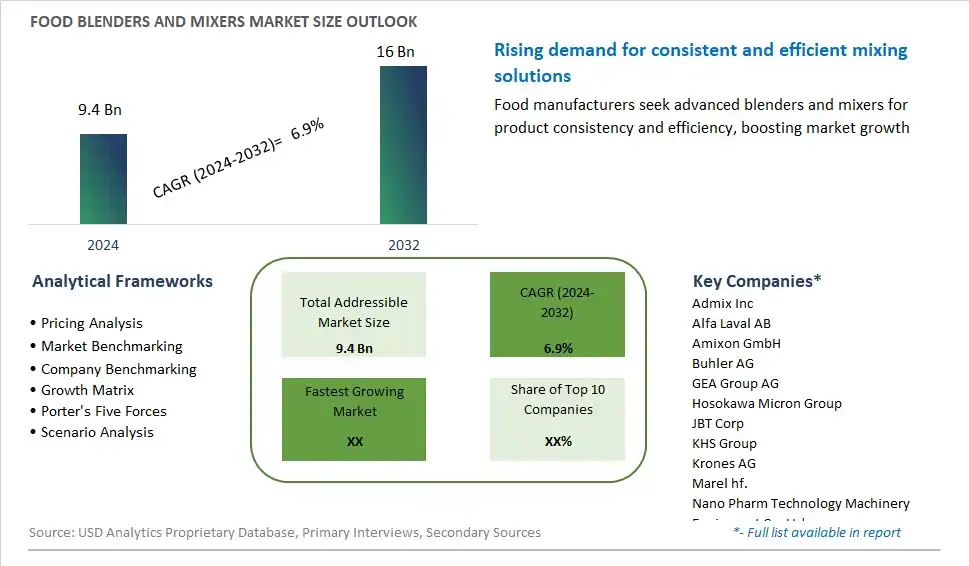
The market report analyses the leading companies in the industry including Admix Inc, Alfa Laval AB, Amixon GmbH, Buhler AG, GEA Group AG, Hosokawa Micron Group, JBT Corp, KHS Group, Krones AG, Marel hf., Nano Pharm Technology Machinery Equipment Co. Ltd, SPX Flow Inc, Sulzer Ltd, Technosilos AP, Tetra Laval, and Others.
One prominent trend in the food blenders and mixers market is the continuous advancements in mixing and blending technologies to meet the evolving needs of food manufacturers. Manufacturers are increasingly investing in innovative mixing and blending equipment that offer enhanced performance, versatility, and efficiency. These advancements include the development of high-speed mixers, precision control systems, automated recipe management software, and hygienic design features to ensure product safety and quality compliance. Additionally, there is a growing focus on the integration of digital connectivity, IoT sensors, and data analytics capabilities into mixing and blending equipment to enable real-time monitoring, remote operation, and predictive maintenance, thereby optimizing production processes and minimizing downtime.
A significant driver propelling the food blenders and mixers market is the increasing demand from food manufacturers for product consistency, quality, and customization. With changing consumer preferences and the growing trend towards healthier, clean-label, and artisanal food products, manufacturers need versatile mixing and blending solutions that can efficiently handle a wide range of ingredients, recipes, and production volumes while maintaining precise control over product attributes such as texture, flavor, and appearance. Moreover, stringent regulatory requirements and food safety standards necessitate the use of equipment that ensures uniform mixing, thorough blending, and sanitation to prevent cross-contamination and microbial growth. As a result, food companies are investing in state-of-the-art blending and mixing equipment that offer flexibility, scalability, and reliability to meet diverse market demands and maintain a competitive edge.
An opportunity within the food blenders and mixers market lies in the adoption of automated batch processing solutions to enhance efficiency, productivity, and throughput in food manufacturing operations. Automation technologies enable seamless integration of mixing and blending processes with upstream and downstream production activities, including ingredient handling, recipe formulation, packaging, and quality control. By implementing automated batch processing systems equipped with programmable logic controllers (PLCs), robotics, and advanced process control algorithms, manufacturers can achieve precise ingredient dosing, recipe consistency, and batch-to-batch reproducibility while minimizing manual intervention and human error. Furthermore, automated batch processing facilitates rapid changeovers between product formulations, reduces setup times, and enhances operational flexibility to meet dynamic market demands and product diversification strategies. As food manufacturers seek to optimize production efficiency, reduce labor costs, and improve product quality, the adoption of automated batch processing solutions presents a significant opportunity for equipment suppliers in the food blenders and mixers market to provide value-added solutions and expand their market presence.
In the Food Blenders and Mixers market segmented by Type, the Ribbon Blender segment is the largest category. This dominance is attributed to the widespread use of ribbon blenders across various food processing applications due to their versatility, efficiency, and ability to handle a wide range of ingredients and product formulations. Ribbon blenders are ideal for mixing dry, free-flowing powders, granules, and other solid materials, making them essential equipment in industries such as bakery, confectionery, snack food, and nutritional supplements. Additionally, ribbon blenders offer advantages such as gentle mixing action, uniform blending, and quick batch turnaround times, ensuring consistent product quality and minimizing production downtime. Further, advancements in ribbon blender design, such as improved ribbon configurations, variable speed controls, and sanitary construction materials, further enhance their suitability for food processing applications. As food manufacturers strive to optimize production processes, reduce costs, and maintain product quality, the Ribbon Blender segment maintains its leadership position in the Food Blenders and Mixers market, driving growth and innovation to meet evolving industry needs.
In the Food Blenders and Mixers market segmented by Technology, the Continuous Mixing segment is the fastest-growing category. This accelerated growth is propelled by the increasing adoption of continuous mixing technology in food processing operations for its efficiency, consistency, and scalability benefits. Continuous mixing systems offer advantages such as continuous product flow, precise ingredient dosing, and minimal batch-to-batch variations, leading to higher production throughput and reduced processing times. Additionally, continuous mixing technology enables seamless integration with downstream processing equipment, such as extruders, ovens, and packaging lines, optimizing production efficiency and minimizing product handling. Further, advancements in continuous mixing systems, including advanced control algorithms, inline quality monitoring sensors, and hygienic design features, further enhance their suitability for a wide range of food applications. As food manufacturers seek to improve productivity, reduce operating costs, and enhance product quality and consistency, the Continuous Mixing segment continues to witness rapid growth, underscoring its significance in driving innovation and efficiency within the Food Blenders and Mixers market.
In the Food Blenders and Mixers market segmented by Mode of Operation, the Automatic segment is the largest category. This dominance is attributed to the increasing demand for automated solutions in food processing operations to improve efficiency, consistency, and productivity. Automatic blenders and mixers offer advantages such as precise ingredient dosing, uniform mixing, and programmable controls, leading to higher throughput and reduced labor requirements compared to semi-automatic counterparts. Additionally, automatic operation minimizes human error and ensures product quality and consistency, making it an essential requirement in industries such as bakery, confectionery, and prepared foods. Further, advancements in automation technology, including robotics, sensors, and integrated control systems, further enhance the performance and capabilities of automatic blenders and mixers, driving their widespread adoption across the food industry. As food manufacturers prioritize operational efficiency, scalability, and product quality, the Automatic Mode of Operation segment maintains its leadership position in the Food Blenders and Mixers market, driving growth and innovation to meet evolving industry needs.
By Type
High Shear Mixer
Shaft Mixer
Screw Mixer and Blender
Double Cone Blender
Ribbon Blender
Planetary Mixer
Others
By Technology
Batch Mixing
Continuous Mixing
By Mode of Operation
Automatic
Semi-Automatic
By Application
Bakery
Dairy
Beverage
Confectionary
Others
By End-User
Household
Commercial
Countries Analyzed
North America (US, Canada, Mexico)
Europe (Germany, UK, France, Spain, Italy, Russia, Rest of Europe)
Asia Pacific (China, India, Japan, South Korea, Australia, South East Asia, Rest of Asia)
South America (Brazil, Argentina, Rest of South America)
Middle East and Africa (Saudi Arabia, UAE, Rest of Middle East, South Africa, Egypt, Rest of Africa)

Admix Inc
Alfa Laval AB
Amixon GmbH
Buhler AG
GEA Group AG
Hosokawa Micron Group
JBT Corp
KHS Group
Krones AG
Marel hf.
Nano Pharm Technology Machinery Equipment Co. Ltd
SPX Flow Inc
Sulzer Ltd
Technosilos AP
Tetra Laval
*- List Not Exhaustive
Chapter 1. TABLE OF CONTENTS
Chapter 2. Introduction to Food Blenders and Mixers Market
2.1. Market Overview
2.2. Key Statistics and Report Highlights
2.3. Scope of the Comprehensive Study
2.3.1. Market Definition
2.3.2 Countries and Regions Covered
2.3.3 Research Objective
2.3.4 Units, Currency, and Conversions
2.3.5 Industry Value Chain
2.4. Key Market Segments
2.5. Key Companies
2.6. Study Period
Chapter 3. Strategic Analysis Review
3.1. Food Blenders and Mixers Pricing Analysis and Forecast
3.2. Porter’s Five Forces
3.3. Market Ecosystem
3.4. SWOT Analysis
3.5. Regulatory Scenario
3.3. Effects of Inflation, Russia-Ukraine War, moderating economic growth, and other macroeconomic factors
Chapter 4. Competitive Landscape
4.1. Market Share Analysis
4.1.1. Global Food Blenders and Mixers Market Share by Company, 2023
4.1.2. Product Offerings of Leading Food Blenders and Mixers Companies
4.2. Market Entropy
4.2.1. New Product Launches in the Industry
4.2.2. Mergers, Acquisitions, Joint ventures, and Partnerships
4.3. Key Strategies and Best Practices
Chapter 5. Global Market Projections: Best, Reference, and Low Case Scenarios
5.1. Growth Analysis- Case Scenario Definitions
5.2. Low Growth Case Scenario Forecasts
5.3. Reference Growth Case Scenario Forecasts
5.4. High Growth Case Scenario Forecasts
Chapter 6. Market Dynamics
6.1. Food Blenders and Mixers Market Drivers
6.2. Food Blenders and Mixers Market Challenges
6.6. Food Blenders and Mixers Market Opportunities
6.4. Food Blenders and Mixers Market Trends
Chapter 7. Global Food Blenders and Mixers Market Outlook Trends
7.1. Global Food Blenders and Mixers Revenue (USD Million) and CAGR (%) by Type (2021-2032)
7.2. Global Food Blenders and Mixers Revenue (USD Million) and CAGR (%) by Application (2021-2032)
7.3. Global Food Blenders and Mixers Revenue (USD Million) and CAGR (%) by Product (2021-2032)
By Type
High Shear Mixer
Shaft Mixer
Screw Mixer and Blender
Double Cone Blender
Ribbon Blender
Planetary Mixer
Others
By Technology
Batch Mixing
Continuous Mixing
By Mode of Operation
Automatic
Semi-Automatic
By Application
Bakery
Dairy
Beverage
Confectionary
Others
By End-User
Household
Commercial
Chapter 8. Global Food Blenders and Mixers Regional Analysis and Outlook
8.1. Global Food Blenders and Mixers Revenue (USD Million) By Regions (2021- 2032)
8.2. North America Food Blenders and Mixers Revenue (USD Million) by Country (2021-2032)
8.2.1. United States Food Blenders and Mixers Regional Analysis and Outlook
8.2.2. Canada Food Blenders and Mixers Regional Analysis and Outlook
8.2.3. Mexico Food Blenders and Mixers Regional Analysis and Outlook
8.3. Europe Food Blenders and Mixers Revenue (USD Million), by Country (2021-2032)
8.3.1. Germany Food Blenders and Mixers Regional Analysis and Outlook
8.3.2. France Food Blenders and Mixers Regional Analysis and Outlook
8.3.3. United Kingdom Food Blenders and Mixers Regional Analysis and Outlook
8.3.4. Spain Food Blenders and Mixers Regional Analysis and Outlook
8.3.5. Italy Food Blenders and Mixers Regional Analysis and Outlook
8.3.6. Russia Food Blenders and Mixers Regional Analysis and Outlook
8.3.7. Rest of Europe Food Blenders and Mixers Regional Analysis and Outlook
8.4. Asia Pacific Food Blenders and Mixers Revenue (USD Million) by Country (2021-2032)
8.4.1. China Food Blenders and Mixers Regional Analysis and Outlook
8.4.2. Japan Food Blenders and Mixers Regional Analysis and Outlook
8.4.3. India Food Blenders and Mixers Regional Analysis and Outlook
8.4.4. South Korea Food Blenders and Mixers Regional Analysis and Outlook
8.4.5. Australia Food Blenders and Mixers Regional Analysis and Outlook
8.4.6. South East Asia Food Blenders and Mixers Regional Analysis and Outlook
8.4.7. Rest of Asia Pacific Food Blenders and Mixers Regional Analysis and Outlook
8.5. South America Food Blenders and Mixers Revenue (USD Million), by Country (2021-2032)
8.5.1. Brazil Food Blenders and Mixers Regional Analysis and Outlook
8.5.2. Argentina Food Blenders and Mixers Regional Analysis and Outlook
8.5.3. Rest of South America Food Blenders and Mixers Regional Analysis and Outlook
8.6. Middle East and Africa Food Blenders and Mixers Revenue (USD Million) by Country (2021-2032)
8.6.1. Middle East Food Blenders and Mixers Regional Analysis and Outlook
8.6.2. Africa Food Blenders and Mixers Regional Analysis and Outlook
Chapter 9. North America Food Blenders and Mixers Analysis and Outlook
9.1. North America Food Blenders and Mixers Revenue (USD Million) by Segments (2021-2032)
9.1.1. North America Food Blenders and Mixers Revenue (USD Million) by Type (2021-2032)
9.1.2. North America Food Blenders and Mixers Revenue (USD Million) by Application (2021-2032)
9.1.3. North America Food Blenders and Mixers Revenue (USD Million) by Product (2021-2032)
By Type
High Shear Mixer
Shaft Mixer
Screw Mixer and Blender
Double Cone Blender
Ribbon Blender
Planetary Mixer
Others
By Technology
Batch Mixing
Continuous Mixing
By Mode of Operation
Automatic
Semi-Automatic
By Application
Bakery
Dairy
Beverage
Confectionary
Others
By End-User
Household
Commercial
Chapter 10. Europe Food Blenders and Mixers Analysis and Outlook
10.1. Europe Food Blenders and Mixers Revenue (USD Million), by Segments (USD Million) (2021-2032)
10.1.1. Europe Food Blenders and Mixers Revenue (USD Million) by Type (2021-2032)
10.1.2. Europe Food Blenders and Mixers Revenue (USD Million) by Application (2021-2032)
10.1.3. Europe Food Blenders and Mixers Revenue (USD Million) by Product (2021-2032)
By Type
High Shear Mixer
Shaft Mixer
Screw Mixer and Blender
Double Cone Blender
Ribbon Blender
Planetary Mixer
Others
By Technology
Batch Mixing
Continuous Mixing
By Mode of Operation
Automatic
Semi-Automatic
By Application
Bakery
Dairy
Beverage
Confectionary
Others
By End-User
Household
Commercial
Chapter 11. Asia Pacific Food Blenders and Mixers Analysis and Outlook
11.1. Asia Pacific Food Blenders and Mixers Revenue (USD Million), and Revenue (USD Million) by Segments (2021-2032)
11.1.1. Asia Pacific Food Blenders and Mixers Revenue (USD Million) by Type (2021-2032)
11.1.2. Asia Pacific Food Blenders and Mixers Revenue (USD Million) by Application (2021-2032)
11.1.3. Asia Pacific Food Blenders and Mixers Revenue (USD Million) by Product (2021-2032)
By Type
High Shear Mixer
Shaft Mixer
Screw Mixer and Blender
Double Cone Blender
Ribbon Blender
Planetary Mixer
Others
By Technology
Batch Mixing
Continuous Mixing
By Mode of Operation
Automatic
Semi-Automatic
By Application
Bakery
Dairy
Beverage
Confectionary
Others
By End-User
Household
Commercial
Chapter 12. South America Food Blenders and Mixers Analysis and Outlook
12.1. South America Food Blenders and Mixers Revenue (USD Million), by Segments (2021-2032)
12.1.1. South America Food Blenders and Mixers Revenue (USD Million) by Type (2021-2032)
12.1.2. South America Food Blenders and Mixers Revenue (USD Million) by Application (2021-2032)
12.1.3. South America Food Blenders and Mixers Revenue (USD Million) by Product (2021-2032)
By Type
High Shear Mixer
Shaft Mixer
Screw Mixer and Blender
Double Cone Blender
Ribbon Blender
Planetary Mixer
Others
By Technology
Batch Mixing
Continuous Mixing
By Mode of Operation
Automatic
Semi-Automatic
By Application
Bakery
Dairy
Beverage
Confectionary
Others
By End-User
Household
Commercial
Chapter 13. Middle East and Africa Food Blenders and Mixers Analysis and Outlook
13.1. Middle East and Africa Food Blenders and Mixers Revenue (USD Million), by Segments (2021-2032)
13.1.1. Middle East and Africa Food Blenders and Mixers Revenue (USD Million) by Type (2021-2032)
13.1.2. Middle East and Africa Food Blenders and Mixers Revenue (USD Million) by Application (2021-2032)
13.1.3. Middle East and Africa Food Blenders and Mixers Revenue (USD Million) by Product (2021-2032)
By Type
High Shear Mixer
Shaft Mixer
Screw Mixer and Blender
Double Cone Blender
Ribbon Blender
Planetary Mixer
Others
By Technology
Batch Mixing
Continuous Mixing
By Mode of Operation
Automatic
Semi-Automatic
By Application
Bakery
Dairy
Beverage
Confectionary
Others
By End-User
Household
Commercial
Chapter 14. Food Blenders and Mixers Company Profiles
14.1 Business Overview
14.2 Product Profiles
14.3 SWOT Profiles
14.5 Recent Developments
14.6 Financial Profile
List of Companies
Admix Inc
Alfa Laval AB
Amixon GmbH
Buhler AG
GEA Group AG
Hosokawa Micron Group
JBT Corp
KHS Group
Krones AG
Marel hf.
Nano Pharm Technology Machinery Equipment Co. Ltd
SPX Flow Inc
Sulzer Ltd
Technosilos AP
Tetra Laval
15. Methodology and Data Sources
15.1 Customization Offerings
15.2 Subscription Services
15.3 Related Reports
15.4 Publisher Expertise
LIST OF TABLES
Table 1 Market Segmentation Analysis
Table 2 Global Food Blenders and Mixers Market Share of Leading Companies, 2023
Table 3 Product Offerings of Leading Companies
Table 4 Low Growth Scenario Forecasts
Table 5 Reference Case Growth Scenario
Table 6 High Growth Case Scenario
Table 7 Global Food Blenders and Mixers Revenue (USD Million) And CAGR (%) By Type (2021-2032)
Table 8 Global Food Blenders and Mixers Revenue (USD Million) And CAGR (%) By Application (2021-2032)
Table 9 Global Food Blenders and Mixers Revenue (USD Million) And CAGR (%) By Product (2021-2032)
Table 10 Global Food Blenders and Mixers Market Revenue (USD Million) By Regions (2021-2032)
Table 11 Global Food Blenders and Mixers Market Share (%) By Regions (2021-2032)
Table 12 North America Food Blenders and Mixers Revenue (USD Million) By Country (2021-2032)
Table 13 Europe Food Blenders and Mixers Revenue (USD Million) By Country (2021-2032)
Table 14 Asia Pacific Food Blenders and Mixers Revenue (USD Million) By Country (2021-2032)
Table 15 South America Food Blenders and Mixers Revenue (USD Million) By Country (2021-2032)
Table 16 Middle East and Africa Food Blenders and Mixers Revenue (USD Million) By Region (2021-2032)
Table 17 North America Food Blenders and Mixers Revenue (USD Million) By Type (2021-2032)
Table 18 North America Food Blenders and Mixers Revenue (USD Million) By Application (2021-2032)
Table 19 North America Food Blenders and Mixers Revenue (USD Million) By Product (2021-2032)
Table 20 Europe Food Blenders and Mixers Revenue (USD Million) By Type (2021-2032)
Table 21 Europe Food Blenders and Mixers Revenue (USD Million) By Application (2021-2032)
Table 22 Europe Food Blenders and Mixers Revenue (USD Million) By Product (2021-2032)
Table 23 Asia Pacific Food Blenders and Mixers Revenue (USD Million) By Type (2021-2032)
Table 24 Asia Pacific Food Blenders and Mixers Revenue (USD Million) By Application (2021-2032)
Table 25 Asia Pacific Food Blenders and Mixers Revenue (USD Million) By Product (2021-2032)
Table 26 South America Food Blenders and Mixers Revenue (USD Million) By Type (2021-2032)
Table 27 South America Food Blenders and Mixers Revenue (USD Million) By Application (2021-2032)
Table 28 South America Food Blenders and Mixers Revenue (USD Million) By Product (2021-2032)
Table 29 Middle East and Africa Food Blenders and Mixers Revenue (USD Million) By Type (2021-2032)
Table 30 Middle East and Africa Food Blenders and Mixers Revenue (USD Million) By Application (2021-2032)
Table 31 Middle East and Africa Food Blenders and Mixers Revenue (USD Million) By Product (2021-2032)
LIST OF FIGURES
Figure 1. Market Scope
Figure 2. Pricing Forecasts Per Unit, 2023- 2032
Figure 3. Porter’s Five Forces
Figure 4. Global Food Blenders and Mixers Market Revenue (USD Million) By Regions (2021-2032)
Figure 5. Global Food Blenders and Mixers Market Share (%) By Regions (2023)
Figure 6. North America Food Blenders and Mixers Revenue (USD Million) By Country (2021-2032)
Figure 7. United States Food Blenders and Mixers Revenue (USD Million) By Country (2021-2032)
Figure 8. Canada Food Blenders and Mixers Revenue (USD Million) By Country (2021-2032)
Figure 9. Mexico Food Blenders and Mixers Revenue (USD Million) By Country (2021-2032)
Figure 10. Europe Food Blenders and Mixers Revenue (USD Million) By Country (2021-2032)
Figure 11. Germany Food Blenders and Mixers Revenue (USD Million) By Country (2021-2032)
Figure 12. France Food Blenders and Mixers Revenue (USD Million) By Country (2021-2032)
Figure 13. United Kingdom Food Blenders and Mixers Revenue (USD Million) By Country (2021-2032)
Figure 14. Spain Food Blenders and Mixers Revenue (USD Million) By Country (2021-2032)
Figure 15. Italy Food Blenders and Mixers Revenue (USD Million) By Country (2021-2032)
Figure 16. Russia Food Blenders and Mixers Revenue (USD Million) By Country (2021-2032)
Figure 17. Rest of Europe Food Blenders and Mixers Revenue (USD Million) By Country (2021-2032)
Figure 11. Asia Pacific Food Blenders and Mixers Revenue (USD Million) By Country (2021-2032)
Figure 12. China Food Blenders and Mixers Revenue (USD Million) By Country (2021-2032)
Figure 13. Japan Food Blenders and Mixers Revenue (USD Million) By Country (2021-2032)
Figure 14. India Food Blenders and Mixers Revenue (USD Million) By Country (2021-2032)
Figure 15. South Korea Food Blenders and Mixers Revenue (USD Million) By Country (2021-2032)
Figure 16. Australia Food Blenders and Mixers Revenue (USD Million) By Country (2021-2032)
Figure 17. South East Asia Food Blenders and Mixers Revenue (USD Million) By Country (2021-2032)
Figure 18. South America Food Blenders and Mixers Revenue (USD Million) By Country (2021-2032)
Figure 19. Brazil Food Blenders and Mixers Revenue (USD Million) By Country (2021-2032)
Figure 20. Argentina Food Blenders and Mixers Revenue (USD Million) By Country (2021-2032)
Figure 21. Rest of Asia Pacific Food Blenders and Mixers Revenue (USD Million) By Country (2021-2032)
Figure 22. Middle East and Africa Food Blenders and Mixers Revenue (USD Million) By Region (2021-2032)
Figure 23. Saudi Arabia Food Blenders and Mixers Revenue (USD Million) By Region (2021-2032)
Figure 24. The UAE Food Blenders and Mixers Revenue (USD Million) By Region (2021-2032)
Figure 25. Rest of Middle East Food Blenders and Mixers Revenue (USD Million) By Region (2021-2032)
Figure 26. South Africa Food Blenders and Mixers Revenue (USD Million) By Region (2021-2032)
Figure 27. Africa Food Blenders and Mixers Revenue (USD Million) By Region (2021-2032)
Figure 28. North America Food Blenders and Mixers Revenue (USD Million) By Type (2021-2032)
Figure 29. North America Food Blenders and Mixers Revenue (USD Million) By Application (2021-2032)
Figure 30. North America Food Blenders and Mixers Revenue (USD Million) By Product (2021-2032)
Figure 31. Europe Food Blenders and Mixers Revenue (USD Million) By Type (2021-2032)
Figure 32. Europe Food Blenders and Mixers Revenue (USD Million) By Application (2021-2032)
Figure 33. Europe Food Blenders and Mixers Revenue (USD Million) By Product (2021-2032)
Figure 34. Asia Pacific Food Blenders and Mixers Revenue (USD Million) By Type (2021-2032)
Figure 35. Asia Pacific Food Blenders and Mixers Revenue (USD Million) By Application (2021-2032)
Figure 36. Asia Pacific Food Blenders and Mixers Revenue (USD Million) By Product (2021-2032)
Figure 37. South America Food Blenders and Mixers Revenue (USD Million) By Type (2021-2032)
Figure 38. South America Food Blenders and Mixers Revenue (USD Million) By Application (2021-2032)
Figure 39. South America Food Blenders and Mixers Revenue (USD Million) By Product (2021-2032)
Figure 40. Middle East and Africa Food Blenders and Mixers Revenue (USD Million) By Type (2021-2032)
Figure 41. Middle East and Africa Food Blenders and Mixers Revenue (USD Million) By Application (2021-2032)
Figure 42. Middle East and Africa Food Blenders and Mixers Revenue (USD Million) By Product (2021-2032)
By Type
High Shear Mixer
Shaft Mixer
Screw Mixer and Blender
Double Cone Blender
Ribbon Blender
Planetary Mixer
Others
By Technology
Batch Mixing
Continuous Mixing
By Mode of Operation
Automatic
Semi-Automatic
By Application
Bakery
Dairy
Beverage
Confectionary
Others
By End-User
Household
Commercial
Countries Analyzed
North America (US, Canada, Mexico)
Europe (Germany, UK, France, Spain, Italy, Russia, Rest of Europe)
Asia Pacific (China, India, Japan, South Korea, Australia, South East Asia, Rest of Asia)
South America (Brazil, Argentina, Rest of South America)
Middle East and Africa (Saudi Arabia, UAE, Rest of Middle East, South Africa, Egypt, Rest of Africa)
Global Food Blenders and Mixers Market Size is valued at $9.4 Billion in 2024 and is forecast to register a growth rate (CAGR) of 6.9% to reach $16 Billion by 2032.
Emerging Markets across Asia Pacific, Europe, and Americas present robust growth prospects.
Admix Inc, Alfa Laval AB, Amixon GmbH, Buhler AG, GEA Group AG, Hosokawa Micron Group, JBT Corp, KHS Group, Krones AG, Marel hf., Nano Pharm Technology Machinery Equipment Co. Ltd, SPX Flow Inc, Sulzer Ltd, Technosilos AP, Tetra Laval
Base Year- 2023; Estimated Year- 2024; Historic Period- 2018-2023; Forecast period- 2024 to 2032; Currency: Revenue (USD); Volume