The global Food Coatings Market Comprehensive Study analyzes and forecasts the market size across 6 regions and 24 countries for diverse segments -By Ingredient (Batter, Flours), By Application (Bakery, Snacks), By Equipment (Coaters & Applicators, Enrobers), By Form (Dry, Liquid), By Mode of Operation (Automatic, Semi-automatic)
Food coatings are edible layers or films applied to food products to enhance their appearance, texture, flavor, and shelf life in 2024. These coatings serve various functions, including moisture barrier, protective barrier, anti-sticking agent, and flavor carrier, depending on the application and formulation. Food coatings come in a wide range of forms, including batters, breadings, glazes, and edible films, to suit different product types and processing techniques. Whether coating meats, poultry, seafood, or vegetables, food manufacturers rely on coatings to create crispy, golden-brown exteriors, lock in moisture, and preserve freshness and quality during storage and transportation. With advancements in coating technology, such as extrusion, enrobing, and spray coating, manufacturers can achieve precise control over coating thickness, adhesion, and texture, enabling them to customize product formulations and sensory attributes to meet consumer preferences and market trends. As consumer demand for convenience foods, snacks, and prepared meals grows, the market for food coatings is expected to expand, driven by innovations in coating ingredients, formulations, and application methods that enhance product appeal, differentiation, and shelf stability.
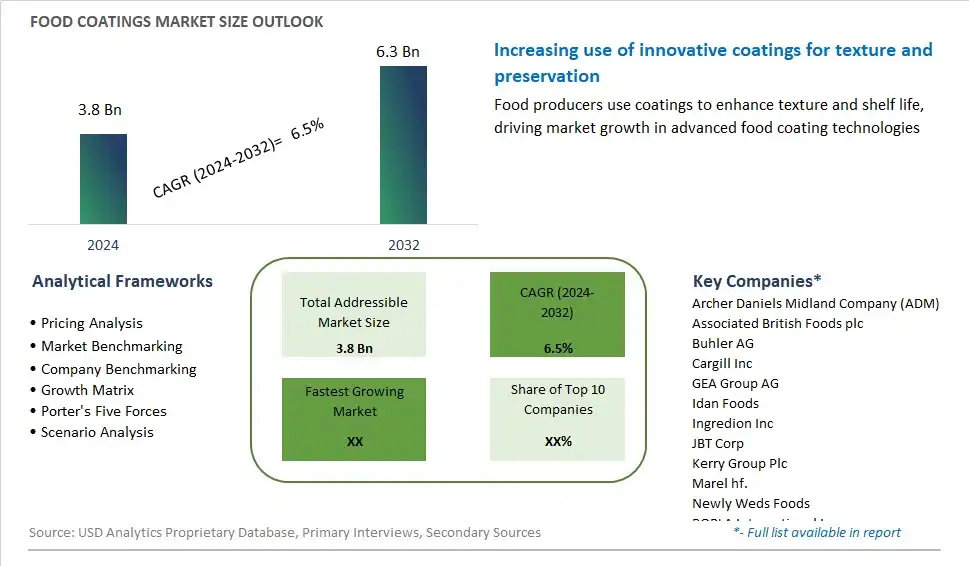
The market report analyses the leading companies in the industry including Archer Daniels Midland Company (ADM), Associated British Foods plc, Buhler AG, Cargill Inc, GEA Group AG, Idan Foods, Ingredion Inc, JBT Corp, Kerry Group Plc, Marel hf., Newly Weds Foods, POPLA International Inc, Solina, Tate & Lyle Plc, TNA Australia Pty Ltd, and Others.
One prominent trend in the food coatings market is the increasing demand for clean-label and functional coatings that offer enhanced nutritional value, sensory appeal, and sustainability. Consumers are seeking healthier food options with minimal artificial additives, preservatives, and allergens, driving food manufacturers to develop coatings formulated with natural ingredients, plant-based extracts, and functional additives such as vitamins, minerals, and antioxidants. Additionally, there is a rising interest in eco-friendly coatings that reduce environmental impact and support sustainable sourcing practices. Manufacturers are innovating with biodegradable, compostable, and renewable materials to create coatings that align with consumer preferences for environmentally responsible products while delivering superior performance and functionality.
A significant driver fueling the food coatings market is the consumer preference for enhanced texture, flavor, and convenience in food products. Coatings play a crucial role in enhancing the sensory attributes of various food items, including meats, poultry, seafood, vegetables, and snacks, by providing crispiness, crunchiness, juiciness, and flavor infusion. Moreover, coatings serve as a barrier to moisture and oil absorption, prolonging shelf life and maintaining product freshness. With the growing demand for ready-to-eat and on-the-go food options, manufacturers are increasingly incorporating coatings into convenience foods, frozen meals, and snacks to meet the needs of busy consumers seeking quick, tasty, and satisfying meal solutions. Additionally, coatings enable food manufacturers to differentiate their products in a competitive market landscape and cater to diverse consumer preferences, including gluten-free, vegan, and allergy-friendly options.
An opportunity within the food coatings market lies in the expansion into health and wellness segments to address the growing demand for functional and fortified food products. As consumers become more health-conscious and seek foods that offer nutritional benefits beyond basic sustenance, there is a growing market for coatings enriched with vitamins, minerals, dietary fibers, and other bioactive compounds that promote health and well-being. Food manufacturers can capitalize on this trend by developing coatings tailored to specific health concerns, such as heart health, digestive wellness, immune support, and weight management. Additionally, there is an opportunity to collaborate with nutritionists, dietitians, and health professionals to formulate coatings that meet dietary recommendations and address nutritional deficiencies prevalent in modern diets. By positioning themselves as providers of value-added, health-enhancing coatings, manufacturers can tap into the lucrative health and wellness market segments and capture consumer interest in functional foods with tangible health benefits.
In the Food Coatings market segmented by Ingredient, the Flours segment is the largest category. This dominance is attributed to the widespread use of flour-based coatings across a diverse range of food products due to their versatility, functionality, and widespread availability. Flour-based coatings, derived from various grains such as wheat, corn, and rice, offer excellent adhesion, texture, and flavor enhancement properties, making them ideal for coating applications in foods such as fried chicken, fish fillets, vegetables, and snacks. Additionally, flour-based coatings provide a crispy and golden-brown exterior while retaining moisture and flavor, enhancing the sensory appeal of coated food products. Further, flour-based coatings can be easily customized with seasonings, spices, and other ingredients to create a wide range of flavor profiles and textures, catering to diverse consumer preferences. As food manufacturers seek to enhance product appeal, texture, and taste while maintaining cost-effectiveness, the Flour-based Coatings segment maintains its leadership position in the Food Coatings market, driving growth and innovation across various food categories.
In the Food Coatings market segmented by Application, the Snacks segment is the fastest-growing category. This accelerated growth is propelled by several factors, including the increasing consumer demand for convenient, indulgent, and innovative snack products. Coatings play a pivotal role in enhancing the taste, texture, and visual appeal of snack foods, including potato chips, pretzels, nuts, and extruded snacks. Further, the growing trend towards healthier snacking options drives the demand for coatings made from natural ingredients, such as whole grains, seeds, and spices, offering nutritional benefits and clean label appeal. Additionally, the snacks industry's emphasis on product differentiation and premiumization fosters innovation in coatings, leading to the introduction of novel flavors, textures, and formats to captivate consumer interest. As snack manufacturers strive to cater to evolving consumer preferences for on-the-go, flavorful, and wholesome snacks, the Snacks Application segment continues to witness rapid growth, underscoring its significance in driving innovation and expansion within the Food Coatings market.
In the Food Coatings market segmented by Equipment, the Coaters & Applicators segment is the largest category. This dominance is attributed to the widespread use of coaters and applicators across various food processing operations due to their versatility, precision, and efficiency in applying coatings to a wide range of food products. Coaters and applicators are essential equipment in coating operations, offering capabilities such as uniform coating thickness, accurate dosing, and adjustable application rates, ensuring consistent product quality and appearance. Further, coaters and applicators are adaptable to different coating materials, including batter, flour, breading, and seasoning blends, making them suitable for a diverse range of food applications such as fried foods, baked goods, and snacks. Additionally, advancements in coating equipment technology, including automation, digital controls, and hygienic design features, further enhance the performance and capabilities of coaters and applicators, driving their widespread adoption across the food industry. As food manufacturers prioritize operational efficiency, product consistency, and innovation, the Coaters & Applicators segment maintains its leadership position in the Food Coatings market, driving growth and innovation to meet evolving industry needs.
By Ingredient
Batter
Flours
By Application
Bakery
Snacks
By Equipment
Coaters & Applicators
Enrobers
By Form
Dry
Liquid
By Mode of Operation
Automatic
Semi-automatic
Countries Analyzed
North America (US, Canada, Mexico)
Europe (Germany, UK, France, Spain, Italy, Russia, Rest of Europe)
Asia Pacific (China, India, Japan, South Korea, Australia, South East Asia, Rest of Asia)
South America (Brazil, Argentina, Rest of South America)
Middle East and Africa (Saudi Arabia, UAE, Rest of Middle East, South Africa, Egypt, Rest of Africa)
Archer Daniels Midland Company (ADM)
Associated British Foods plc
Buhler AG
Cargill Inc
GEA Group AG
Idan Foods
Ingredion Inc
JBT Corp
Kerry Group Plc
Marel hf.
Newly Weds Foods
POPLA International Inc
Solina
Tate & Lyle Plc
TNA Australia Pty Ltd
*- List Not Exhaustive

Chapter 1. TABLE OF CONTENTS
Chapter 2. Introduction to Food Coatings Market
2.1. Market Overview
2.2. Key Statistics and Report Highlights
2.3. Scope of the Comprehensive Study
2.3.1. Market Definition
2.3.2 Countries and Regions Covered
2.3.3 Research Objective
2.3.4 Units, Currency, and Conversions
2.3.5 Industry Value Chain
2.4. Key Market Segments
2.5. Key Companies
2.6. Study Period
Chapter 3. Strategic Analysis Review
3.1. Food Coatings Pricing Analysis and Forecast
3.2. Porter’s Five Forces
3.3. Market Ecosystem
3.4. SWOT Analysis
3.5. Regulatory Scenario
3.3. Effects of Inflation, Russia-Ukraine War, moderating economic growth, and other macroeconomic factors
Chapter 4. Competitive Landscape
4.1. Market Share Analysis
4.1.1. Global Food Coatings Market Share by Company, 2023
4.1.2. Product Offerings of Leading Food Coatings Companies
4.2. Market Entropy
4.2.1. New Product Launches in the Industry
4.2.2. Mergers, Acquisitions, Joint ventures, and Partnerships
4.3. Key Strategies and Best Practices
Chapter 5. Global Market Projections: Best, Reference, and Low Case Scenarios
5.1. Growth Analysis- Case Scenario Definitions
5.2. Low Growth Case Scenario Forecasts
5.3. Reference Growth Case Scenario Forecasts
5.4. High Growth Case Scenario Forecasts
Chapter 6. Market Dynamics
6.1. Food Coatings Market Drivers
6.2. Food Coatings Market Challenges
6.6. Food Coatings Market Opportunities
6.4. Food Coatings Market Trends
Chapter 7. Global Food Coatings Market Outlook Trends
7.1. Global Food Coatings Revenue (USD Million) and CAGR (%) by Type (2021-2032)
7.2. Global Food Coatings Revenue (USD Million) and CAGR (%) by Application (2021-2032)
7.3. Global Food Coatings Revenue (USD Million) and CAGR (%) by Product (2021-2032)
By Ingredient
Batter
Flours
By Application
Bakery
Snacks
By Equipment
Coaters & Applicators
Enrobers
By Form
Dry
Liquid
By Mode of Operation
Automatic
Semi-automatic
Chapter 8. Global Food Coatings Regional Analysis and Outlook
8.1. Global Food Coatings Revenue (USD Million) By Regions (2021- 2032)
8.2. North America Food Coatings Revenue (USD Million) by Country (2021-2032)
8.2.1. United States Food Coatings Regional Analysis and Outlook
8.2.2. Canada Food Coatings Regional Analysis and Outlook
8.2.3. Mexico Food Coatings Regional Analysis and Outlook
8.3. Europe Food Coatings Revenue (USD Million), by Country (2021-2032)
8.3.1. Germany Food Coatings Regional Analysis and Outlook
8.3.2. France Food Coatings Regional Analysis and Outlook
8.3.3. United Kingdom Food Coatings Regional Analysis and Outlook
8.3.4. Spain Food Coatings Regional Analysis and Outlook
8.3.5. Italy Food Coatings Regional Analysis and Outlook
8.3.6. Russia Food Coatings Regional Analysis and Outlook
8.3.7. Rest of Europe Food Coatings Regional Analysis and Outlook
8.4. Asia Pacific Food Coatings Revenue (USD Million) by Country (2021-2032)
8.4.1. China Food Coatings Regional Analysis and Outlook
8.4.2. Japan Food Coatings Regional Analysis and Outlook
8.4.3. India Food Coatings Regional Analysis and Outlook
8.4.4. South Korea Food Coatings Regional Analysis and Outlook
8.4.5. Australia Food Coatings Regional Analysis and Outlook
8.4.6. South East Asia Food Coatings Regional Analysis and Outlook
8.4.7. Rest of Asia Pacific Food Coatings Regional Analysis and Outlook
8.5. South America Food Coatings Revenue (USD Million), by Country (2021-2032)
8.5.1. Brazil Food Coatings Regional Analysis and Outlook
8.5.2. Argentina Food Coatings Regional Analysis and Outlook
8.5.3. Rest of South America Food Coatings Regional Analysis and Outlook
8.6. Middle East and Africa Food Coatings Revenue (USD Million) by Country (2021-2032)
8.6.1. Middle East Food Coatings Regional Analysis and Outlook
8.6.2. Africa Food Coatings Regional Analysis and Outlook
Chapter 9. North America Food Coatings Analysis and Outlook
9.1. North America Food Coatings Revenue (USD Million) by Segments (2021-2032)
9.1.1. North America Food Coatings Revenue (USD Million) by Type (2021-2032)
9.1.2. North America Food Coatings Revenue (USD Million) by Application (2021-2032)
9.1.3. North America Food Coatings Revenue (USD Million) by Product (2021-2032)
By Ingredient
Batter
Flours
By Application
Bakery
Snacks
By Equipment
Coaters & Applicators
Enrobers
By Form
Dry
Liquid
By Mode of Operation
Automatic
Semi-automatic
Chapter 10. Europe Food Coatings Analysis and Outlook
10.1. Europe Food Coatings Revenue (USD Million), by Segments (USD Million) (2021-2032)
10.1.1. Europe Food Coatings Revenue (USD Million) by Type (2021-2032)
10.1.2. Europe Food Coatings Revenue (USD Million) by Application (2021-2032)
10.1.3. Europe Food Coatings Revenue (USD Million) by Product (2021-2032)
By Ingredient
Batter
Flours
By Application
Bakery
Snacks
By Equipment
Coaters & Applicators
Enrobers
By Form
Dry
Liquid
By Mode of Operation
Automatic
Semi-automatic
Chapter 11. Asia Pacific Food Coatings Analysis and Outlook
11.1. Asia Pacific Food Coatings Revenue (USD Million), and Revenue (USD Million) by Segments (2021-2032)
11.1.1. Asia Pacific Food Coatings Revenue (USD Million) by Type (2021-2032)
11.1.2. Asia Pacific Food Coatings Revenue (USD Million) by Application (2021-2032)
11.1.3. Asia Pacific Food Coatings Revenue (USD Million) by Product (2021-2032)
By Ingredient
Batter
Flours
By Application
Bakery
Snacks
By Equipment
Coaters & Applicators
Enrobers
By Form
Dry
Liquid
By Mode of Operation
Automatic
Semi-automatic
Chapter 12. South America Food Coatings Analysis and Outlook
12.1. South America Food Coatings Revenue (USD Million), by Segments (2021-2032)
12.1.1. South America Food Coatings Revenue (USD Million) by Type (2021-2032)
12.1.2. South America Food Coatings Revenue (USD Million) by Application (2021-2032)
12.1.3. South America Food Coatings Revenue (USD Million) by Product (2021-2032)
By Ingredient
Batter
Flours
By Application
Bakery
Snacks
By Equipment
Coaters & Applicators
Enrobers
By Form
Dry
Liquid
By Mode of Operation
Automatic
Semi-automatic
Chapter 13. Middle East and Africa Food Coatings Analysis and Outlook
13.1. Middle East and Africa Food Coatings Revenue (USD Million), by Segments (2021-2032)
13.1.1. Middle East and Africa Food Coatings Revenue (USD Million) by Type (2021-2032)
13.1.2. Middle East and Africa Food Coatings Revenue (USD Million) by Application (2021-2032)
13.1.3. Middle East and Africa Food Coatings Revenue (USD Million) by Product (2021-2032)
By Ingredient
Batter
Flours
By Application
Bakery
Snacks
By Equipment
Coaters & Applicators
Enrobers
By Form
Dry
Liquid
By Mode of Operation
Automatic
Semi-automatic
Chapter 14. Food Coatings Company Profiles
14.1 Business Overview
14.2 Product Profiles
14.3 SWOT Profiles
14.5 Recent Developments
14.6 Financial Profile
List of Companies
Archer Daniels Midland Company (ADM)
Associated British Foods plc
Buhler AG
Cargill Inc
GEA Group AG
Idan Foods
Ingredion Inc
JBT Corp
Kerry Group Plc
Marel hf.
Newly Weds Foods
POPLA International Inc
Solina
Tate & Lyle Plc
TNA Australia Pty Ltd
15. Methodology and Data Sources
15.1 Customization Offerings
15.2 Subscription Services
15.3 Related Reports
15.4 Publisher Expertise
LIST OF TABLES
Table 1 Market Segmentation Analysis
Table 2 Global Food Coatings Market Share of Leading Companies, 2023
Table 3 Product Offerings of Leading Companies
Table 4 Low Growth Scenario Forecasts
Table 5 Reference Case Growth Scenario
Table 6 High Growth Case Scenario
Table 7 Global Food Coatings Revenue (USD Million) And CAGR (%) By Type (2021-2032)
Table 8 Global Food Coatings Revenue (USD Million) And CAGR (%) By Application (2021-2032)
Table 9 Global Food Coatings Revenue (USD Million) And CAGR (%) By Product (2021-2032)
Table 10 Global Food Coatings Market Revenue (USD Million) By Regions (2021-2032)
Table 11 Global Food Coatings Market Share (%) By Regions (2021-2032)
Table 12 North America Food Coatings Revenue (USD Million) By Country (2021-2032)
Table 13 Europe Food Coatings Revenue (USD Million) By Country (2021-2032)
Table 14 Asia Pacific Food Coatings Revenue (USD Million) By Country (2021-2032)
Table 15 South America Food Coatings Revenue (USD Million) By Country (2021-2032)
Table 16 Middle East and Africa Food Coatings Revenue (USD Million) By Region (2021-2032)
Table 17 North America Food Coatings Revenue (USD Million) By Type (2021-2032)
Table 18 North America Food Coatings Revenue (USD Million) By Application (2021-2032)
Table 19 North America Food Coatings Revenue (USD Million) By Product (2021-2032)
Table 20 Europe Food Coatings Revenue (USD Million) By Type (2021-2032)
Table 21 Europe Food Coatings Revenue (USD Million) By Application (2021-2032)
Table 22 Europe Food Coatings Revenue (USD Million) By Product (2021-2032)
Table 23 Asia Pacific Food Coatings Revenue (USD Million) By Type (2021-2032)
Table 24 Asia Pacific Food Coatings Revenue (USD Million) By Application (2021-2032)
Table 25 Asia Pacific Food Coatings Revenue (USD Million) By Product (2021-2032)
Table 26 South America Food Coatings Revenue (USD Million) By Type (2021-2032)
Table 27 South America Food Coatings Revenue (USD Million) By Application (2021-2032)
Table 28 South America Food Coatings Revenue (USD Million) By Product (2021-2032)
Table 29 Middle East and Africa Food Coatings Revenue (USD Million) By Type (2021-2032)
Table 30 Middle East and Africa Food Coatings Revenue (USD Million) By Application (2021-2032)
Table 31 Middle East and Africa Food Coatings Revenue (USD Million) By Product (2021-2032)
LIST OF FIGURES
Figure 1. Market Scope
Figure 2. Pricing Forecasts Per Unit, 2023- 2032
Figure 3. Porter’s Five Forces
Figure 4. Global Food Coatings Market Revenue (USD Million) By Regions (2021-2032)
Figure 5. Global Food Coatings Market Share (%) By Regions (2023)
Figure 6. North America Food Coatings Revenue (USD Million) By Country (2021-2032)
Figure 7. United States Food Coatings Revenue (USD Million) By Country (2021-2032)
Figure 8. Canada Food Coatings Revenue (USD Million) By Country (2021-2032)
Figure 9. Mexico Food Coatings Revenue (USD Million) By Country (2021-2032)
Figure 10. Europe Food Coatings Revenue (USD Million) By Country (2021-2032)
Figure 11. Germany Food Coatings Revenue (USD Million) By Country (2021-2032)
Figure 12. France Food Coatings Revenue (USD Million) By Country (2021-2032)
Figure 13. United Kingdom Food Coatings Revenue (USD Million) By Country (2021-2032)
Figure 14. Spain Food Coatings Revenue (USD Million) By Country (2021-2032)
Figure 15. Italy Food Coatings Revenue (USD Million) By Country (2021-2032)
Figure 16. Russia Food Coatings Revenue (USD Million) By Country (2021-2032)
Figure 17. Rest of Europe Food Coatings Revenue (USD Million) By Country (2021-2032)
Figure 11. Asia Pacific Food Coatings Revenue (USD Million) By Country (2021-2032)
Figure 12. China Food Coatings Revenue (USD Million) By Country (2021-2032)
Figure 13. Japan Food Coatings Revenue (USD Million) By Country (2021-2032)
Figure 14. India Food Coatings Revenue (USD Million) By Country (2021-2032)
Figure 15. South Korea Food Coatings Revenue (USD Million) By Country (2021-2032)
Figure 16. Australia Food Coatings Revenue (USD Million) By Country (2021-2032)
Figure 17. South East Asia Food Coatings Revenue (USD Million) By Country (2021-2032)
Figure 18. South America Food Coatings Revenue (USD Million) By Country (2021-2032)
Figure 19. Brazil Food Coatings Revenue (USD Million) By Country (2021-2032)
Figure 20. Argentina Food Coatings Revenue (USD Million) By Country (2021-2032)
Figure 21. Rest of Asia Pacific Food Coatings Revenue (USD Million) By Country (2021-2032)
Figure 22. Middle East and Africa Food Coatings Revenue (USD Million) By Region (2021-2032)
Figure 23. Saudi Arabia Food Coatings Revenue (USD Million) By Region (2021-2032)
Figure 24. The UAE Food Coatings Revenue (USD Million) By Region (2021-2032)
Figure 25. Rest of Middle East Food Coatings Revenue (USD Million) By Region (2021-2032)
Figure 26. South Africa Food Coatings Revenue (USD Million) By Region (2021-2032)
Figure 27. Africa Food Coatings Revenue (USD Million) By Region (2021-2032)
Figure 28. North America Food Coatings Revenue (USD Million) By Type (2021-2032)
Figure 29. North America Food Coatings Revenue (USD Million) By Application (2021-2032)
Figure 30. North America Food Coatings Revenue (USD Million) By Product (2021-2032)
Figure 31. Europe Food Coatings Revenue (USD Million) By Type (2021-2032)
Figure 32. Europe Food Coatings Revenue (USD Million) By Application (2021-2032)
Figure 33. Europe Food Coatings Revenue (USD Million) By Product (2021-2032)
Figure 34. Asia Pacific Food Coatings Revenue (USD Million) By Type (2021-2032)
Figure 35. Asia Pacific Food Coatings Revenue (USD Million) By Application (2021-2032)
Figure 36. Asia Pacific Food Coatings Revenue (USD Million) By Product (2021-2032)
Figure 37. South America Food Coatings Revenue (USD Million) By Type (2021-2032)
Figure 38. South America Food Coatings Revenue (USD Million) By Application (2021-2032)
Figure 39. South America Food Coatings Revenue (USD Million) By Product (2021-2032)
Figure 40. Middle East and Africa Food Coatings Revenue (USD Million) By Type (2021-2032)
Figure 41. Middle East and Africa Food Coatings Revenue (USD Million) By Application (2021-2032)
Figure 42. Middle East and Africa Food Coatings Revenue (USD Million) By Product (2021-2032)
By Ingredient
Batter
Flours
By Application
Bakery
Snacks
By Equipment
Coaters & Applicators
Enrobers
By Form
Dry
Liquid
By Mode of Operation
Automatic
Semi-automatic
Countries Analyzed
North America (US, Canada, Mexico)
Europe (Germany, UK, France, Spain, Italy, Russia, Rest of Europe)
Asia Pacific (China, India, Japan, South Korea, Australia, South East Asia, Rest of Asia)
South America (Brazil, Argentina, Rest of South America)
Middle East and Africa (Saudi Arabia, UAE, Rest of Middle East, South Africa, Egypt, Rest of Africa)
Global Food Coatings Market Size is valued at $3.8 Billion in 2024 and is forecast to register a growth rate (CAGR) of 6.5% to reach $6.3 Billion by 2032.
Emerging Markets across Asia Pacific, Europe, and Americas present robust growth prospects.
Archer Daniels Midland Company (ADM), Associated British Foods plc, Buhler AG, Cargill Inc, GEA Group AG, Idan Foods, Ingredion Inc, JBT Corp, Kerry Group Plc, Marel hf., Newly Weds Foods, POPLA International Inc, Solina, Tate & Lyle Plc, TNA Australia Pty Ltd
Base Year- 2023; Estimated Year- 2024; Historic Period- 2018-2023; Forecast period- 2024 to 2032; Currency: Revenue (USD); Volume