The global Food Encapsulation Market Comprehensive Study analyzes and forecasts the market size across 6 regions and 24 countries for diverse segments -By Core Phase (Vitamins and Mineral, Enzymes, Organic Acids, Probiotics, Sweeteners, Nutritional Lipids, Prebiotics, Preservatives, Colors, Amino Acids, Flavors, Proteins, Others), By Application (Functional Foods, Dietary Supplements, Bakery Products, Confectionary Products, Beverages, Frozen products, Dairy Products), By Method (Physical Method, Chemical Method, Physicochemical Method), By Shell Material (Polysaccharides, Lipids, Proteins, Emulsifiers), By Technology (Nanoencapsulation, Microencapsulation, Hybrid Encapsulation)
Food encapsulation involves the encapsulation or entrapment of active ingredients, flavors, and nutrients within a protective matrix or shell to enhance stability, bioavailability, and controlled release in 2024. Encapsulation technologies offer solutions to various challenges in food and beverage formulation, including ingredient compatibility, stability during processing and storage, and targeted delivery to improve product performance and consumer experience. Encapsulated ingredients can be delivered in various forms, such as microcapsules, nanoparticles, liposomes, and emulsions, depending on the application and desired release profile. Whether masking off-flavors, protecting sensitive nutrients, or enhancing ingredient solubility, food encapsulation enables manufacturers to innovate with novel ingredients and formulations that meet consumer demand for functional, convenient, and sensory-enhanced products. With advancements in encapsulation materials, techniques, and applications, food manufacturers are exploring new opportunities to incorporate encapsulated ingredients into a wide range of products, including beverages, baked goods, supplements, and functional foods. As consumer interest in personalized nutrition and functional ingredients grows, the market for food encapsulation is expected to expand, driven by investments in research, development, and commercialization that unlock the potential of encapsulated technologies to address emerging market trends and consumer needs.
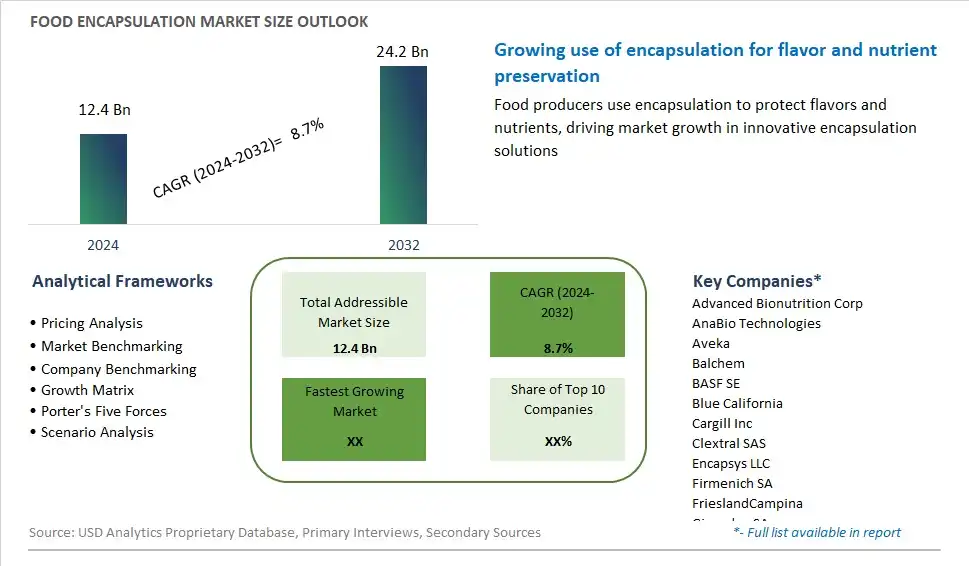
The market report analyses the leading companies in the industry including Advanced Bionutrition Corp, AnaBio Technologies, Aveka, Balchem, BASF SE, Blue California, Cargill Inc, Clextral SAS, Encapsys LLC, Firmenich SA, FrieslandCampina, Givaudan SA, Ingredion Inc, Innov'io, International Flavors & Fragrances Inc IFF, Kerry Group plc, LycoRed Corp, Reed Pacific, Ronald T Dodge Company, Royal DSM N.V., Sensient Technologies Corp, Sphera Encapsulation, Symrise AG, TasteTech, Vitablend, and Others.
A prominent trend in the food encapsulation market is the growing demand for functional and nutrient-enhanced foods driven by consumer preferences for healthier and convenient dietary options. Food encapsulation technology allows for the targeted delivery of bioactive compounds, flavors, vitamins, and other sensitive ingredients, enhancing the nutritional profile, taste, and shelf life of food products. As consumers become more health-conscious and seek out products with added benefits, food manufacturers are increasingly incorporating encapsulated ingredients to create innovative formulations that address specific health concerns, such as immunity support, weight management, and digestive health. Moreover, the rise of personalized nutrition trends has fueled the development of customized encapsulation solutions tailored to individual preferences and dietary requirements, driving further innovation and market expansion.
A key driver propelling the growth of the food encapsulation market is the heightened emphasis on product differentiation and innovation among food manufacturers seeking to gain a competitive edge in the market. Encapsulation technology offers unique opportunities for creating novel food products with enhanced sensory attributes, extended shelf life, and improved stability, enabling manufacturers to meet evolving consumer preferences and market trends. By encapsulating sensitive or reactive ingredients within protective matrices, such as liposomes, microcapsules, or nanoparticles, manufacturers can overcome formulation challenges, mask off-flavors, and control release kinetics, resulting in superior product performance and consumer acceptance. Furthermore, encapsulation allows for the development of functional foods, dietary supplements, and fortified beverages with targeted health benefits, catering to diverse consumer segments and driving market growth.
An opportunity within the food encapsulation market lies in the expansion of applications across various food segments, including beverages, dairy products, bakery goods, confectionery, and convenience foods. As consumer demand for convenience, nutrition, and sensory appeal continues to rise, there is a growing need for encapsulation solutions that address specific formulation challenges and deliver value-added benefits across different product categories. For instance, in the beverage industry, encapsulation technology can be utilized to stabilize volatile flavors, mask bitterness, and improve solubility in functional beverages, such as sports drinks and fortified waters. Similarly, in the dairy sector, encapsulated probiotics can enhance the viability and efficacy of beneficial bacteria in yogurt, kefir, and fermented dairy products, promoting digestive health and immune function. By leveraging the versatility and versatility of encapsulation technology, food manufacturers can innovate and diversify their product portfolios, tap into new market opportunities, and meet the evolving needs of discerning consumers.
In the Food Encapsulation market segmented by Core Phase, the Flavors segment is the largest category. This dominance is attributed to the crucial role of flavor encapsulation in enhancing taste perception, aroma retention, and shelf life extension of food products. Encapsulated flavors protect volatile compounds from degradation due to exposure to light, oxygen, moisture, and other environmental factors, ensuring long-lasting flavor intensity and freshness. Further, encapsulation technology enables controlled release of flavors during food consumption, resulting in a more consistent sensory experience for consumers. Additionally, the versatility of flavor encapsulation allows for the incorporation of a wide range of flavor profiles, including natural, artificial, and exotic flavors, catering to diverse consumer preferences and product formulations across various food categories. As food manufacturers prioritize product differentiation, flavor innovation, and consumer satisfaction, the Flavors segment maintains its leadership position in the Food Encapsulation market, driving growth and innovation to meet evolving industry demands.
In the Food Encapsulation market segmented by Application, the Functional Foods segment is the fastest-growing category. This accelerated growth is propelled by the increasing consumer demand for functional foods fortified with encapsulated ingredients such as vitamins, minerals, probiotics, and omega-3 fatty acids, offering health benefits beyond basic nutrition. Encapsulation technology enables the protection and controlled release of bioactive compounds in functional foods, ensuring their efficacy and stability during processing, storage, and digestion. Further, as consumers become more health-conscious and seek convenient ways to incorporate functional ingredients into their diets, the demand for encapsulated functional foods continues to rise. Additionally, advancements in encapsulation techniques, such as nanoencapsulation and coacervation, enhance the bioavailability and targeted delivery of active compounds, further driving the adoption of encapsulated functional ingredients in food products. As food manufacturers strive to meet growing consumer demand for health-enhancing foods and beverages, the Functional Foods segment experiences rapid growth, underscoring its significance in driving innovation and expansion within the Food Encapsulation market.
In the Food Encapsulation market segmented by Method, the Physical Method segment is the largest category. This dominance is attributed to the widespread adoption of physical encapsulation techniques across various food industries due to their versatility, efficiency, and safety. Physical encapsulation methods, such as spray drying, fluidized bed coating, and extrusion, involve the physical entrapment of active ingredients within protective shells, ensuring their stability and controlled release in food products. Further, physical encapsulation techniques are suitable for a wide range of food ingredients, including flavors, colors, vitamins, and essential oils, preserving their sensory attributes and bioactivity. Additionally, physical encapsulation processes typically involve fewer chemical additives and solvents, minimizing the risk of chemical contamination and ensuring consumer safety. As food manufacturers prioritize clean label formulations, product innovation, and consumer satisfaction, the Physical Method segment maintains its leadership position in the Food Encapsulation market, driving growth and innovation to meet evolving industry demands.
By Core Phase
Vitamins and Mineral
Enzymes
Organic Acids
Probiotics
Sweeteners
Nutritional Lipids
Prebiotics
Preservatives
Colors
Amino Acids
Flavors
Proteins
Others
By Application
Functional Foods
Dietary Supplements
Bakery Products
Confectionary Products
Beverages
Frozen products
Dairy Products
By Method
Physical Method
Chemical Method
Physicochemical Method
By Shell Material
Polysaccharides
Lipids
Proteins
Emulsifiers
By Technology
Nanoencapsulation
Microencapsulation
Hybrid Encapsulation
Countries Analyzed
North America (US, Canada, Mexico)
Europe (Germany, UK, France, Spain, Italy, Russia, Rest of Europe)
Asia Pacific (China, India, Japan, South Korea, Australia, South East Asia, Rest of Asia)
South America (Brazil, Argentina, Rest of South America)
Middle East and Africa (Saudi Arabia, UAE, Rest of Middle East, South Africa, Egypt, Rest of Africa)
Advanced Bionutrition Corp
AnaBio Technologies
Aveka
Balchem
BASF SE
Blue California
Cargill Inc
Clextral SAS
Encapsys LLC
Firmenich SA
FrieslandCampina
Givaudan SA
Ingredion Inc
Innov'io
International Flavors & Fragrances Inc IFF
Kerry Group plc
LycoRed Corp
Reed Pacific
Ronald T Dodge Company
Royal DSM N.V.
Sensient Technologies Corp
Sphera Encapsulation
Symrise AG
TasteTech
Vitablend
*- List Not Exhaustive

Chapter 1. TABLE OF CONTENTS
Chapter 2. Introduction to Food Encapsulation Market
2.1. Market Overview
2.2. Key Statistics and Report Highlights
2.3. Scope of the Comprehensive Study
2.3.1. Market Definition
2.3.2 Countries and Regions Covered
2.3.3 Research Objective
2.3.4 Units, Currency, and Conversions
2.3.5 Industry Value Chain
2.4. Key Market Segments
2.5. Key Companies
2.6. Study Period
Chapter 3. Strategic Analysis Review
3.1. Food Encapsulation Pricing Analysis and Forecast
3.2. Porter’s Five Forces
3.3. Market Ecosystem
3.4. SWOT Analysis
3.5. Regulatory Scenario
3.3. Effects of Inflation, Russia-Ukraine War, moderating economic growth, and other macroeconomic factors
Chapter 4. Competitive Landscape
4.1. Market Share Analysis
4.1.1. Global Food Encapsulation Market Share by Company, 2023
4.1.2. Product Offerings of Leading Food Encapsulation Companies
4.2. Market Entropy
4.2.1. New Product Launches in the Industry
4.2.2. Mergers, Acquisitions, Joint ventures, and Partnerships
4.3. Key Strategies and Best Practices
Chapter 5. Global Market Projections: Best, Reference, and Low Case Scenarios
5.1. Growth Analysis- Case Scenario Definitions
5.2. Low Growth Case Scenario Forecasts
5.3. Reference Growth Case Scenario Forecasts
5.4. High Growth Case Scenario Forecasts
Chapter 6. Market Dynamics
6.1. Food Encapsulation Market Drivers
6.2. Food Encapsulation Market Challenges
6.6. Food Encapsulation Market Opportunities
6.4. Food Encapsulation Market Trends
Chapter 7. Global Food Encapsulation Market Outlook Trends
7.1. Global Food Encapsulation Revenue (USD Million) and CAGR (%) by Type (2021-2032)
7.2. Global Food Encapsulation Revenue (USD Million) and CAGR (%) by Application (2021-2032)
7.3. Global Food Encapsulation Revenue (USD Million) and CAGR (%) by Product (2021-2032)
By Core Phase
Vitamins and Mineral
Enzymes
Organic Acids
Probiotics
Sweeteners
Nutritional Lipids
Prebiotics
Preservatives
Colors
Amino Acids
Flavors
Proteins
Others
By Application
Functional Foods
Dietary Supplements
Bakery Products
Confectionary Products
Beverages
Frozen products
Dairy Products
By Method
Physical Method
Chemical Method
Physicochemical Method
By Shell Material
Polysaccharides
Lipids
Proteins
Emulsifiers
By Technology
Nanoencapsulation
Microencapsulation
Hybrid Encapsulation
Chapter 8. Global Food Encapsulation Regional Analysis and Outlook
8.1. Global Food Encapsulation Revenue (USD Million) By Regions (2021- 2032)
8.2. North America Food Encapsulation Revenue (USD Million) by Country (2021-2032)
8.2.1. United States Food Encapsulation Regional Analysis and Outlook
8.2.2. Canada Food Encapsulation Regional Analysis and Outlook
8.2.3. Mexico Food Encapsulation Regional Analysis and Outlook
8.3. Europe Food Encapsulation Revenue (USD Million), by Country (2021-2032)
8.3.1. Germany Food Encapsulation Regional Analysis and Outlook
8.3.2. France Food Encapsulation Regional Analysis and Outlook
8.3.3. United Kingdom Food Encapsulation Regional Analysis and Outlook
8.3.4. Spain Food Encapsulation Regional Analysis and Outlook
8.3.5. Italy Food Encapsulation Regional Analysis and Outlook
8.3.6. Russia Food Encapsulation Regional Analysis and Outlook
8.3.7. Rest of Europe Food Encapsulation Regional Analysis and Outlook
8.4. Asia Pacific Food Encapsulation Revenue (USD Million) by Country (2021-2032)
8.4.1. China Food Encapsulation Regional Analysis and Outlook
8.4.2. Japan Food Encapsulation Regional Analysis and Outlook
8.4.3. India Food Encapsulation Regional Analysis and Outlook
8.4.4. South Korea Food Encapsulation Regional Analysis and Outlook
8.4.5. Australia Food Encapsulation Regional Analysis and Outlook
8.4.6. South East Asia Food Encapsulation Regional Analysis and Outlook
8.4.7. Rest of Asia Pacific Food Encapsulation Regional Analysis and Outlook
8.5. South America Food Encapsulation Revenue (USD Million), by Country (2021-2032)
8.5.1. Brazil Food Encapsulation Regional Analysis and Outlook
8.5.2. Argentina Food Encapsulation Regional Analysis and Outlook
8.5.3. Rest of South America Food Encapsulation Regional Analysis and Outlook
8.6. Middle East and Africa Food Encapsulation Revenue (USD Million) by Country (2021-2032)
8.6.1. Middle East Food Encapsulation Regional Analysis and Outlook
8.6.2. Africa Food Encapsulation Regional Analysis and Outlook
Chapter 9. North America Food Encapsulation Analysis and Outlook
9.1. North America Food Encapsulation Revenue (USD Million) by Segments (2021-2032)
9.1.1. North America Food Encapsulation Revenue (USD Million) by Type (2021-2032)
9.1.2. North America Food Encapsulation Revenue (USD Million) by Application (2021-2032)
9.1.3. North America Food Encapsulation Revenue (USD Million) by Product (2021-2032)
By Core Phase
Vitamins and Mineral
Enzymes
Organic Acids
Probiotics
Sweeteners
Nutritional Lipids
Prebiotics
Preservatives
Colors
Amino Acids
Flavors
Proteins
Others
By Application
Functional Foods
Dietary Supplements
Bakery Products
Confectionary Products
Beverages
Frozen products
Dairy Products
By Method
Physical Method
Chemical Method
Physicochemical Method
By Shell Material
Polysaccharides
Lipids
Proteins
Emulsifiers
By Technology
Nanoencapsulation
Microencapsulation
Hybrid Encapsulation
Chapter 10. Europe Food Encapsulation Analysis and Outlook
10.1. Europe Food Encapsulation Revenue (USD Million), by Segments (USD Million) (2021-2032)
10.1.1. Europe Food Encapsulation Revenue (USD Million) by Type (2021-2032)
10.1.2. Europe Food Encapsulation Revenue (USD Million) by Application (2021-2032)
10.1.3. Europe Food Encapsulation Revenue (USD Million) by Product (2021-2032)
By Core Phase
Vitamins and Mineral
Enzymes
Organic Acids
Probiotics
Sweeteners
Nutritional Lipids
Prebiotics
Preservatives
Colors
Amino Acids
Flavors
Proteins
Others
By Application
Functional Foods
Dietary Supplements
Bakery Products
Confectionary Products
Beverages
Frozen products
Dairy Products
By Method
Physical Method
Chemical Method
Physicochemical Method
By Shell Material
Polysaccharides
Lipids
Proteins
Emulsifiers
By Technology
Nanoencapsulation
Microencapsulation
Hybrid Encapsulation
Chapter 11. Asia Pacific Food Encapsulation Analysis and Outlook
11.1. Asia Pacific Food Encapsulation Revenue (USD Million), and Revenue (USD Million) by Segments (2021-2032)
11.1.1. Asia Pacific Food Encapsulation Revenue (USD Million) by Type (2021-2032)
11.1.2. Asia Pacific Food Encapsulation Revenue (USD Million) by Application (2021-2032)
11.1.3. Asia Pacific Food Encapsulation Revenue (USD Million) by Product (2021-2032)
By Core Phase
Vitamins and Mineral
Enzymes
Organic Acids
Probiotics
Sweeteners
Nutritional Lipids
Prebiotics
Preservatives
Colors
Amino Acids
Flavors
Proteins
Others
By Application
Functional Foods
Dietary Supplements
Bakery Products
Confectionary Products
Beverages
Frozen products
Dairy Products
By Method
Physical Method
Chemical Method
Physicochemical Method
By Shell Material
Polysaccharides
Lipids
Proteins
Emulsifiers
By Technology
Nanoencapsulation
Microencapsulation
Hybrid Encapsulation
Chapter 12. South America Food Encapsulation Analysis and Outlook
12.1. South America Food Encapsulation Revenue (USD Million), by Segments (2021-2032)
12.1.1. South America Food Encapsulation Revenue (USD Million) by Type (2021-2032)
12.1.2. South America Food Encapsulation Revenue (USD Million) by Application (2021-2032)
12.1.3. South America Food Encapsulation Revenue (USD Million) by Product (2021-2032)
By Core Phase
Vitamins and Mineral
Enzymes
Organic Acids
Probiotics
Sweeteners
Nutritional Lipids
Prebiotics
Preservatives
Colors
Amino Acids
Flavors
Proteins
Others
By Application
Functional Foods
Dietary Supplements
Bakery Products
Confectionary Products
Beverages
Frozen products
Dairy Products
By Method
Physical Method
Chemical Method
Physicochemical Method
By Shell Material
Polysaccharides
Lipids
Proteins
Emulsifiers
By Technology
Nanoencapsulation
Microencapsulation
Hybrid Encapsulation
Chapter 13. Middle East and Africa Food Encapsulation Analysis and Outlook
13.1. Middle East and Africa Food Encapsulation Revenue (USD Million), by Segments (2021-2032)
13.1.1. Middle East and Africa Food Encapsulation Revenue (USD Million) by Type (2021-2032)
13.1.2. Middle East and Africa Food Encapsulation Revenue (USD Million) by Application (2021-2032)
13.1.3. Middle East and Africa Food Encapsulation Revenue (USD Million) by Product (2021-2032)
By Core Phase
Vitamins and Mineral
Enzymes
Organic Acids
Probiotics
Sweeteners
Nutritional Lipids
Prebiotics
Preservatives
Colors
Amino Acids
Flavors
Proteins
Others
By Application
Functional Foods
Dietary Supplements
Bakery Products
Confectionary Products
Beverages
Frozen products
Dairy Products
By Method
Physical Method
Chemical Method
Physicochemical Method
By Shell Material
Polysaccharides
Lipids
Proteins
Emulsifiers
By Technology
Nanoencapsulation
Microencapsulation
Hybrid Encapsulation
Chapter 14. Food Encapsulation Company Profiles
14.1 Business Overview
14.2 Product Profiles
14.3 SWOT Profiles
14.5 Recent Developments
14.6 Financial Profile
List of Companies
Advanced Bionutrition Corp
AnaBio Technologies
Aveka
Balchem
BASF SE
Blue California
Cargill Inc
Clextral SAS
Encapsys LLC
Firmenich SA
FrieslandCampina
Givaudan SA
Ingredion Inc
Innov'io
International Flavors & Fragrances Inc IFF
Kerry Group plc
LycoRed Corp
Reed Pacific
Ronald T Dodge Company
Royal DSM N.V.
Sensient Technologies Corp
Sphera Encapsulation
Symrise AG
TasteTech
Vitablend
15. Methodology and Data Sources
15.1 Customization Offerings
15.2 Subscription Services
15.3 Related Reports
15.4 Publisher Expertise
LIST OF TABLES
Table 1 Market Segmentation Analysis
Table 2 Global Food Encapsulation Market Share of Leading Companies, 2023
Table 3 Product Offerings of Leading Companies
Table 4 Low Growth Scenario Forecasts
Table 5 Reference Case Growth Scenario
Table 6 High Growth Case Scenario
Table 7 Global Food Encapsulation Revenue (USD Million) And CAGR (%) By Type (2021-2032)
Table 8 Global Food Encapsulation Revenue (USD Million) And CAGR (%) By Application (2021-2032)
Table 9 Global Food Encapsulation Revenue (USD Million) And CAGR (%) By Product (2021-2032)
Table 10 Global Food Encapsulation Market Revenue (USD Million) By Regions (2021-2032)
Table 11 Global Food Encapsulation Market Share (%) By Regions (2021-2032)
Table 12 North America Food Encapsulation Revenue (USD Million) By Country (2021-2032)
Table 13 Europe Food Encapsulation Revenue (USD Million) By Country (2021-2032)
Table 14 Asia Pacific Food Encapsulation Revenue (USD Million) By Country (2021-2032)
Table 15 South America Food Encapsulation Revenue (USD Million) By Country (2021-2032)
Table 16 Middle East and Africa Food Encapsulation Revenue (USD Million) By Region (2021-2032)
Table 17 North America Food Encapsulation Revenue (USD Million) By Type (2021-2032)
Table 18 North America Food Encapsulation Revenue (USD Million) By Application (2021-2032)
Table 19 North America Food Encapsulation Revenue (USD Million) By Product (2021-2032)
Table 20 Europe Food Encapsulation Revenue (USD Million) By Type (2021-2032)
Table 21 Europe Food Encapsulation Revenue (USD Million) By Application (2021-2032)
Table 22 Europe Food Encapsulation Revenue (USD Million) By Product (2021-2032)
Table 23 Asia Pacific Food Encapsulation Revenue (USD Million) By Type (2021-2032)
Table 24 Asia Pacific Food Encapsulation Revenue (USD Million) By Application (2021-2032)
Table 25 Asia Pacific Food Encapsulation Revenue (USD Million) By Product (2021-2032)
Table 26 South America Food Encapsulation Revenue (USD Million) By Type (2021-2032)
Table 27 South America Food Encapsulation Revenue (USD Million) By Application (2021-2032)
Table 28 South America Food Encapsulation Revenue (USD Million) By Product (2021-2032)
Table 29 Middle East and Africa Food Encapsulation Revenue (USD Million) By Type (2021-2032)
Table 30 Middle East and Africa Food Encapsulation Revenue (USD Million) By Application (2021-2032)
Table 31 Middle East and Africa Food Encapsulation Revenue (USD Million) By Product (2021-2032)
LIST OF FIGURES
Figure 1. Market Scope
Figure 2. Pricing Forecasts Per Unit, 2023- 2032
Figure 3. Porter’s Five Forces
Figure 4. Global Food Encapsulation Market Revenue (USD Million) By Regions (2021-2032)
Figure 5. Global Food Encapsulation Market Share (%) By Regions (2023)
Figure 6. North America Food Encapsulation Revenue (USD Million) By Country (2021-2032)
Figure 7. United States Food Encapsulation Revenue (USD Million) By Country (2021-2032)
Figure 8. Canada Food Encapsulation Revenue (USD Million) By Country (2021-2032)
Figure 9. Mexico Food Encapsulation Revenue (USD Million) By Country (2021-2032)
Figure 10. Europe Food Encapsulation Revenue (USD Million) By Country (2021-2032)
Figure 11. Germany Food Encapsulation Revenue (USD Million) By Country (2021-2032)
Figure 12. France Food Encapsulation Revenue (USD Million) By Country (2021-2032)
Figure 13. United Kingdom Food Encapsulation Revenue (USD Million) By Country (2021-2032)
Figure 14. Spain Food Encapsulation Revenue (USD Million) By Country (2021-2032)
Figure 15. Italy Food Encapsulation Revenue (USD Million) By Country (2021-2032)
Figure 16. Russia Food Encapsulation Revenue (USD Million) By Country (2021-2032)
Figure 17. Rest of Europe Food Encapsulation Revenue (USD Million) By Country (2021-2032)
Figure 11. Asia Pacific Food Encapsulation Revenue (USD Million) By Country (2021-2032)
Figure 12. China Food Encapsulation Revenue (USD Million) By Country (2021-2032)
Figure 13. Japan Food Encapsulation Revenue (USD Million) By Country (2021-2032)
Figure 14. India Food Encapsulation Revenue (USD Million) By Country (2021-2032)
Figure 15. South Korea Food Encapsulation Revenue (USD Million) By Country (2021-2032)
Figure 16. Australia Food Encapsulation Revenue (USD Million) By Country (2021-2032)
Figure 17. South East Asia Food Encapsulation Revenue (USD Million) By Country (2021-2032)
Figure 18. South America Food Encapsulation Revenue (USD Million) By Country (2021-2032)
Figure 19. Brazil Food Encapsulation Revenue (USD Million) By Country (2021-2032)
Figure 20. Argentina Food Encapsulation Revenue (USD Million) By Country (2021-2032)
Figure 21. Rest of Asia Pacific Food Encapsulation Revenue (USD Million) By Country (2021-2032)
Figure 22. Middle East and Africa Food Encapsulation Revenue (USD Million) By Region (2021-2032)
Figure 23. Saudi Arabia Food Encapsulation Revenue (USD Million) By Region (2021-2032)
Figure 24. The UAE Food Encapsulation Revenue (USD Million) By Region (2021-2032)
Figure 25. Rest of Middle East Food Encapsulation Revenue (USD Million) By Region (2021-2032)
Figure 26. South Africa Food Encapsulation Revenue (USD Million) By Region (2021-2032)
Figure 27. Africa Food Encapsulation Revenue (USD Million) By Region (2021-2032)
Figure 28. North America Food Encapsulation Revenue (USD Million) By Type (2021-2032)
Figure 29. North America Food Encapsulation Revenue (USD Million) By Application (2021-2032)
Figure 30. North America Food Encapsulation Revenue (USD Million) By Product (2021-2032)
Figure 31. Europe Food Encapsulation Revenue (USD Million) By Type (2021-2032)
Figure 32. Europe Food Encapsulation Revenue (USD Million) By Application (2021-2032)
Figure 33. Europe Food Encapsulation Revenue (USD Million) By Product (2021-2032)
Figure 34. Asia Pacific Food Encapsulation Revenue (USD Million) By Type (2021-2032)
Figure 35. Asia Pacific Food Encapsulation Revenue (USD Million) By Application (2021-2032)
Figure 36. Asia Pacific Food Encapsulation Revenue (USD Million) By Product (2021-2032)
Figure 37. South America Food Encapsulation Revenue (USD Million) By Type (2021-2032)
Figure 38. South America Food Encapsulation Revenue (USD Million) By Application (2021-2032)
Figure 39. South America Food Encapsulation Revenue (USD Million) By Product (2021-2032)
Figure 40. Middle East and Africa Food Encapsulation Revenue (USD Million) By Type (2021-2032)
Figure 41. Middle East and Africa Food Encapsulation Revenue (USD Million) By Application (2021-2032)
Figure 42. Middle East and Africa Food Encapsulation Revenue (USD Million) By Product (2021-2032)
By Core Phase
Vitamins and Mineral
Enzymes
Organic Acids
Probiotics
Sweeteners
Nutritional Lipids
Prebiotics
Preservatives
Colors
Amino Acids
Flavors
Proteins
Others
By Application
Functional Foods
Dietary Supplements
Bakery Products
Confectionary Products
Beverages
Frozen products
Dairy Products
By Method
Physical Method
Chemical Method
Physicochemical Method
By Shell Material
Polysaccharides
Lipids
Proteins
Emulsifiers
By Technology
Nanoencapsulation
Microencapsulation
Hybrid Encapsulation
Countries Analyzed
North America (US, Canada, Mexico)
Europe (Germany, UK, France, Spain, Italy, Russia, Rest of Europe)
Asia Pacific (China, India, Japan, South Korea, Australia, South East Asia, Rest of Asia)
South America (Brazil, Argentina, Rest of South America)
Middle East and Africa (Saudi Arabia, UAE, Rest of Middle East, South Africa, Egypt, Rest of Africa)
Global Food Encapsulation Market Size is valued at $12.4 Billion in 2024 and is forecast to register a growth rate (CAGR) of 8.7% to reach $24.2 Billion by 2032.
Emerging Markets across Asia Pacific, Europe, and Americas present robust growth prospects.
Advanced Bionutrition Corp, AnaBio Technologies, Aveka, Balchem, BASF SE, Blue California, Cargill Inc, Clextral SAS, Encapsys LLC, Firmenich SA, FrieslandCampina, Givaudan SA, Ingredion Inc, Innov'io, International Flavors & Fragrances Inc IFF, Kerry Group plc, LycoRed Corp, Reed Pacific, Ronald T Dodge Company, Royal DSM N.V., Sensient Technologies Corp, Sphera Encapsulation, Symrise AG, TasteTech, Vitablend
Base Year- 2023; Estimated Year- 2024; Historic Period- 2018-2023; Forecast period- 2024 to 2032; Currency: Revenue (USD); Volume