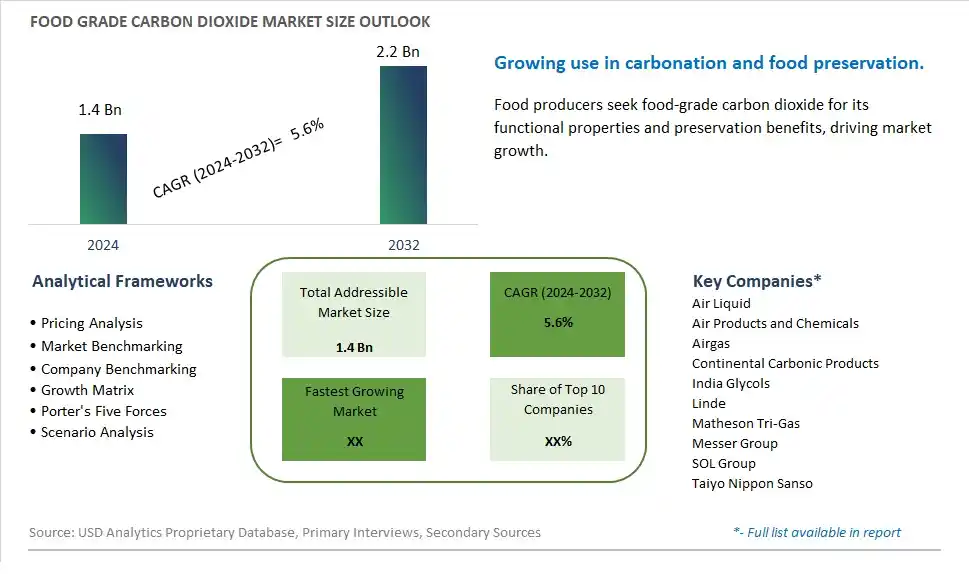
Global Food Grade Carbon Dioxide Market Size is valued at $1.4 Billion in 2024 and is forecast to register a growth rate (CAGR) of 5.6% to reach $2.2 Billion by 2032.
The global Food Grade Carbon Dioxide Market Comprehensive Study analyzes and forecasts the market size across 6 regions and 24 countries for diverse segments -By Source (Dairy & Frozen Products, Beverages, Meat, Poultry, Others), By Application (Freezing & Chilling, Packaging, Carbonation)
An Introduction to Food Grade Carbon Dioxide Market
The Food Grade Carbon Dioxide market in 2024 is experiencing significant growth, driven by the increasing demand for carbonation and preservation in the food and beverage industry. Food-grade carbon dioxide, used in carbonated beverages, modified atmosphere packaging, and freezing, plays a critical role in product quality and shelf life. The market benefits from advancements in carbon dioxide production and purification technologies, the growing trend of convenience foods, and the expansion of the global beverage sector. Additionally, the rising focus on food safety and quality control is contributing to market growth.
Food Grade Carbon Dioxide Competitive Landscape
The market report analyses the leading companies in the industry including Air Liquid, Air Products and Chemicals, Airgas, Continental Carbonic Products, India Glycols, Linde, Matheson Tri-Gas, Messer Group, SOL Group, Taiyo Nippon Sanso, and Others.
Food Grade Carbon Dioxide Market Dynamics
Food Grade Carbon Dioxide Market Trend: Increased Demand for Carbonation and Extended Shelf Life
One prominent trend in the food grade carbon dioxide market is the increased demand for carbonation and extended shelf life in food and beverage products. As consumers seek refreshing and fizzy beverages, carbon dioxide is essential for creating carbonated drinks such as sodas, sparkling water, and beer. Additionally, carbon dioxide is used in modified atmosphere packaging (MAP) to extend the shelf life of perishable foods by inhibiting microbial growth and maintaining product freshness. This trend is driven by consumer preferences for carbonated beverages and the food industry's focus on enhancing food preservation methods to meet consumer demand for longer-lasting products with improved quality.
Food Grade Carbon Dioxide Market Driver: Versatility in Food Processing and Preservation
A key driver propelling the food grade carbon dioxide market is its versatility in food processing and preservation applications. Carbon dioxide serves multiple purposes, including carbonation, pH control, microbial inhibition, and packaging preservation. Its ability to dissolve in liquids, create a protective atmosphere, and control microbial growth makes it a valuable ingredient and tool in the food industry. The driver behind this trend is the need for efficient and effective food processing methods that enhance product quality, safety, and shelf life, driving the adoption of food grade carbon dioxide across various food and beverage segments.
Food Grade Carbon Dioxide Market Opportunity: Expansion into Innovative Packaging and Preservation Solutions
A significant opportunity in the food grade carbon dioxide market lies in the expansion into innovative packaging and preservation solutions that leverage carbon dioxide's properties for improved food safety and quality. Companies can capitalize on this opportunity by developing advanced MAP systems, active packaging technologies, and carbon dioxide-infused packaging materials that extend shelf life, reduce food waste, and maintain product freshness. Additionally, there's potential for offering carbon dioxide-based solutions for controlled atmosphere storage, modified atmosphere packaging, and carbonation systems that cater to diverse food processing needs and market preferences. By focusing on innovation and offering advanced packaging and preservation solutions, companies can differentiate their offerings, meet evolving consumer demands, and contribute to the development of sustainable and efficient food preservation methods.
Food Grade Carbon Dioxide Market Share Analysis: Beverages segment generated the highest revenue share in the industry
The Beverages segment stands out as the largest in the Food Grade Carbon Dioxide Market. Carbon dioxide (CO2) is extensively used in the beverage industry for carbonation, which enhances the sensory experience by providing fizziness and effervescence to various drinks, including carbonated soft drinks, beer, sparkling water, and other carbonated beverages. The demand for carbon dioxide in the beverage sector is driven by the growing consumption of carbonated drinks globally. As consumer preferences shift towards healthier and more diverse beverage options, carbonated beverages remain popular due to their refreshing taste and perceived indulgence. Further, the versatility of CO2 extends beyond carbonation; it is also used in beverage dispensing systems, where it maintains pressure and freshness in draft beers and other dispensable beverages. With increasing urbanization, rising disposable incomes, and changing lifestyle preferences, the Beverages segment continues to drive substantial demand for food-grade carbon dioxide. Manufacturers and suppliers are leveraging technological advancements to ensure reliable supply chains and sustainable production practices to meet this growing market demand effectively.
Food Grade Carbon Dioxide Market Share Analysis: Carbonation is the fastest growing segment over the forecast period to 2032
The Carbonation segment emerges as the fastest-growing application in the Food Grade Carbon Dioxide Market through 2032. Carbon dioxide (CO2) plays a pivotal role in carbonating beverages, a process crucial for enhancing flavor, providing effervescence, and preserving product freshness. This segment's rapid growth is driven by increasing consumer demand for carbonated drinks worldwide, including carbonated soft drinks, sparkling water, and beer. As lifestyles evolve and consumer preferences lean towards more refreshing and indulgent beverage choices, carbonated beverages continue to gain popularity. The use of CO2 in carbonation extends beyond traditional sodas to include emerging trends like flavored sparkling waters and energy drinks, amplifying its application scope. Manufacturers in the food and beverage industry are investing in advanced technologies to optimize CO2 usage, ensuring efficiency in carbonation processes while meeting stringent quality standards. Further, the sustainability aspect of CO2 utilization is becoming increasingly crucial, prompting innovations in carbon capture and utilization technologies to minimize environmental impact. As a result, the Carbonation segment not only drives significant revenue growth but also fosters innovation towards sustainable practices in the food and beverage sector.
Food Grade Carbon Dioxide Market Segmentation
By Source
Dairy & Frozen Products
Beverages
Meat
Poultry
Others
By Application
Freezing & Chilling
Packaging
Carbonation
Countries Analyzed
North America (US, Canada, Mexico)
Europe (Germany, UK, France, Spain, Italy, Russia, Rest of Europe)
Asia Pacific (China, India, Japan, South Korea, Australia, South East Asia, Rest of Asia)
South America (Brazil, Argentina, Rest of South America)
Middle East and Africa (Saudi Arabia, UAE, Rest of Middle East, South Africa, Egypt, Rest of Africa)
Food Grade Carbon Dioxide Companies Profiled in the Study
Air Liquid
Air Products and Chemicals
Airgas
Continental Carbonic Products
India Glycols
Linde
Matheson Tri-Gas
Messer Group
SOL Group
Taiyo Nippon Sanso
*- List Not Exhaustive
Chapter 1. TABLE OF CONTENTS
Chapter 2. Introduction to Food Grade Carbon Dioxide Market
2.1. Market Overview
2.2. Key Statistics and Report Highlights
2.3. Scope of the Comprehensive Study
2.3.1. Market Definition
2.3.2 Countries and Regions Covered
2.3.3 Research Objective
2.3.4 Units, Currency, and Conversions
2.3.5 Industry Value Chain
2.4. Key Market Segments
2.5. Key Companies
2.6. Study Period
Chapter 3. Strategic Analysis Review
3.1. Food Grade Carbon Dioxide Pricing Analysis and Forecast
3.2. Porter’s Five Forces
3.3. Market Ecosystem
3.4. SWOT Analysis
3.5. Regulatory Scenario
3.3. Effects of Inflation, Russia-Ukraine War, moderating economic growth, and other macroeconomic factors
Chapter 4. Competitive Landscape
4.1. Market Share Analysis
4.1.1. Global Food Grade Carbon Dioxide Market Share by Company, 2023
4.1.2. Product Offerings of Leading Food Grade Carbon Dioxide Companies
4.2. Market Entropy
4.2.1. New Product Launches in the Industry
4.2.2. Mergers, Acquisitions, Joint ventures, and Partnerships
4.3. Key Strategies and Best Practices
Chapter 5. Global Market Projections: Best, Reference, and Low Case Scenarios
5.1. Growth Analysis- Case Scenario Definitions
5.2. Low Growth Case Scenario Forecasts
5.3. Reference Growth Case Scenario Forecasts
5.4. High Growth Case Scenario Forecasts
Chapter 6. Market Dynamics
6.1. Food Grade Carbon Dioxide Market Drivers
6.2. Food Grade Carbon Dioxide Market Challenges
6.6. Food Grade Carbon Dioxide Market Opportunities
6.4. Food Grade Carbon Dioxide Market Trends
Chapter 7. Global Food Grade Carbon Dioxide Market Outlook Trends
7.1. Global Food Grade Carbon Dioxide Revenue (USD Million) and CAGR (%) by Type (2021-2032)
7.2. Global Food Grade Carbon Dioxide Revenue (USD Million) and CAGR (%) by Application (2021-2032)
7.3. Global Food Grade Carbon Dioxide Revenue (USD Million) and CAGR (%) by Product (2021-2032)
By Source
Dairy & Frozen Products
Beverages
Meat
Poultry
Others
By Application
Freezing & Chilling
Packaging
Carbonation
Chapter 8. Global Food Grade Carbon Dioxide Regional Analysis and Outlook
8.1. Global Food Grade Carbon Dioxide Revenue (USD Million) By Regions (2021- 2032)
8.2. North America Food Grade Carbon Dioxide Revenue (USD Million) by Country (2021-2032)
8.2.1. United States Food Grade Carbon Dioxide Regional Analysis and Outlook
8.2.2. Canada Food Grade Carbon Dioxide Regional Analysis and Outlook
8.2.3. Mexico Food Grade Carbon Dioxide Regional Analysis and Outlook
8.3. Europe Food Grade Carbon Dioxide Revenue (USD Million), by Country (2021-2032)
8.3.1. Germany Food Grade Carbon Dioxide Regional Analysis and Outlook
8.3.2. France Food Grade Carbon Dioxide Regional Analysis and Outlook
8.3.3. United Kingdom Food Grade Carbon Dioxide Regional Analysis and Outlook
8.3.4. Spain Food Grade Carbon Dioxide Regional Analysis and Outlook
8.3.5. Italy Food Grade Carbon Dioxide Regional Analysis and Outlook
8.3.6. Russia Food Grade Carbon Dioxide Regional Analysis and Outlook
8.3.7. Rest of Europe Food Grade Carbon Dioxide Regional Analysis and Outlook
8.4. Asia Pacific Food Grade Carbon Dioxide Revenue (USD Million) by Country (2021-2032)
8.4.1. China Food Grade Carbon Dioxide Regional Analysis and Outlook
8.4.2. Japan Food Grade Carbon Dioxide Regional Analysis and Outlook
8.4.3. India Food Grade Carbon Dioxide Regional Analysis and Outlook
8.4.4. South Korea Food Grade Carbon Dioxide Regional Analysis and Outlook
8.4.5. Australia Food Grade Carbon Dioxide Regional Analysis and Outlook
8.4.6. South East Asia Food Grade Carbon Dioxide Regional Analysis and Outlook
8.4.7. Rest of Asia Pacific Food Grade Carbon Dioxide Regional Analysis and Outlook
8.5. South America Food Grade Carbon Dioxide Revenue (USD Million), by Country (2021-2032)
8.5.1. Brazil Food Grade Carbon Dioxide Regional Analysis and Outlook
8.5.2. Argentina Food Grade Carbon Dioxide Regional Analysis and Outlook
8.5.3. Rest of South America Food Grade Carbon Dioxide Regional Analysis and Outlook
8.6. Middle East and Africa Food Grade Carbon Dioxide Revenue (USD Million) by Country (2021-2032)
8.6.1. Middle East Food Grade Carbon Dioxide Regional Analysis and Outlook
8.6.2. Africa Food Grade Carbon Dioxide Regional Analysis and Outlook
Chapter 9. North America Food Grade Carbon Dioxide Analysis and Outlook
9.1. North America Food Grade Carbon Dioxide Revenue (USD Million) by Segments (2021-2032)
9.1.1. North America Food Grade Carbon Dioxide Revenue (USD Million) by Type (2021-2032)
9.1.2. North America Food Grade Carbon Dioxide Revenue (USD Million) by Application (2021-2032)
9.1.3. North America Food Grade Carbon Dioxide Revenue (USD Million) by Product (2021-2032)
By Source
Dairy & Frozen Products
Beverages
Meat
Poultry
Others
By Application
Freezing & Chilling
Packaging
Carbonation
Chapter 10. Europe Food Grade Carbon Dioxide Analysis and Outlook
10.1. Europe Food Grade Carbon Dioxide Revenue (USD Million), by Segments (USD Million) (2021-2032)
10.1.1. Europe Food Grade Carbon Dioxide Revenue (USD Million) by Type (2021-2032)
10.1.2. Europe Food Grade Carbon Dioxide Revenue (USD Million) by Application (2021-2032)
10.1.3. Europe Food Grade Carbon Dioxide Revenue (USD Million) by Product (2021-2032)
By Source
Dairy & Frozen Products
Beverages
Meat
Poultry
Others
By Application
Freezing & Chilling
Packaging
Carbonation
Chapter 11. Asia Pacific Food Grade Carbon Dioxide Analysis and Outlook
11.1. Asia Pacific Food Grade Carbon Dioxide Revenue (USD Million), and Revenue (USD Million) by Segments (2021-2032)
11.1.1. Asia Pacific Food Grade Carbon Dioxide Revenue (USD Million) by Type (2021-2032)
11.1.2. Asia Pacific Food Grade Carbon Dioxide Revenue (USD Million) by Application (2021-2032)
11.1.3. Asia Pacific Food Grade Carbon Dioxide Revenue (USD Million) by Product (2021-2032)
By Source
Dairy & Frozen Products
Beverages
Meat
Poultry
Others
By Application
Freezing & Chilling
Packaging
Carbonation
Chapter 12. South America Food Grade Carbon Dioxide Analysis and Outlook
12.1. South America Food Grade Carbon Dioxide Revenue (USD Million), by Segments (2021-2032)
12.1.1. South America Food Grade Carbon Dioxide Revenue (USD Million) by Type (2021-2032)
12.1.2. South America Food Grade Carbon Dioxide Revenue (USD Million) by Application (2021-2032)
12.1.3. South America Food Grade Carbon Dioxide Revenue (USD Million) by Product (2021-2032)
By Source
Dairy & Frozen Products
Beverages
Meat
Poultry
Others
By Application
Freezing & Chilling
Packaging
Carbonation
Chapter 13. Middle East and Africa Food Grade Carbon Dioxide Analysis and Outlook
13.1. Middle East and Africa Food Grade Carbon Dioxide Revenue (USD Million), by Segments (2021-2032)
13.1.1. Middle East and Africa Food Grade Carbon Dioxide Revenue (USD Million) by Type (2021-2032)
13.1.2. Middle East and Africa Food Grade Carbon Dioxide Revenue (USD Million) by Application (2021-2032)
13.1.3. Middle East and Africa Food Grade Carbon Dioxide Revenue (USD Million) by Product (2021-2032)
By Source
Dairy & Frozen Products
Beverages
Meat
Poultry
Others
By Application
Freezing & Chilling
Packaging
Carbonation
Chapter 14. Food Grade Carbon Dioxide Company Profiles
14.1 Business Overview
14.2 Product Profiles
14.3 SWOT Profiles
14.5 Recent Developments
14.6 Financial Profile
List of Companies
Air Liquid
Air Products and Chemicals
Airgas
Continental Carbonic Products
India Glycols
Linde
Matheson Tri-Gas
Messer Group
SOL Group
Taiyo Nippon Sanso
15. Methodology and Data Sources
15.1 Customization Offerings
15.2 Subscription Services
15.3 Related Reports
15.4 Publisher Expertise
LIST OF TABLES
Table 1 Market Segmentation Analysis
Table 2 Global Food Grade Carbon Dioxide Market Share of Leading Companies, 2023
Table 3 Product Offerings of Leading Companies
Table 4 Low Growth Scenario Forecasts
Table 5 Reference Case Growth Scenario
Table 6 High Growth Case Scenario
Table 7 Global Food Grade Carbon Dioxide Revenue (USD Million) And CAGR (%) By Type (2021-2032)
Table 8 Global Food Grade Carbon Dioxide Revenue (USD Million) And CAGR (%) By Application (2021-2032)
Table 9 Global Food Grade Carbon Dioxide Revenue (USD Million) And CAGR (%) By Product (2021-2032)
Table 10 Global Food Grade Carbon Dioxide Market Revenue (USD Million) By Regions (2021-2032)
Table 11 Global Food Grade Carbon Dioxide Market Share (%) By Regions (2021-2032)
Table 12 North America Food Grade Carbon Dioxide Revenue (USD Million) By Country (2021-2032)
Table 13 Europe Food Grade Carbon Dioxide Revenue (USD Million) By Country (2021-2032)
Table 14 Asia Pacific Food Grade Carbon Dioxide Revenue (USD Million) By Country (2021-2032)
Table 15 South America Food Grade Carbon Dioxide Revenue (USD Million) By Country (2021-2032)
Table 16 Middle East and Africa Food Grade Carbon Dioxide Revenue (USD Million) By Region (2021-2032)
Table 17 North America Food Grade Carbon Dioxide Revenue (USD Million) By Type (2021-2032)
Table 18 North America Food Grade Carbon Dioxide Revenue (USD Million) By Application (2021-2032)
Table 19 North America Food Grade Carbon Dioxide Revenue (USD Million) By Product (2021-2032)
Table 20 Europe Food Grade Carbon Dioxide Revenue (USD Million) By Type (2021-2032)
Table 21 Europe Food Grade Carbon Dioxide Revenue (USD Million) By Application (2021-2032)
Table 22 Europe Food Grade Carbon Dioxide Revenue (USD Million) By Product (2021-2032)
Table 23 Asia Pacific Food Grade Carbon Dioxide Revenue (USD Million) By Type (2021-2032)
Table 24 Asia Pacific Food Grade Carbon Dioxide Revenue (USD Million) By Application (2021-2032)
Table 25 Asia Pacific Food Grade Carbon Dioxide Revenue (USD Million) By Product (2021-2032)
Table 26 South America Food Grade Carbon Dioxide Revenue (USD Million) By Type (2021-2032)
Table 27 South America Food Grade Carbon Dioxide Revenue (USD Million) By Application (2021-2032)
Table 28 South America Food Grade Carbon Dioxide Revenue (USD Million) By Product (2021-2032)
Table 29 Middle East and Africa Food Grade Carbon Dioxide Revenue (USD Million) By Type (2021-2032)
Table 30 Middle East and Africa Food Grade Carbon Dioxide Revenue (USD Million) By Application (2021-2032)
Table 31 Middle East and Africa Food Grade Carbon Dioxide Revenue (USD Million) By Product (2021-2032)
LIST OF FIGURES
Figure 1. Market Scope
Figure 2. Pricing Forecasts Per Unit, 2023- 2032
Figure 3. Porter’s Five Forces
Figure 4. Global Food Grade Carbon Dioxide Market Revenue (USD Million) By Regions (2021-2032)
Figure 5. Global Food Grade Carbon Dioxide Market Share (%) By Regions (2023)
Figure 6. North America Food Grade Carbon Dioxide Revenue (USD Million) By Country (2021-2032)
Figure 7. United States Food Grade Carbon Dioxide Revenue (USD Million) By Country (2021-2032)
Figure 8. Canada Food Grade Carbon Dioxide Revenue (USD Million) By Country (2021-2032)
Figure 9. Mexico Food Grade Carbon Dioxide Revenue (USD Million) By Country (2021-2032)
Figure 10. Europe Food Grade Carbon Dioxide Revenue (USD Million) By Country (2021-2032)
Figure 11. Germany Food Grade Carbon Dioxide Revenue (USD Million) By Country (2021-2032)
Figure 12. France Food Grade Carbon Dioxide Revenue (USD Million) By Country (2021-2032)
Figure 13. United Kingdom Food Grade Carbon Dioxide Revenue (USD Million) By Country (2021-2032)
Figure 14. Spain Food Grade Carbon Dioxide Revenue (USD Million) By Country (2021-2032)
Figure 15. Italy Food Grade Carbon Dioxide Revenue (USD Million) By Country (2021-2032)
Figure 16. Russia Food Grade Carbon Dioxide Revenue (USD Million) By Country (2021-2032)
Figure 17. Rest of Europe Food Grade Carbon Dioxide Revenue (USD Million) By Country (2021-2032)
Figure 11. Asia Pacific Food Grade Carbon Dioxide Revenue (USD Million) By Country (2021-2032)
Figure 12. China Food Grade Carbon Dioxide Revenue (USD Million) By Country (2021-2032)
Figure 13. Japan Food Grade Carbon Dioxide Revenue (USD Million) By Country (2021-2032)
Figure 14. India Food Grade Carbon Dioxide Revenue (USD Million) By Country (2021-2032)
Figure 15. South Korea Food Grade Carbon Dioxide Revenue (USD Million) By Country (2021-2032)
Figure 16. Australia Food Grade Carbon Dioxide Revenue (USD Million) By Country (2021-2032)
Figure 17. South East Asia Food Grade Carbon Dioxide Revenue (USD Million) By Country (2021-2032)
Figure 18. South America Food Grade Carbon Dioxide Revenue (USD Million) By Country (2021-2032)
Figure 19. Brazil Food Grade Carbon Dioxide Revenue (USD Million) By Country (2021-2032)
Figure 20. Argentina Food Grade Carbon Dioxide Revenue (USD Million) By Country (2021-2032)
Figure 21. Rest of Asia Pacific Food Grade Carbon Dioxide Revenue (USD Million) By Country (2021-2032)
Figure 22. Middle East and Africa Food Grade Carbon Dioxide Revenue (USD Million) By Region (2021-2032)
Figure 23. Saudi Arabia Food Grade Carbon Dioxide Revenue (USD Million) By Region (2021-2032)
Figure 24. The UAE Food Grade Carbon Dioxide Revenue (USD Million) By Region (2021-2032)
Figure 25. Rest of Middle East Food Grade Carbon Dioxide Revenue (USD Million) By Region (2021-2032)
Figure 26. South Africa Food Grade Carbon Dioxide Revenue (USD Million) By Region (2021-2032)
Figure 27. Africa Food Grade Carbon Dioxide Revenue (USD Million) By Region (2021-2032)
Figure 28. North America Food Grade Carbon Dioxide Revenue (USD Million) By Type (2021-2032)
Figure 29. North America Food Grade Carbon Dioxide Revenue (USD Million) By Application (2021-2032)
Figure 30. North America Food Grade Carbon Dioxide Revenue (USD Million) By Product (2021-2032)
Figure 31. Europe Food Grade Carbon Dioxide Revenue (USD Million) By Type (2021-2032)
Figure 32. Europe Food Grade Carbon Dioxide Revenue (USD Million) By Application (2021-2032)
Figure 33. Europe Food Grade Carbon Dioxide Revenue (USD Million) By Product (2021-2032)
Figure 34. Asia Pacific Food Grade Carbon Dioxide Revenue (USD Million) By Type (2021-2032)
Figure 35. Asia Pacific Food Grade Carbon Dioxide Revenue (USD Million) By Application (2021-2032)
Figure 36. Asia Pacific Food Grade Carbon Dioxide Revenue (USD Million) By Product (2021-2032)
Figure 37. South America Food Grade Carbon Dioxide Revenue (USD Million) By Type (2021-2032)
Figure 38. South America Food Grade Carbon Dioxide Revenue (USD Million) By Application (2021-2032)
Figure 39. South America Food Grade Carbon Dioxide Revenue (USD Million) By Product (2021-2032)
Figure 40. Middle East and Africa Food Grade Carbon Dioxide Revenue (USD Million) By Type (2021-2032)
Figure 41. Middle East and Africa Food Grade Carbon Dioxide Revenue (USD Million) By Application (2021-2032)
Figure 42. Middle East and Africa Food Grade Carbon Dioxide Revenue (USD Million) By Product (2021-2032)
By Source
Dairy & Frozen Products
Beverages
Meat
Poultry
Others
By Application
Freezing & Chilling
Packaging
Carbonation
Countries Analyzed
North America (US, Canada, Mexico)
Europe (Germany, UK, France, Spain, Italy, Russia, Rest of Europe)
Asia Pacific (China, India, Japan, South Korea, Australia, South East Asia, Rest of Asia)
South America (Brazil, Argentina, Rest of South America)
Middle East and Africa (Saudi Arabia, UAE, Rest of Middle East, South Africa, Egypt, Rest of Africa)
