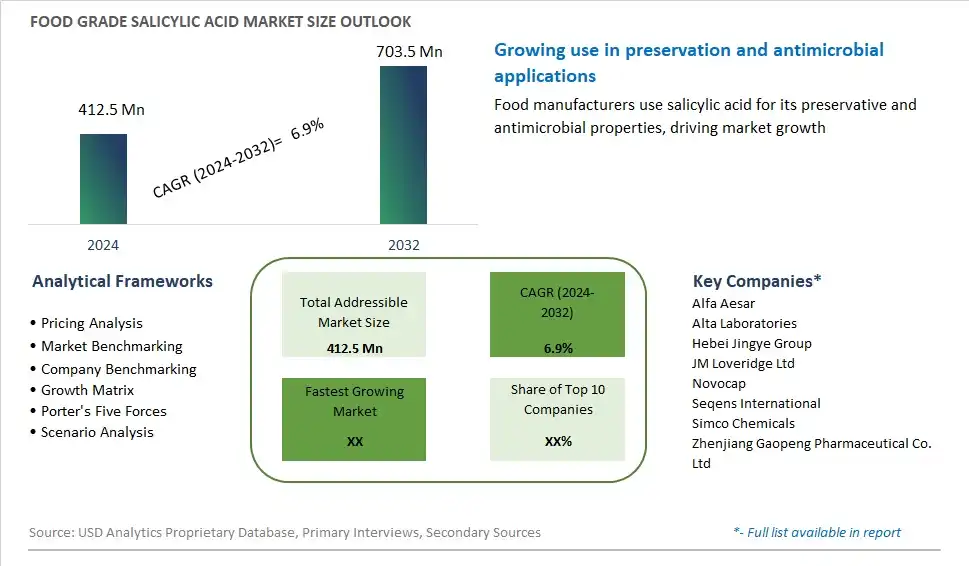
Global Food Grade Salicylic Acid Market Size is valued at $412.5 Million in 2024 and is forecast to register a growth rate (CAGR) of 6.9% to reach $703.5 Million by 2032.
The global Food Grade Salicylic Acid Market Comprehensive Study analyzes and forecasts the market size across 6 regions and 24 countries for diverse segments -By Type (Food Preservation, Flavor Enhancer), By End-User (Food and Beverage, Processed Food), By Packaging (Bulk Packaging, Consumer Packaging)
An Introduction to Food Grade Salicylic Acid Market
In 2024, the food grade salicylic acid market is expanding, driven by its crucial role as a preservative and food additive. Salicylic acid, a natural compound found in plants, is valued for its antimicrobial properties, which help extend the shelf life of food products. It is particularly effective in preserving fruits, vegetables, and beverages. The market is influenced by the growing demand for natural preservatives, as consumers increasingly prefer foods free from synthetic chemicals. Additionally, salicylic acid's application in enhancing the flavor and freshness of food products further boosts its demand. Regulatory approvals and the trend towards cleaner and safer food ingredients support its adoption. As the food industry prioritizes safety and quality, the use of food grade salicylic acid is set to increase, driving market growth and innovation.
Food Grade Salicylic Acid Competitive Landscape
The market report analyses the leading companies in the industry including Alfa Aesar, Alta Laboratories, Hebei Jingye Group, JM Loveridge Ltd, Novocap, Seqens International, Simco Chemicals, Zhenjiang Gaopeng Pharmaceutical Co. Ltd, and Others.
Food Grade Salicylic Acid Market Dynamics
Food Grade Salicylic Acid Market Trend: Growing Demand for Natural and Organic Food Preservation
A prominent trend in the food grade salicylic acid market is the growing demand for natural and organic food preservation solutions. As consumers become more health-conscious and seek products with minimal additives and preservatives, there's a rising interest in natural alternatives to traditional chemical preservatives. Salicylic acid, derived from natural sources such as willow bark and wintergreen leaves, is gaining traction as a food preservative for its antimicrobial properties and potential to extend shelf life without compromising food safety. This trend is driven by regulatory shifts towards cleaner label requirements, consumer preferences for clean label products, and the food industry's commitment to meeting evolving market demands. Manufacturers are exploring the use of food grade salicylic acid in various food and beverage applications, including sauces, dressings, and meat products, to offer consumers safer, more natural food options while ensuring product integrity and freshness.
Market Driver: Increasing Focus on Food Safety and Quality Assurance
An essential driver fueling the food grade salicylic acid market is the increasing focus on food safety and quality assurance. With foodborne illnesses and contamination incidents posing significant risks to public health and consumer confidence, there's a heightened awareness of the importance of effective food preservation methods and stringent quality control measures in the food industry. Salicylic acid, known for its broad-spectrum antimicrobial activity against bacteria, fungi, and yeasts, is recognized as a valuable tool for preventing microbial spoilage and extending the shelf life of perishable foods. The need to ensure product safety, meet regulatory standards, and maintain consumer trust is driving the adoption of food grade salicylic acid by food manufacturers seeking effective, science-based solutions for food preservation and quality assurance.
Market Opportunity: Expansion into Natural Food Additive and Functional Ingredient Markets
A significant opportunity within the food grade salicylic acid market lies in expanding into the natural food additive and functional ingredient markets. Beyond its role as a preservative, salicylic acid has the potential to add value to a range of food and beverage products as a functional ingredient with potential health benefits. For example, salicylic acid may be used in functional beverages, dietary supplements, and wellness products for its anti-inflammatory properties and potential to support immune function and skin health. Additionally, salicylic acid derivatives, such as methyl salicylate, have applications in flavoring agents, fragrances, and topical preparations, further expanding the market opportunities for food grade salicylic acid. By leveraging its natural origins, safety profile, and multifunctional properties, manufacturers can capitalize on the growing consumer demand for natural additives and functional ingredients that offer both functional and health benefits, driving market growth and differentiation in the competitive food industry landscape.
Food Grade Salicylic Acid Market Share Analysis: Food Preservation held the dominant market share in 2024
In the Food Grade Salicylic Acid Market, the Food Preservation segment is the largest, primarily due to the widespread use of salicylic acid as a preservative in food products. Salicylic acid's antimicrobial properties make it an effective agent for inhibiting the growth of bacteria, fungi, and yeasts, thereby extending the shelf life of various food items. It is commonly utilized in meat products, sauces, dressings, and canned goods to prevent spoilage and maintain freshness. Further, salicylic acid's role in food preservation aligns with consumers' preferences for minimally processed and safely preserved food options. Additionally, its regulatory approval for use in food products and its recognized efficacy as a preservative further reinforce its dominance in the Food Grade Salicylic Acid Market. With food safety and quality being paramount concerns for consumers and manufacturers alike, the Food Preservation segment continues to maintain its position as the largest in the market.
Food Grade Salicylic Acid Market Share Analysis: Processed Food market is poised to register the fastest growth rae over the forecast period to 2032
In the Food Grade Salicylic Acid Market, the Processed Food segment is the fastest-growing, driven by the increasing demand for preservative solutions to maintain product quality and extend shelf life in processed food items. Salicylic acid serves as a versatile preservative in a wide range of processed food products, including sauces, condiments, ready-to-eat meals, and snack foods, where it inhibits microbial growth and prevents spoilage. With the rising consumer preference for convenience foods and packaged meals, manufacturers are increasingly incorporating salicylic acid to ensure food safety, freshness, and stability throughout the distribution chain. Additionally, salicylic acid's compatibility with various food formulations and its efficacy in preserving product integrity contribute to its growing adoption in the processed food industry. Further, as regulations tighten around the use of traditional preservatives and consumers seek clean-label alternatives, the demand for salicylic acid as a natural preservative in processed foods is expected to surge, driving the rapid growth of the Processed Food segment in the Food Grade Salicylic Acid Market.
Food Grade Salicylic Acid Market Share Analysis: Bulk Packaging held the dominant market share in 2024
In the Food Grade Salicylic Acid Market, the Bulk Packaging segment is the largest, driven by the extensive use of salicylic acid in large-scale food production and manufacturing processes. Bulk packaging caters to the needs of food processing companies and manufacturers who require significant quantities of salicylic acid for various applications such as food preservation, flavor enhancement, and pharmaceutical formulations. Industries like meat processing, beverage manufacturing, and packaged food production rely heavily on bulk quantities of salicylic acid to meet their production demands efficiently and cost-effectively. Additionally, bulk packaging ensures convenient handling, storage, and transportation of salicylic acid for industrial applications, contributing to its widespread adoption in the food industry. Further, as food production volumes continue to rise to meet global demand, the Bulk Packaging segment maintains its dominance in the Food Grade Salicylic Acid Market.
Food Grade Salicylic Acid Market Segmentation
By Type
Food Preservation
Flavor Enhancer
By End-User
Food and Beverage
Processed Food
By Packaging
Bulk Packaging
Consumer Packaging
Countries Analyzed
North America (US, Canada, Mexico)
Europe (Germany, UK, France, Spain, Italy, Russia, Rest of Europe)
Asia Pacific (China, India, Japan, South Korea, Australia, South East Asia, Rest of Asia)
South America (Brazil, Argentina, Rest of South America)
Middle East and Africa (Saudi Arabia, UAE, Rest of Middle East, South Africa, Egypt, Rest of Africa)
Food Grade Salicylic Acid Companies Profiled in the Study
Alfa Aesar
Alta Laboratories
Hebei Jingye Group
JM Loveridge Ltd
Novocap
Seqens International
Simco Chemicals
Zhenjiang Gaopeng Pharmaceutical Co. Ltd
*- List Not Exhaustive
Chapter 1. TABLE OF CONTENTS
Chapter 2. Introduction to Food Grade Salicylic Acid Market
2.1. Market Overview
2.2. Key Statistics and Report Highlights
2.3. Scope of the Comprehensive Study
2.3.1. Market Definition
2.3.2 Countries and Regions Covered
2.3.3 Research Objective
2.3.4 Units, Currency, and Conversions
2.3.5 Industry Value Chain
2.4. Key Market Segments
2.5. Key Companies
2.6. Study Period
Chapter 3. Strategic Analysis Review
3.1. Food Grade Salicylic Acid Pricing Analysis and Forecast
3.2. Porter’s Five Forces
3.3. Market Ecosystem
3.4. SWOT Analysis
3.5. Regulatory Scenario
3.3. Effects of Inflation, Russia-Ukraine War, moderating economic growth, and other macroeconomic factors
Chapter 4. Competitive Landscape
4.1. Market Share Analysis
4.1.1. Global Food Grade Salicylic Acid Market Share by Company, 2023
4.1.2. Product Offerings of Leading Food Grade Salicylic Acid Companies
4.2. Market Entropy
4.2.1. New Product Launches in the Industry
4.2.2. Mergers, Acquisitions, Joint ventures, and Partnerships
4.3. Key Strategies and Best Practices
Chapter 5. Global Market Projections: Best, Reference, and Low Case Scenarios
5.1. Growth Analysis- Case Scenario Definitions
5.2. Low Growth Case Scenario Forecasts
5.3. Reference Growth Case Scenario Forecasts
5.4. High Growth Case Scenario Forecasts
Chapter 6. Market Dynamics
6.1. Food Grade Salicylic Acid Market Drivers
6.2. Food Grade Salicylic Acid Market Challenges
6.6. Food Grade Salicylic Acid Market Opportunities
6.4. Food Grade Salicylic Acid Market Trends
Chapter 7. Global Food Grade Salicylic Acid Market Outlook Trends
7.1. Global Food Grade Salicylic Acid Revenue (USD Million) and CAGR (%) by Type (2021-2032)
7.2. Global Food Grade Salicylic Acid Revenue (USD Million) and CAGR (%) by Application (2021-2032)
7.3. Global Food Grade Salicylic Acid Revenue (USD Million) and CAGR (%) by Product (2021-2032)
By Type
Food Preservation
Flavor Enhancer
By End-User
Food and Beverage
Processed Food
By Packaging
Bulk Packaging
Consumer Packaging
Chapter 8. Global Food Grade Salicylic Acid Regional Analysis and Outlook
8.1. Global Food Grade Salicylic Acid Revenue (USD Million) By Regions (2021- 2032)
8.2. North America Food Grade Salicylic Acid Revenue (USD Million) by Country (2021-2032)
8.2.1. United States Food Grade Salicylic Acid Regional Analysis and Outlook
8.2.2. Canada Food Grade Salicylic Acid Regional Analysis and Outlook
8.2.3. Mexico Food Grade Salicylic Acid Regional Analysis and Outlook
8.3. Europe Food Grade Salicylic Acid Revenue (USD Million), by Country (2021-2032)
8.3.1. Germany Food Grade Salicylic Acid Regional Analysis and Outlook
8.3.2. France Food Grade Salicylic Acid Regional Analysis and Outlook
8.3.3. United Kingdom Food Grade Salicylic Acid Regional Analysis and Outlook
8.3.4. Spain Food Grade Salicylic Acid Regional Analysis and Outlook
8.3.5. Italy Food Grade Salicylic Acid Regional Analysis and Outlook
8.3.6. Russia Food Grade Salicylic Acid Regional Analysis and Outlook
8.3.7. Rest of Europe Food Grade Salicylic Acid Regional Analysis and Outlook
8.4. Asia Pacific Food Grade Salicylic Acid Revenue (USD Million) by Country (2021-2032)
8.4.1. China Food Grade Salicylic Acid Regional Analysis and Outlook
8.4.2. Japan Food Grade Salicylic Acid Regional Analysis and Outlook
8.4.3. India Food Grade Salicylic Acid Regional Analysis and Outlook
8.4.4. South Korea Food Grade Salicylic Acid Regional Analysis and Outlook
8.4.5. Australia Food Grade Salicylic Acid Regional Analysis and Outlook
8.4.6. South East Asia Food Grade Salicylic Acid Regional Analysis and Outlook
8.4.7. Rest of Asia Pacific Food Grade Salicylic Acid Regional Analysis and Outlook
8.5. South America Food Grade Salicylic Acid Revenue (USD Million), by Country (2021-2032)
8.5.1. Brazil Food Grade Salicylic Acid Regional Analysis and Outlook
8.5.2. Argentina Food Grade Salicylic Acid Regional Analysis and Outlook
8.5.3. Rest of South America Food Grade Salicylic Acid Regional Analysis and Outlook
8.6. Middle East and Africa Food Grade Salicylic Acid Revenue (USD Million) by Country (2021-2032)
8.6.1. Middle East Food Grade Salicylic Acid Regional Analysis and Outlook
8.6.2. Africa Food Grade Salicylic Acid Regional Analysis and Outlook
Chapter 9. North America Food Grade Salicylic Acid Analysis and Outlook
9.1. North America Food Grade Salicylic Acid Revenue (USD Million) by Segments (2021-2032)
9.1.1. North America Food Grade Salicylic Acid Revenue (USD Million) by Type (2021-2032)
9.1.2. North America Food Grade Salicylic Acid Revenue (USD Million) by Application (2021-2032)
9.1.3. North America Food Grade Salicylic Acid Revenue (USD Million) by Product (2021-2032)
By Type
Food Preservation
Flavor Enhancer
By End-User
Food and Beverage
Processed Food
By Packaging
Bulk Packaging
Consumer Packaging
Chapter 10. Europe Food Grade Salicylic Acid Analysis and Outlook
10.1. Europe Food Grade Salicylic Acid Revenue (USD Million), by Segments (USD Million) (2021-2032)
10.1.1. Europe Food Grade Salicylic Acid Revenue (USD Million) by Type (2021-2032)
10.1.2. Europe Food Grade Salicylic Acid Revenue (USD Million) by Application (2021-2032)
10.1.3. Europe Food Grade Salicylic Acid Revenue (USD Million) by Product (2021-2032)
By Type
Food Preservation
Flavor Enhancer
By End-User
Food and Beverage
Processed Food
By Packaging
Bulk Packaging
Consumer Packaging
Chapter 11. Asia Pacific Food Grade Salicylic Acid Analysis and Outlook
11.1. Asia Pacific Food Grade Salicylic Acid Revenue (USD Million), and Revenue (USD Million) by Segments (2021-2032)
11.1.1. Asia Pacific Food Grade Salicylic Acid Revenue (USD Million) by Type (2021-2032)
11.1.2. Asia Pacific Food Grade Salicylic Acid Revenue (USD Million) by Application (2021-2032)
11.1.3. Asia Pacific Food Grade Salicylic Acid Revenue (USD Million) by Product (2021-2032)
By Type
Food Preservation
Flavor Enhancer
By End-User
Food and Beverage
Processed Food
By Packaging
Bulk Packaging
Consumer Packaging
Chapter 12. South America Food Grade Salicylic Acid Analysis and Outlook
12.1. South America Food Grade Salicylic Acid Revenue (USD Million), by Segments (2021-2032)
12.1.1. South America Food Grade Salicylic Acid Revenue (USD Million) by Type (2021-2032)
12.1.2. South America Food Grade Salicylic Acid Revenue (USD Million) by Application (2021-2032)
12.1.3. South America Food Grade Salicylic Acid Revenue (USD Million) by Product (2021-2032)
By Type
Food Preservation
Flavor Enhancer
By End-User
Food and Beverage
Processed Food
By Packaging
Bulk Packaging
Consumer Packaging
Chapter 13. Middle East and Africa Food Grade Salicylic Acid Analysis and Outlook
13.1. Middle East and Africa Food Grade Salicylic Acid Revenue (USD Million), by Segments (2021-2032)
13.1.1. Middle East and Africa Food Grade Salicylic Acid Revenue (USD Million) by Type (2021-2032)
13.1.2. Middle East and Africa Food Grade Salicylic Acid Revenue (USD Million) by Application (2021-2032)
13.1.3. Middle East and Africa Food Grade Salicylic Acid Revenue (USD Million) by Product (2021-2032)
By Type
Food Preservation
Flavor Enhancer
By End-User
Food and Beverage
Processed Food
By Packaging
Bulk Packaging
Consumer Packaging
Chapter 14. Food Grade Salicylic Acid Company Profiles
14.1 Business Overview
14.2 Product Profiles
14.3 SWOT Profiles
14.5 Recent Developments
14.6 Financial Profile
List of Companies
Alfa Aesar
Alta Laboratories
Hebei Jingye Group
JM Loveridge Ltd
Novocap
Seqens International
Simco Chemicals
Zhenjiang Gaopeng Pharmaceutical Co. Ltd
15. Methodology and Data Sources
15.1 Customization Offerings
15.2 Subscription Services
15.3 Related Reports
15.4 Publisher Expertise
LIST OF TABLES
Table 1 Market Segmentation Analysis
Table 2 Global Food Grade Salicylic Acid Market Share of Leading Companies, 2023
Table 3 Product Offerings of Leading Companies
Table 4 Low Growth Scenario Forecasts
Table 5 Reference Case Growth Scenario
Table 6 High Growth Case Scenario
Table 7 Global Food Grade Salicylic Acid Revenue (USD Million) And CAGR (%) By Type (2021-2032)
Table 8 Global Food Grade Salicylic Acid Revenue (USD Million) And CAGR (%) By Application (2021-2032)
Table 9 Global Food Grade Salicylic Acid Revenue (USD Million) And CAGR (%) By Product (2021-2032)
Table 10 Global Food Grade Salicylic Acid Market Revenue (USD Million) By Regions (2021-2032)
Table 11 Global Food Grade Salicylic Acid Market Share (%) By Regions (2021-2032)
Table 12 North America Food Grade Salicylic Acid Revenue (USD Million) By Country (2021-2032)
Table 13 Europe Food Grade Salicylic Acid Revenue (USD Million) By Country (2021-2032)
Table 14 Asia Pacific Food Grade Salicylic Acid Revenue (USD Million) By Country (2021-2032)
Table 15 South America Food Grade Salicylic Acid Revenue (USD Million) By Country (2021-2032)
Table 16 Middle East and Africa Food Grade Salicylic Acid Revenue (USD Million) By Region (2021-2032)
Table 17 North America Food Grade Salicylic Acid Revenue (USD Million) By Type (2021-2032)
Table 18 North America Food Grade Salicylic Acid Revenue (USD Million) By Application (2021-2032)
Table 19 North America Food Grade Salicylic Acid Revenue (USD Million) By Product (2021-2032)
Table 20 Europe Food Grade Salicylic Acid Revenue (USD Million) By Type (2021-2032)
Table 21 Europe Food Grade Salicylic Acid Revenue (USD Million) By Application (2021-2032)
Table 22 Europe Food Grade Salicylic Acid Revenue (USD Million) By Product (2021-2032)
Table 23 Asia Pacific Food Grade Salicylic Acid Revenue (USD Million) By Type (2021-2032)
Table 24 Asia Pacific Food Grade Salicylic Acid Revenue (USD Million) By Application (2021-2032)
Table 25 Asia Pacific Food Grade Salicylic Acid Revenue (USD Million) By Product (2021-2032)
Table 26 South America Food Grade Salicylic Acid Revenue (USD Million) By Type (2021-2032)
Table 27 South America Food Grade Salicylic Acid Revenue (USD Million) By Application (2021-2032)
Table 28 South America Food Grade Salicylic Acid Revenue (USD Million) By Product (2021-2032)
Table 29 Middle East and Africa Food Grade Salicylic Acid Revenue (USD Million) By Type (2021-2032)
Table 30 Middle East and Africa Food Grade Salicylic Acid Revenue (USD Million) By Application (2021-2032)
Table 31 Middle East and Africa Food Grade Salicylic Acid Revenue (USD Million) By Product (2021-2032)
LIST OF FIGURES
Figure 1. Market Scope
Figure 2. Pricing Forecasts Per Unit, 2023- 2032
Figure 3. Porter’s Five Forces
Figure 4. Global Food Grade Salicylic Acid Market Revenue (USD Million) By Regions (2021-2032)
Figure 5. Global Food Grade Salicylic Acid Market Share (%) By Regions (2023)
Figure 6. North America Food Grade Salicylic Acid Revenue (USD Million) By Country (2021-2032)
Figure 7. United States Food Grade Salicylic Acid Revenue (USD Million) By Country (2021-2032)
Figure 8. Canada Food Grade Salicylic Acid Revenue (USD Million) By Country (2021-2032)
Figure 9. Mexico Food Grade Salicylic Acid Revenue (USD Million) By Country (2021-2032)
Figure 10. Europe Food Grade Salicylic Acid Revenue (USD Million) By Country (2021-2032)
Figure 11. Germany Food Grade Salicylic Acid Revenue (USD Million) By Country (2021-2032)
Figure 12. France Food Grade Salicylic Acid Revenue (USD Million) By Country (2021-2032)
Figure 13. United Kingdom Food Grade Salicylic Acid Revenue (USD Million) By Country (2021-2032)
Figure 14. Spain Food Grade Salicylic Acid Revenue (USD Million) By Country (2021-2032)
Figure 15. Italy Food Grade Salicylic Acid Revenue (USD Million) By Country (2021-2032)
Figure 16. Russia Food Grade Salicylic Acid Revenue (USD Million) By Country (2021-2032)
Figure 17. Rest of Europe Food Grade Salicylic Acid Revenue (USD Million) By Country (2021-2032)
Figure 11. Asia Pacific Food Grade Salicylic Acid Revenue (USD Million) By Country (2021-2032)
Figure 12. China Food Grade Salicylic Acid Revenue (USD Million) By Country (2021-2032)
Figure 13. Japan Food Grade Salicylic Acid Revenue (USD Million) By Country (2021-2032)
Figure 14. India Food Grade Salicylic Acid Revenue (USD Million) By Country (2021-2032)
Figure 15. South Korea Food Grade Salicylic Acid Revenue (USD Million) By Country (2021-2032)
Figure 16. Australia Food Grade Salicylic Acid Revenue (USD Million) By Country (2021-2032)
Figure 17. South East Asia Food Grade Salicylic Acid Revenue (USD Million) By Country (2021-2032)
Figure 18. South America Food Grade Salicylic Acid Revenue (USD Million) By Country (2021-2032)
Figure 19. Brazil Food Grade Salicylic Acid Revenue (USD Million) By Country (2021-2032)
Figure 20. Argentina Food Grade Salicylic Acid Revenue (USD Million) By Country (2021-2032)
Figure 21. Rest of Asia Pacific Food Grade Salicylic Acid Revenue (USD Million) By Country (2021-2032)
Figure 22. Middle East and Africa Food Grade Salicylic Acid Revenue (USD Million) By Region (2021-2032)
Figure 23. Saudi Arabia Food Grade Salicylic Acid Revenue (USD Million) By Region (2021-2032)
Figure 24. The UAE Food Grade Salicylic Acid Revenue (USD Million) By Region (2021-2032)
Figure 25. Rest of Middle East Food Grade Salicylic Acid Revenue (USD Million) By Region (2021-2032)
Figure 26. South Africa Food Grade Salicylic Acid Revenue (USD Million) By Region (2021-2032)
Figure 27. Africa Food Grade Salicylic Acid Revenue (USD Million) By Region (2021-2032)
Figure 28. North America Food Grade Salicylic Acid Revenue (USD Million) By Type (2021-2032)
Figure 29. North America Food Grade Salicylic Acid Revenue (USD Million) By Application (2021-2032)
Figure 30. North America Food Grade Salicylic Acid Revenue (USD Million) By Product (2021-2032)
Figure 31. Europe Food Grade Salicylic Acid Revenue (USD Million) By Type (2021-2032)
Figure 32. Europe Food Grade Salicylic Acid Revenue (USD Million) By Application (2021-2032)
Figure 33. Europe Food Grade Salicylic Acid Revenue (USD Million) By Product (2021-2032)
Figure 34. Asia Pacific Food Grade Salicylic Acid Revenue (USD Million) By Type (2021-2032)
Figure 35. Asia Pacific Food Grade Salicylic Acid Revenue (USD Million) By Application (2021-2032)
Figure 36. Asia Pacific Food Grade Salicylic Acid Revenue (USD Million) By Product (2021-2032)
Figure 37. South America Food Grade Salicylic Acid Revenue (USD Million) By Type (2021-2032)
Figure 38. South America Food Grade Salicylic Acid Revenue (USD Million) By Application (2021-2032)
Figure 39. South America Food Grade Salicylic Acid Revenue (USD Million) By Product (2021-2032)
Figure 40. Middle East and Africa Food Grade Salicylic Acid Revenue (USD Million) By Type (2021-2032)
Figure 41. Middle East and Africa Food Grade Salicylic Acid Revenue (USD Million) By Application (2021-2032)
Figure 42. Middle East and Africa Food Grade Salicylic Acid Revenue (USD Million) By Product (2021-2032)
By Type
Food Preservation
Flavor Enhancer
By End-User
Food and Beverage
Processed Food
By Packaging
Bulk Packaging
Consumer Packaging
Countries Analyzed
North America (US, Canada, Mexico)
Europe (Germany, UK, France, Spain, Italy, Russia, Rest of Europe)
Asia Pacific (China, India, Japan, South Korea, Australia, South East Asia, Rest of Asia)
South America (Brazil, Argentina, Rest of South America)
Middle East and Africa (Saudi Arabia, UAE, Rest of Middle East, South Africa, Egypt, Rest of Africa)
