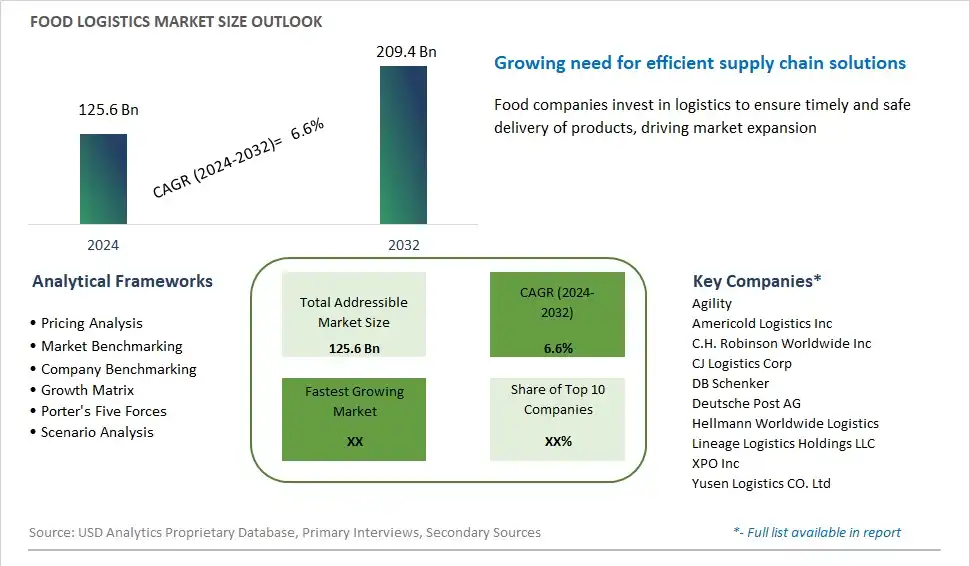
Global Food Logistics Market Size is valued at $125.6 Billion in 2024 and is forecast to register a growth rate (CAGR) of 6.6% to reach $209.4 Billion by 2032.
The global Food Logistics Market Comprehensive Study analyzes and forecasts the market size across 6 regions and 24 countries for diverse segments -By Business (Warehouse, Distribution, Value added services), By Mode of Operation (Storage, Roadways, Seaways, Others), By Product (Fish, Shellfish, Meat, Vegetables, Fruits, Nuts, Cereals, Bakery and Dairy Products, Coffee, Tea, Vegetable Oil, Others), By Service (Cold Chain, Non-Cold Chain)
An Introduction to Food Logistics Market
In 2024, the food logistics market is experiencing substantial growth, driven by the increasing complexity and demands of the global food supply chain. Food logistics encompasses the transportation, storage, and distribution of food products, ensuring they reach consumers in a safe and timely manner. Advanced technologies such as IoT, AI, and blockchain are being leveraged to enhance supply chain transparency, optimize routes, and ensure the freshness and quality of food products during transit. The market is also witnessing a shift towards sustainable logistics practices, including the use of electric vehicles and eco-friendly packaging. The COVID-19 pandemic has further highlighted the importance of robust food logistics systems to meet the surging demand for home delivery and online grocery services. As consumer expectations for fast and reliable food delivery grow, the food logistics market is poised for continued expansion and innovation.
Food Logistics Competitive Landscape
The market report analyses the leading companies in the industry including Agility, Americold Logistics Inc, C.H. Robinson Worldwide Inc, CJ Logistics Corp, DB Schenker, Deutsche Post AG, Hellmann Worldwide Logistics, Lineage Logistics Holdings LLC, XPO Inc, Yusen Logistics CO. Ltd, and Others.
Food Logistics Market Dynamics
Food Logistics Market Trend: Adoption of Technology for Supply Chain Optimization
A prominent trend in the food logistics market is the increasing adoption of technology for supply chain optimization. With the rising complexity of global food supply chains and growing consumer expectations for transparency and efficiency, there's a greater reliance on digital solutions to streamline logistics operations, track product movements, and ensure food safety and quality. Technologies such as blockchain, IoT (Internet of Things), and AI (Artificial Intelligence) are being leveraged to improve visibility, traceability, and real-time monitoring of food shipments from farm to fork. This trend is driven by the need for greater transparency and accountability in food supply chains, regulatory requirements for traceability and food safety compliance, and the desire to reduce waste and inefficiencies in logistics operations. As the adoption of technology-enabled solutions continues to grow, food logistics providers are investing in digital transformation initiatives to enhance agility, responsiveness, and resilience in the face of evolving market dynamics and consumer demands.
Market Driver: Growth in E-commerce and Direct-to-Consumer Channels
An essential driver fueling the food logistics market is the growth in e-commerce and direct-to-consumer (DTC) channels for food distribution. With the proliferation of online grocery shopping platforms, meal kit delivery services, and DTC brands, there's a shifting landscape in food retailing towards digital channels and personalized shopping experiences. This shift is reshaping logistics requirements, driving the need for flexible, scalable, and efficient distribution solutions to meet the demands of online shoppers for fast delivery, product freshness, and order customization. The convenience and accessibility offered by e-commerce and DTC channels are driving consumer preferences for online food purchases, fueling the demand for specialized logistics services tailored to the unique requirements of perishable food items. As e-commerce penetration rates continue to rise, especially in urban areas, food logistics providers are adapting their strategies and investing in infrastructure, technology, and last-mile delivery capabilities to capitalize on the opportunities presented by the digitalization of food retailing and distribution.
Market Opportunity: Development of Cold Chain Infrastructure and Temperature-Controlled Logistics
A significant opportunity within the food logistics market lies in the development of cold chain infrastructure and temperature-controlled logistics capabilities. As the demand for perishable food items such as fresh produce, dairy products, and frozen foods grows, there's a growing need for specialized storage, handling, and transportation solutions to maintain product quality and safety throughout the supply chain. Cold chain logistics, which involves the transportation of temperature-sensitive goods within a controlled temperature environment, is critical for preserving the freshness, nutritional value, and shelf life of perishable foods from production to consumption. The expansion of cold chain infrastructure, including refrigerated warehouses, transport vehicles, and distribution hubs, presents opportunities for investment and partnership in the food logistics sector. By offering end-to-end cold chain solutions and value-added services such as temperature monitoring, quality assurance, and regulatory compliance, food logistics providers can meet the evolving needs of food manufacturers, retailers, and consumers for safe, reliable, and efficient transportation of perishable food products, thereby unlocking new avenues for growth and differentiation in the competitive marketplace.
Food Logistics Market Share Analysis: Warehouse held the dominant market share in 2024
In the Food Logistics Market, the Warehouse segment is the largest, driven by its pivotal role in the food supply chain. Warehouses serve as crucial hubs for storing, sorting, and managing food products before they are distributed to retailers or directly to consumers. With the increasing demand for efficiency and speed in food distribution, warehouses play a vital role in ensuring timely delivery and minimizing product spoilage or damage. Further, the rise of e-commerce and online grocery platforms has further amplified the importance of warehouses in fulfilling orders and managing inventory effectively. Additionally, warehouses often offer value-added services such as temperature-controlled storage, inventory tracking, and order fulfillment, catering to the diverse needs of food manufacturers, distributors, and retailers. As the food industry continues to evolve and adapt to changing consumer preferences and market dynamics, the Warehouse segment remains the cornerstone of the Food Logistics Market.
Food Logistics Market Share Analysis: Roadways market is poised to register the fastest growth rae over the forecast period to 2032
In the Food Logistics Market, the Roadways segment is the fastest-growing, propelled by its flexibility, reliability, and efficiency in transporting food products across short to medium distances. Road transportation offers numerous advantages, including door-to-door delivery, accessibility to remote areas, and the ability to navigate diverse terrain and weather conditions. Additionally, the growth of urbanization and changing consumer behaviors, such as increased demand for fresh and perishable goods, drive the need for agile and responsive logistics solutions provided by road transport. Further, advancements in technology, such as GPS tracking and route optimization software, further enhance the efficiency and safety of road transportation, making it an attractive option for food manufacturers and distributors. With the increasing emphasis on speed, flexibility, and sustainability in food logistics, the Roadways segment is poised for rapid growth in the Food Logistics Market.
Food Logistics Market Share Analysis: Vegetables and Fruits held the dominant market share in 2024
In the Food Logistics Market, the Vegetables and Fruits segment is the largest, driven by the high volume and perishable nature of these commodities. Vegetables and fruits require careful handling, temperature control, and timely delivery to maintain their freshness and quality throughout the supply chain. Due to their short shelf life, efficient logistics solutions are essential to minimize spoilage and ensure that these products reach consumers in optimal condition. Further, the increasing consumer demand for fresh produce, coupled with the rise of online grocery shopping and home delivery services, further amplifies the importance of efficient logistics operations for vegetables and fruits. Additionally, the global trade of fresh produce necessitates sophisticated logistics networks to transport these items across long distances while preserving their quality. With the continuous growth in consumer demand for fresh and nutritious foods, the Vegetables and Fruits segment remains the largest in the Food Logistics Market.
Food Logistics Market Segmentation
By Business
Warehouse
Distribution
Value added services
By Mode of Operation
Storage
Roadways
Seaways
Others
By Product
Fish
Shellfish
Meat
Vegetables
Fruits
Nuts
Cereals
Bakery and Dairy Products
Coffee
Tea
Vegetable Oil
Others
By Service
Cold Chain
Non-Cold Chain
Countries Analyzed
North America (US, Canada, Mexico)
Europe (Germany, UK, France, Spain, Italy, Russia, Rest of Europe)
Asia Pacific (China, India, Japan, South Korea, Australia, South East Asia, Rest of Asia)
South America (Brazil, Argentina, Rest of South America)
Middle East and Africa (Saudi Arabia, UAE, Rest of Middle East, South Africa, Egypt, Rest of Africa)
Food Logistics Companies Profiled in the Study
Agility
Americold Logistics Inc
C.H. Robinson Worldwide Inc
CJ Logistics Corp
DB Schenker
Deutsche Post AG
Hellmann Worldwide Logistics
Lineage Logistics Holdings LLC
XPO Inc
Yusen Logistics CO. Ltd
*- List Not Exhaustive
Chapter 1. TABLE OF CONTENTS
Chapter 2. Introduction to Food Logistics Market
2.1. Market Overview
2.2. Key Statistics and Report Highlights
2.3. Scope of the Comprehensive Study
2.3.1. Market Definition
2.3.2 Countries and Regions Covered
2.3.3 Research Objective
2.3.4 Units, Currency, and Conversions
2.3.5 Industry Value Chain
2.4. Key Market Segments
2.5. Key Companies
2.6. Study Period
Chapter 3. Strategic Analysis Review
3.1. Food Logistics Pricing Analysis and Forecast
3.2. Porter’s Five Forces
3.3. Market Ecosystem
3.4. SWOT Analysis
3.5. Regulatory Scenario
3.3. Effects of Inflation, Russia-Ukraine War, moderating economic growth, and other macroeconomic factors
Chapter 4. Competitive Landscape
4.1. Market Share Analysis
4.1.1. Global Food Logistics Market Share by Company, 2023
4.1.2. Product Offerings of Leading Food Logistics Companies
4.2. Market Entropy
4.2.1. New Product Launches in the Industry
4.2.2. Mergers, Acquisitions, Joint ventures, and Partnerships
4.3. Key Strategies and Best Practices
Chapter 5. Global Market Projections: Best, Reference, and Low Case Scenarios
5.1. Growth Analysis- Case Scenario Definitions
5.2. Low Growth Case Scenario Forecasts
5.3. Reference Growth Case Scenario Forecasts
5.4. High Growth Case Scenario Forecasts
Chapter 6. Market Dynamics
6.1. Food Logistics Market Drivers
6.2. Food Logistics Market Challenges
6.6. Food Logistics Market Opportunities
6.4. Food Logistics Market Trends
Chapter 7. Global Food Logistics Market Outlook Trends
7.1. Global Food Logistics Revenue (USD Million) and CAGR (%) by Type (2021-2032)
7.2. Global Food Logistics Revenue (USD Million) and CAGR (%) by Application (2021-2032)
7.3. Global Food Logistics Revenue (USD Million) and CAGR (%) by Product (2021-2032)
By Business
Warehouse
Distribution
Value added services
By Mode of Operation
Storage
Roadways
Seaways
Others
By Product
Fish
Shellfish
Meat
Vegetables
Fruits
Nuts
Cereals
Bakery and Dairy Products
Coffee
Tea
Vegetable Oil
Others
By Service
Cold Chain
Non-Cold Chain
Chapter 8. Global Food Logistics Regional Analysis and Outlook
8.1. Global Food Logistics Revenue (USD Million) By Regions (2021- 2032)
8.2. North America Food Logistics Revenue (USD Million) by Country (2021-2032)
8.2.1. United States Food Logistics Regional Analysis and Outlook
8.2.2. Canada Food Logistics Regional Analysis and Outlook
8.2.3. Mexico Food Logistics Regional Analysis and Outlook
8.3. Europe Food Logistics Revenue (USD Million), by Country (2021-2032)
8.3.1. Germany Food Logistics Regional Analysis and Outlook
8.3.2. France Food Logistics Regional Analysis and Outlook
8.3.3. United Kingdom Food Logistics Regional Analysis and Outlook
8.3.4. Spain Food Logistics Regional Analysis and Outlook
8.3.5. Italy Food Logistics Regional Analysis and Outlook
8.3.6. Russia Food Logistics Regional Analysis and Outlook
8.3.7. Rest of Europe Food Logistics Regional Analysis and Outlook
8.4. Asia Pacific Food Logistics Revenue (USD Million) by Country (2021-2032)
8.4.1. China Food Logistics Regional Analysis and Outlook
8.4.2. Japan Food Logistics Regional Analysis and Outlook
8.4.3. India Food Logistics Regional Analysis and Outlook
8.4.4. South Korea Food Logistics Regional Analysis and Outlook
8.4.5. Australia Food Logistics Regional Analysis and Outlook
8.4.6. South East Asia Food Logistics Regional Analysis and Outlook
8.4.7. Rest of Asia Pacific Food Logistics Regional Analysis and Outlook
8.5. South America Food Logistics Revenue (USD Million), by Country (2021-2032)
8.5.1. Brazil Food Logistics Regional Analysis and Outlook
8.5.2. Argentina Food Logistics Regional Analysis and Outlook
8.5.3. Rest of South America Food Logistics Regional Analysis and Outlook
8.6. Middle East and Africa Food Logistics Revenue (USD Million) by Country (2021-2032)
8.6.1. Middle East Food Logistics Regional Analysis and Outlook
8.6.2. Africa Food Logistics Regional Analysis and Outlook
Chapter 9. North America Food Logistics Analysis and Outlook
9.1. North America Food Logistics Revenue (USD Million) by Segments (2021-2032)
9.1.1. North America Food Logistics Revenue (USD Million) by Type (2021-2032)
9.1.2. North America Food Logistics Revenue (USD Million) by Application (2021-2032)
9.1.3. North America Food Logistics Revenue (USD Million) by Product (2021-2032)
By Business
Warehouse
Distribution
Value added services
By Mode of Operation
Storage
Roadways
Seaways
Others
By Product
Fish
Shellfish
Meat
Vegetables
Fruits
Nuts
Cereals
Bakery and Dairy Products
Coffee
Tea
Vegetable Oil
Others
By Service
Cold Chain
Non-Cold Chain
Chapter 10. Europe Food Logistics Analysis and Outlook
10.1. Europe Food Logistics Revenue (USD Million), by Segments (USD Million) (2021-2032)
10.1.1. Europe Food Logistics Revenue (USD Million) by Type (2021-2032)
10.1.2. Europe Food Logistics Revenue (USD Million) by Application (2021-2032)
10.1.3. Europe Food Logistics Revenue (USD Million) by Product (2021-2032)
By Business
Warehouse
Distribution
Value added services
By Mode of Operation
Storage
Roadways
Seaways
Others
By Product
Fish
Shellfish
Meat
Vegetables
Fruits
Nuts
Cereals
Bakery and Dairy Products
Coffee
Tea
Vegetable Oil
Others
By Service
Cold Chain
Non-Cold Chain
Chapter 11. Asia Pacific Food Logistics Analysis and Outlook
11.1. Asia Pacific Food Logistics Revenue (USD Million), and Revenue (USD Million) by Segments (2021-2032)
11.1.1. Asia Pacific Food Logistics Revenue (USD Million) by Type (2021-2032)
11.1.2. Asia Pacific Food Logistics Revenue (USD Million) by Application (2021-2032)
11.1.3. Asia Pacific Food Logistics Revenue (USD Million) by Product (2021-2032)
By Business
Warehouse
Distribution
Value added services
By Mode of Operation
Storage
Roadways
Seaways
Others
By Product
Fish
Shellfish
Meat
Vegetables
Fruits
Nuts
Cereals
Bakery and Dairy Products
Coffee
Tea
Vegetable Oil
Others
By Service
Cold Chain
Non-Cold Chain
Chapter 12. South America Food Logistics Analysis and Outlook
12.1. South America Food Logistics Revenue (USD Million), by Segments (2021-2032)
12.1.1. South America Food Logistics Revenue (USD Million) by Type (2021-2032)
12.1.2. South America Food Logistics Revenue (USD Million) by Application (2021-2032)
12.1.3. South America Food Logistics Revenue (USD Million) by Product (2021-2032)
By Business
Warehouse
Distribution
Value added services
By Mode of Operation
Storage
Roadways
Seaways
Others
By Product
Fish
Shellfish
Meat
Vegetables
Fruits
Nuts
Cereals
Bakery and Dairy Products
Coffee
Tea
Vegetable Oil
Others
By Service
Cold Chain
Non-Cold Chain
Chapter 13. Middle East and Africa Food Logistics Analysis and Outlook
13.1. Middle East and Africa Food Logistics Revenue (USD Million), by Segments (2021-2032)
13.1.1. Middle East and Africa Food Logistics Revenue (USD Million) by Type (2021-2032)
13.1.2. Middle East and Africa Food Logistics Revenue (USD Million) by Application (2021-2032)
13.1.3. Middle East and Africa Food Logistics Revenue (USD Million) by Product (2021-2032)
By Business
Warehouse
Distribution
Value added services
By Mode of Operation
Storage
Roadways
Seaways
Others
By Product
Fish
Shellfish
Meat
Vegetables
Fruits
Nuts
Cereals
Bakery and Dairy Products
Coffee
Tea
Vegetable Oil
Others
By Service
Cold Chain
Non-Cold Chain
Chapter 14. Food Logistics Company Profiles
14.1 Business Overview
14.2 Product Profiles
14.3 SWOT Profiles
14.5 Recent Developments
14.6 Financial Profile
List of Companies
Agility
Americold Logistics Inc
C.H. Robinson Worldwide Inc
CJ Logistics Corp
DB Schenker
Deutsche Post AG
Hellmann Worldwide Logistics
Lineage Logistics Holdings LLC
XPO Inc
Yusen Logistics CO. Ltd
15. Methodology and Data Sources
15.1 Customization Offerings
15.2 Subscription Services
15.3 Related Reports
15.4 Publisher Expertise
LIST OF TABLES
Table 1 Market Segmentation Analysis
Table 2 Global Food Logistics Market Share of Leading Companies, 2023
Table 3 Product Offerings of Leading Companies
Table 4 Low Growth Scenario Forecasts
Table 5 Reference Case Growth Scenario
Table 6 High Growth Case Scenario
Table 7 Global Food Logistics Revenue (USD Million) And CAGR (%) By Type (2021-2032)
Table 8 Global Food Logistics Revenue (USD Million) And CAGR (%) By Application (2021-2032)
Table 9 Global Food Logistics Revenue (USD Million) And CAGR (%) By Product (2021-2032)
Table 10 Global Food Logistics Market Revenue (USD Million) By Regions (2021-2032)
Table 11 Global Food Logistics Market Share (%) By Regions (2021-2032)
Table 12 North America Food Logistics Revenue (USD Million) By Country (2021-2032)
Table 13 Europe Food Logistics Revenue (USD Million) By Country (2021-2032)
Table 14 Asia Pacific Food Logistics Revenue (USD Million) By Country (2021-2032)
Table 15 South America Food Logistics Revenue (USD Million) By Country (2021-2032)
Table 16 Middle East and Africa Food Logistics Revenue (USD Million) By Region (2021-2032)
Table 17 North America Food Logistics Revenue (USD Million) By Type (2021-2032)
Table 18 North America Food Logistics Revenue (USD Million) By Application (2021-2032)
Table 19 North America Food Logistics Revenue (USD Million) By Product (2021-2032)
Table 20 Europe Food Logistics Revenue (USD Million) By Type (2021-2032)
Table 21 Europe Food Logistics Revenue (USD Million) By Application (2021-2032)
Table 22 Europe Food Logistics Revenue (USD Million) By Product (2021-2032)
Table 23 Asia Pacific Food Logistics Revenue (USD Million) By Type (2021-2032)
Table 24 Asia Pacific Food Logistics Revenue (USD Million) By Application (2021-2032)
Table 25 Asia Pacific Food Logistics Revenue (USD Million) By Product (2021-2032)
Table 26 South America Food Logistics Revenue (USD Million) By Type (2021-2032)
Table 27 South America Food Logistics Revenue (USD Million) By Application (2021-2032)
Table 28 South America Food Logistics Revenue (USD Million) By Product (2021-2032)
Table 29 Middle East and Africa Food Logistics Revenue (USD Million) By Type (2021-2032)
Table 30 Middle East and Africa Food Logistics Revenue (USD Million) By Application (2021-2032)
Table 31 Middle East and Africa Food Logistics Revenue (USD Million) By Product (2021-2032)
LIST OF FIGURES
Figure 1. Market Scope
Figure 2. Pricing Forecasts Per Unit, 2023- 2032
Figure 3. Porter’s Five Forces
Figure 4. Global Food Logistics Market Revenue (USD Million) By Regions (2021-2032)
Figure 5. Global Food Logistics Market Share (%) By Regions (2023)
Figure 6. North America Food Logistics Revenue (USD Million) By Country (2021-2032)
Figure 7. United States Food Logistics Revenue (USD Million) By Country (2021-2032)
Figure 8. Canada Food Logistics Revenue (USD Million) By Country (2021-2032)
Figure 9. Mexico Food Logistics Revenue (USD Million) By Country (2021-2032)
Figure 10. Europe Food Logistics Revenue (USD Million) By Country (2021-2032)
Figure 11. Germany Food Logistics Revenue (USD Million) By Country (2021-2032)
Figure 12. France Food Logistics Revenue (USD Million) By Country (2021-2032)
Figure 13. United Kingdom Food Logistics Revenue (USD Million) By Country (2021-2032)
Figure 14. Spain Food Logistics Revenue (USD Million) By Country (2021-2032)
Figure 15. Italy Food Logistics Revenue (USD Million) By Country (2021-2032)
Figure 16. Russia Food Logistics Revenue (USD Million) By Country (2021-2032)
Figure 17. Rest of Europe Food Logistics Revenue (USD Million) By Country (2021-2032)
Figure 11. Asia Pacific Food Logistics Revenue (USD Million) By Country (2021-2032)
Figure 12. China Food Logistics Revenue (USD Million) By Country (2021-2032)
Figure 13. Japan Food Logistics Revenue (USD Million) By Country (2021-2032)
Figure 14. India Food Logistics Revenue (USD Million) By Country (2021-2032)
Figure 15. South Korea Food Logistics Revenue (USD Million) By Country (2021-2032)
Figure 16. Australia Food Logistics Revenue (USD Million) By Country (2021-2032)
Figure 17. South East Asia Food Logistics Revenue (USD Million) By Country (2021-2032)
Figure 18. South America Food Logistics Revenue (USD Million) By Country (2021-2032)
Figure 19. Brazil Food Logistics Revenue (USD Million) By Country (2021-2032)
Figure 20. Argentina Food Logistics Revenue (USD Million) By Country (2021-2032)
Figure 21. Rest of Asia Pacific Food Logistics Revenue (USD Million) By Country (2021-2032)
Figure 22. Middle East and Africa Food Logistics Revenue (USD Million) By Region (2021-2032)
Figure 23. Saudi Arabia Food Logistics Revenue (USD Million) By Region (2021-2032)
Figure 24. The UAE Food Logistics Revenue (USD Million) By Region (2021-2032)
Figure 25. Rest of Middle East Food Logistics Revenue (USD Million) By Region (2021-2032)
Figure 26. South Africa Food Logistics Revenue (USD Million) By Region (2021-2032)
Figure 27. Africa Food Logistics Revenue (USD Million) By Region (2021-2032)
Figure 28. North America Food Logistics Revenue (USD Million) By Type (2021-2032)
Figure 29. North America Food Logistics Revenue (USD Million) By Application (2021-2032)
Figure 30. North America Food Logistics Revenue (USD Million) By Product (2021-2032)
Figure 31. Europe Food Logistics Revenue (USD Million) By Type (2021-2032)
Figure 32. Europe Food Logistics Revenue (USD Million) By Application (2021-2032)
Figure 33. Europe Food Logistics Revenue (USD Million) By Product (2021-2032)
Figure 34. Asia Pacific Food Logistics Revenue (USD Million) By Type (2021-2032)
Figure 35. Asia Pacific Food Logistics Revenue (USD Million) By Application (2021-2032)
Figure 36. Asia Pacific Food Logistics Revenue (USD Million) By Product (2021-2032)
Figure 37. South America Food Logistics Revenue (USD Million) By Type (2021-2032)
Figure 38. South America Food Logistics Revenue (USD Million) By Application (2021-2032)
Figure 39. South America Food Logistics Revenue (USD Million) By Product (2021-2032)
Figure 40. Middle East and Africa Food Logistics Revenue (USD Million) By Type (2021-2032)
Figure 41. Middle East and Africa Food Logistics Revenue (USD Million) By Application (2021-2032)
Figure 42. Middle East and Africa Food Logistics Revenue (USD Million) By Product (2021-2032)
By Business
Warehouse
Distribution
Value added services
By Mode of Operation
Storage
Roadways
Seaways
Others
By Product
Fish
Shellfish
Meat
Vegetables
Fruits
Nuts
Cereals
Bakery and Dairy Products
Coffee
Tea
Vegetable Oil
Others
By Service
Cold Chain
Non-Cold Chain
Countries Analyzed
North America (US, Canada, Mexico)
Europe (Germany, UK, France, Spain, Italy, Russia, Rest of Europe)
Asia Pacific (China, India, Japan, South Korea, Australia, South East Asia, Rest of Asia)
South America (Brazil, Argentina, Rest of South America)
Middle East and Africa (Saudi Arabia, UAE, Rest of Middle East, South Africa, Egypt, Rest of Africa)
