
The global Forage Harvester Market study analyzes and forecasts the market size across 6 regions and 24 countries for diverse segments including By Type (Pull-Type Forage Harvester, Self-Propelled Forage Harvester), By Application (Feed Mill, Farms, Others).
The Forage Harvester Market is experiencing notable growth and technological advancement in 2024, driven by the increasing demand for efficient, high-capacity equipment in agricultural harvesting and biomass processing operations. Forage harvesters, also known as silage harvesters or choppers, are specialized agricultural machines used to harvest and process various crops such as corn, grass, and alfalfa into silage for livestock feed, biofuel production, and organic matter recycling. With advancements in harvesting technology, precision farming practices, and crop genetics, forage harvester manufacturers offer a diverse range of products that deliver higher throughput, fuel efficiency, and crop processing capabilities compared to conventional harvesting methods. Moreover, the integration of advanced features such as GPS guidance systems, crop sensors, and automated controls enhances the productivity, accuracy, and sustainability of forage harvesting operations, optimizing crop yields and resource utilization for farmers and agricultural contractors. Additionally, the versatility and adaptability of forage harvesters allow operators to perform a wide range of tasks, including chopping, shredding, and bagging, to meet the diverse needs of modern agriculture and biomass processing industries. As farmers seek to improve efficiency, profitability, and environmental sustainability in their operations, the Forage Harvester Market continues to evolve, offering innovative solutions to meet the evolving demands of agricultural harvesting and biomass utilization.
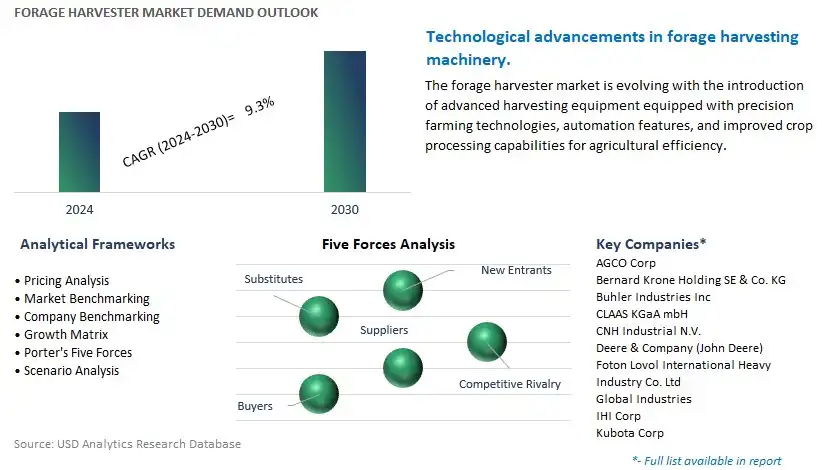
The global Forage Harvester market is highly competitive with a large number of companies focusing on niche market segments. Amidst intense competitive conditions, Forage Harvester Companies are investing in new product launches and strengthening distribution channels. Key companies operating in the Forage Harvester Market Industry include- AGCO Corp, Bernard Krone Holding SE & Co. KG, Buhler Industries Inc, CLAAS KGaA mbH, CNH Industrial N.V., Deere & Company (John Deere), Foton Lovol International Heavy Industry Co. Ltd, Global Industries, IHI Corp, Kubota Corp.
The most prominent trend in the forage harvester market is the adoption of precision agriculture technologies. As farmers seek to optimize crop yields and reduce operational costs, there is increasing interest in precision agriculture solutions that enable more efficient harvesting processes. Forage harvesters equipped with advanced technologies such as GPS guidance systems, yield monitoring sensors, and automated control systems offer farmers greater precision and accuracy in harvesting operations. This trend towards precision agriculture is driving demand for modern forage harvesters that can enhance productivity and profitability in farming operations.
A key driver shaping the forage harvester market is the growing demand for animal feed and biomass production. With increasing global population and changing dietary preferences, there is rising demand for high-quality forage crops such as alfalfa, corn silage, and grasses to feed livestock and produce biofuels. Forage harvesters play a critical role in efficiently harvesting and processing these crops, enabling farmers to meet the growing demand for animal feed and renewable energy sources. Additionally, government incentives and regulations promoting sustainable agriculture practices further drive the adoption of forage harvesters for biomass production, stimulating market growth.
An opportunity for growth in the forage harvester market lies in the integration of automation and artificial intelligence (AI) technologies. With advancements in robotics and AI algorithms, there is potential to develop autonomous forage harvesters capable of performing harvesting operations with minimal human intervention. By incorporating sensors, cameras, and machine learning algorithms, autonomous forage harvesters can optimize harvesting efficiency, reduce operator fatigue, and improve crop quality. Furthermore, integration with farm management software and data analytics platforms enables real-time monitoring and optimization of harvesting processes, leading to greater productivity and cost savings for farmers. By embracing automation and AI, manufacturers can differentiate their forage harvester offerings and cater to the evolving needs of modern agriculture.
By Type
Pull-Type Forage Harvester
Self-Propelled Forage Harvester
By Application
Feed Mill
Farms
OthersGeographical Analysis
North America (United States, Canada, Mexico)
Europe (Germany, France, United Kingdom, Spain, Italy, Rest of Europe)
Asia Pacific (China, India, Japan, South Korea, Rest of Asia Pacific)
South America (Brazil, Argentina, Rest of South America)
Middle East and Africa (Saudi Arabia, UAE, Rest of Middle East, South Africa, Egypt, Rest of Africa
AGCO Corp
Bernard Krone Holding SE & Co. KG
Buhler Industries Inc
CLAAS KGaA mbH
CNH Industrial N.V.
Deere & Company (John Deere)
Foton Lovol International Heavy Industry Co. Ltd
Global Industries
IHI Corp
Kubota Corp
*- List not Exhaustive
TABLE OF CONTENTS
1 Introduction to 2024 Forage Harvester Market
1.1 Market Overview
1.2 Quick Facts
1.3 Scope/Objective of the Study
1.4 Market Definition
1.5 Countries and Regions Analyzed
1.6 Units, Currency, and Conversions
1.7 Industry Value Chain
2 Research Methodology
2.1 Market Size Estimation
2.2 Sources and Research Methodology
2.3 Data Triangulation
2.4 Assumptions and Limitations
3 Executive Summary
3.1 Global Forage Harvester Market Size Outlook, $ Million, 2021 to 2030
3.2 Forage Harvester Market Outlook by Type, $ Million, 2021 to 2030
3.3 Forage Harvester Market Outlook by Product, $ Million, 2021 to 2030
3.4 Forage Harvester Market Outlook by Application, $ Million, 2021 to 2030
3.5 Forage Harvester Market Outlook by Key Countries, $ Million, 2021 to 2030
4 Market Dynamics
4.1 Key Driving Forces of Forage Harvester Industry
4.2 Key Market Trends in Forage Harvester Industry
4.3 Potential Opportunities in Forage Harvester Industry
4.4 Key Challenges in Forage Harvester Industry
5 Market Factor Analysis
5.1 Value Chain Analysis
5.2 Competitive Landscape
5.2.1 Global Forage Harvester Market Share by Company (%), 2023
5.2.2 Product Offerings by Company
5.3 Porter’s Five Forces Analysis
5.4 Pricing Analysis and Outlook
6 Growth Outlook Across Scenarios
6.1 Growth Analysis-Case Scenario Definitions
6.2 Low Growth Scenario Forecasts
6.3 Reference Growth Scenario Forecasts
6.4 High Growth Scenario Forecasts
7 Global Forage Harvester Market Outlook by Segments
7.1 Forage Harvester Market Outlook by Segments, $ Million, 2021- 2030
By Type
Pull-Type Forage Harvester
Self-Propelled Forage Harvester
By Application
Feed Mill
Farms
Others
8 North America Forage Harvester Market Analysis and Outlook To 2030
8.1 Introduction to North America Forage Harvester Markets in 2024
8.2 North America Forage Harvester Market Size Outlook by Country, 2021-2030
8.2.1 United States
8.2.2 Canada
8.2.3 Mexico
8.3 North America Forage Harvester Market size Outlook by Segments, 2021-2030
By Type
Pull-Type Forage Harvester
Self-Propelled Forage Harvester
By Application
Feed Mill
Farms
Others
9 Europe Forage Harvester Market Analysis and Outlook To 2030
9.1 Introduction to Europe Forage Harvester Markets in 2024
9.2 Europe Forage Harvester Market Size Outlook by Country, 2021-2030
9.2.1 Germany
9.2.2 France
9.2.3 Spain
9.2.4 United Kingdom
9.2.4 Italy
9.2.5 Russia
9.2.6 Norway
9.2.7 Rest of Europe
9.3 Europe Forage Harvester Market Size Outlook by Segments, 2021-2030
By Type
Pull-Type Forage Harvester
Self-Propelled Forage Harvester
By Application
Feed Mill
Farms
Others
10 Asia Pacific Forage Harvester Market Analysis and Outlook To 2030
10.1 Introduction to Asia Pacific Forage Harvester Markets in 2024
10.2 Asia Pacific Forage Harvester Market Size Outlook by Country, 2021-2030
10.2.1 China
10.2.2 India
10.2.3 Japan
10.2.4 South Korea
10.2.5 Indonesia
10.2.6 Malaysia
10.2.7 Australia
10.2.8 Rest of Asia Pacific
10.3 Asia Pacific Forage Harvester Market size Outlook by Segments, 2021-2030
By Type
Pull-Type Forage Harvester
Self-Propelled Forage Harvester
By Application
Feed Mill
Farms
Others
11 South America Forage Harvester Market Analysis and Outlook To 2030
11.1 Introduction to South America Forage Harvester Markets in 2024
11.2 South America Forage Harvester Market Size Outlook by Country, 2021-2030
11.2.1 Brazil
11.2.2 Argentina
11.2.3 Rest of South America
11.3 South America Forage Harvester Market size Outlook by Segments, 2021-2030
By Type
Pull-Type Forage Harvester
Self-Propelled Forage Harvester
By Application
Feed Mill
Farms
Others
12 Middle East and Africa Forage Harvester Market Analysis and Outlook To 2030
12.1 Introduction to Middle East and Africa Forage Harvester Markets in 2024
12.2 Middle East and Africa Forage Harvester Market Size Outlook by Country, 2021-2030
12.2.1 Saudi Arabia
12.2.2 UAE
12.2.3 Oman
12.2.4 Rest of Middle East
12.2.5 Egypt
12.2.6 Nigeria
12.2.7 South Africa
12.2.8 Rest of Africa
12.3 Middle East and Africa Forage Harvester Market size Outlook by Segments, 2021-2030
By Type
Pull-Type Forage Harvester
Self-Propelled Forage Harvester
By Application
Feed Mill
Farms
Others
13 Company Profiles
13.1 Company Snapshot
13.2 SWOT Profiles
13.3 Products and Services
13.4 Recent Developments
13.5 Financial Profile
List of Companies
AGCO Corp
Bernard Krone Holding SE & Co. KG
Buhler Industries Inc
CLAAS KGaA mbH
CNH Industrial N.V.
Deere & Company (John Deere)
Foton Lovol International Heavy Industry Co. Ltd
Global Industries
IHI Corp
Kubota Corp
14 Appendix
14.1 Customization Offerings
14.2 Subscription Services
14.3 Related Reports
14.4 Publisher Expertise
By Type
Pull-Type Forage Harvester
Self-Propelled Forage Harvester
By Application
Feed Mill
Farms
Others
The global Forage Harvester Market is one of the lucrative growth markets, poised to register a 9.3% growth (CAGR) between 2024 and 2030.
Emerging Markets across Asia Pacific, Europe, and Americas present robust growth prospects.
AGCO Corp, Bernard Krone Holding SE & Co. KG, Buhler Industries Inc, CLAAS KGaA mbH, CNH Industrial N.V., Deere & Company (John Deere), Foton Lovol International Heavy Industry Co. Ltd, Global Industries, IHI Corp, Kubota Corp
Base Year- 2023; Estimated Year- 2024; Historic Period- 2018-2023; Forecast period- 2024 to 2030; Currency: USD; Volume