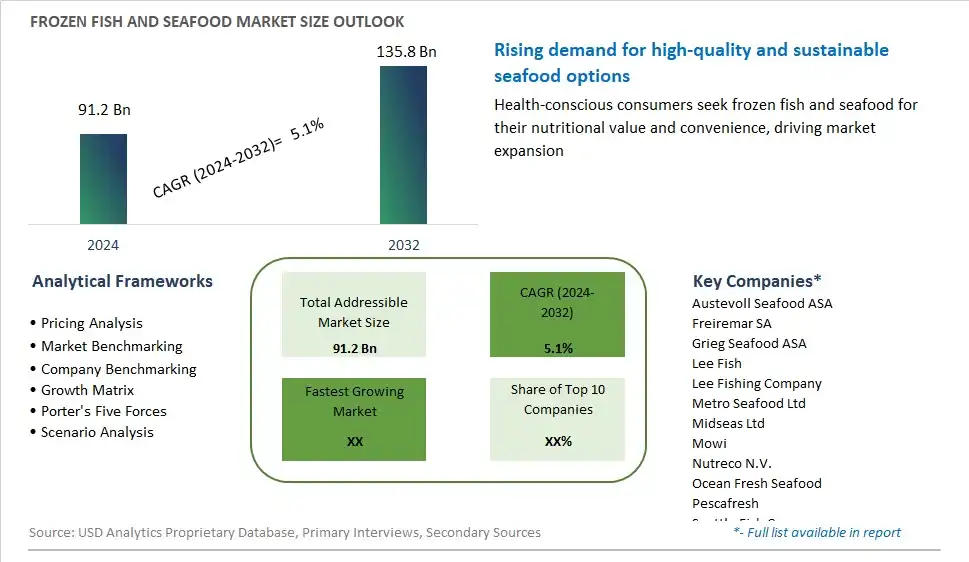
Global Frozen Fish and Seafood Market Size is valued at $91.2 Billion in 2024 and is forecast to register a growth rate (CAGR) of 5.1% to reach $135.8 Billion by 2032.
The global Frozen Fish and Seafood Market Comprehensive Study analyzes and forecasts the market size across 6 regions and 24 countries for diverse segments -By End-User (Food Processing, Food Service Provider, Retail And Household, Animal Feed and Pet Food), By Distribution Channel (Offline, Online)
An Introduction to Frozen Fish and Seafood Market
The market for frozen fish and seafood is experiencing steady growth and diversification in 2024, driven by factors such as convenience, globalization, and sustainability. Frozen fish and seafood offer several advantages over fresh options, including longer shelf life, reduced food waste, and year-round availability of seasonal favorites. Moreover, advancements in freezing technologies, such as flash freezing and individual quick freezing (IQF), preserve the quality, flavor, and nutritional value of fish and seafood, making them comparable to fresh counterparts. Additionally, the rise of aquaculture and sustainable fishing practices has increased the availability and variety of frozen fish and seafood products, catering to diverse tastes and culinary preferences. With the growing popularity of seafood-rich diets for health and environmental reasons, consumers are turning to frozen fish and seafood as convenient and affordable options to incorporate more seafood into their meals. Moreover, the convenience and versatility of frozen fish and seafood products, from fillets and shrimp to seafood mixes and ready-to-cook meals, make them ideal for a variety of culinary applications, from quick weeknight dinners to gourmet feasts. As consumers continue to seek convenient and nutritious meal solutions, the market for frozen fish and seafood is poised for continued growth and innovation, offering endless possibilities for delicious and sustainable seafood experiences.
Frozen Fish and Seafood Competitive Landscape
The market report analyses the leading companies in the industry including Austevoll Seafood ASA, Freiremar SA, Grieg Seafood ASA, Lee Fish, Lee Fishing Company, Metro Seafood Ltd, Midseas Ltd, Mowi, Nutreco N.V., Ocean Fresh Seafood, Pescafresh, Seattle Fish Co., Tassal Group, Tesco Plc, Trident Seafoods Corp, and Others.
Frozen Fish and Seafood Market Dynamics
Frozen Fish and Seafood Market Trend: Increasing Consumer Demand for Convenient and Sustainable Seafood Options
A notable trend in the frozen fish and seafood market is the increasing consumer demand for convenient and sustainable seafood options, driven by busy lifestyles, concerns about food safety, and a growing awareness of the environmental impact of fishing practices. As consumers seek out healthier dietary choices and look for ways to simplify meal preparation, there's a preference for frozen fish and seafood products that offer convenience without compromising on quality or sustainability. Frozen seafood provides a convenient solution for consumers to incorporate nutritious and protein-rich seafood into their diets, with the added benefit of extended shelf life and reduced food waste. Moreover, there's a growing interest in sustainably sourced seafood products that are harvested or farmed in an environmentally responsible manner, aligning with consumer values and preferences for ethical and eco-friendly food choices. This trend towards convenient and sustainable seafood options reflects broader shifts in consumer behavior towards health-conscious and environmentally conscious consumption patterns, driving market growth and innovation in the frozen fish and seafood segment as manufacturers and retailers respond to evolving consumer demands.
Market Driver: Expanding Awareness of Health Benefits and Nutritional Value
A key driver of the frozen fish and seafood market is the expanding awareness of the health benefits and nutritional value of seafood, fueled by scientific research, dietary recommendations, and public health campaigns promoting seafood consumption as part of a balanced diet. Seafood is valued for its high protein content, omega-3 fatty acids, vitamins, and minerals that support heart health, brain function, and overall well-being. With growing concerns about diet-related health issues such as obesity, diabetes, and cardiovascular disease, there's a renewed focus on incorporating more seafood into the diet as a source of lean protein and essential nutrients. Frozen fish and seafood products offer a convenient and versatile option for consumers to enjoy the health benefits of seafood year-round, regardless of seasonality or geographical location. Additionally, the COVID-19 pandemic has further emphasized the importance of immune-boosting foods and nutrient-rich diets, driving increased demand for frozen seafood products as consumers prioritize health and wellness in their food choices. This driver underscores the significance of nutritional awareness and dietary education in driving market growth and consumption of frozen fish and seafood products as consumers recognize the health benefits of incorporating seafood into their diets.
Market Opportunity: Innovation in Value-Added and Ready-to-Cook Seafood Products
An opportunity for growth in the frozen fish and seafood market lies in innovation in value-added and ready-to-cook seafood products that cater to evolving consumer tastes and preferences for convenient meal solutions. Beyond traditional offerings such as fillets and shrimp, there's potential to develop a wide range of value-added seafood products that are pre-seasoned, marinated, or flavored to enhance taste and convenience. Ready-to-cook options such as seafood skewers, stuffed fish fillets, and seafood stir-fry mixes provide consumers with convenient meal solutions that require minimal preparation time and effort. Additionally, there's an opportunity to introduce innovative packaging formats, such as portioned pouches and microwaveable trays, that offer convenience and ease of use for busy consumers. By leveraging culinary trends, flavor profiles, and cooking techniques, frozen fish and seafood brands can create value-added products that appeal to a wide range of consumer preferences and occasions, driving market expansion and differentiation in the frozen fish and seafood segment.
Frozen Fish and Seafood Market Share Analysis: Retail and Household held the dominant market share in 2024
Within the Frozen Fish and Seafood Market, the Retail and Household segment is the largest, underpinned by its widespread consumer base and diverse applications in culinary practices. This segment caters directly to households and retail consumers seeking convenient and nutritious seafood options, encompassing a broad range of products from fillets to shellfish. The increasing consumer awareness regarding the health benefits of consuming fish and seafood, coupled with the convenience of frozen varieties, drives the demand in this segment. Further, the versatility of frozen fish and seafood products enables consumers to experiment with various recipes at home, contributing to their enduring popularity. As consumers continue to prioritize health-conscious and convenient meal solutions, the Retail and Household segment is poised to maintain its dominance in the Frozen Fish and Seafood Market, offering a gateway to culinary exploration and nutritional excellence.
Frozen Fish and Seafood Market Share Analysis: Online Distribution market is poised to register the fastest growth rae over the forecast period to 2032
In the dynamic landscape of the Frozen Fish and Seafood Market, the Online Distribution segment is the fastest-growing, propelled by shifting consumer preferences and technological advancements. The convenience and accessibility offered by online shopping platforms have revolutionized the seafood procurement process, enabling consumers to browse and purchase a wide array of frozen fish and seafood products with just a few clicks. The COVID-19 pandemic further accelerated the adoption of online shopping, as consumers sought safe and contactless shopping experiences. Additionally, online platforms provide an avenue for consumers to access a diverse range of products, including specialty and exotic seafood varieties, which may not be readily available in traditional brick-and-mortar stores. As e-commerce continues to evolve and expand, the Online Distribution segment is poised to sustain its rapid growth trajectory, reshaping the Frozen Fish and Seafood Market landscape with innovation and convenience.
Frozen Fish and Seafood Market Segmentation
By End-User
Food Processing
Food Service Provider
Retail And Household
Animal Feed and Pet Food
By Distribution Channel
Offline
Online
Countries Analyzed
North America (US, Canada, Mexico)
Europe (Germany, UK, France, Spain, Italy, Russia, Rest of Europe)
Asia Pacific (China, India, Japan, South Korea, Australia, South East Asia, Rest of Asia)
South America (Brazil, Argentina, Rest of South America)
Middle East and Africa (Saudi Arabia, UAE, Rest of Middle East, South Africa, Egypt, Rest of Africa)
Frozen Fish and Seafood Companies Profiled in the Study
Austevoll Seafood ASA
Freiremar SA
Grieg Seafood ASA
Lee Fish
Lee Fishing Company
Metro Seafood Ltd
Midseas Ltd
Mowi
Nutreco N.V.
Ocean Fresh Seafood
Pescafresh
Seattle Fish Co.
Tassal Group
Tesco Plc
Trident Seafoods Corp
*- List Not Exhaustive
Chapter 1. TABLE OF CONTENTS
Chapter 2. Introduction to Frozen Fish and Seafood Market
2.1. Market Overview
2.2. Key Statistics and Report Highlights
2.3. Scope of the Comprehensive Study
2.3.1. Market Definition
2.3.2 Countries and Regions Covered
2.3.3 Research Objective
2.3.4 Units, Currency, and Conversions
2.3.5 Industry Value Chain
2.4. Key Market Segments
2.5. Key Companies
2.6. Study Period
Chapter 3. Strategic Analysis Review
3.1. Frozen Fish and Seafood Pricing Analysis and Forecast
3.2. Porter’s Five Forces
3.3. Market Ecosystem
3.4. SWOT Analysis
3.5. Regulatory Scenario
3.3. Effects of Inflation, Russia-Ukraine War, moderating economic growth, and other macroeconomic factors
Chapter 4. Competitive Landscape
4.1. Market Share Analysis
4.1.1. Global Frozen Fish and Seafood Market Share by Company, 2023
4.1.2. Product Offerings of Leading Frozen Fish and Seafood Companies
4.2. Market Entropy
4.2.1. New Product Launches in the Industry
4.2.2. Mergers, Acquisitions, Joint ventures, and Partnerships
4.3. Key Strategies and Best Practices
Chapter 5. Global Market Projections: Best, Reference, and Low Case Scenarios
5.1. Growth Analysis- Case Scenario Definitions
5.2. Low Growth Case Scenario Forecasts
5.3. Reference Growth Case Scenario Forecasts
5.4. High Growth Case Scenario Forecasts
Chapter 6. Market Dynamics
6.1. Frozen Fish and Seafood Market Drivers
6.2. Frozen Fish and Seafood Market Challenges
6.6. Frozen Fish and Seafood Market Opportunities
6.4. Frozen Fish and Seafood Market Trends
Chapter 7. Global Frozen Fish and Seafood Market Outlook Trends
7.1. Global Frozen Fish and Seafood Revenue (USD Million) and CAGR (%) by Type (2021-2032)
7.2. Global Frozen Fish and Seafood Revenue (USD Million) and CAGR (%) by Application (2021-2032)
7.3. Global Frozen Fish and Seafood Revenue (USD Million) and CAGR (%) by Product (2021-2032)
By End-User
Food Processing
Food Service Provider
Retail And Household
Animal Feed and Pet Food
By Distribution Channel
Offline
Online
Chapter 8. Global Frozen Fish and Seafood Regional Analysis and Outlook
8.1. Global Frozen Fish and Seafood Revenue (USD Million) By Regions (2021- 2032)
8.2. North America Frozen Fish and Seafood Revenue (USD Million) by Country (2021-2032)
8.2.1. United States Frozen Fish and Seafood Regional Analysis and Outlook
8.2.2. Canada Frozen Fish and Seafood Regional Analysis and Outlook
8.2.3. Mexico Frozen Fish and Seafood Regional Analysis and Outlook
8.3. Europe Frozen Fish and Seafood Revenue (USD Million), by Country (2021-2032)
8.3.1. Germany Frozen Fish and Seafood Regional Analysis and Outlook
8.3.2. France Frozen Fish and Seafood Regional Analysis and Outlook
8.3.3. United Kingdom Frozen Fish and Seafood Regional Analysis and Outlook
8.3.4. Spain Frozen Fish and Seafood Regional Analysis and Outlook
8.3.5. Italy Frozen Fish and Seafood Regional Analysis and Outlook
8.3.6. Russia Frozen Fish and Seafood Regional Analysis and Outlook
8.3.7. Rest of Europe Frozen Fish and Seafood Regional Analysis and Outlook
8.4. Asia Pacific Frozen Fish and Seafood Revenue (USD Million) by Country (2021-2032)
8.4.1. China Frozen Fish and Seafood Regional Analysis and Outlook
8.4.2. Japan Frozen Fish and Seafood Regional Analysis and Outlook
8.4.3. India Frozen Fish and Seafood Regional Analysis and Outlook
8.4.4. South Korea Frozen Fish and Seafood Regional Analysis and Outlook
8.4.5. Australia Frozen Fish and Seafood Regional Analysis and Outlook
8.4.6. South East Asia Frozen Fish and Seafood Regional Analysis and Outlook
8.4.7. Rest of Asia Pacific Frozen Fish and Seafood Regional Analysis and Outlook
8.5. South America Frozen Fish and Seafood Revenue (USD Million), by Country (2021-2032)
8.5.1. Brazil Frozen Fish and Seafood Regional Analysis and Outlook
8.5.2. Argentina Frozen Fish and Seafood Regional Analysis and Outlook
8.5.3. Rest of South America Frozen Fish and Seafood Regional Analysis and Outlook
8.6. Middle East and Africa Frozen Fish and Seafood Revenue (USD Million) by Country (2021-2032)
8.6.1. Middle East Frozen Fish and Seafood Regional Analysis and Outlook
8.6.2. Africa Frozen Fish and Seafood Regional Analysis and Outlook
Chapter 9. North America Frozen Fish and Seafood Analysis and Outlook
9.1. North America Frozen Fish and Seafood Revenue (USD Million) by Segments (2021-2032)
9.1.1. North America Frozen Fish and Seafood Revenue (USD Million) by Type (2021-2032)
9.1.2. North America Frozen Fish and Seafood Revenue (USD Million) by Application (2021-2032)
9.1.3. North America Frozen Fish and Seafood Revenue (USD Million) by Product (2021-2032)
By End-User
Food Processing
Food Service Provider
Retail And Household
Animal Feed and Pet Food
By Distribution Channel
Offline
Online
Chapter 10. Europe Frozen Fish and Seafood Analysis and Outlook
10.1. Europe Frozen Fish and Seafood Revenue (USD Million), by Segments (USD Million) (2021-2032)
10.1.1. Europe Frozen Fish and Seafood Revenue (USD Million) by Type (2021-2032)
10.1.2. Europe Frozen Fish and Seafood Revenue (USD Million) by Application (2021-2032)
10.1.3. Europe Frozen Fish and Seafood Revenue (USD Million) by Product (2021-2032)
By End-User
Food Processing
Food Service Provider
Retail And Household
Animal Feed and Pet Food
By Distribution Channel
Offline
Online
Chapter 11. Asia Pacific Frozen Fish and Seafood Analysis and Outlook
11.1. Asia Pacific Frozen Fish and Seafood Revenue (USD Million), and Revenue (USD Million) by Segments (2021-2032)
11.1.1. Asia Pacific Frozen Fish and Seafood Revenue (USD Million) by Type (2021-2032)
11.1.2. Asia Pacific Frozen Fish and Seafood Revenue (USD Million) by Application (2021-2032)
11.1.3. Asia Pacific Frozen Fish and Seafood Revenue (USD Million) by Product (2021-2032)
By End-User
Food Processing
Food Service Provider
Retail And Household
Animal Feed and Pet Food
By Distribution Channel
Offline
Online
Chapter 12. South America Frozen Fish and Seafood Analysis and Outlook
12.1. South America Frozen Fish and Seafood Revenue (USD Million), by Segments (2021-2032)
12.1.1. South America Frozen Fish and Seafood Revenue (USD Million) by Type (2021-2032)
12.1.2. South America Frozen Fish and Seafood Revenue (USD Million) by Application (2021-2032)
12.1.3. South America Frozen Fish and Seafood Revenue (USD Million) by Product (2021-2032)
By End-User
Food Processing
Food Service Provider
Retail And Household
Animal Feed and Pet Food
By Distribution Channel
Offline
Online
Chapter 13. Middle East and Africa Frozen Fish and Seafood Analysis and Outlook
13.1. Middle East and Africa Frozen Fish and Seafood Revenue (USD Million), by Segments (2021-2032)
13.1.1. Middle East and Africa Frozen Fish and Seafood Revenue (USD Million) by Type (2021-2032)
13.1.2. Middle East and Africa Frozen Fish and Seafood Revenue (USD Million) by Application (2021-2032)
13.1.3. Middle East and Africa Frozen Fish and Seafood Revenue (USD Million) by Product (2021-2032)
By End-User
Food Processing
Food Service Provider
Retail And Household
Animal Feed and Pet Food
By Distribution Channel
Offline
Online
Chapter 14. Frozen Fish and Seafood Company Profiles
14.1 Business Overview
14.2 Product Profiles
14.3 SWOT Profiles
14.5 Recent Developments
14.6 Financial Profile
List of Companies
Austevoll Seafood ASA
Freiremar SA
Grieg Seafood ASA
Lee Fish
Lee Fishing Company
Metro Seafood Ltd
Midseas Ltd
Mowi
Nutreco N.V.
Ocean Fresh Seafood
Pescafresh
Seattle Fish Co.
Tassal Group
Tesco Plc
Trident Seafoods Corp
15. Methodology and Data Sources
15.1 Customization Offerings
15.2 Subscription Services
15.3 Related Reports
15.4 Publisher Expertise
LIST OF TABLES
Table 1 Market Segmentation Analysis
Table 2 Global Frozen Fish and Seafood Market Share of Leading Companies, 2023
Table 3 Product Offerings of Leading Companies
Table 4 Low Growth Scenario Forecasts
Table 5 Reference Case Growth Scenario
Table 6 High Growth Case Scenario
Table 7 Global Frozen Fish and Seafood Revenue (USD Million) And CAGR (%) By Type (2021-2032)
Table 8 Global Frozen Fish and Seafood Revenue (USD Million) And CAGR (%) By Application (2021-2032)
Table 9 Global Frozen Fish and Seafood Revenue (USD Million) And CAGR (%) By Product (2021-2032)
Table 10 Global Frozen Fish and Seafood Market Revenue (USD Million) By Regions (2021-2032)
Table 11 Global Frozen Fish and Seafood Market Share (%) By Regions (2021-2032)
Table 12 North America Frozen Fish and Seafood Revenue (USD Million) By Country (2021-2032)
Table 13 Europe Frozen Fish and Seafood Revenue (USD Million) By Country (2021-2032)
Table 14 Asia Pacific Frozen Fish and Seafood Revenue (USD Million) By Country (2021-2032)
Table 15 South America Frozen Fish and Seafood Revenue (USD Million) By Country (2021-2032)
Table 16 Middle East and Africa Frozen Fish and Seafood Revenue (USD Million) By Region (2021-2032)
Table 17 North America Frozen Fish and Seafood Revenue (USD Million) By Type (2021-2032)
Table 18 North America Frozen Fish and Seafood Revenue (USD Million) By Application (2021-2032)
Table 19 North America Frozen Fish and Seafood Revenue (USD Million) By Product (2021-2032)
Table 20 Europe Frozen Fish and Seafood Revenue (USD Million) By Type (2021-2032)
Table 21 Europe Frozen Fish and Seafood Revenue (USD Million) By Application (2021-2032)
Table 22 Europe Frozen Fish and Seafood Revenue (USD Million) By Product (2021-2032)
Table 23 Asia Pacific Frozen Fish and Seafood Revenue (USD Million) By Type (2021-2032)
Table 24 Asia Pacific Frozen Fish and Seafood Revenue (USD Million) By Application (2021-2032)
Table 25 Asia Pacific Frozen Fish and Seafood Revenue (USD Million) By Product (2021-2032)
Table 26 South America Frozen Fish and Seafood Revenue (USD Million) By Type (2021-2032)
Table 27 South America Frozen Fish and Seafood Revenue (USD Million) By Application (2021-2032)
Table 28 South America Frozen Fish and Seafood Revenue (USD Million) By Product (2021-2032)
Table 29 Middle East and Africa Frozen Fish and Seafood Revenue (USD Million) By Type (2021-2032)
Table 30 Middle East and Africa Frozen Fish and Seafood Revenue (USD Million) By Application (2021-2032)
Table 31 Middle East and Africa Frozen Fish and Seafood Revenue (USD Million) By Product (2021-2032)
LIST OF FIGURES
Figure 1. Market Scope
Figure 2. Pricing Forecasts Per Unit, 2023- 2032
Figure 3. Porter’s Five Forces
Figure 4. Global Frozen Fish and Seafood Market Revenue (USD Million) By Regions (2021-2032)
Figure 5. Global Frozen Fish and Seafood Market Share (%) By Regions (2023)
Figure 6. North America Frozen Fish and Seafood Revenue (USD Million) By Country (2021-2032)
Figure 7. United States Frozen Fish and Seafood Revenue (USD Million) By Country (2021-2032)
Figure 8. Canada Frozen Fish and Seafood Revenue (USD Million) By Country (2021-2032)
Figure 9. Mexico Frozen Fish and Seafood Revenue (USD Million) By Country (2021-2032)
Figure 10. Europe Frozen Fish and Seafood Revenue (USD Million) By Country (2021-2032)
Figure 11. Germany Frozen Fish and Seafood Revenue (USD Million) By Country (2021-2032)
Figure 12. France Frozen Fish and Seafood Revenue (USD Million) By Country (2021-2032)
Figure 13. United Kingdom Frozen Fish and Seafood Revenue (USD Million) By Country (2021-2032)
Figure 14. Spain Frozen Fish and Seafood Revenue (USD Million) By Country (2021-2032)
Figure 15. Italy Frozen Fish and Seafood Revenue (USD Million) By Country (2021-2032)
Figure 16. Russia Frozen Fish and Seafood Revenue (USD Million) By Country (2021-2032)
Figure 17. Rest of Europe Frozen Fish and Seafood Revenue (USD Million) By Country (2021-2032)
Figure 11. Asia Pacific Frozen Fish and Seafood Revenue (USD Million) By Country (2021-2032)
Figure 12. China Frozen Fish and Seafood Revenue (USD Million) By Country (2021-2032)
Figure 13. Japan Frozen Fish and Seafood Revenue (USD Million) By Country (2021-2032)
Figure 14. India Frozen Fish and Seafood Revenue (USD Million) By Country (2021-2032)
Figure 15. South Korea Frozen Fish and Seafood Revenue (USD Million) By Country (2021-2032)
Figure 16. Australia Frozen Fish and Seafood Revenue (USD Million) By Country (2021-2032)
Figure 17. South East Asia Frozen Fish and Seafood Revenue (USD Million) By Country (2021-2032)
Figure 18. South America Frozen Fish and Seafood Revenue (USD Million) By Country (2021-2032)
Figure 19. Brazil Frozen Fish and Seafood Revenue (USD Million) By Country (2021-2032)
Figure 20. Argentina Frozen Fish and Seafood Revenue (USD Million) By Country (2021-2032)
Figure 21. Rest of Asia Pacific Frozen Fish and Seafood Revenue (USD Million) By Country (2021-2032)
Figure 22. Middle East and Africa Frozen Fish and Seafood Revenue (USD Million) By Region (2021-2032)
Figure 23. Saudi Arabia Frozen Fish and Seafood Revenue (USD Million) By Region (2021-2032)
Figure 24. The UAE Frozen Fish and Seafood Revenue (USD Million) By Region (2021-2032)
Figure 25. Rest of Middle East Frozen Fish and Seafood Revenue (USD Million) By Region (2021-2032)
Figure 26. South Africa Frozen Fish and Seafood Revenue (USD Million) By Region (2021-2032)
Figure 27. Africa Frozen Fish and Seafood Revenue (USD Million) By Region (2021-2032)
Figure 28. North America Frozen Fish and Seafood Revenue (USD Million) By Type (2021-2032)
Figure 29. North America Frozen Fish and Seafood Revenue (USD Million) By Application (2021-2032)
Figure 30. North America Frozen Fish and Seafood Revenue (USD Million) By Product (2021-2032)
Figure 31. Europe Frozen Fish and Seafood Revenue (USD Million) By Type (2021-2032)
Figure 32. Europe Frozen Fish and Seafood Revenue (USD Million) By Application (2021-2032)
Figure 33. Europe Frozen Fish and Seafood Revenue (USD Million) By Product (2021-2032)
Figure 34. Asia Pacific Frozen Fish and Seafood Revenue (USD Million) By Type (2021-2032)
Figure 35. Asia Pacific Frozen Fish and Seafood Revenue (USD Million) By Application (2021-2032)
Figure 36. Asia Pacific Frozen Fish and Seafood Revenue (USD Million) By Product (2021-2032)
Figure 37. South America Frozen Fish and Seafood Revenue (USD Million) By Type (2021-2032)
Figure 38. South America Frozen Fish and Seafood Revenue (USD Million) By Application (2021-2032)
Figure 39. South America Frozen Fish and Seafood Revenue (USD Million) By Product (2021-2032)
Figure 40. Middle East and Africa Frozen Fish and Seafood Revenue (USD Million) By Type (2021-2032)
Figure 41. Middle East and Africa Frozen Fish and Seafood Revenue (USD Million) By Application (2021-2032)
Figure 42. Middle East and Africa Frozen Fish and Seafood Revenue (USD Million) By Product (2021-2032)
By End-User
Food Processing
Food Service Provider
Retail And Household
Animal Feed and Pet Food
By Distribution Channel
Offline
Online
Countries Analyzed
North America (US, Canada, Mexico)
Europe (Germany, UK, France, Spain, Italy, Russia, Rest of Europe)
Asia Pacific (China, India, Japan, South Korea, Australia, South East Asia, Rest of Asia)
South America (Brazil, Argentina, Rest of South America)
Middle East and Africa (Saudi Arabia, UAE, Rest of Middle East, South Africa, Egypt, Rest of Africa)
