
The Fume Hood Market study analyzes and forecasts the market size across 6 regions and 24 countries for diverse segments- By Product (Duct Fume Hood, Duct-less Fume Hood, Accessories), By Mobility (Bench-top, Mobile).
In 2024, the market for fume hoods caters to the needs of laboratories, research facilities, and industrial settings requiring effective containment and ventilation of hazardous chemical fumes, vapors, and particulates to ensure the safety of personnel and protect the environment. Fume hoods are specialized enclosures equipped with exhaust systems designed to capture, contain, and remove airborne contaminants generated during laboratory procedures such as chemical reactions, solvent evaporation, or sample preparation. These hoods provide a barrier between the operator and the hazardous materials, preventing exposure to toxic, flammable, or reactive substances while allowing for safe handling and manipulation within a controlled environment. Fume hoods come in various configurations, including benchtop, ductless, and walk-in models, each offering different levels of containment, airflow patterns, and filtration options to suit specific application requirements and space constraints. With a focus on safety, efficiency, and regulatory compliance, fume hoods undergo rigorous testing, certification, and maintenance to ensure their performance meets industry standards and user expectations. Moreover, with advancements in design, materials, and energy-saving technologies, modern fume hoods offer improved airflow management, ergonomic features, and sustainability enhancements that contribute to a safer and more productive laboratory environment. As laboratories continue to play a critical role in scientific research, healthcare, and industrial processes, the demand for fume hoods is expected to grow, driving innovation and investment in ventilation solutions that prioritize worker safety, environmental stewardship, and operational efficiency.
A prominent trend in the fume hood market is the increasing adoption of sustainable and energy-efficient designs. With growing awareness of environmental conservation and energy consumption reduction, laboratories and industrial facilities are seeking fume hoods that minimize their ecological footprint. Manufacturers are developing fume hoods with features such as variable air volume (VAV) controls, low-flow/high-performance (LFHP) ventilation systems, and energy-efficient fan motors to optimize airflow and reduce energy consumption. Additionally, materials with lower environmental impact, such as recycled or recyclable components, are being incorporated into fume hood construction. The trend towards sustainable and energy-efficient designs not only aligns with environmental goals but also offers cost savings and regulatory compliance benefits for users, driving market growth and innovation in the fume hood segment.
A key driver for the fume hood market is the implementation of stringent safety and regulatory standards governing workplace safety, environmental protection, and hazardous chemical handling. Fume hoods play a critical role in protecting laboratory personnel, researchers, and industrial workers from exposure to harmful fumes, vapors, and airborne contaminants generated during chemical experiments and processes. Regulatory agencies, such as the Occupational Safety and Health Administration (OSHA) and the Environmental Protection Agency (EPA), mandate the use of fume hoods in laboratory and industrial settings to ensure compliance with safety and health regulations. Additionally, industry-specific standards and guidelines, such as those from the American National Standards Institute (ANSI) and the American Industrial Hygiene Association (AIHA), further drive the adoption of fume hoods to mitigate occupational hazards and minimize environmental impact. As organizations strive to maintain safe working environments and regulatory compliance, the demand for fume hoods that meet stringent safety and regulatory standards remains high, fueling market growth in the fume hood segment.
An opportunity for innovation and market expansion in the fume hood market lies in the integration of smart technologies for remote monitoring and control. With the advancement of the Internet of Things (IoT) and connectivity solutions, there is an opportunity to develop smart fume hoods equipped with sensors, actuators, and digital interfaces for real-time monitoring of airflow, temperature, humidity, and air quality parameters. Smart fume hoods can be remotely controlled and managed via mobile applications or cloud-based platforms, allowing users to monitor fume hood performance, receive alerts for maintenance or calibration needs, and optimize energy usage from anywhere. Furthermore, advanced analytics and machine learning algorithms can analyze data collected from smart fume hoods to identify usage patterns, predict maintenance issues, and optimize ventilation settings for improved efficiency and safety. By integrating smart technologies into fume hood design, manufacturers can offer enhanced functionality, convenience, and user experience, while addressing the evolving needs of modern laboratories and industrial facilities.
The Duct-less Fume Hood segment within the Fume Hood Market is experiencing rapid growth due to several factors driving the demand for innovative and versatile laboratory containment solutions in research, industrial, and educational settings. Duct-less fume hoods, also known as filtered fume hoods or recirculating fume hoods, are advanced laboratory enclosures designed to capture and remove hazardous fumes, vapors, and particulates from the laboratory workspace without the need for external ductwork or ventilation systems. With the increasing emphasis on safety, sustainability, and flexibility in laboratory design and operations, there is growing demand for duct-less fume hoods that offer efficient containment of chemical contaminants, cost-effective installation, and ease of relocation in diverse laboratory environments. Duct-less fume hoods utilize high-efficiency particulate air (HEPA) or activated carbon filters to remove harmful gases and particulates from the air, providing a safe and controlled environment for handling hazardous substances and conducting experiments requiring chemical containment. Additionally, duct-less fume hoods offer advantages such as energy efficiency, space-saving design, and portability, making them ideal for laboratories with limited space or those requiring flexible workspace configurations. As research institutions, industrial facilities, and educational laboratories increasingly adopt duct-less fume hoods as integral components of their laboratory safety and containment strategies, the Duct-less Fume Hood segment is poised for significant growth in the Fume Hood Market, offering innovative solutions for addressing evolving safety and environmental requirements while optimizing laboratory performance and productivity.
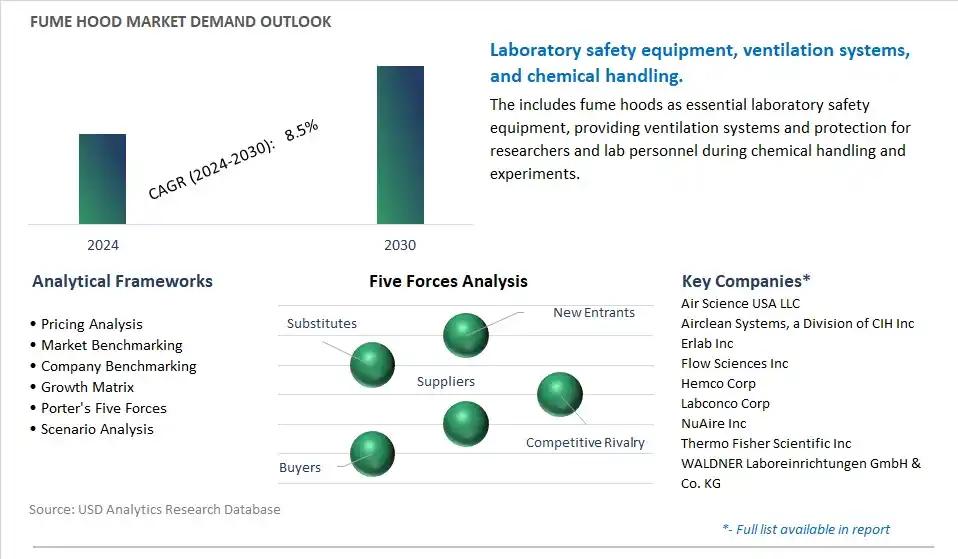
The market research study provides in-depth insights into leading companies including the SWOT analyses, product profile, financial details, and recent developments acrossAir Science USA LLC, Airclean Systems, a Division of CIH Inc, Erlab Inc, Flow Sciences Inc, Hemco Corp, Labconco Corp, NuAire Inc, Thermo Fisher Scientific Inc, WALDNER Laboreinrichtungen GmbH & Co. KG
By Product
Duct Fume Hood
Duct-less Fume Hood
Accessories
By Mobility
Bench-top
Mobile
Geographical Analysis
North America (United States, Canada, Mexico)
Europe (Germany, France, United Kingdom, Spain, Italy, Rest of Europe)
Asia Pacific (China, India, Japan, South Korea, Rest of Asia Pacific)
South America (Brazil, Argentina, Rest of South America)
Middle East and Africa (Saudi Arabia, UAE, Rest of Middle East, South Africa, Egypt, Rest of Africa)
Air Science USA LLC
Airclean Systems, a Division of CIH Inc
Erlab Inc
Flow Sciences Inc
Hemco Corp
Labconco Corp
NuAire Inc
Thermo Fisher Scientific Inc
WALDNER Laboreinrichtungen GmbH & Co. KG
• Deepen your industry insights and navigate uncertainties for strategy formulation, CAPEX, and Operational decisions
• Gain access to detailed insights on the Fume Hood Market, encompassing current market size, growth trends, and forecasts till 2030.
• Access detailed competitor analysis, enabling competitive advantage through a thorough understanding of market players, strategies, and potential differentiation opportunities
• Stay ahead of the curve with insights on technological advancements, innovations, and upcoming trends
• Identify lucrative investment avenues and expansion opportunities within the Fume Hood Market industry, guided by robust, data-backed analysis.
• Understand regional and global markets through country-wise analysis, regional market potential, regulatory nuances, and dynamics
• Execute strategies with confidence and speed through information, analytics, and insights on the industry value chain
• Corporate leaders, strategists, financial experts, shareholders, asset managers, and governmental representatives can make long-term planning scenarios and build an integrated and timely understanding of market dynamics
• Benefit from tailored solutions and expert consultation based on report insights, providing personalized strategies aligned with specific business needs.
TABLE OF CONTENTS
1 Introduction to 2024 Fume Hood Market
1.1 Market Overview
1.2 Quick Facts
1.3 Scope/Objective of the Study
1.4 Market Definition
1.5 Countries and Regions Covered
1.6 Units, Currency, and Conversions
1.7 Industry Value Chain
2 Research Methodology
2.1 Market Size Estimation
2.2 Sources and Research Methodology
2.3 Data Triangulation
2.4 Assumptions and Limitations
3 Executive Summary
3.1 Global Fume Hood Market Size Outlook, $ Million, 2021 to 2030
3.2 Fume Hood Market Outlook by Type, $ Million, 2021 to 2030
3.3 Fume Hood Market Outlook by Product, $ Million, 2021 to 2030
3.4 Fume Hood Market Outlook by Application, $ Million, 2021 to 2030
3.5 Fume Hood Market Outlook by Key Countries, $ Million, 2021 to 2030
4 Market Dynamics
4.1 Key Driving Forces of Fume Hood Industry
4.2 Key Market Trends in Fume Hood Industry
4.3 Potential Opportunities in Fume Hood Industry
4.4 Key Challenges in Fume Hood Industry
5 Market Factor Analysis
5.1 Value Chain Analysis
5.2 Competitive Landscape
5.2.1 Global Fume Hood Market Share by Company (%), 2023
5.2.2 Product Offerings by Company
5.3 Porter’s Five Forces Analysis
5.4 Pricing Analysis and Outlook
6 Growth Outlook Across Scenarios
6.1 Growth Analysis-Case Scenario Definitions
6.2 Low Growth Scenario Forecasts
6.3 Reference Growth Scenario Forecasts
6.4 High Growth Scenario Forecasts
7 Global Fume Hood Market Outlook by Segments
7.1 Fume Hood Market Outlook by Segments, $ Million, 2021- 2030
By Product
Duct Fume Hood
Duct-less Fume Hood
Accessories
By Mobility
Bench-top
Mobile
8 North America Fume Hood Market Analysis and Outlook To 2030
8.1 Introduction to North America Fume Hood Markets in 2024
8.2 North America Fume Hood Market Size Outlook by Country, 2021-2030
8.2.1 United States
8.2.2 Canada
8.2.3 Mexico
8.3 North America Fume Hood Market size Outlook by Segments, 2021-2030
By Product
Duct Fume Hood
Duct-less Fume Hood
Accessories
By Mobility
Bench-top
Mobile
9 Europe Fume Hood Market Analysis and Outlook To 2030
9.1 Introduction to Europe Fume Hood Markets in 2024
9.2 Europe Fume Hood Market Size Outlook by Country, 2021-2030
9.2.1 Germany
9.2.2 France
9.2.3 Spain
9.2.4 United Kingdom
9.2.4 Italy
9.2.5 Russia
9.2.6 Norway
9.2.7 Rest of Europe
9.3 Europe Fume Hood Market Size Outlook by Segments, 2021-2030
By Product
Duct Fume Hood
Duct-less Fume Hood
Accessories
By Mobility
Bench-top
Mobile
10 Asia Pacific Fume Hood Market Analysis and Outlook To 2030
10.1 Introduction to Asia Pacific Fume Hood Markets in 2024
10.2 Asia Pacific Fume Hood Market Size Outlook by Country, 2021-2030
10.2.1 China
10.2.2 India
10.2.3 Japan
10.2.4 South Korea
10.2.5 Indonesia
10.2.6 Malaysia
10.2.7 Australia
10.2.8 Rest of Asia Pacific
10.3 Asia Pacific Fume Hood Market size Outlook by Segments, 2021-2030
By Product
Duct Fume Hood
Duct-less Fume Hood
Accessories
By Mobility
Bench-top
Mobile
11 South America Fume Hood Market Analysis and Outlook To 2030
11.1 Introduction to South America Fume Hood Markets in 2024
11.2 South America Fume Hood Market Size Outlook by Country, 2021-2030
11.2.1 Brazil
11.2.2 Argentina
11.2.3 Rest of South America
11.3 South America Fume Hood Market size Outlook by Segments, 2021-2030
By Product
Duct Fume Hood
Duct-less Fume Hood
Accessories
By Mobility
Bench-top
Mobile
12 Middle East and Africa Fume Hood Market Analysis and Outlook To 2030
12.1 Introduction to Middle East and Africa Fume Hood Markets in 2024
12.2 Middle East and Africa Fume Hood Market Size Outlook by Country, 2021-2030
12.2.1 Saudi Arabia
12.2.2 UAE
12.2.3 Oman
12.2.4 Rest of Middle East
12.2.5 Egypt
12.2.6 Nigeria
12.2.7 South Africa
12.2.8 Rest of Africa
12.3 Middle East and Africa Fume Hood Market size Outlook by Segments, 2021-2030
By Product
Duct Fume Hood
Duct-less Fume Hood
Accessories
By Mobility
Bench-top
Mobile
13 Company Profiles
13.1 Company Snapshot
13.2 SWOT Profiles
13.3 Products and Services
13.4 Recent Developments
13.5 Financial Profile
List of Companies
Air Science USA LLC
Airclean Systems, a Division of CIH Inc
Erlab Inc
Flow Sciences Inc
Hemco Corp
Labconco Corp
NuAire Inc
Thermo Fisher Scientific Inc
WALDNER Laboreinrichtungen GmbH & Co. KG
14 Appendix
14.1 Customization Offerings
14.2 Subscription Services
14.3 Related Reports
14.4 Publisher Expertise
By Product
Duct Fume Hood
Duct-less Fume Hood
Accessories
By Mobility
Bench-top
Mobile
Countries Analyzed
North America (United States, Canada, Mexico)
Europe (Germany, France, United Kingdom, Spain, Italy, Rest of Europe)
Asia Pacific (China, India, Japan, South Korea, Rest of Asia Pacific)
South America (Brazil, Argentina, Rest of South America)
Middle East and Africa (Saudi Arabia, UAE, Rest of Middle East, South Africa, Egypt, Rest of Africa)
The global Fume Hood Market is one of the lucrative growth markets, poised to register a 8.5% growth (CAGR) between 2024 and 2030.
Emerging Markets across Asia Pacific, Europe, and Americas present robust growth prospects.
Air Science USA LLC, Airclean Systems, a Division of CIH Inc, Erlab Inc, Flow Sciences Inc, Hemco Corp, Labconco Corp, NuAire Inc, Thermo Fisher Scientific Inc, WALDNER Laboreinrichtungen GmbH & Co. KG
Base Year- 2023; Estimated Year- 2024; Historic Period- 2018-2023; Forecast period- 2024 to 2030; Currency: USD; Volume