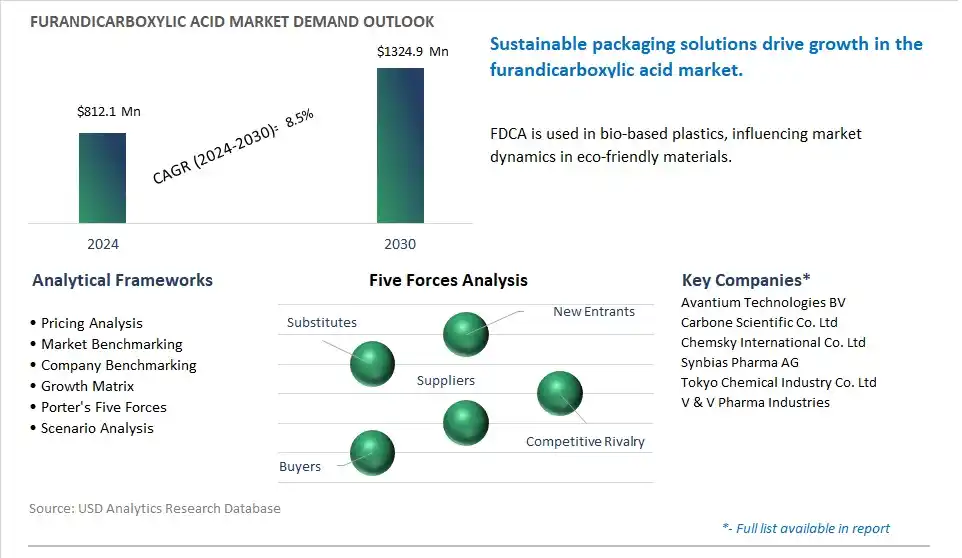
The global Furandicarboxylic Acid Market is poised to register a 8.5% CAGR from $812.1 Million in 2024 to $1324.9 Million in 2030.
The global Furandicarboxylic Acid Market Study analyzes and forecasts the market size across 6 regions and 24 countries for diverse segments -By Application (PET, Polyamides, Polycarbonates, Plasticizers, Polyester Polyols, Others), By End-User (Textiles, Packaging, Carpets, Electronics, Automotive, Others).
An Introduction to Global Furandicarboxylic Acid Market in 2024
The furandicarboxylic acid (FDCA) market is experiencing rapid growth driven by its potential applications as a renewable building block for the production of bioplastics, polyesters, and other sustainable materials. Key trends shaping the future of the industry include the increasing demand for FDCA-based polymers and chemicals that offer superior performance, biodegradability, and carbon neutrality compared to petroleum-based counterparts while meeting regulatory standards and consumer preferences for eco-friendly alternatives to conventional plastics and packaging materials. As companies and governments worldwide seek to reduce dependency on fossil fuels, mitigate plastic pollution, and achieve carbon neutrality goals, there's a growing need for FDCA produced from renewable biomass feedstocks such as sugar, cellulose, and agricultural residues using green chemistry processes such as enzymatic catalysis, microbial fermentation, and hydrothermal conversion. Moreover, advancements in FDCA production technologies, including process optimization, scale-up, and cost reduction, are driving market expansion by improving production efficiency, yield, and environmental performance while reducing energy consumption, waste generation, and greenhouse gas emissions associated with conventional chemical synthesis routes. Additionally, the growing adoption of FDCA-based bioplastics in packaging, textiles, and automotive industries is fueling demand for sustainable materials that offer durability, recyclability, and end-of-life options that minimize environmental impact and promote circular economy principles. Furthermore, the integration of FDCA with biorefinery concepts, waste valorization strategies, and renewable energy sources is driving innovation and market growth in the bio-based chemicals industry, enabling the development of smarter, greener, and more sustainable solutions for the future of materials science, packaging, and manufacturing.
Furandicarboxylic Acid Market Competitive Landscape
The market report analyses the leading companies in the industry including Avantium Technologies BV, Carbone Scientific Co. Ltd, Chemsky International Co. Ltd, Synbias Pharma AG, Tokyo Chemical Industry Co. Ltd, V & V Pharma Industries.
Furandicarboxylic Acid Market Dynamics
Furandicarboxylic Acid Market Trend: Shift Towards Sustainable and Bio-based Materials
A significant trend in the furandicarboxylic acid (FDCA) market is the increasing adoption of sustainable and bio-based materials driven by environmental concerns and regulatory initiatives. FDCA, a key building block for producing bioplastics such as polyethylene furanoate (PEF), offers a renewable and eco-friendly alternative to traditional petrochemical-based plastics. With growing awareness of plastic pollution and the need to reduce reliance on fossil fuels, there is a rising demand for bioplastics derived from FDCA that are biodegradable, recyclable, and have a lower carbon footprint. This trend is reshaping the FDCA market towards more sustainable material solutions that meet the sustainability goals of industries ranging from packaging to automotive to textiles.
Furandicarboxylic Acid Market Driver: Demand for Renewable and High-Performance Materials
A key driver propelling the FDCA market is the increasing demand for renewable and high-performance materials across various industrial sectors. FDCA-based bioplastics offer several advantages over conventional plastics, including superior mechanical properties, barrier properties, and thermal stability, making them suitable for a wide range of applications. With companies seeking to reduce their environmental impact and meet sustainability targets, there is a growing interest in incorporating FDCA-based bioplastics into product designs and supply chains. Additionally, the versatility and compatibility of FDCA with existing manufacturing processes provide opportunities for innovation and product differentiation, driving market demand for FDCA as a sustainable material solution.
Furandicarboxylic Acid Market Opportunity: Expansion into Packaging and Automotive Industries
An opportunity for market expansion lies in the expansion of FDCA-based bioplastics into packaging and automotive industries, offering sustainable alternatives to traditional plastics. In the packaging sector, FDCA-based bioplastics such as PEF have the potential to replace polyethylene terephthalate (PET) in various applications such as bottles, films, and trays, offering improved barrier properties and recyclability. Similarly, in the automotive industry, FDCA-based bioplastics can be used in interior components, exterior panels, and structural parts to reduce vehicle weight, improve fuel efficiency, and lower carbon emissions. By collaborating with packaging manufacturers and automotive OEMs to develop FDCA-based bioplastic solutions tailored to their specific needs and performance requirements, FDCA suppliers can capitalize on the growing demand for sustainable materials in these key market segments, driving market growth and adoption of FDCA-based bioplastics.
Furandicarboxylic Acid Market Share Analysis: PET segment generated the highest revenue in the industry
The PET (Polyethylene Terephthalate) segment is the largest segment in the Furandicarboxylic Acid (FDCA) Market, driven by diverse key factors that highlight the extensive use, versatility, and market demand for FDCA as a key building block in the production of PET resins for packaging applications. FDCA serves as a renewable and bio-based alternative to traditional petrochemical-derived intermediates used in polymer synthesis, offering environmental sustainability, performance advantages, and compatibility with existing manufacturing infrastructure in the plastics industry. One primary reason for the dominance of the PET segment is the increasing demand for sustainable packaging solutions, driven by regulatory initiatives, consumer preferences, and corporate sustainability goals aimed at reducing environmental impact and promoting circular economy principles. PET resins derived from FDCA exhibit excellent mechanical properties, clarity, barrier properties, and recyclability, making them ideal materials for manufacturing lightweight, transparent, and recyclable packaging containers, bottles, films, and fibers for food and beverage packaging, personal care products, household goods, and other consumer products. Additionally, the versatility and processability of PET resins enable manufacturers to produce a wide range of packaging formats and designs that meet market requirements for product protection, shelf-life extension, branding, and consumer convenience. In addition, advancements in FDCA production technologies, catalytic processes, and renewable feedstock sourcing have improved the cost competitiveness, scalability, and sustainability profile of FDCA-based PET resins, facilitating their adoption by leading packaging manufacturers, brand owners, and retailers seeking to transition towards bio-based and recyclable packaging solutions. Further, the global expansion of the packaging industry, urbanization, and changing consumer lifestyles have driven the demand for PET packaging in emerging markets, particularly in Asia-Pacific, Latin America, and the Middle East, further fueling the growth of the PET segment in the FDCA Market. With the increasing emphasis on sustainable packaging innovation, plastic waste reduction, and circular economy initiatives, the PET segment of the FDCA Market is expected to maintain its leadership position, offering manufacturers, converters, and brand owners opportunities for product differentiation, market expansion, and value creation in the dynamic and competitive packaging industry landscape.
Furandicarboxylic Acid Market Share Analysis: Packaging Segment is poised to register the fastest growth rate (CAGR) over the forecast period to 2030
The Packaging segment is the fastest-growing segment in the Furandicarboxylic Acid (FDCA) Market, driven by diverse key factors that underscore the increasing demand for sustainable packaging solutions, regulatory pressures, and technological advancements in the packaging industry. FDCA, as a renewable and bio-based building block, offers significant advantages for the production of environmentally friendly packaging materials, catering to the growing consumer and industry demand for sustainable alternatives to traditional petrochemical-based plastics. One primary reason for the rapid growth of the Packaging segment is the escalating global concerns regarding plastic pollution, waste management, and environmental sustainability, driving the adoption of bio-based and biodegradable packaging materials by brand owners, retailers, and consumers alike. FDCA-based polymers, such as polyethylene furanoate (PEF), offer superior barrier properties, mechanical strength, and thermal stability compared to conventional plastics like polyethylene terephthalate (PET), making them suitable for various packaging applications, including bottles, films, trays, and pouches for food, beverages, personal care products, and pharmaceuticals. Additionally, the implementation of stringent regulations and sustainability targets by governments and multinational corporations has accelerated the transition towards bio-based and recyclable packaging solutions, creating opportunities for FDCA-based polymers to penetrate new markets and applications within the packaging industry. In addition, advancements in FDCA production technologies, catalytic processes, and feedstock sourcing have improved the cost competitiveness, scalability, and environmental footprint of FDCA-based polymers, making them increasingly attractive for commercialization and large-scale adoption by packaging manufacturers and converters. Further, the shift in consumer preferences towards eco-friendly products, brand loyalty towards sustainable brands, and the rise of circular economy initiatives have propelled the demand for packaging materials with improved environmental credentials, positioning FDCA-based polymers as promising alternatives to conventional plastics in the global packaging market. With the ongoing emphasis on sustainability, innovation, and regulatory compliance in the packaging industry, the Packaging segment of the FDCA Market is expected to experience significant growth, offering manufacturers, brand owners, and stakeholders opportunities for product differentiation, market expansion, and value creation in the dynamic and competitive packaging industry landscape.
Furandicarboxylic Acid Market Report Segmentation
By Application
PET
Polyamides
Polycarbonates
Plasticizers
Polyester Polyols
Others
By End-User
Textiles
Packaging
Carpets
Electronics
Automotive
Others
Regions Included
North America (US, Canada, Mexico)
Europe (Germany, UK, France, Spain, Italy, Russia, Rest of Europe)
Asia Pacific (China, India, Japan, South Korea, Australia, South East Asia, Rest of Asia)
South America (Brazil, Argentina, Rest of South America)
Middle East and Africa (Saudi Arabia, UAE, Rest of Middle East, South Africa, Egypt, Rest of Africa)
Furandicarboxylic Acid Companies Profiled in the Market Study
Avantium Technologies BV
Carbone Scientific Co. Ltd
Chemsky International Co. Ltd
Synbias Pharma AG
Tokyo Chemical Industry Co. Ltd
V & V Pharma Industries
*- List Not Exhaustive
TABLE OF CONTENTS
1 Introduction to 2024 Furandicarboxylic Acid Market
1.1 Market Overview
1.2 Quick Facts
1.3 Scope/Objective of the Study
1.4 Market Definition
1.5 Countries and Regions Covered
1.6 Units, Currency, and Conversions
1.7 Industry Value Chain
2 Research Methodology
2.1 Market Size Estimation
2.2 Sources and Research Methodology
2.3 Data Triangulation
2.4 Assumptions and Limitations
3 Executive Summary
3.1 Global Furandicarboxylic Acid Market Size Outlook, $ Million, 2021 to 2030
3.2 Furandicarboxylic Acid Market Outlook by Type, $ Million, 2021 to 2030
3.3 Furandicarboxylic Acid Market Outlook by Product, $ Million, 2021 to 2030
3.4 Furandicarboxylic Acid Market Outlook by Application, $ Million, 2021 to 2030
3.5 Furandicarboxylic Acid Market Outlook by Key Countries, $ Million, 2021 to 2030
4 Market Dynamics
4.1 Key Driving Forces of Furandicarboxylic Acid Industry
4.2 Key Market Trends in Furandicarboxylic Acid Industry
4.3 Potential Opportunities in Furandicarboxylic Acid Industry
4.4 Key Challenges in Furandicarboxylic Acid Industry
5 Market Factor Analysis
5.1 Value Chain Analysis
5.2 Competitive Landscape
5.2.1 Global Furandicarboxylic Acid Market Share by Company (%), 2023
5.2.2 Product Offerings by Company
5.3 Porter’s Five Forces Analysis
5.4 Pricing Analysis and Outlook
6 Growth Outlook Across Scenarios
6.1 Growth Analysis-Case Scenario Definitions
6.2 Low Growth Scenario Forecasts
6.3 Reference Growth Scenario Forecasts
6.4 High Growth Scenario Forecasts
7 Global Furandicarboxylic Acid Market Outlook by Segments
7.1 Furandicarboxylic Acid Market Outlook by Segments, $ Million, 2021- 2030
By Application
PET
Polyamides
Polycarbonates
Plasticizers
Polyester Polyols
Others
By End-User
Textiles
Packaging
Carpets
Electronics
Automotive
Others
8 North America Furandicarboxylic Acid Market Analysis and Outlook To 2030
8.1 Introduction to North America Furandicarboxylic Acid Markets in 2024
8.2 North America Furandicarboxylic Acid Market Size Outlook by Country, 2021-2030
8.2.1 United States
8.2.2 Canada
8.2.3 Mexico
8.3 North America Furandicarboxylic Acid Market size Outlook by Segments, 2021-2030
By Application
PET
Polyamides
Polycarbonates
Plasticizers
Polyester Polyols
Others
By End-User
Textiles
Packaging
Carpets
Electronics
Automotive
Others
9 Europe Furandicarboxylic Acid Market Analysis and Outlook To 2030
9.1 Introduction to Europe Furandicarboxylic Acid Markets in 2024
9.2 Europe Furandicarboxylic Acid Market Size Outlook by Country, 2021-2030
9.2.1 Germany
9.2.2 France
9.2.3 Spain
9.2.4 United Kingdom
9.2.4 Italy
9.2.5 Russia
9.2.6 Norway
9.2.7 Rest of Europe
9.3 Europe Furandicarboxylic Acid Market Size Outlook by Segments, 2021-2030
By Application
PET
Polyamides
Polycarbonates
Plasticizers
Polyester Polyols
Others
By End-User
Textiles
Packaging
Carpets
Electronics
Automotive
Others
10 Asia Pacific Furandicarboxylic Acid Market Analysis and Outlook To 2030
10.1 Introduction to Asia Pacific Furandicarboxylic Acid Markets in 2024
10.2 Asia Pacific Furandicarboxylic Acid Market Size Outlook by Country, 2021-2030
10.2.1 China
10.2.2 India
10.2.3 Japan
10.2.4 South Korea
10.2.5 Indonesia
10.2.6 Malaysia
10.2.7 Australia
10.2.8 Rest of Asia Pacific
10.3 Asia Pacific Furandicarboxylic Acid Market size Outlook by Segments, 2021-2030
By Application
PET
Polyamides
Polycarbonates
Plasticizers
Polyester Polyols
Others
By End-User
Textiles
Packaging
Carpets
Electronics
Automotive
Others
11 South America Furandicarboxylic Acid Market Analysis and Outlook To 2030
11.1 Introduction to South America Furandicarboxylic Acid Markets in 2024
11.2 South America Furandicarboxylic Acid Market Size Outlook by Country, 2021-2030
11.2.1 Brazil
11.2.2 Argentina
11.2.3 Rest of South America
11.3 South America Furandicarboxylic Acid Market size Outlook by Segments, 2021-2030
By Application
PET
Polyamides
Polycarbonates
Plasticizers
Polyester Polyols
Others
By End-User
Textiles
Packaging
Carpets
Electronics
Automotive
Others
12 Middle East and Africa Furandicarboxylic Acid Market Analysis and Outlook To 2030
12.1 Introduction to Middle East and Africa Furandicarboxylic Acid Markets in 2024
12.2 Middle East and Africa Furandicarboxylic Acid Market Size Outlook by Country, 2021-2030
12.2.1 Saudi Arabia
12.2.2 UAE
12.2.3 Oman
12.2.4 Rest of Middle East
12.2.5 Egypt
12.2.6 Nigeria
12.2.7 South Africa
12.2.8 Rest of Africa
12.3 Middle East and Africa Furandicarboxylic Acid Market size Outlook by Segments, 2021-2030
By Application
PET
Polyamides
Polycarbonates
Plasticizers
Polyester Polyols
Others
By End-User
Textiles
Packaging
Carpets
Electronics
Automotive
Others
13 Company Profiles
13.1 Company Snapshot
13.2 SWOT Profiles
13.3 Products and Services
13.4 Recent Developments
13.5 Financial Profile
Avantium Technologies BV
Carbone Scientific Co. Ltd
Chemsky International Co. Ltd
Synbias Pharma AG
Tokyo Chemical Industry Co. Ltd
V & V Pharma Industries
14 Appendix
14.1 Customization Offerings
14.2 Subscription Services
14.3 Related Reports
14.4 Publisher Expertise
By Application
PET
Polyamides
Polycarbonates
Plasticizers
Polyester Polyols
Others
By End-User
Textiles
Packaging
Carpets
Electronics
Automotive
Others
Countries Analyzed
North America (US, Canada, Mexico)
Europe (Germany, UK, France, Spain, Italy, Russia, Rest of Europe)
Asia Pacific (China, India, Japan, South Korea, Australia, South East Asia, Rest of Asia)
South America (Brazil, Argentina, Rest of South America)
Middle East and Africa (Saudi Arabia, UAE, Rest of Middle East, South Africa, Egypt, Rest of Africa)
