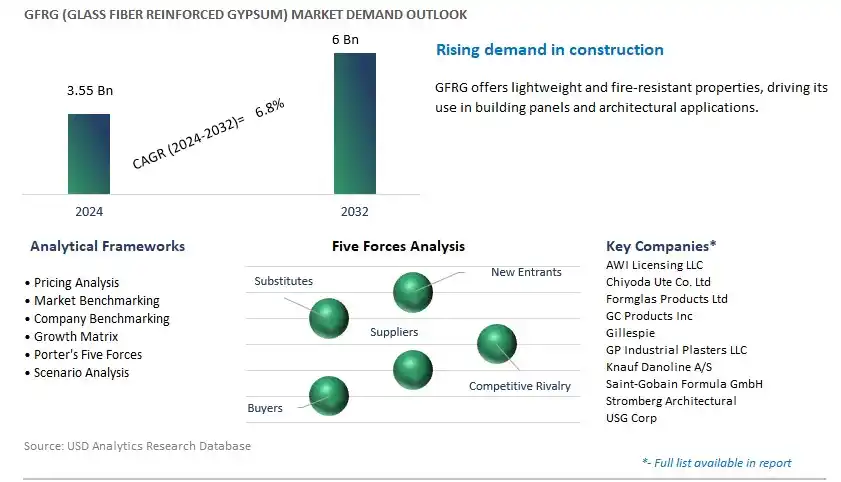
Global GFRG (Glass Fiber Reinforced Gypsum) Market Size is valued at $3.55 Billion in 2024 and is forecast to register a growth rate (CAGR) of 6.8% to reach $6 Billion by 2032.
The global GFRG (Glass Fiber Reinforced Gypsum) Market Study analyzes and forecasts the market size across 6 regions and 24 countries for diverse segments -By Type (Type X, Type C, Others), By Application (Interior, Exterior), By End-User (Residential, Non-Residential).
An Introduction to GFRG (Glass Fiber Reinforced Gypsum) Market in 2024
Glass Fiber Reinforced Gypsum (GFRG) represents a lightweight, high-strength composite material used in architectural and construction applications for decorative elements, moldings, panels, and partitions. In 2024, the market for GFRG is witnessing significant growth driven by its advantages such as moldability, fire resistance, acoustic insulation, and rapid installation compared to traditional construction materials. GFRG products, comprising gypsum plaster reinforced with glass fibers, offer design flexibility and cost-effectiveness for interior and exterior building components. Further, advancements in GFRG manufacturing processes, including 3D printing and automated molding techniques, enable customization and intricate detailing for architectural designs. As architects, designers, and builders seek sustainable and aesthetically pleasing solutions for modern construction projects, the demand for GFRG is expected to escalate, driving further innovation and market expansion.
GFRG (Glass Fiber Reinforced Gypsum) Market Competitive Landscape
The market report analyses the leading companies in the industry including AWI Licensing LLC, Chiyoda Ute Co. Ltd, Formglas Products Ltd, GC Products Inc, Gillespie, GP Industrial Plasters LLC, Knauf Danoline A/S, Saint-Gobain Formula GmbH, Stromberg Architectural, USG Corp, and others.
GFRG (Glass Fiber Reinforced Gypsum) Market Dynamics
Market Trend: Increased Adoption of Sustainable Construction Materials
A prominent trend in the glass fiber reinforced gypsum (GFRG) market is the increased adoption of sustainable construction materials in building projects worldwide. With growing environmental awareness and regulations promoting green building practices, there is a rising demand for construction materials that offer both performance and sustainability benefits. GFRG, composed of gypsum plaster reinforced with glass fibers, aligns with this trend as it provides a lightweight, durable, and fire-resistant alternative to traditional construction materials like concrete and wood. Architects, developers, and builders are increasingly incorporating GFRG panels, tiles, and architectural elements into their designs to achieve energy efficiency, reduce carbon footprint, and meet green building certifications such as LEED (Leadership in Energy and Environmental Design). This trend underscores the industry's recognition of GFRG as a versatile and eco-friendly material solution for sustainable construction projects.
Market Driver: Advantages in Cost, Performance, and Design Flexibility
A key driver fueling the demand for glass fiber reinforced gypsum is its advantages in cost, performance, and design flexibility compared to conventional construction materials. GFRG offers cost savings in terms of material procurement, transportation, and installation, making it an attractive option for budget-conscious projects. Additionally, GFRG exhibits excellent fire resistance, mold resistance, and acoustic insulation properties, enhancing building safety and comfort. Moreover, GFRG's versatility in molding and shaping allows for intricate designs, curved surfaces, and customized architectural features that may be challenging or costly to achieve with other materials. These advantages drive market adoption of GFRG in various applications such as interior wall panels, ceilings, decorative elements, and exterior cladding systems, where performance, aesthetics, and cost-effectiveness are essential considerations for building projects.
Market Opportunity: Expansion into Prefabricated Construction and Modular Building Systems
Amidst the evolving landscape of the glass fiber reinforced gypsum market, there exists a significant opportunity for expansion into prefabricated construction and modular building systems. Manufacturers can capitalize on this opportunity by developing GFRG-based prefabricated components, modules, and building systems that streamline construction processes, reduce onsite labor, and accelerate project timelines. GFRG's lightweight nature, moldability, and ease of handling make it well-suited for prefabrication and modular construction applications, where offsite manufacturing and assembly offer efficiency gains and quality control benefits. Additionally, there are opportunities to integrate GFRG with other prefabricated materials such as steel, wood, and composites to create hybrid building systems that combine the strengths of different materials for optimized performance and functionality. By leveraging their expertise in GFRG manufacturing and collaborating with stakeholders in the construction industry, companies can address emerging market needs, drive innovation, and unlock growth opportunities in the dynamic GFRG market.
GFRG (Glass Fiber Reinforced Gypsum) Market Share Analysis: Type X segment generated the highest revenue in 2024
The Type X segment is the largest in the GFRG (Glass Fiber Reinforced Gypsum) market. Type X GFRG is specifically formulated with additives to provide enhanced fire resistance, making it suitable for use in applications where fire safety is a critical consideration, such as commercial buildings, hospitals, and schools. The additives in Type X GFRG improve its ability to withstand high temperatures and inhibit the spread of flames, thereby meeting stringent building code requirements and regulations related to fire safety. Moreover, Type X GFRG retains the desirable properties of standard GFRG, including lightweight, high strength, and moldability, making it a versatile material for architectural elements such as ceilings, columns, and decorative panels. Additionally, as the construction industry places increasing emphasis on sustainable building materials and energy-efficient designs, Type X GFRG offers environmental benefits such as low embodied energy and recyclability, further driving its adoption in construction projects. As a result of its superior fire resistance properties and versatility, the Type X segment dominates the GFRG market, solidifying its position as the largest segment.
GFRG (Glass Fiber Reinforced Gypsum) Market Share Analysis: Exterior Application is poised to register the fastest CAGR over the forecast period
The exterior application segment is the fastest-growing segment in the GFRG (Glass Fiber Reinforced Gypsum). Traditionally, GFRG has been predominantly used for interior applications such as ceilings, walls, and decorative elements due to its lightweight, moldability, and ease of installation. However, advancements in manufacturing technology and material formulations have expanded the capabilities of GFRG, making it increasingly suitable for exterior applications. GFRG panels and cladding systems offer numerous benefits for exterior use, including high durability, weather resistance, and design versatility. These panels can be manufactured with intricate designs and textures, offering architects and designers a wide range of aesthetic options for exterior facades. Moreover, GFRG's inherent fire resistance and low maintenance requirements make it an attractive choice for exterior applications in both commercial and residential construction projects. Additionally, as the construction industry continues to embrace sustainable and energy-efficient building practices, GFRG's lightweight nature and recyclability further contribute to its growing popularity for exterior applications, reducing material and transportation costs while minimizing environmental impact. As a result of these factors, the exterior application segment in the GFRG market is experiencing rapid growth, making it the fastest-growing segment.
GFRG (Glass Fiber Reinforced Gypsum) Market Share Analysis: Non-Residential segment generated the highest revenue in 2024
The non-residential segment stands as the largest in the GFRG (Glass Fiber Reinforced Gypsum) market. GFRG finds extensive use in non-residential applications such as commercial buildings, institutional facilities, and public infrastructure projects. One key factor driving the dominance of the non-residential segment is the widespread adoption of GFRG for interior architectural elements in commercial and institutional buildings. GFRG's lightweight nature, moldability, and fire resistance make it an attractive choice for applications such as ceilings, wall panels, column covers, and decorative features in these settings. Moreover, GFRG offers cost-effective solutions for achieving intricate designs and customizations, allowing architects and designers to create visually appealing spaces while adhering to budget constraints. Additionally, the durability and low maintenance requirements of GFRG contribute to its popularity in non-residential applications, ensuring long-term performance and cost savings for building owners and operators. Furthermore, as the non-residential construction sector continues to grow globally, driven by urbanization, infrastructure development, and commercial expansion, the demand for GFRG in non-residential applications is expected to remain strong, solidifying its position as the largest segment in the market.
GFRG (Glass Fiber Reinforced Gypsum) Market
By Type
Type X
Type C
Others
By Application
Interior
Exterior
By End-User
Residential
Non-ResidentialCountries Analyzed
North America (US, Canada, Mexico)
Europe (Germany, UK, France, Spain, Italy, Russia, Rest of Europe)
Asia Pacific (China, India, Japan, South Korea, Australia, South East Asia, Rest of Asia)
South America (Brazil, Argentina, Rest of South America)
Middle East and Africa (Saudi Arabia, UAE, Rest of Middle East, South Africa, Egypt, Rest of Africa)
Glass Fiber Reinforced Gypsum Companies Profiled in the Study
AWI Licensing LLC
Chiyoda Ute Co. Ltd
Formglas Products Ltd
GC Products Inc
Gillespie
GP Industrial Plasters LLC
Knauf Danoline A/S
Saint-Gobain Formula GmbH
Stromberg Architectural
USG Corp
*- List Not Exhaustive
TABLE OF CONTENTS
1 Introduction to 2024 Glass Fiber Reinforced Gypsum Market
1.1 Market Overview
1.2 Quick Facts
1.3 Scope/Objective of the Study
1.4 Market Definition
1.5 Countries and Regions Covered
1.6 Units, Currency, and Conversions
1.7 Industry Value Chain
2 Research Methodology
2.1 Market Size Estimation
2.2 Sources and Research Methodology
2.3 Data Triangulation
2.4 Assumptions and Limitations
3 Executive Summary
3.1 Global Glass Fiber Reinforced Gypsum Market Size Outlook, $ Million, 2021 to 2032
3.2 Glass Fiber Reinforced Gypsum Market Outlook by Type, $ Million, 2021 to 2032
3.3 Glass Fiber Reinforced Gypsum Market Outlook by Product, $ Million, 2021 to 2032
3.4 Glass Fiber Reinforced Gypsum Market Outlook by Application, $ Million, 2021 to 2032
3.5 Glass Fiber Reinforced Gypsum Market Outlook by Key Countries, $ Million, 2021 to 2032
4 Market Dynamics
4.1 Key Driving Forces of Glass Fiber Reinforced Gypsum Industry
4.2 Key Market Trends in Glass Fiber Reinforced Gypsum Industry
4.3 Potential Opportunities in Glass Fiber Reinforced Gypsum Industry
4.4 Key Challenges in Glass Fiber Reinforced Gypsum Industry
5 Market Factor Analysis
5.1 Value Chain Analysis
5.2 Competitive Landscape
5.2.1 Global Glass Fiber Reinforced Gypsum Market Share by Company (%), 2023
5.2.2 Product Offerings by Company
5.3 Porter’s Five Forces Analysis
5.4 Pricing Analysis and Outlook
6 Growth Outlook Across Scenarios
6.1 Growth Analysis-Case Scenario Definitions
6.2 Low Growth Scenario Forecasts
6.3 Reference Growth Scenario Forecasts
6.4 High Growth Scenario Forecasts
7 Global Glass Fiber Reinforced Gypsum Market Outlook by Segments
7.1 Glass Fiber Reinforced Gypsum Market Outlook by Segments, $ Million, 2021- 2032
By Type
Type X
Type C
Others
By Application
Interior
Exterior
By End-User
Residential
Non-Residential
8 North America Glass Fiber Reinforced Gypsum Market Analysis and Outlook To 2032
8.1 Introduction to North America Glass Fiber Reinforced Gypsum Markets in 2024
8.2 North America Glass Fiber Reinforced Gypsum Market Size Outlook by Country, 2021-2032
8.2.1 United States
8.2.2 Canada
8.2.3 Mexico
8.3 North America Glass Fiber Reinforced Gypsum Market size Outlook by Segments, 2021-2032
By Type
Type X
Type C
Others
By Application
Interior
Exterior
By End-User
Residential
Non-Residential
9 Europe Glass Fiber Reinforced Gypsum Market Analysis and Outlook To 2032
9.1 Introduction to Europe Glass Fiber Reinforced Gypsum Markets in 2024
9.2 Europe Glass Fiber Reinforced Gypsum Market Size Outlook by Country, 2021-2032
9.2.1 Germany
9.2.2 France
9.2.3 Spain
9.2.4 United Kingdom
9.2.4 Italy
9.2.5 Russia
9.2.6 Norway
9.2.7 Rest of Europe
9.3 Europe Glass Fiber Reinforced Gypsum Market Size Outlook by Segments, 2021-2032
By Type
Type X
Type C
Others
By Application
Interior
Exterior
By End-User
Residential
Non-Residential
10 Asia Pacific Glass Fiber Reinforced Gypsum Market Analysis and Outlook To 2032
10.1 Introduction to Asia Pacific Glass Fiber Reinforced Gypsum Markets in 2024
10.2 Asia Pacific Glass Fiber Reinforced Gypsum Market Size Outlook by Country, 2021-2032
10.2.1 China
10.2.2 India
10.2.3 Japan
10.2.4 South Korea
10.2.5 Indonesia
10.2.6 Malaysia
10.2.7 Australia
10.2.8 Rest of Asia Pacific
10.3 Asia Pacific Glass Fiber Reinforced Gypsum Market size Outlook by Segments, 2021-2032
By Type
Type X
Type C
Others
By Application
Interior
Exterior
By End-User
Residential
Non-Residential
11 South America Glass Fiber Reinforced Gypsum Market Analysis and Outlook To 2032
11.1 Introduction to South America Glass Fiber Reinforced Gypsum Markets in 2024
11.2 South America Glass Fiber Reinforced Gypsum Market Size Outlook by Country, 2021-2032
11.2.1 Brazil
11.2.2 Argentina
11.2.3 Rest of South America
11.3 South America Glass Fiber Reinforced Gypsum Market size Outlook by Segments, 2021-2032
By Type
Type X
Type C
Others
By Application
Interior
Exterior
By End-User
Residential
Non-Residential
12 Middle East and Africa Glass Fiber Reinforced Gypsum Market Analysis and Outlook To 2032
12.1 Introduction to Middle East and Africa Glass Fiber Reinforced Gypsum Markets in 2024
12.2 Middle East and Africa Glass Fiber Reinforced Gypsum Market Size Outlook by Country, 2021-2032
12.2.1 Saudi Arabia
12.2.2 UAE
12.2.3 Oman
12.2.4 Rest of Middle East
12.2.5 Egypt
12.2.6 Nigeria
12.2.7 South Africa
12.2.8 Rest of Africa
12.3 Middle East and Africa Glass Fiber Reinforced Gypsum Market size Outlook by Segments, 2021-2032
By Type
Type X
Type C
Others
By Application
Interior
Exterior
By End-User
Residential
Non-Residential
13 Company Profiles
13.1 Company Snapshot
13.2 SWOT Profiles
13.3 Products and Services
13.4 Recent Developments
13.5 Financial Profile
AWI Licensing LLC
Chiyoda Ute Co. Ltd
Formglas Products Ltd
GC Products Inc
Gillespie
GP Industrial Plasters LLC
Knauf Danoline A/S
Saint-Gobain Formula GmbH
Stromberg Architectural
USG Corp
14 Appendix
14.1 Customization Offerings
14.2 Subscription Services
14.3 Related Reports
14.4 Publisher Expertise
By Type
Type X
Type C
Others
By Application
Interior
Exterior
By End-User
Residential
Non-Residential
Countries Analyzed
North America (US, Canada, Mexico)
Europe (Germany, UK, France, Spain, Italy, Russia, Rest of Europe)
Asia Pacific (China, India, Japan, South Korea, Australia, South East Asia, Rest of Asia)
South America (Brazil, Argentina, Rest of South America)
Middle East and Africa (Saudi Arabia, UAE, Rest of Middle East, South Africa, Egypt, Rest of Africa)
