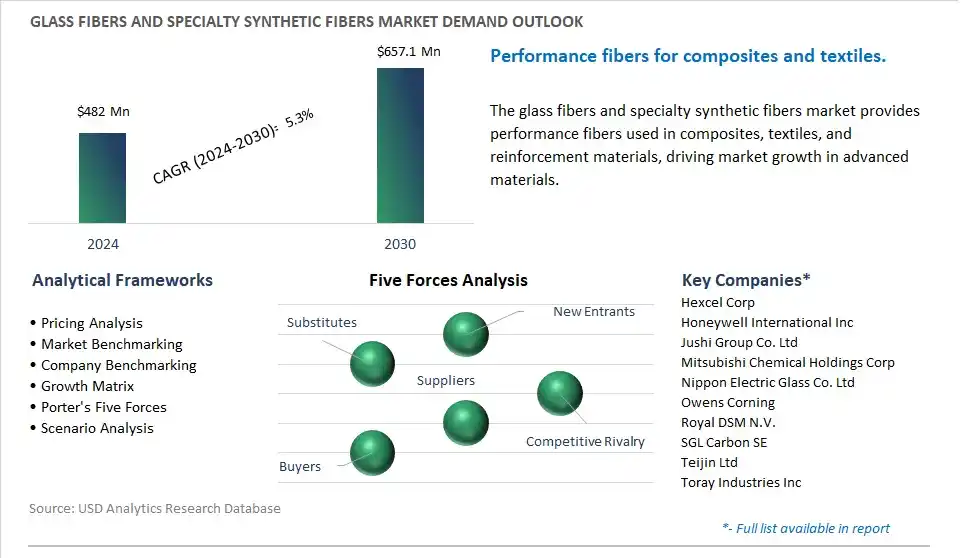
The global Glass Fibers and Specialty Synthetic Fibers Market is poised to register a 5.3% CAGR from $482 Million in 2024 to $657.1 Million in 2030.
The global Glass Fibers and Specialty Synthetic Fibers Market Study analyzes and forecasts the market size across 6 regions and 24 countries for diverse segments -By Fiber (Glass, Carbon, Aramid, Ultra-High Molecular Weight Polyethylene (UHMWPE) Fibers, Polyphenylene Sulfide (PPS) Fibers, Others), By Application (Composite, Non-Composite), By End-User (Aerospace & Defense, Wind Energy, Transportation, Construction & Infrastructure, Marine, Pipe & Tank, Electrical & Electronics, Protective Clothing, Others).
An Introduction to Global Glass Fibers and Specialty Synthetic Fibers Market in 2024
The future of the glass fibers and specialty synthetic fibers market is shaped by trends such as lightweight materials, high-performance applications, and sustainability driving innovation in fiber compositions, manufacturing processes, and application versatility. Glass fibers and specialty synthetic fibers are used in various industries such as automotive, aerospace, and construction for applications such as reinforcement, insulation, and filtration. Key trends shaping this market include advancements in fiber materials such as carbon fiber, aramid fiber, and basalt fiber to achieve high strength-to-weight ratios, temperature resistance, and chemical inertness while reducing environmental impact and energy consumption during production, the development of innovative fiber manufacturing techniques such as melt spinning, electrospinning, and solution spinning to produce fibers with tailored properties and functionalities to meet specific application requirements in diverse industries, and the adoption of fibers in advanced composite materials, textile reinforcements, and filtration media to enhance product performance, durability, and sustainability across various applications. As industries seek lightweight, high-performance solutions for structural reinforcement, thermal insulation, and environmental protection, the demand for glass fibers and specialty synthetic fibers that offer superior mechanical properties, versatility, and environmental sustainability is expected to drive market growth and inspire further innovation in fiber technology and applications.
Glass Fibers and Specialty Synthetic Fibers Market Competitive Landscape
The market report analyses the leading companies in the industry including Hexcel Corp, Honeywell International Inc, Jushi Group Co. Ltd, Mitsubishi Chemical Holdings Corp, Nippon Electric Glass Co. Ltd, Owens Corning, Royal DSM N.V., SGL Carbon SE, Teijin Ltd, Toray Industries Inc.
Glass Fibers and Specialty Synthetic Fibers Market Dynamics
Glass Fibers And Specialty Synthetic Fibers Market Trend: Increasing Demand for Lightweight and High-Performance Materials
A significant trend in the glass fibers and specialty synthetic fibers market is the increasing demand for lightweight and high-performance materials across various industries. With advancements in technology and manufacturing processes, there is a growing preference for materials that offer superior strength, durability, and versatility while being lightweight and easy to handle. Glass fibers and specialty synthetic fibers, such as carbon fibers, aramid fibers, and ultra-high molecular weight polyethylene (UHMWPE) fibers, are sought after for their exceptional mechanical properties, including high tensile strength, stiffness, and resistance to heat, chemicals, and abrasion. These fibers find applications in diverse sectors such as aerospace, automotive, construction, sports and leisure, and defense, where lightweight and high-performance materials are essential for improving efficiency, fuel economy, safety, and sustainability. The trend towards lightweight and high-performance materials drives market growth for glass fibers and specialty synthetic fibers, as industries seek innovative solutions to address evolving performance requirements and market demands, fostering opportunities for market expansion and product development in the fiber industry.
Glass Fibers And Specialty Synthetic Fibers Market Driver: Growth in End-Use Industries and Applications
The primary driver for the glass fibers and specialty synthetic fibers market is the growth in end-use industries and applications that require advanced materials with specific performance characteristics. As industries such as aerospace, automotive, wind energy, construction, and protective apparel continue to expand and innovate, there is a corresponding increase in demand for fibers that offer unique properties and functionalities to meet the stringent requirements of these applications. Glass fibers and specialty synthetic fibers are preferred choices for applications such as composite materials, reinforcement in structural components, ballistic protection, filtration, insulation, and high-performance textiles, where their exceptional strength-to-weight ratio, chemical resistance, and thermal stability provide significant advantages. The growth in end-use industries and applications drives market demand for glass fibers and specialty synthetic fibers, as manufacturers and end-users seek materials that enable them to achieve higher performance standards, improve product quality, and gain a competitive edge in the market, creating opportunities for market growth and expansion in the fiber industry.
Glass Fibers And Specialty Synthetic Fibers Market Opportunity: Innovation in Sustainable and Eco-Friendly Fibers
An opportunity exists for companies operating in the glass fibers and specialty synthetic fibers market to innovate in sustainable and eco-friendly fibers. With increasing emphasis on environmental sustainability and corporate responsibility, there is a growing demand for fibers that are derived from renewable sources, have lower environmental impact throughout their lifecycle, and can be recycled or biodegraded after use. Companies aim to capitalize on this opportunity by investing in research and development to develop bio-based fibers, such as bio-derived polyesters, cellulose-based fibers, and natural fibers reinforced with specialty synthetic fibers, that offer comparable or superior performance to traditional fibers while being more environmentally friendly. Additionally, there is potential to explore technologies for recycling and upcycling of fibers to minimize waste and promote circularity in the fiber industry. By focusing on sustainability and eco-friendliness, companies can differentiate their products, attract environmentally conscious customers, and contribute to the transition towards a more sustainable and circular economy, driving growth and innovation in the fiber market.
Glass Fibers and Specialty Synthetic Fibers Market Ecosystem
Key players including Exxon Mobil Corporation, Owens Corning, and Reliance Industries Ltd. drive innovation and supply fibers that meet the diverse needs of industries worldwide. The Market Ecosystem of the glass fibers and specialty synthetic fibers market starts with raw material production, where chemical manufacturers including Exxon Mobil Corporation and Huntsman Corporation produce petrochemicals and specialty chemicals used in synthetic fiber production. Polymerization follows, where companies including Reliance Industries Ltd. and LyondellBasell Industries NV convert raw materials into polymers, the building blocks for synthetic fibers.
Fiber spinning then occurs, with companies including Owens Corning and Saint-Gobain S.A. transforming polymers or molten glass into continuous filaments through various spinning processes. Further processing steps including drawing, texturing, and cutting are undertaken by fiber processors to tailor fibers for specific applications. Treatment and finishing follow, enhancing fiber properties before distribution and sales through companies including fiber distributors to end users in the textile industry, the composite materials sector, and various other applications including medical textiles and geotextiles.
End users benefit from the diverse applications of synthetic and specialty fibers, including apparel fabrics, industrial textiles, home textiles, and composite materials. Glass fibers, a primary reinforcement material in composite materials, find extensive use in construction, transportation, and aerospace industries due to their strength and durability. Specialty fibers cater to niche markets including medical textiles and filtration applications, providing unique properties including antibacterial coatings or enhanced dyeability.
Glass Fibers And Specialty Synthetic Fibers Market Share Analysis: Glass Fiber Segment held the dominant revenue share in 2024
The Glass Fiber segment is the largest segment in the Glass Fibers And Specialty Synthetic Fibers Market. This dominance is driven by glass fibers are widely used in various industries such as construction, automotive, aerospace, marine, and wind energy due to their exceptional mechanical properties, including high tensile strength, stiffness, and resistance to corrosion and temperature fluctuations. Additionally, glass fibers offer excellent electrical insulation properties, making them suitable for applications in electrical and electronic components. In addition, the versatility of glass fibers allows for the production of a wide range of products such as reinforcement materials, composites, insulation, and textiles, further expanding their market presence. Further, the growing demand for lightweight, durable, and sustainable materials in construction, transportation, and renewable energy sectors drives the adoption of glass fibers as a preferred reinforcement material. As industries continue to innovate and seek advanced materials for diverse applications, the Glass Fiber segment maintains its position as the largest in the Glass Fibers And Specialty Synthetic Fibers Market.
Glass Fibers And Specialty Synthetic Fibers Market Share Analysis: Composite Segment is the fastest growing market segment over the forecast period to 2030
The Composite segment is the fastest-growing segment in the Glass Fibers And Specialty Synthetic Fibers Market. This rapid growth is driven by composite materials reinforced with glass fibers offer superior mechanical properties, including high strength-to-weight ratio, stiffness, and impact resistance, making them ideal for a wide range of applications in aerospace, automotive, construction, wind energy, and sports equipment industries. Additionally, the increasing demand for lightweight and high-performance materials to replace traditional metals and plastics drives the adoption of glass fiber-reinforced composites in various structural and non-structural components. In addition, advancements in composite manufacturing technologies, such as resin infusion, pultrusion, and automated layup processes, enable the production of complex shapes and tailored properties, further expanding the application scope of glass fiber composites. Further, the growing emphasis on sustainability and environmental regulations incentivize industries to adopt composite materials as they offer reduced energy consumption, lower greenhouse gas emissions, and longer service life compared to conventional materials. As industries continue to seek innovative solutions for lightweighting, durability, and efficiency, the Composite segment experiences significant growth in the Glass Fibers And Specialty Synthetic Fibers Market.
Glass Fibers And Specialty Synthetic Fibers Market Share Analysis: Wind Energy Segment is the fastest growing market segment over the forecast period to 2030
The Wind Energy segment is the fastest-growing segment in the Glass Fibers And Specialty Synthetic Fibers Market. This rapid growth is driven by the global shift toward renewable energy sources, coupled with government incentives and climate change regulations, drives the expansion of wind energy infrastructure worldwide. Glass fibers are essential components in the manufacturing of wind turbine blades due to their high strength, stiffness, and fatigue resistance, enabling the production of larger and more efficient blades capable of harnessing wind energy effectively. Additionally, the increasing demand for wind energy as a clean and sustainable power source to meet growing electricity needs further accelerates the adoption of glass fiber-reinforced composites in wind turbine manufacturing. In addition, advancements in blade design, materials, and manufacturing processes enhance the performance, reliability, and durability of wind turbines, contributing to the rapid growth of the Wind Energy segment in the Glass Fibers And Specialty Synthetic Fibers Market. Further, as governments and industries continue to invest in renewable energy infrastructure to mitigate climate change and reduce dependence on fossil fuels, the demand for glass fibers in the wind energy sector is expected to witness sustained growth, making it the fastest-growing segment in the market.
Glass Fibers and Specialty Synthetic Fibers Market Report Scope-
By Fiber
Glass
Carbon
Aramid
Ultra-High Molecular Weight Polyethylene (UHMWPE) Fibers
Polyphenylene Sulfide (PPS) Fibers
Others
By Application
Composite
Non-Composite
By End-User
Aerospace & Defense
Wind Energy
Transportation
Construction & Infrastructure
Marine
Pipe & Tank
Electrical & Electronics
Protective Clothing
Others
Glass Fibers and Specialty Synthetic Fibers Market Companies Profiled
Hexcel Corp
Honeywell International Inc
Jushi Group Co. Ltd
Mitsubishi Chemical Holdings Corp
Nippon Electric Glass Co. Ltd
Owens Corning
Royal DSM N.V.
SGL Carbon SE
Teijin Ltd
Toray Industries Inc
*- List Not Exhaustive
TABLE OF CONTENTS
1 Introduction to 2024 Glass Fibers and Specialty Synthetic Fibers Market
1.1 Market Overview
1.2 Quick Facts
1.3 Scope/Objective of the Study
1.4 Market Definition
1.5 Countries and Regions Covered
1.6 Units, Currency, and Conversions
1.7 Industry Value Chain
2 Research Methodology
2.1 Market Size Estimation
2.2 Sources and Research Methodology
2.3 Data Triangulation
2.4 Assumptions and Limitations
3 Executive Summary
3.1 Global Glass Fibers and Specialty Synthetic Fibers Market Size Outlook, $ Million, 2021 to 2030
3.2 Glass Fibers and Specialty Synthetic Fibers Market Outlook by Type, $ Million, 2021 to 2030
3.3 Glass Fibers and Specialty Synthetic Fibers Market Outlook by Product, $ Million, 2021 to 2030
3.4 Glass Fibers and Specialty Synthetic Fibers Market Outlook by Application, $ Million, 2021 to 2030
3.5 Glass Fibers and Specialty Synthetic Fibers Market Outlook by Key Countries, $ Million, 2021 to 2030
4 Market Dynamics
4.1 Key Driving Forces of Glass Fibers and Specialty Synthetic Fibers Industry
4.2 Key Market Trends in Glass Fibers and Specialty Synthetic Fibers Industry
4.3 Potential Opportunities in Glass Fibers and Specialty Synthetic Fibers Industry
4.4 Key Challenges in Glass Fibers and Specialty Synthetic Fibers Industry
5 Market Factor Analysis
5.1 Value Chain Analysis
5.2 Competitive Landscape
5.2.1 Global Glass Fibers and Specialty Synthetic Fibers Market Share by Company (%), 2023
5.2.2 Product Offerings by Company
5.3 Porter’s Five Forces Analysis
5.4 Pricing Analysis and Outlook
6 Growth Outlook Across Scenarios
6.1 Growth Analysis-Case Scenario Definitions
6.2 Low Growth Scenario Forecasts
6.3 Reference Growth Scenario Forecasts
6.4 High Growth Scenario Forecasts
7 Global Glass Fibers and Specialty Synthetic Fibers Market Outlook by Segments
7.1 Glass Fibers and Specialty Synthetic Fibers Market Outlook by Segments, $ Million, 2021- 2030
By Fiber
Glass
Carbon
Aramid
Ultra-High Molecular Weight Polyethylene (UHMWPE) Fibers
Polyphenylene Sulfide (PPS) Fibers
Others
By Application
Composite
Non-Composite
By End-User
Aerospace & Defense
Wind Energy
Transportation
Construction & Infrastructure
Marine
Pipe & Tank
Electrical & Electronics
Protective Clothing
Others
8 North America Glass Fibers and Specialty Synthetic Fibers Market Analysis and Outlook To 2030
8.1 Introduction to North America Glass Fibers and Specialty Synthetic Fibers Markets in 2024
8.2 North America Glass Fibers and Specialty Synthetic Fibers Market Size Outlook by Country, 2021-2030
8.2.1 United States
8.2.2 Canada
8.2.3 Mexico
8.3 North America Glass Fibers and Specialty Synthetic Fibers Market size Outlook by Segments, 2021-2030
By Fiber
Glass
Carbon
Aramid
Ultra-High Molecular Weight Polyethylene (UHMWPE) Fibers
Polyphenylene Sulfide (PPS) Fibers
Others
By Application
Composite
Non-Composite
By End-User
Aerospace & Defense
Wind Energy
Transportation
Construction & Infrastructure
Marine
Pipe & Tank
Electrical & Electronics
Protective Clothing
Others
9 Europe Glass Fibers and Specialty Synthetic Fibers Market Analysis and Outlook To 2030
9.1 Introduction to Europe Glass Fibers and Specialty Synthetic Fibers Markets in 2024
9.2 Europe Glass Fibers and Specialty Synthetic Fibers Market Size Outlook by Country, 2021-2030
9.2.1 Germany
9.2.2 France
9.2.3 Spain
9.2.4 United Kingdom
9.2.4 Italy
9.2.5 Russia
9.2.6 Norway
9.2.7 Rest of Europe
9.3 Europe Glass Fibers and Specialty Synthetic Fibers Market Size Outlook by Segments, 2021-2030
By Fiber
Glass
Carbon
Aramid
Ultra-High Molecular Weight Polyethylene (UHMWPE) Fibers
Polyphenylene Sulfide (PPS) Fibers
Others
By Application
Composite
Non-Composite
By End-User
Aerospace & Defense
Wind Energy
Transportation
Construction & Infrastructure
Marine
Pipe & Tank
Electrical & Electronics
Protective Clothing
Others
10 Asia Pacific Glass Fibers and Specialty Synthetic Fibers Market Analysis and Outlook To 2030
10.1 Introduction to Asia Pacific Glass Fibers and Specialty Synthetic Fibers Markets in 2024
10.2 Asia Pacific Glass Fibers and Specialty Synthetic Fibers Market Size Outlook by Country, 2021-2030
10.2.1 China
10.2.2 India
10.2.3 Japan
10.2.4 South Korea
10.2.5 Indonesia
10.2.6 Malaysia
10.2.7 Australia
10.2.8 Rest of Asia Pacific
10.3 Asia Pacific Glass Fibers and Specialty Synthetic Fibers Market size Outlook by Segments, 2021-2030
By Fiber
Glass
Carbon
Aramid
Ultra-High Molecular Weight Polyethylene (UHMWPE) Fibers
Polyphenylene Sulfide (PPS) Fibers
Others
By Application
Composite
Non-Composite
By End-User
Aerospace & Defense
Wind Energy
Transportation
Construction & Infrastructure
Marine
Pipe & Tank
Electrical & Electronics
Protective Clothing
Others
11 South America Glass Fibers and Specialty Synthetic Fibers Market Analysis and Outlook To 2030
11.1 Introduction to South America Glass Fibers and Specialty Synthetic Fibers Markets in 2024
11.2 South America Glass Fibers and Specialty Synthetic Fibers Market Size Outlook by Country, 2021-2030
11.2.1 Brazil
11.2.2 Argentina
11.2.3 Rest of South America
11.3 South America Glass Fibers and Specialty Synthetic Fibers Market size Outlook by Segments, 2021-2030
By Fiber
Glass
Carbon
Aramid
Ultra-High Molecular Weight Polyethylene (UHMWPE) Fibers
Polyphenylene Sulfide (PPS) Fibers
Others
By Application
Composite
Non-Composite
By End-User
Aerospace & Defense
Wind Energy
Transportation
Construction & Infrastructure
Marine
Pipe & Tank
Electrical & Electronics
Protective Clothing
Others
12 Middle East and Africa Glass Fibers and Specialty Synthetic Fibers Market Analysis and Outlook To 2030
12.1 Introduction to Middle East and Africa Glass Fibers and Specialty Synthetic Fibers Markets in 2024
12.2 Middle East and Africa Glass Fibers and Specialty Synthetic Fibers Market Size Outlook by Country, 2021-2030
12.2.1 Saudi Arabia
12.2.2 UAE
12.2.3 Oman
12.2.4 Rest of Middle East
12.2.5 Egypt
12.2.6 Nigeria
12.2.7 South Africa
12.2.8 Rest of Africa
12.3 Middle East and Africa Glass Fibers and Specialty Synthetic Fibers Market size Outlook by Segments, 2021-2030
By Fiber
Glass
Carbon
Aramid
Ultra-High Molecular Weight Polyethylene (UHMWPE) Fibers
Polyphenylene Sulfide (PPS) Fibers
Others
By Application
Composite
Non-Composite
By End-User
Aerospace & Defense
Wind Energy
Transportation
Construction & Infrastructure
Marine
Pipe & Tank
Electrical & Electronics
Protective Clothing
Others
13 Company Profiles
13.1 Company Snapshot
13.2 SWOT Profiles
13.3 Products and Services
13.4 Recent Developments
13.5 Financial Profile
Hexcel Corp
Honeywell International Inc
Jushi Group Co. Ltd
Mitsubishi Chemical Holdings Corp
Nippon Electric Glass Co. Ltd
Owens Corning
Royal DSM N.V.
SGL Carbon SE
Teijin Ltd
Toray Industries Inc
14 Appendix
14.1 Customization Offerings
14.2 Subscription Services
14.3 Related Reports
14.4 Publisher Expertise
By Fiber
Glass
Carbon
Aramid
Ultra-High Molecular Weight Polyethylene (UHMWPE) Fibers
Polyphenylene Sulfide (PPS) Fibers
Others
By Application
Composite
Non-Composite
By End-User
Aerospace & Defense
Wind Energy
Transportation
Construction & Infrastructure
Marine
Pipe & Tank
Electrical & Electronics
Protective Clothing
Others
Countries Analyzed
North America (US, Canada, Mexico)
Europe (Germany, UK, France, Spain, Italy, Russia, Rest of Europe)
Asia Pacific (China, India, Japan, South Korea, Australia, South East Asia, Rest of Asia)
South America (Brazil, Argentina, Rest of South America)
Middle East and Africa (Saudi Arabia, UAE, Rest of Middle East, South Africa, Egypt, Rest of Africa)
