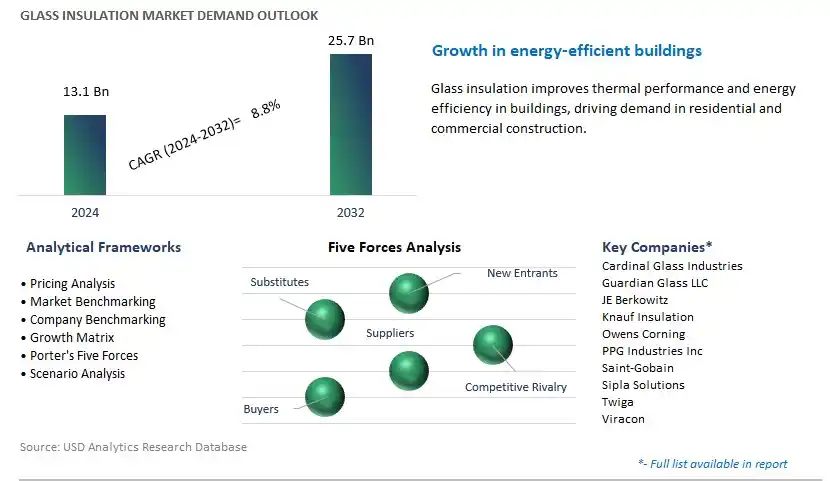
Global Glass Insulation Market Size is valued at $13.1 Billion in 2024 and is forecast to register a growth rate (CAGR) of 8.8% to reach $25.7 Billion by 2032.
The global Glass Insulation Market Study analyzes and forecasts the market size across 6 regions and 24 countries for diverse segments -By Type (Insulating glass units, Glass wool, Cellular glass), By Application (Non-residential construction, Residential construction, Industrial, HVAC, Others).
An Introduction to Glass Insulation Market in 2024
Glass insulation represents a vital component in building envelopes, HVAC systems, and industrial applications, providing thermal and acoustic insulation to enhance energy efficiency, occupant comfort, and process performance. In 2024, the market for glass insulation is witnessing robust growth driven by increasing emphasis on sustainability, energy conservation, and regulatory requirements for building performance. These insulation products, composed of glass fibers bonded with resin or mineral binders, offer advantages such as thermal resistance, fire resistance, moisture resistance, and non-combustibility, meeting stringent industry standards and green building certifications. Further, advancements in glass insulation manufacturing processes, including blown-in insulation, batts, and loose-fill applications, ensure compatibility with diverse construction methods and building designs. As architects, builders, and facility managers prioritize energy-efficient building solutions, the demand for glass insulation is expected to escalate, driving further innovation and market expansion.
Glass Insulation Market Competitive Landscape
The market report analyses the leading companies in the industry including Cardinal Glass Industries, Guardian Glass LLC, JE Berkowitz, Knauf Insulation, Owens Corning, PPG Industries Inc, Saint-Gobain, Sipla Solutions, Twiga, Viracon, and others.
Glass Insulation Market Dynamics
Market Trend: Rising Emphasis on Energy Efficiency and Sustainable Building Practices
A prominent trend in the glass insulation market is the rising emphasis on energy efficiency and sustainable building practices. With increasing awareness of environmental concerns and the need to reduce carbon emissions, there is a growing demand for building materials that improve energy efficiency and indoor comfort while minimizing environmental impact. Glass insulation, known for its thermal performance, acoustic properties, and fire resistance, is witnessing greater adoption in residential, commercial, and industrial construction projects. Builders, developers, and homeowners are incorporating glass insulation solutions to enhance building envelope performance, reduce heating and cooling costs, and meet energy efficiency standards and green building certifications such as LEED (Leadership in Energy and Environmental Design). This trend reflects the industry's recognition of glass insulation as a key component in achieving sustainable building goals and addressing climate change challenges.
Market Driver: Stringent Building Codes and Energy Efficiency Regulations
A key driver fueling the demand for glass insulation is the implementation of stringent building codes and energy efficiency regulations worldwide. Governments, regulatory agencies, and industry organizations are enacting measures to improve building energy performance, reduce greenhouse gas emissions, and enhance occupant comfort and well-being. Glass insulation products, such as fiberglass batts, blown-in insulation, and rigid panels, help buildings meet or exceed thermal insulation requirements by effectively reducing heat transfer and air infiltration. Additionally, glass insulation's non-combustible nature and fire resistance properties contribute to building safety and code compliance in fire-prone areas. The enforcement of energy codes, standards, and incentives drives market adoption of glass insulation solutions in both new construction and retrofit projects, where energy efficiency and regulatory compliance are essential considerations for building design and performance.
Market Opportunity: Innovation in High-Performance Insulation Solutions
Amidst the evolving landscape of the glass insulation market, there exists a significant opportunity for innovation in high-performance insulation solutions tailored to meet the evolving needs of the construction industry. Manufacturers can capitalize on this opportunity by developing glass insulation products with enhanced thermal conductivity, moisture resistance, and acoustic attenuation properties. Advanced glass insulation technologies such as vacuum insulated panels (VIPs), aerogel-based insulation, and hybrid insulation systems offer opportunities to improve insulation performance while reducing material thickness and space requirements. Additionally, there are opportunities to integrate smart technologies such as phase change materials (PCMs) and thermal energy storage solutions into glass insulation products to provide dynamic thermal management and energy efficiency benefits. By leveraging their expertise in glass manufacturing and insulation technology, companies can address emerging market needs, drive innovation, and unlock growth opportunities in the dynamic glass insulation market.
Glass Insulation Market Share Analysis: Insulating Glass Units segment generated the highest revenue in 2024
The insulating glass units segment stands as the largest in the Glass Insulation market. Insulating glass units (IGUs), also known as double glazing or double-pane windows, consist of two or more glass panes separated by a spacer and sealed to form an airtight unit. IGUs offer superior thermal insulation properties compared to single-pane windows, helping to reduce heat transfer and improve energy efficiency in buildings. This makes them highly desirable for both residential and commercial construction projects, where energy efficiency and environmental sustainability are key considerations. Additionally, IGUs provide benefits such as sound insulation, reduced condensation, and enhanced security, further increasing their popularity in the market. Moreover, advancements in IGU technology, such as low-emissivity coatings, gas fills (e.g., argon or krypton), and warm edge spacers, have further improved their performance and energy efficiency, driving their widespread adoption. Furthermore, government regulations and incentives promoting energy-efficient building practices have spurred the demand for IGUs in regions around the world. As a result of these factors, the insulating glass units segment dominates the Glass Insulation market, solidifying its position as the largest segment.
Glass Insulation Market Share Analysis: HVAC is poised to register the fastest CAGR over the forecast period
The HVAC (Heating, Ventilation, and Air Conditioning) segment is the fastest-growing segment in the Glass Insulation market. HVAC systems play a critical role in maintaining comfortable indoor environments in various settings, including residential, commercial, and industrial buildings. Glass insulation materials are integral components of HVAC systems, providing thermal insulation to ductwork, pipes, and equipment to improve energy efficiency and system performance. As energy efficiency regulations become increasingly stringent and environmental concerns drive the demand for sustainable building practices, the adoption of high-performance glass insulation materials in HVAC applications is on the rise. Moreover, advancements in glass insulation technology, such as the development of low thermal conductivity materials and improved installation methods, further enhance the energy-saving potential and effectiveness of HVAC systems. Additionally, the growing emphasis on indoor air quality and occupant comfort drives the demand for HVAC systems with enhanced insulation properties, promoting the adoption of glass insulation materials in new construction projects and retrofit applications. Furthermore, the expansion of commercial and industrial sectors, coupled with increasing investments in infrastructure development globally, contributes to the growing demand for HVAC systems and associated insulation materials. As a result of these factors, the HVAC segment is experiencing rapid growth in the Glass Insulation market, making it the fastest-growing segment.
Glass Insulation Market
By Type
Insulating glass units
Glass wool
Cellular glass
By Application
Non-residential construction
Residential construction
Industrial
HVAC
Others
Countries Analyzed
North America (US, Canada, Mexico)
Europe (Germany, UK, France, Spain, Italy, Russia, Rest of Europe)
Asia Pacific (China, India, Japan, South Korea, Australia, South East Asia, Rest of Asia)
South America (Brazil, Argentina, Rest of South America)
Middle East and Africa (Saudi Arabia, UAE, Rest of Middle East, South Africa, Egypt, Rest of Africa)
Glass Insulation Companies Profiled in the Study
Cardinal Glass Industries
Guardian Glass LLC
JE Berkowitz
Knauf Insulation
Owens Corning
PPG Industries Inc
Saint-Gobain
Sipla Solutions
Twiga
Viracon
*- List Not Exhaustive
TABLE OF CONTENTS
1 Introduction to 2024 Glass Insulation Market
1.1 Market Overview
1.2 Quick Facts
1.3 Scope/Objective of the Study
1.4 Market Definition
1.5 Countries and Regions Covered
1.6 Units, Currency, and Conversions
1.7 Industry Value Chain
2 Research Methodology
2.1 Market Size Estimation
2.2 Sources and Research Methodology
2.3 Data Triangulation
2.4 Assumptions and Limitations
3 Executive Summary
3.1 Global Glass Insulation Market Size Outlook, $ Million, 2021 to 2032
3.2 Glass Insulation Market Outlook by Type, $ Million, 2021 to 2032
3.3 Glass Insulation Market Outlook by Product, $ Million, 2021 to 2032
3.4 Glass Insulation Market Outlook by Application, $ Million, 2021 to 2032
3.5 Glass Insulation Market Outlook by Key Countries, $ Million, 2021 to 2032
4 Market Dynamics
4.1 Key Driving Forces of Glass Insulation Industry
4.2 Key Market Trends in Glass Insulation Industry
4.3 Potential Opportunities in Glass Insulation Industry
4.4 Key Challenges in Glass Insulation Industry
5 Market Factor Analysis
5.1 Value Chain Analysis
5.2 Competitive Landscape
5.2.1 Global Glass Insulation Market Share by Company (%), 2023
5.2.2 Product Offerings by Company
5.3 Porter’s Five Forces Analysis
5.4 Pricing Analysis and Outlook
6 Growth Outlook Across Scenarios
6.1 Growth Analysis-Case Scenario Definitions
6.2 Low Growth Scenario Forecasts
6.3 Reference Growth Scenario Forecasts
6.4 High Growth Scenario Forecasts
7 Global Glass Insulation Market Outlook by Segments
7.1 Glass Insulation Market Outlook by Segments, $ Million, 2021- 2032
By Type
Insulating glass units
Glass wool
Cellular glass
By Application
Non-residential construction
Residential construction
Industrial
HVAC
Others
8 North America Glass Insulation Market Analysis and Outlook To 2032
8.1 Introduction to North America Glass Insulation Markets in 2024
8.2 North America Glass Insulation Market Size Outlook by Country, 2021-2032
8.2.1 United States
8.2.2 Canada
8.2.3 Mexico
8.3 North America Glass Insulation Market size Outlook by Segments, 2021-2032
By Type
Insulating glass units
Glass wool
Cellular glass
By Application
Non-residential construction
Residential construction
Industrial
HVAC
Others
9 Europe Glass Insulation Market Analysis and Outlook To 2032
9.1 Introduction to Europe Glass Insulation Markets in 2024
9.2 Europe Glass Insulation Market Size Outlook by Country, 2021-2032
9.2.1 Germany
9.2.2 France
9.2.3 Spain
9.2.4 United Kingdom
9.2.4 Italy
9.2.5 Russia
9.2.6 Norway
9.2.7 Rest of Europe
9.3 Europe Glass Insulation Market Size Outlook by Segments, 2021-2032
By Type
Insulating glass units
Glass wool
Cellular glass
By Application
Non-residential construction
Residential construction
Industrial
HVAC
Others
10 Asia Pacific Glass Insulation Market Analysis and Outlook To 2032
10.1 Introduction to Asia Pacific Glass Insulation Markets in 2024
10.2 Asia Pacific Glass Insulation Market Size Outlook by Country, 2021-2032
10.2.1 China
10.2.2 India
10.2.3 Japan
10.2.4 South Korea
10.2.5 Indonesia
10.2.6 Malaysia
10.2.7 Australia
10.2.8 Rest of Asia Pacific
10.3 Asia Pacific Glass Insulation Market size Outlook by Segments, 2021-2032
By Type
Insulating glass units
Glass wool
Cellular glass
By Application
Non-residential construction
Residential construction
Industrial
HVAC
Others
11 South America Glass Insulation Market Analysis and Outlook To 2032
11.1 Introduction to South America Glass Insulation Markets in 2024
11.2 South America Glass Insulation Market Size Outlook by Country, 2021-2032
11.2.1 Brazil
11.2.2 Argentina
11.2.3 Rest of South America
11.3 South America Glass Insulation Market size Outlook by Segments, 2021-2032
By Type
Insulating glass units
Glass wool
Cellular glass
By Application
Non-residential construction
Residential construction
Industrial
HVAC
Others
12 Middle East and Africa Glass Insulation Market Analysis and Outlook To 2032
12.1 Introduction to Middle East and Africa Glass Insulation Markets in 2024
12.2 Middle East and Africa Glass Insulation Market Size Outlook by Country, 2021-2032
12.2.1 Saudi Arabia
12.2.2 UAE
12.2.3 Oman
12.2.4 Rest of Middle East
12.2.5 Egypt
12.2.6 Nigeria
12.2.7 South Africa
12.2.8 Rest of Africa
12.3 Middle East and Africa Glass Insulation Market size Outlook by Segments, 2021-2032
By Type
Insulating glass units
Glass wool
Cellular glass
By Application
Non-residential construction
Residential construction
Industrial
HVAC
Others
13 Company Profiles
13.1 Company Snapshot
13.2 SWOT Profiles
13.3 Products and Services
13.4 Recent Developments
13.5 Financial Profile
Cardinal Glass Industries
Guardian Glass LLC
JE Berkowitz
Knauf Insulation
Owens Corning
PPG Industries Inc
Saint-Gobain
Sipla Solutions
Twiga
Viracon
14 Appendix
14.1 Customization Offerings
14.2 Subscription Services
14.3 Related Reports
14.4 Publisher Expertise
By Type
Insulating glass units
Glass wool
Cellular glass
By Application
Non-residential construction
Residential construction
Industrial
HVAC
Others
Countries Analyzed
North America (US, Canada, Mexico)
Europe (Germany, UK, France, Spain, Italy, Russia, Rest of Europe)
Asia Pacific (China, India, Japan, South Korea, Australia, South East Asia, Rest of Asia)
South America (Brazil, Argentina, Rest of South America)
Middle East and Africa (Saudi Arabia, UAE, Rest of Middle East, South Africa, Egypt, Rest of Africa)
