GLP-1 Injectable Drug Delivery Devices Market Overview: Self-Injection Demand, Device Manufacturing Economics and Commercial Supply
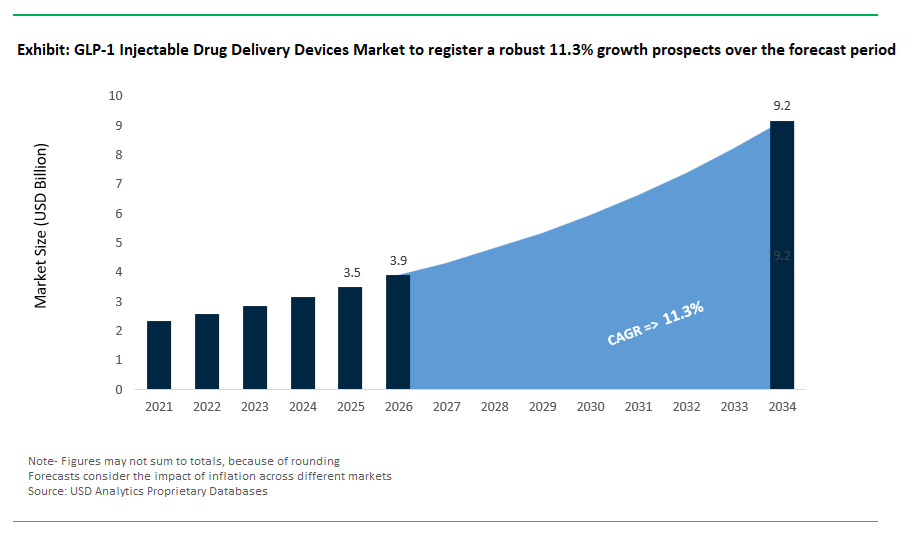
The global GLP-1 Injectable Drug Delivery Devices Market is valued at USD 3,954.3 million in 2026 and is projected to reach USD 9,296.6 million by 2034, expanding at a CAGR of 11.3% during 2026–2034. The market encompasses injection pens, autoinjectors, prefilled syringe systems and specialized subcutaneous delivery platforms used to administer GLP-1 receptor agonists and related injectable incretin therapies. Its revenue is attributable to drug delivery devices, related components and associated manufacturing services rather than the pharmaceutical selling value of semaglutide, tirzepatide and other therapeutic molecules. Pharmaceutical manufacturers source drug delivery systems through device OEMs, specialized component suppliers and contract manufacturing partners, with commercial requirements varying according to drug formulation, administration frequency, dose presentation and expected treatment volumes. The market includes standardized injection platforms and customized drug-device configurations involving different levels of engineering, tooling, assembly and product qualification.
The commercial economics of GLP-1 injectable devices differ substantially between disposable single-dose systems, multi-dose injection pens and reusable configurations. Single-dose devices generate repeated demand for complete injection mechanisms, while multi-dose devices distribute the manufacturing cost of a device across several administered doses. This distinction affects polymer consumption, mechanical component requirements, assembly productivity and device-related expenditure per treatment course. Manufacturing revenue is also influenced by the degree of device customization, the use of established delivery platforms and the scale of production required for commercial pharmaceutical supply. Injection molding, spring and drive mechanism assembly, primary container integration and finished-device testing contribute to device manufacturing costs, with production yield and automated assembly throughput affecting the economic performance of high-volume supply contracts. Device platforms with established manufacturing processes can support multiple pharmaceutical programs, although formulation compatibility and product-specific validation remain separate commercial requirements.
The commercial value of GLP-1 drug delivery device suppliers is determined by the reliability of their manufacturing systems, device performance and ability to support pharmaceutical product supply throughout its commercial lifecycle. Device malfunctions, dimensional variation and inconsistent dose delivery can affect finished-product acceptance and create additional manufacturing or product-quality costs. Pharmaceutical-device interfaces also introduce operational dependencies between component production, sterile drug filling and final device assembly, making production scheduling and container compatibility significant factors in overall supply continuity. Supplier agreements may encompass development services, dedicated tooling, finished-device components, assembly equipment support and recurring device deliveries. Contract economics vary according to product maturity, committed production volumes, manufacturing location and the extent of technical services included. Changes in dose strengths, pharmaceutical presentations and component specifications can generate additional engineering and validation activity during the commercial life of an injectable medicine.
Key Insights
- Recurring injectable therapy demand supports sustained production of disposable pens, autoinjectors and associated drug delivery components.
- Cost per administered dose varies by device configuration, reflecting differences in component consumption, device reuse and assembly requirements.
- Platform-based injection devices support pharmaceutical product customization while retaining common manufacturing technologies and component architectures.
- Manufacturing scale and device reliability influence supplier competitiveness through assembly yield, dose-delivery consistency and commercial supply continuity.
- Drug-device integration creates long-term supplier relationships, encompassing container compatibility, product qualification, component manufacturing and final assembly.
GLP-1 Injectable Drug Delivery Devices Market Recent Developments: Pen Injector Approvals, Autoinjector Platforms and Manufacturing Expansion
Recent developments in the GLP-1 Injectable Drug Delivery Devices Market reflect changes in approved injection presentations, device platform portfolios and manufacturing capacity for pharmaceutical self-administration systems. On February 23, 2026, Eli Lilly announced that the U.S. Food and Drug Administration (FDA) had approved an expansion of the Zepbound (tirzepatide) label to include a four-dose KwikPen. The Zepbound multi-dose KwikPen approval introduced a single-patient-use device capable of providing four weekly doses, alongside the medicine's existing single-dose vial presentation. The device configuration extends Lilly's established KwikPen technology into an additional U.S. obesity treatment presentation, involving integrated dose-metering components and a pharmaceutical cartridge system.
Higher-dose semaglutide presentations have also reached additional regulatory and commercial milestones. In March 2026, Novo Nordisk announced U.S. FDA approval of Wegovy HD, containing 7.2 mg of semaglutide for once-weekly administration through a single-dose pen, with commercial introduction following in April. The company's second-quarter 2026 results confirmed that the 7.2 mg single-dose pen had subsequently launched in the United Kingdom in June and received European regulatory approval in July. These product developments introduce additional approved device-and-dose configurations within established injectable obesity treatment portfolios, involving higher-dose pharmaceutical presentations and corresponding injection-device supply requirements.
Drug delivery device manufacturers have expanded their commercial platforms and production capabilities alongside pharmaceutical product development. In May 2026, Ypsomed reported 33.6% growth in commercial autoinjector sales during fiscal 2025/26, together with the introduction of the YpsoLoop, YpsoDot and YpsoFlow platforms. The company also reported acquiring a manufacturing facility in Holly Springs, North Carolina, and expanding its clinical-stage autoinjector service offering. Separately, SHL Medical introduced its Quanta automatic multi-fixed-dose pen in 2026, extending its portfolio for once-weekly cardiometabolic therapies. These developments cover broader self-injection applications as well as device technologies relevant to GLP-1 medicines.
Manufacturing localization has accompanied these product and platform developments. In March 2025, SHL Medical inaugurated a USD 220 million autoinjector manufacturing facility in North Charleston, South Carolina, incorporating advanced injection molding and automated assembly capabilities. The facility was established to support growing demand across several therapeutic categories, including GLP-1-based treatments. By October 2026, the company also reported that its Molly autoinjector platform was used in more than 20 approved combination products across multiple therapeutic indications, with 90 million Molly devices delivered globally during 2025. The reported volumes refer to the broader platform portfolio rather than GLP-1-specific device shipments.
GLP-1 Injectable Drug Delivery Devices Market Regulatory Framework, Injection Device Standards and Combination Product Quality
The GLP-1 Injectable Drug Delivery Devices Market operates within pharmaceutical and medical device regulatory frameworks because prefilled injection pens and autoinjectors commonly form drug-device combination products. In the United States, applicable manufacturing requirements depend on the product's regulatory classification and constituent components. The FDA's Quality Management System Regulation (QMSR), effective February 2, 2026, revised 21 CFR Part 820 by incorporating ISO 13485:2016 for medical device quality management systems. Combination products are additionally subject to applicable current good manufacturing practice provisions under 21 CFR Part 4, with quality responsibilities extending across device development, pharmaceutical filling, final assembly and postmarket activities.
Device performance verification is informed by ISO 11608-1:2022 and its April 2026 amendment, covering requirements and testing methods for applicable needle-based injection systems. The standard addresses devices intended to deliver discrete medicinal product volumes through needles or soft cannulas, including relevant prefilled-container configurations. Device qualification encompasses delivered-dose accuracy, injection mechanism reliability, mechanical performance and compatibility with the intended drug container. Standalone prefilled syringes are subject to separate applicable specifications, including ISO 11040-8.
Human-factors evidence is another important component of GLP-1 injection-device development. The FDA's August 2026 human-factors and usability engineering guidance addresses use-related risks, user-interface design and validation for intended users and operating environments. For pharmaceutical-device combinations marketed in Europe, the European Medicines Agency's drug-device quality documentation guideline distinguishes integral, co-packaged and separately obtained devices, with relevant requirements under Regulation (EU) 2017/745. Technical documentation includes container compatibility, device functionality, pharmaceutical stability, usability evidence and applicable conformity assessment information.
Key Market Trends Shaping GLP-1 Injectable Drug Delivery Devices
Single-Dose Autoinjectors and Multi-Dose Pen Injectors Reshape GLP-1 Drug Delivery Device Demand
The GLP-1 Injectable Drug Delivery Devices Market is characterized by the coexistence of single-dose autoinjectors and multi-dose pen injectors, reflecting differences in pharmaceutical product presentation, dosing schedules and device manufacturing economics. Single-dose autoinjectors typically integrate a prefilled syringe with an automated injection mechanism, providing a fixed-dose delivery system with needle shielding and visual or audible dose-completion feedback. Multi-dose disposable pens accommodate repeated injections from a single drug reservoir, reducing the number of complete device mechanisms required across a treatment cycle while introducing dose-metering, cartridge and needle-interface requirements. Device selection is influenced by formulation characteristics, dose escalation, administration frequency, injection volume and regional pharmaceutical commercialization models. For drug delivery device manufacturers, the distinction affects injection molding requirements, spring and drive mechanisms, assembly-line configurations and component consumption per administered dose. Commercial differentiation also reflects device reliability, manufacturing yield, primary container compatibility and the ability to maintain consistent injection performance across different drug strengths.
Platform-Based GLP-1 Injection Devices and Connected Dose-Tracking Technologies Expand Drug Delivery Capabilities
Platform-based drug delivery systems are gaining commercial importance as pharmaceutical manufacturers seek injection devices compatible with different formulations, dose strengths and product presentations without requiring entirely separate mechanical architectures. Standardized autoinjector and pen injector platforms use common drive mechanisms, housing configurations and assembly principles while accommodating selected variations in primary containers, injection forces and user interfaces. This platform approach influences tooling requirements, component procurement, production validation and manufacturing transfer between pharmaceutical programs. Connected drug delivery technologies introduce an additional level of differentiation through electronic dose-event recording, near-field communication (NFC), Bluetooth-enabled accessories and digital injection guidance. Connectivity can provide information on injection timing, device activation and selected handling events, although recorded device events do not necessarily establish that the complete prescribed dose entered the patient. Commercial adoption depends on electronic component costs, power requirements, device compatibility, data-system integration and the additional validation associated with connected drug-device configurations.
Sustainable Autoinjector Materials and Recyclable Device Designs Gain Importance in GLP-1 Drug Delivery
Increasing production of disposable GLP-1 injection devices is bringing material consumption, device architecture and end-of-life handling into greater focus within the pharmaceutical drug delivery supply chain. Single-use autoinjectors incorporate molded polymers, metallic springs, needle assemblies and pharmaceutical primary containers, creating different material recovery challenges from reusable cartridge-based injection systems. Drug delivery device manufacturers are exploring reduced-component designs, bio-circular polymer sourcing, reusable drive mechanisms and simplified material combinations to address lifecycle environmental impacts. The commercial implications extend to polymer procurement, injection molding compatibility, tooling performance, device assembly and packaging material consumption. Design-for-disassembly concepts can facilitate separation of selected device components, but actual recycling remains dependent on collection infrastructure, sharps handling restrictions and material recovery processes. Environmental differentiation is increasingly associated with lifecycle assessment boundaries, material sourcing documentation, manufacturing energy consumption and the practical treatment of contaminated device components after use.
GLP-1 Injectable Drug Delivery Devices Market Drivers
Expanding GLP-1 Therapy Demand and Approved Metabolic Disease Indications Drive Injectable Device Production
Increasing utilization of GLP-1 receptor agonists and related injectable incretin therapies is expanding the manufacturing requirements for pharmaceutical injection devices used in type 2 diabetes, obesity and selected associated metabolic conditions. Commercial device demand is influenced by the number of patients receiving injectable treatment, administration frequency, treatment duration and the presentation selected for each pharmaceutical product. Expansion of approved therapeutic indications can broaden eligible patient populations, although device consumption remains dependent on prescribing patterns, treatment access and the proportion of patients receiving injectable rather than oral therapy. For single-dose delivery systems, treatment volumes translate into recurring requirements for complete injection devices, while multi-dose pens create a different relationship between administered doses and finished device quantities. Pharmaceutical demand also affects requirements for prefilled syringes, cartridges, precision molded components and automated final assembly. Manufacturing contracts are consequently linked to product-specific volume forecasts, validated production capacity and the continuity of drug-device component supply across successive treatment periods.
Self-Administration, Dose Accuracy and Human-Factors Requirements Drive GLP-1 Injection Device Development
The widespread use of self-administered injectable therapies creates demand for GLP-1 drug delivery devices that maintain consistent dose delivery across patients with different levels of injection experience, manual dexterity and visual capability. Device performance depends on activation force, needle insertion characteristics, injection duration, dose-setting accuracy and the clarity of feedback indicating completion of administration. Multi-dose pen systems introduce user interactions involving dose selection and needle attachment, while single-dose autoinjectors typically simplify the administration sequence through fixed-dose mechanisms. These differences influence the likelihood of incomplete injections, handling errors and device-related product complaints. Device engineering also incorporates drug viscosity, container closure friction, mechanical drive performance and dose-delivery consistency under specified storage and operating conditions. Pharmaceutical-device combination product qualification involves simulated-use testing, mechanical verification and compatibility assessment across the intended patient population, with commercial differentiation associated with reliable functionality, user-interface consistency and device-related manufacturing quality.
Emerging Opportunities in the GLP-1 Injectable Drug Delivery Devices Market
High-Volume GLP-1 Device Assembly and Integrated Drug-Device Manufacturing Expand Contract Production Opportunities
Large-scale GLP-1 injectable product manufacturing is expanding the commercial role of specialized device manufacturers, component suppliers and contract organizations providing integrated drug-device assembly services. Manufacturing requirements extend across precision injection molding, automated mechanism assembly, prefilled syringe or cartridge integration, functional testing and finished device packaging. Production economics are influenced by component cycle times, assembly yield, equipment availability and the proportion of manufactured devices meeting dose-delivery specifications. Integrated manufacturing models connect pharmaceutical fill-finish operations with downstream autoinjector assembly, labeling and combination-product packaging, reducing the number of organizational interfaces between drug-product preparation and finished injection-device supply. Regional manufacturing capacity also affects component transportation, production scheduling and responsiveness to pharmaceutical demand variability. Commercial contracts may include dedicated tooling, validated assembly lines, quality testing services and ongoing component supply, with revenue linked to finished device output, technical qualification and manufacturing support.
Higher-Concentration Formulations and Large-Volume Injection Platforms Create New GLP-1 Drug Delivery Opportunities
Development of higher-concentration peptide formulations and alternative injectable treatment regimens is expanding the technical requirements addressed by next-generation GLP-1 drug delivery platforms. Increasing drug concentration can reduce the volume required for a given dose, although formulation changes may also affect viscosity, stability and the mechanical force needed to expel the solution through an injection needle. Device performance depends on the interaction between liquid viscosity, needle geometry, syringe dimensions, drive force and allowable injection duration. Larger-volume autoinjector platforms, reusable delivery mechanisms and emerging wearable injection systems provide different approaches for formulations that cannot be accommodated efficiently within conventional device configurations. Wearable delivery remains a prospective application for selected future GLP-1 formulations rather than an established requirement across currently marketed therapies. Commercial opportunities are associated with specialized drive mechanisms, container compatibility, formulation-device testing and delivery platforms capable of accommodating differentiated injection volumes and pharmaceutical product characteristics.
GLP-1 Injectable Drug Delivery Devices Market Share Analysis, 2026
GLP-1 Injectable Drug Delivery Devices Market Share by Device Type: Pen Injectors Lead Global Demand
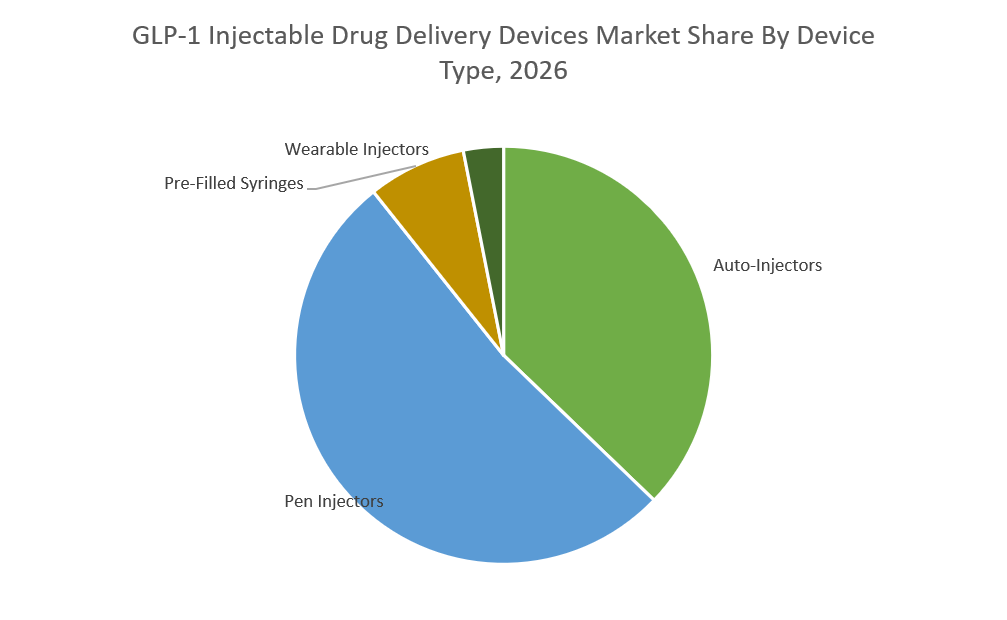
Pen Injectors dominate the global GLP-1 Injectable Drug Delivery Devices Market, accounting for an estimated 52.1% of total revenue in 2026, supported by their established use in injectable therapies for type 2 diabetes and chronic weight management. Multi-dose injection pens enable repeated administration from a single drug-filled device, with commercial differentiation centered on dose accuracy, injection force, cartridge compatibility and manufacturing cost per administered dose. Auto-injectors represent another substantial device category, particularly for single-dose, fixed-dose presentations where automated needle insertion, injection consistency and user handling characteristics influence device selection. Pre-filled syringe systems serve selected ready-to-administer drug presentations, while wearable injectors represent a more specialized delivery category with different engineering, manufacturing and product qualification requirements. Competition among GLP-1 injection device manufacturers is influenced by drug formulation compatibility, injection volume, production scalability, device reliability and the integration of drug containment with injection mechanisms.
GLP-1 Injectable Drug Delivery Devices Market Share by Device Configuration: Single-Use Injection Devices Maintain the Largest Share
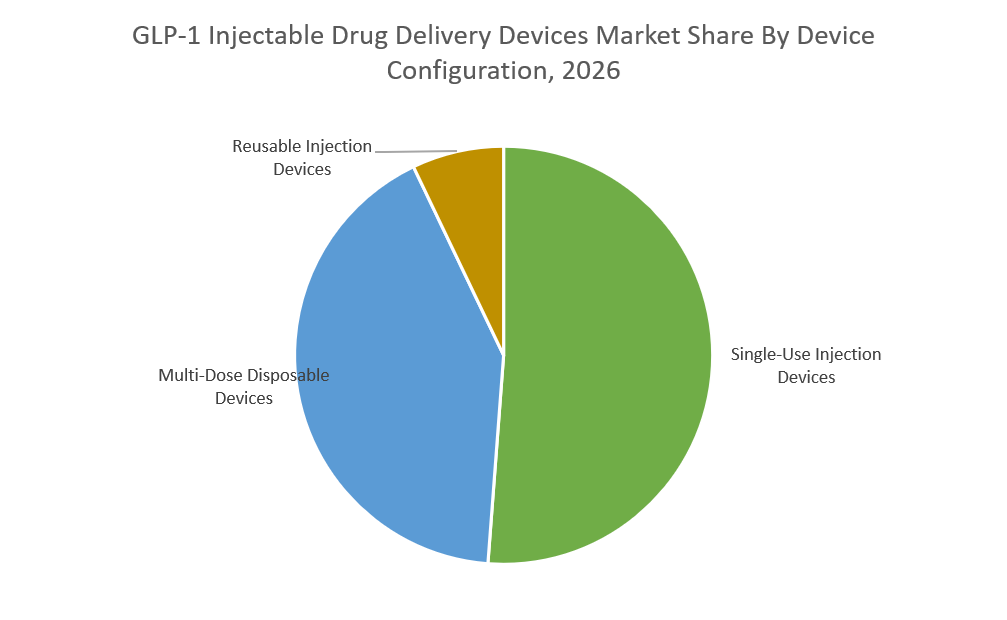
Single-Use Injection Devices represent the largest configuration segment in the global GLP-1 Injectable Drug Delivery Devices Market, accounting for an estimated 51.2% of total revenue in 2026, reflecting demand for prefilled, single-dose systems used in self-administered injectable therapies. These devices combine drug containment, injection mechanisms and safety components within a disposable presentation, generating recurring device manufacturing requirements for each administered dose. Multi-dose disposable devices maintain a significant commercial position through injection pen systems capable of delivering multiple doses from one prefilled container, with manufacturing economics influenced by dose-setting mechanisms, cartridge capacity and component utilization. Reusable injection devices represent a smaller specialized category involving replaceable drug cartridges and durable injection mechanisms. Device configuration affects pharmaceutical-device combination product development, assembly automation, component procurement, packaging requirements and production costs, with differences in material consumption and manufacturing complexity influencing revenue across the respective delivery formats.
GLP-1 Injectable Drug Delivery Devices Market Competitive Landscape
The global GLP-1 Injectable Drug Delivery Devices Market features competition among specialized injection device manufacturers, pharmaceutical delivery system developers and integrated medical device contract manufacturers. Ypsomed, SHL Medical, Gerresheimer, Nemera, Owen Mumford and medmix's Haselmeier business participate across disposable injection pens, reusable delivery systems and autoinjector technologies. Becton, Dickinson and Company (BD) and Stevanato Group provide additional competition through device platforms and pharmaceutical containment capabilities. The competitive environment encompasses proprietary device designs, standardized delivery platforms and customer-specific manufacturing programs, with supplier differentiation reflecting device performance, manufacturing experience, platform compatibility and established relationships with pharmaceutical manufacturers.
Competition in GLP-1 pen injector and autoinjector manufacturing is influenced by the breadth of available delivery platforms and the ability to accommodate different pharmaceutical product specifications. Manufacturers such as Shaily Engineering Plastics, Phillips Medisize and Elcam Drug Delivery Devices participate in device development, precision manufacturing and production of injection systems for pharmaceutical customers. Equipment and component requirements differ between manually operated multi-dose pens, mechanically driven autoinjectors and specialized wearable systems. Proprietary device architectures and associated intellectual property contribute to competitive differentiation, while established product platforms can support several pharmaceutical programs with different technical configurations. Device OEMs compete through engineering capabilities, commercial production experience and the compatibility of their systems with pharmaceutical primary containers.
The wider competitive landscape includes pharmaceutical packaging and drug delivery component manufacturers, whose products affect the compatibility and operating performance of finished injection systems. West Pharmaceutical Services and Aptar Pharma supply selected injection-related components and delivery technologies, while BD and Stevanato Group participate in both containment and device-related product categories. Competition at the component level involves dimensional consistency, material compatibility, container integration and supply reliability across large pharmaceutical manufacturing programs. Specialized manufacturers of injection mechanisms and prefilled container components occupy different positions in the value chain, creating commercial relationships between pharmaceutical sponsors, device OEMs, component suppliers and final assembly providers.
Supplier competitiveness is also shaped by commercial manufacturing scale, product qualification and lifecycle service capabilities. Pharmaceutical manufacturers commonly establish device-specific manufacturing arrangements that involve dedicated tooling, qualified components and validated assembly procedures. Differences in production capacity, manufacturing location and technical support affect the ability of device suppliers to serve multiple commercial programs simultaneously. Contracts may cover platform licensing, device customization, component manufacturing, final assembly and associated engineering services. Switching between established device suppliers can involve additional compatibility testing, manufacturing transfers and product-specific validation, influencing the duration and commercial structure of pharmaceutical-device supply relationships.
GLP-1 Injectable Drug Delivery Devices Market Geographical Analysis: Leading Injection Pen and Autoinjector Manufacturing Countries
United States GLP-1 Injectable Drug Delivery Devices Market: Commercial Autoinjector Manufacturing and Drug-Device Assembly
The United States represents a major market for GLP-1 injectable drug delivery devices, supported by pharmaceutical commercialization, domestic autoinjector manufacturing and a network of medical device component suppliers. Eli Lilly and Novo Nordisk maintain substantial U.S. commercialization activities involving injectable incretin therapies, creating demand for single-dose autoinjectors, multi-dose pen injectors and associated pharmaceutical containers. SHL Medical operates autoinjector manufacturing in North Charleston, South Carolina, while Gerresheimer maintains medical device manufacturing capabilities in Peachtree City, Georgia. The domestic supply chain includes precision injection molding, automated device assembly, pharmaceutical primary packaging and functional device testing. Commercial competition reflects the ability of device manufacturers to supply qualified products at sustained production volumes while coordinating with pharmaceutical filling and final packaging operations. Manufacturing economics vary according to proprietary device platforms, customer-specific configurations, component sourcing arrangements and the level of automation used in assembly and testing.
Switzerland GLP-1 Injectable Drug Delivery Devices Market: Precision Injection Systems and Autoinjector Platform Manufacturing
Switzerland holds an important supplier-side position in the GLP-1 Injectable Drug Delivery Devices Market through established manufacturers of injection pens, autoinjectors and related drug delivery platforms. Ypsomed operates manufacturing facilities in Burgdorf and Solothurn, where activities encompass precision tooling, injection molding, automated assembly and commercial production of injection systems. The company's Burgdorf operations include more than 50 injection-molding and assembly systems associated with its YpsoMate autoinjector platform. SHL Medical, headquartered in Zug, also maintains Swiss manufacturing and engineering capabilities supporting pharmaceutical self-injection systems. Switzerland's competitive position is associated with precision mechanical engineering, intellectual property development, device-platform qualification and technical integration with pharmaceutical customer programs. Manufacturers participate in projects involving both standardized platforms and customized delivery mechanisms, with commercial relationships extending across device development, tooling qualification, component manufacturing and recurring finished-device supply.
Germany GLP-1 Injectable Drug Delivery Devices Market: High-Volume Injection Molding and Automated Device Assembly
Germany represents an established manufacturing center for pharmaceutical injection devices, supported by specialized medical technology suppliers and high-volume production infrastructure. Ypsomed's Schwerin operations include precision plastic injection molding and automated autoinjector assembly, while Gerresheimer's Pfreimd facility manufactures customized drug delivery systems, autoinjectors and related medical device components. Germany also provides an industrial base for specialized manufacturing equipment, precision tooling and automation technologies used in injection pen production. Device manufacturing requirements include dimensional consistency, component traceability, validated assembly processes and functional testing of finished injection systems. Commercial differentiation is influenced by equipment utilization, manufacturing cycle times, product-specific tooling and compatibility between injection mechanisms and pharmaceutical primary containers. The country's supplier ecosystem supports international pharmaceutical customers through development services and commercial manufacturing, with production economics affected by material efficiency, factory automation and manufacturing quality consistency.
France GLP-1 Injectable Drug Delivery Devices Market: Injection Pen Development and Pharmaceutical Device Engineering
France maintains an important role in pharmaceutical drug delivery device development and manufacturing through companies specializing in injection systems, primary containment interfaces and medical device engineering. Nemera's La Verpillière site near Lyon combines manufacturing and development activities, including capabilities associated with parenteral delivery technologies. The company's portfolio addresses hormonal and other injectable therapies, with device engineering activities relevant to diabetes and obesity treatment applications. French capabilities also extend across mechanical device design, polymer processing, tooling and injection-system qualification. Commercial requirements for GLP-1 delivery platforms differ according to fixed-dose and variable-dose mechanisms, cartridge geometry, injection force and device usability characteristics. Pharmaceutical device programs involve coordination between component design, primary container selection and downstream manufacturing processes, creating demand for engineering support, functional testing and product-specific industrialization. Competition is influenced by device-platform intellectual property, manufacturing transfer capabilities and integration between French development operations and international production networks.
China GLP-1 Injectable Drug Delivery Devices Market: Localized Injection Device Production and Medical Device Component Supply
China is an important manufacturing location for injection pens and autoinjector components, supported by its precision plastics industry, medical device manufacturing infrastructure and domestic pharmaceutical supply chain. Ypsomed operates a dedicated injection-system manufacturing facility in Changzhou, with a reported designed annual capacity of up to 100 million devices. Gerresheimer also maintains medical device manufacturing capabilities in Dongguan, contributing to the production of pharmaceutical components and drug delivery products. China's device manufacturing market encompasses localized component sourcing, automated assembly, injection molding and testing services supporting domestic and international pharmaceutical customers. Production economics are influenced by tooling capacity, polymer component manufacturing, factory automation and logistics between device-component suppliers and pharmaceutical filling facilities. Manufacturing programs vary by delivery platform and qualification requirements, particularly where finished products are intended for multiple regulated markets. The country's competitive position reflects its manufacturing ecosystem and increasingly localized production of specialized drug delivery systems.
India GLP-1 Injectable Drug Delivery Devices Market: Pen Injector Manufacturing and Contract Device Supply
India is developing a more specialized position in GLP-1 injectable drug delivery device manufacturing through domestic medical device engineering, precision polymer processing and pharmaceutical contract production. Shaily Engineering Plastics operates manufacturing facilities in Gujarat, including its Rania and Halol locations, and supplies proprietary injection pen platforms designed for diabetes and obesity therapies. Its portfolio includes fixed-dose and variable-dose pens, reusable delivery systems and autoinjector configurations. The company reported eight pen-injector and autoinjector contracts during FY2024/25, primarily involving GLP-1 therapies and selected additional pharmaceutical applications. India-based manufacturing activity includes precision injection molding, cartridge-holder assembly, injection mechanisms and functional device testing for regulated pharmaceutical customers. Commercial differentiation is associated with proprietary device intellectual property, production scale, manufacturing costs and the ability to support pharmaceutical programs requiring large quantities of mechanically consistent injection devices. Domestic manufacturing capabilities also provide a base for export-oriented drug delivery component supply and customer-specific device development.
GLP-1 Injectable Drug Delivery Devices Market Report Scope
GLP-1 Injectable Drug Delivery Devices Market Report Scope, Segmentation, Leading Manufacturers and Forecast, 2026–2034
|
Parameter
|
Details
|
|
Market Size (2026)
|
$3.9 Billion
|
|
Market Size (2034)
|
$9.2 Billion
|
|
Market Growth Rate
|
11.3%
|
|
Segments
|
By Device Type (Auto-Injectors, Pen Injectors, Pre-Filled Syringes, Wearable Injectors), By Device Configuration (Single-Use Injection Devices, Multi-Dose Disposable Devices, Reusable Injection Devices), By Administration Route & Site (Subcutaneous, Intramuscular), By Therapeutic Application (Type 2 Diabetes Management, Obesity and Chronic Weight Management, Cardiovascular Risk Reduction, Others)
|
|
Study Period
|
Historical: 2021–2025; Forecast: 2026–2034
|
|
Units
|
Revenue (USD Million); Market Share (%); CAGR (%)
|
|
Technology Coverage
|
Disposable Autoinjectors, Multi-Dose Injection Pens, Reusable Cartridge-Based Injection Systems, Prefilled Syringe Delivery Platforms, Wearable and On-Body Injectors, Mechanical Drive Mechanisms, Fixed-Dose and Variable-Dose Injection Systems, Injection Molding, Automated Device Assembly, Drug-Device Integration, Connected Dose-Tracking Technologies, Higher-Viscosity Formulation Delivery and Sustainable Device Materials
|
|
Qualitative Analysis
|
Porter's Five Forces, SWOT Profiles, Market Share Analysis, Market Dynamics, Competitive Landscape, Device Manufacturer Benchmarking, Drug Delivery Industry Value Chain, Manufacturing Cost per Dose, Device Platform Comparison, Component Supply Analysis, Pharmaceutical-Device Partnerships and Regional Market Outlook
|
|
Regulatory & Standards Coverage
|
FDA Drug-Device Combination Product Requirements (21 CFR Part 4), FDA Quality Management System Regulation (QMSR), ISO 13485 Medical Device Quality Management Systems, ISO 11608 Needle-Based Injection Systems, FDA Human Factors and Usability Engineering Guidance, EU Medical Device Regulation (EU) 2017/745 where applicable, EMA Drug-Device Combination Product Quality Requirements
|
|
Companies
|
Ypsomed, SHL Medical, Becton Dickinson (BD), Stevanato Group, Gerresheimer, Nemera, Owen Mumford, medmix (Haselmeier), Phillips Medisize (Molex), Shaily Engineering Plastics, Elcam Medical, West Pharmaceutical Services, Aptar Pharma, Enable Injections
|
|
Countries
|
United States, Canada, Mexico, Germany, France, Spain, Italy, United Kingdom, Russia, China, India, Japan, South Korea, Australia, Southeast Asia, Brazil, Argentina, Middle East, Africa
|
GLP-1 Injectable Drug Delivery Devices Market Segmentation
By Device Type
- Auto-Injectors
- Pen Injectors
- Pre-Filled Syringes
- Wearable Injectors
By Device Configuration
- Single-Use Injection Devices
- Multi-Dose Disposable Devices
- Reusable Injection Devices
By Administration Route & Site
- Subcutaneous
- Intramuscular
By Therapeutic Application
- Type 2 Diabetes Management
- Obesity and Chronic Weight Management
- Cardiovascular Risk Reduction
- Others
Countries Analyzed
- North America (US, Canada, Mexico)
- Europe (Germany, UK, France, Spain, Italy, Russia, Rest of Europe)
- Asia Pacific (China, India, Japan, South Korea, Australia, South East Asia, Rest of Asia)
- South America (Brazil, Argentina, Rest of South America)
- Middle East and Africa (Saudi Arabia, UAE, Rest of Middle East, South Africa, Egypt, Rest of Africa)
Leading Companies in the GLP-1 Injectable Drug Delivery Devices Market
- Ypsomed Holding AG
- SHL Medical AG
- Becton, Dickinson and Company (BD)
- Stevanato Group S.p.A.
- Gerresheimer AG
- Nemera
- Owen Mumford Ltd.
- medmix AG (Haselmeier)
- Phillips Medisize (Molex)
- Shaily Engineering Plastics Ltd.
- Elcam Medical (Elcam Drug Delivery Devices / E3D)
- West Pharmaceutical Services, Inc.
- AptarGroup, Inc. (Aptar Pharma)
- Enable Injections, Inc.
*List not Exhaustive
GLP-1 Injectable Drug Delivery Devices Market Research Methodology
The GLP-1 Injectable Drug Delivery Devices Market assessment is structured around secondary research covering pharmaceutical injection devices, drug-device combination products and commercial manufacturing capabilities. Research inputs include official injection device manufacturer disclosures, pharmaceutical company product documentation, annual reports, regulatory publications and technical specifications for needle-based injection systems. The market scope encompasses autoinjectors, pen injectors, prefilled syringe systems and applicable specialized delivery platforms used for GLP-1-based injectable therapies, including relevant dual-incretin treatments. The valuation framework distinguishes device-related revenue from pharmaceutical drug sales and excludes oral therapies and unrelated injection systems.
Market sizing is structured by device type and device configuration, with demand evaluated through injectable treatment volumes, administration frequency, device utilization and manufacturing economics. The assessment considers finished-device requirements, single-use and multi-dose configurations, device component value, production capacity and commercial assembly activity. Supplier portfolios and publicly available manufacturing information provide reference points for estimating revenue distribution, while forecast assumptions incorporate treatment adoption, device manufacturing requirements and pharmaceutical product presentation changes. Market allocation distinguishes commercialized injection devices from emerging delivery platforms to avoid overstating revenue from developmental technologies.
Table of Contents: GLP-1 Injectable Drug Delivery Devices Market, 2026–2034
1. Executive Summary
- 1.1. Global GLP-1 Injectable Drug Delivery Devices Market Highlights
- 1.2. Key Findings for Pharmaceutical Manufacturers and Drug Delivery Device Suppliers
- 1.3. Global Market Size, Growth Rate and Forecast Snapshot
- 1.4. Market Share Highlights by Device Type and Device Configuration
- 1.5. Regional Market Share and Growth Comparison
- 1.6. GLP-1 Injection Device Manufacturing and Commercial Supply Outlook
- 1.7. Key Industry Developments and Competitive Positioning
2. GLP-1 Injectable Drug Delivery Devices Market Outlook (2021–2034)
2.1. Market Introduction and Industry Structure
- 2.1.1. Market Definition and Revenue Scope
- 2.1.2. GLP-1 Injectable Therapeutics and Associated Delivery Systems
- 2.1.3. Injection Device Industry Value Chain
- 2.1.4. Device OEMs, Component Suppliers and Contract Manufacturing Models
2.2. Global Market Size and Growth Outlook
- 2.2.1. Historical Market Revenue Analysis, 2021–2025
- 2.2.2. Global Market Size Estimate, 2026
- 2.2.3. Annual Market Revenue Forecast, 2026–2034
- 2.2.4. Compound Annual Growth Rate (CAGR), 2026–2034
- 2.2.5. Revenue Contribution by Device Type and Configuration
- 2.2.6. Regional and Country-Level Market Share Distribution
2.3. Key Market Trends
- 2.3.1. Single-Dose Autoinjectors and Multi-Dose Pen Injectors
- 2.3.2. Platform-Based Injection Devices and Connected Dose Tracking
- 2.3.3. Sustainable Autoinjector Materials and Recyclable Device Designs
2.4. Key Market Growth Drivers
- 2.4.1. GLP-1 Treatment Demand and Metabolic Disease Indications
- 2.4.2. Self-Administration, Dose Accuracy and Human-Factors Requirements
2.5. Emerging Market Opportunities
- 2.5.1. High-Volume Injection Device Assembly and Integrated Manufacturing
- 2.5.2. Higher-Concentration Formulations and Large-Volume Delivery Platforms
2.6. Market Restraints and Industry Challenges
- 2.6.1. High-Volume Device Manufacturing and Component Supply Constraints
- 2.6.2. Device Customization, Tooling and Qualification Costs
- 2.6.3. Pharmaceutical Container Compatibility and Manufacturing Transfer Complexity
- 2.6.4. Disposable Device Material Consumption and End-of-Life Management
2.7. Industry Economics and Commercial Analysis
- 2.7.1. Device Manufacturing Cost per Administered Dose
- 2.7.2. Component Procurement, Injection Molding and Assembly Economics
- 2.7.3. Pharmaceutical Device Supply Agreements and Production Commitments
- 2.7.4. Device Platform Licensing and Custom Engineering Revenue
- 2.7.5. Injection Device Manufacturing Capacity and Utilization
2.8. Regulatory and Technical Standards Overview
- 2.8.1. Drug-Device Combination Product Requirements
- 2.8.2. ISO Standards for Needle-Based Injection Systems
- 2.8.3. Injection Device Usability and Human-Factors Validation
- 2.8.4. Manufacturing Quality Systems and Device Traceability
3. Recent Developments in GLP-1 Injection Devices and Manufacturing Technologies
- 3.1. GLP-1 Injection Pen and Autoinjector Product Developments
- 3.2. Pharmaceutical Combination Product Approvals and Commercialization
- 3.3. New Drug Delivery Platforms and Device Technologies
- 3.4. Manufacturing Capacity Expansion and Automated Assembly Facilities
- 3.5. Pharmaceutical-Device Supplier Partnerships and Contract Manufacturing Agreements
- 3.6. Connected Injection Devices and Digital Administration Technologies
- 3.7. Sustainable Device Materials and Circular Design Developments
- 3.8. Industry Acquisitions, Portfolio Changes and Supply-Chain Developments
- 3.9. Recent Developments Timeline, 2024–2026
4. Competitive Landscape: Global GLP-1 Injectable Drug Delivery Devices Market
4.1. Global Competitive Structure
- 4.1.1. Injection Device OEMs and Proprietary Platform Manufacturers
- 4.1.2. Pharmaceutical Container and Device Component Suppliers
- 4.1.3. Contract Device Manufacturers and Assembly Providers
4.2. Market Competition and Supplier Benchmarking
- 4.2.1. Company Market Position and Revenue Share Assessment
- 4.2.2. Autoinjector and Pen Injector Product Portfolio Comparison
- 4.2.3. Manufacturing Capacity and Geographic Production Footprint
- 4.2.4. Proprietary Device Platforms and Intellectual Property
- 4.2.5. Pharmaceutical Customer Relationships and Commercial Supply Contracts
- 4.2.6. Cost Structure, Automation and Manufacturing Scale
- 4.2.7. Company SWOT and Competitive Positioning Analysis
4.3. Industry Structure and Competitive Forces
- 4.3.1. Market Concentration and Supplier Fragmentation
- 4.3.2. Barriers to Entry and Device Qualification
- 4.3.3. Porter’s Five Forces Analysis
- 4.3.4. Supplier Ecosystem and Value Chain Relationships
5. GLP-1 Injectable Drug Delivery Devices Market Segmentation and Market Share Analysis
5.1. Market Size and Share by Device Type, 2021–2034
- 5.1.1. Auto-Injectors
- 5.1.2. Pen Injectors
- 5.1.3. Pre-Filled Syringes
- 5.1.4. Wearable Injectors
- 5.1.5. Device Type Revenue Comparison and 2026 Market Shares
- 5.1.6. Device Type Growth Forecast and CAGR Analysis
5.2. Market Size and Share by Device Configuration, 2021–2034
- 5.2.1. Single-Use Injection Devices
- 5.2.2. Multi-Dose Disposable Devices
- 5.2.3. Reusable Injection Devices
- 5.2.4. Device Configuration Revenue Comparison and 2026 Market Shares
- 5.2.5. Device Configuration Growth Forecast and CAGR Analysis
5.3. Device Manufacturing and Commercial Demand Analysis
- 5.3.1. Device Requirements for Obesity and Type 2 Diabetes Therapies
- 5.3.2. Dose Frequency and Device Consumption Relationships
- 5.3.3. Pharmaceutical Product Presentation and Delivery System Compatibility
- 5.3.4. Device Component Manufacturing and Assembly Requirements
- 5.3.5. Commercial Supply and Drug-Device Integration Economics
6. Country Analysis and Outlook: GLP-1 Injectable Drug Delivery Devices Market
6.1. North America
- 6.1.1. United States: GLP-1 Device Demand, Autoinjector Manufacturing and Commercial Assembly
- 6.1.2. Canada: Injectable Therapy Demand and Pharmaceutical Device Supply
- 6.1.3. Mexico: Medical Device Manufacturing and Regional Component Supply
6.2. Europe
- 6.2.1. Germany: High-Volume Autoinjector Manufacturing and Precision Assembly
- 6.2.2. France: Injection Pen Development and Pharmaceutical Device Engineering
- 6.2.3. Spain: Injectable Drug Supply and Medical Device Manufacturing
- 6.2.4. Italy: Pharmaceutical Injection Device and Component Supply
- 6.2.5. United Kingdom: Drug Delivery Technology and Pharmaceutical Device Development
- 6.2.6. Russia: Injectable Diabetes Treatment Devices and Pharmaceutical Supply
6.3. Asia Pacific
- 6.3.1. China: Localized Injection Device Manufacturing and Component Production
- 6.3.2. India: Pen Injector Manufacturing and Contract Device Supply
- 6.3.3. Japan: Precision Injection Technologies and Diabetes Device Manufacturing
- 6.3.4. South Korea: Injectable Pharmaceutical Products and Drug Delivery Systems
- 6.3.5. Australia: GLP-1 Injectable Device Demand and Pharmaceutical Distribution
- 6.3.6. Southeast Asia: Regional Injectable Device Supply and Pharmaceutical Manufacturing
6.4. South America
- 6.4.1. Brazil: Injectable Therapy Demand and Pharmaceutical Device Supply
- 6.4.2. Argentina: Injection Device Distribution and Domestic Pharmaceutical Manufacturing
6.5. Middle East and Africa
- 6.5.1. Middle East: GLP-1 Injectable Treatment Demand and Device Supply
- 6.5.2. Africa: Diabetes Injection Device Demand and Pharmaceutical Distribution
6.6. Country-Level Comparative Analysis
- 6.6.1. Device Manufacturing and Supplier Presence by Geography
- 6.6.2. Geographic Differences in Injectable Device Demand
- 6.6.3. Country Market Size and Global Market Share Comparison
- 6.6.4. Country Growth Rates and Forecast Ranking
7. GLP-1 Injectable Drug Delivery Devices Market Size and Share Outlook by Region and Country (2026–2034)
7.1. Global Geographic Market Forecast
- 7.1.1. Global Revenue Forecast, 2026–2034
- 7.1.2. Regional Market Size and Global Revenue Share, 2026
- 7.1.3. Regional Market Size and Global Revenue Share, 2034
- 7.1.4. Regional CAGR and Growth Contribution
- 7.1.5. All 19 Geographic Reporting Units: Annual Revenue and Market Share
7.2. North America GLP-1 Injectable Drug Delivery Devices Market
- 7.2.1. Regional Market Size, Global Share and CAGR
- 7.2.2. Revenue and Market Share by Device Type
- 7.2.3. Revenue and Market Share by Device Configuration
- 7.2.4. Country Market Size, Market Share and Forecast:
- 7.2.4.1. United States
- 7.2.4.2. Canada
- 7.2.4.3. Mexico
7.3. Europe GLP-1 Injectable Drug Delivery Devices Market
- 7.3.1. Regional Market Size, Global Share and CAGR
- 7.3.2. Revenue and Market Share by Device Type
- 7.3.3. Revenue and Market Share by Device Configuration
- 7.3.4. Country Market Size, Market Share and Forecast:
- 7.3.4.1. Germany
- 7.3.4.2. France
- 7.3.4.3. Spain
- 7.3.4.4. Italy
- 7.3.4.5. United Kingdom
- 7.3.4.6. Russia
7.4. Asia Pacific GLP-1 Injectable Drug Delivery Devices Market
- 7.4.1. Regional Market Size, Global Share and CAGR
- 7.4.2. Revenue and Market Share by Device Type
- 7.4.3. Revenue and Market Share by Device Configuration
- 7.4.4. Country and Subregional Market Size, Market Share and Forecast:
- 7.4.4.1. China
- 7.4.4.2. India
- 7.4.4.3. Japan
- 7.4.4.4. South Korea
- 7.4.4.5. Australia
- 7.4.4.6. Southeast Asia
7.5. South America GLP-1 Injectable Drug Delivery Devices Market
- 7.5.1. Regional Market Size, Global Share and CAGR
- 7.5.2. Revenue and Market Share by Device Type
- 7.5.3. Revenue and Market Share by Device Configuration
- 7.5.4. Country Market Size, Market Share and Forecast:
- 7.5.4.1. Brazil
- 7.5.4.2. Argentina
7.6. Middle East and Africa GLP-1 Injectable Drug Delivery Devices Market
- 7.6.1. Regional Market Size, Global Share and CAGR
- 7.6.2. Revenue and Market Share by Device Type
- 7.6.3. Revenue and Market Share by Device Configuration
- 7.6.4. Geographic Market Size, Market Share and Forecast:
- 7.6.4.1. Middle East
- 7.6.4.2. Africa
7.7. Global Market Share and Forecast Reconciliation
- 7.7.1. Country-to-Region Revenue Aggregation
- 7.7.2. Regional-to-Global Market Share Reconciliation
- 7.7.3. Rest-of-Region Revenue Adjustments
- 7.7.4. Geographic Growth Rankings and Comparative Forecasts
8. Company Profiles: Leading GLP-1 Injection Device Manufacturers
- 8.1. Ypsomed Holding AG
- 8.2. SHL Medical AG
- 8.3. Becton, Dickinson and Company (BD)
- 8.4. Stevanato Group S.p.A.
- 8.5. Gerresheimer AG
- 8.6. Nemera
- 8.7. Owen Mumford Ltd.
- 8.8. medmix AG (Haselmeier)
- 8.9. Phillips Medisize (Molex)
- 8.10. Shaily Engineering Plastics Ltd.
- 8.11. Elcam Medical (Elcam Drug Delivery Devices)
- 8.12. West Pharmaceutical Services, Inc.
- 8.13. AptarGroup, Inc. (Aptar Pharma)
- 8.14. Enable Injections, Inc.
- 8.15. Comparative Company Profiles: Product Portfolios, Manufacturing Capabilities, Geographic Presence and Competitive Positioning
9. Research Methodology
- 9.1. Market Definition, Scope and Exclusions
- 9.2. Secondary Research Sources and Data Collection
- 9.3. Bottom-Up Injection Device Demand and Revenue Model
- 9.4. Top-Down Pharmaceutical Device Revenue Validation
- 9.5. Device Type and Configuration Revenue Allocation
- 9.6. Country and Regional Market Sizing Methodology
- 9.7. Historical Market Reconstruction, 2021–2025
- 9.8. Forecast Modeling, 2026–2034
- 9.9. Market Share Estimation and Data Triangulation
- 9.10. Forecast Assumptions, Scenario Analysis and Data Limitations
- 9.11. Research Coverage and Deliverables
10. Appendix
- 10.1. Market Definitions and Revenue Inclusion Criteria
- 10.2. Device Technology Terminology and Classification
- 10.3. Acronyms and Abbreviations
- 10.4. Geographic Coverage and Regional Definitions
- 10.5. Detailed Historical and Forecast Data Tables
- 10.6. Global and Country-Level Market Share Tables
- 10.7. List of Tables
- 10.8. List of Figures
- 10.9. Research Sources and References
- 10.10. Assumptions, Notes and Disclaimer