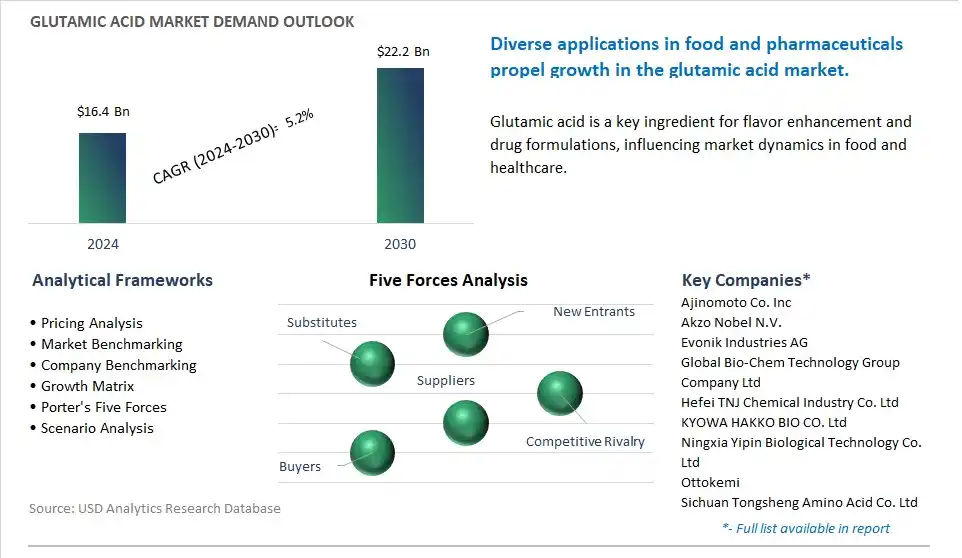
The global Glutamic Acid Market is poised to register a 5.2% CAGR from $16.4 Billion in 2024 to $22.2 Billion in 2030.
The global Glutamic Acid Market Study analyzes and forecasts the market size across 6 regions and 24 countries for diverse segments -By Application (Food & Beverages, Pharmaceuticals, Animal Feed, Others), By Product (Biosynthesis, Industrial Synthesis), By Source (Plant-Based, Animal Based).
An Introduction to Global Glutamic Acid Market in 2024
The glutamic acid market is witnessing steady growth driven by its applications in food and beverage, pharmaceuticals, and biotechnology industries. Key trends shaping the future of the industry include the increasing demand for glutamic acid as a flavor enhancer, nutritional supplement, and precursor for bio-based chemicals, driven by its unique taste profile, physiological benefits, and versatile chemical properties while meeting regulatory standards and consumer preferences for natural, clean-label ingredients. As food manufacturers, pharmaceutical companies, and biotech firms seek sustainable and cost-effective solutions, there's a growing need for glutamic acid produced from renewable feedstocks such as sugars, starches, and agricultural residues using fermentation, enzymatic conversion, and biorefinery technologies. Moreover, advancements in glutamic acid production methods, including strain engineering, fermentation optimization, and downstream processing, are driving market expansion by improving production efficiency, yield, and purity while reducing environmental impact, waste generation, and energy consumption associated with traditional chemical synthesis routes. Additionally, the growing adoption of glutamic acid in food flavoring, nutritional supplements, and pharmaceutical formulations is fueling demand for high-quality products that meet strict quality standards, safety regulations, and consumer expectations for taste, efficacy, and health benefits, contributing to the development of innovative products and formulations that address specific market needs and emerging trends. Furthermore, the integration of glutamic acid with biotechnology, metabolic engineering, and synthetic biology is driving innovation and market growth in the amino acids industry, enabling the development of smarter, more sustainable, and more versatile solutions for the future of food, healthcare, and industrial applications.
Glutamic Acid Market Competitive Landscape
The market report analyses the leading companies in the industry including Ajinomoto Co. Inc, Akzo Nobel N.V., Evonik Industries AG, Global Bio-Chem Technology Group Company Ltd, Hefei TNJ Chemical Industry Co. Ltd, KYOWA HAKKO BIO CO. Ltd, Ningxia Yipin Biological Technology Co. Ltd, Ottokemi, Sichuan Tongsheng Amino Acid Co. Ltd, Suzhou Yuanfang Chemical Co. Ltd.
Glutamic Acid Market Dynamics
Glutamic Acid Market Trend: Growing Demand for Food and Beverage Additives
A significant trend in the glutamic acid market is the increasing demand for food and beverage additives driven by changing consumer preferences, culinary trends, and the rise of processed foods. Glutamic acid and its salts, such as monosodium glutamate (MSG), are widely used as flavor enhancers in the food industry to improve taste, aroma, and overall palatability of various food products. With consumers seeking more flavorful and convenient food options, there is a growing reliance on food additives like glutamic acid to enhance the sensory experience of processed foods, snacks, sauces, soups, and ready-to-eat meals. This trend is reshaping the glutamic acid market towards increased usage in food processing and culinary applications, driving demand for high-quality glutamic acid additives that meet safety, regulatory, and labeling requirements.
Glutamic Acid Market Driver: Expansion of the Food Processing Industry
A key driver propelling the glutamic acid market is the expansion of the food processing industry driven by urbanization, changing lifestyles, and increasing disposable incomes. As urban populations grow and consumer preferences shift towards convenience foods, there is a rising demand for processed and packaged food products that offer taste consistency, shelf stability, and convenience. Glutamic acid additives play a crucial role in meeting these demands by imparting umami flavor, improving taste perception, and masking off-flavors in processed foods. Additionally, the globalization of food supply chains and the proliferation of international cuisines contribute to the demand for glutamic acid additives as essential ingredients in flavor formulations used by food manufacturers worldwide. The continued growth of the food processing industry drives market demand for glutamic acid as a key component in food additives and flavor enhancers, stimulating innovation and investment in production technologies and supply chain logistics.
Glutamic Acid Market Opportunity: Expansion into Pharmaceutical and Nutraceutical Applications
An opportunity for market expansion lies in diversifying glutamic acid applications into pharmaceutical and nutraceutical industries where there is demand for functional ingredients with health benefits and therapeutic properties. Glutamic acid, a non-essential amino acid, plays a role in various physiological functions such as neurotransmission, metabolism, and protein synthesis, making it suitable for pharmaceutical formulations and dietary supplements. Glutamic acid derivatives such as monosodium glutamate (MSG) and glutamine are used in pharmaceutical preparations as excipients, stabilizers, and flavoring agents, while glutamine supplements are marketed for their potential benefits in supporting immune function, gastrointestinal health, and muscle recovery. By leveraging its biochemical properties and nutritional benefits, glutamic acid manufacturers can explore opportunities to enter pharmaceutical and nutraceutical markets, develop value-added products, and expand their customer base beyond the food industry, driving growth and diversification in the glutamic acid market.
Glutamic Acid Market Share Analysis: Food & Beverages segment generated the highest revenue in the industry
The food & beverages segment is the largest segment in the glutamic acid market, primarily due to the widespread use of glutamic acid and its derivatives as flavor enhancers in the food and beverage industry. Glutamic acid is a naturally occurring amino acid that contributes to the umami taste, often described as savory or meaty, in foods. Its sodium salt, monosodium glutamate (MSG), is one of the most commonly used flavor enhancers worldwide. MSG is added to a wide range of processed foods, snacks, soups, sauces, seasonings, and savory snacks to enhance their flavor profile and impart a savory taste. Additionally, glutamic acid derivatives such as glutamate salts and hydrolyzed vegetable proteins are widely used in food manufacturing to enhance the taste and palatability of products. The food industry's emphasis on flavor innovation, product differentiation, and consumer preferences for savory and flavorful foods drives the demand for glutamic acid as a key ingredient in food formulations. In addition, glutamic acid is considered safe for consumption by regulatory authorities worldwide, further supporting its widespread use in the food and beverage industry. Over the forecast period, the flavor-enhancing properties, versatility, and safety profile of glutamic acid contribute to its dominance as the largest segment in the glutamic acid market, with the food & beverages sector being the primary driver of demand.
Glutamic Acid Market Share Analysis: Biosynthesis Segment is poised to register the fastest growth rate (CAGR) over the forecast period to 2030
The biosynthesis segment is the fastest-growing segment in the glutamic acid market, driven by diverse key factors. Biosynthesis involves the production of glutamic acid through biological processes, using microorganisms such as bacteria or yeast. This method offers diverse advantages over industrial synthesis, contributing to its rapid growth in the market. The biosynthesis of glutamic acid is more sustainable and environmentally friendly compared to traditional industrial synthesis methods, which often involve chemical processes and harsh reaction conditions. Biosynthesis relies on renewable raw materials and fermentation processes, reducing the carbon footprint and minimizing waste generation. Additionally, advances in biotechnology and genetic engineering have led to the development of optimized microbial strains capable of producing glutamic acid with higher yields and productivity. This increased efficiency lowers production costs and enhances the competitiveness of biosynthesis compared to industrial synthesis methods. In addition, biosynthesis allows for the production of glutamic acid with high purity and quality, meeting the stringent requirements of various end-use industries such as food and pharmaceuticals. Further, growing consumer demand for natural and sustainably sourced ingredients in food and beverages drives the adoption of biosynthesized glutamic acid as a natural flavor enhancer and food ingredient. Over the forecast period, the combination of sustainability, efficiency, purity, and consumer preference for natural products positions the biosynthesis segment as the fastest-growing segment in the glutamic acid market.
Glutamic Acid Market Share Analysis: Plant-Based Segment is poised to register the fastest growth rate (CAGR) over the forecast period to 2030
The plant-based segment is the fastest-growing segment in the glutamic acid market, driven by diverse key factors. The there is a growing global trend towards plant-based diets and lifestyles driven by concerns over health, sustainability, and animal welfare. As consumers become more conscious of their food choices, there is an increasing demand for plant-based ingredients and alternatives across various industries, including food and beverages. Glutamic acid derived from plant-based sources aligns with this trend, offering a natural and sustainable alternative to animal-derived glutamic acid. Secondly, plant-based glutamic acid appeals to consumers seeking clean-label and natural ingredients in their food and beverage products. Plant-based sources such as soybeans, wheat, and corn are widely used for the production of glutamic acid through fermentation processes. These sources are non-allergenic and free from animal-derived components, making them suitable for a broader consumer base, including vegetarians and vegans. Additionally, advancements in biotechnology and fermentation processes have led to the development of efficient and scalable methods for producing glutamic acid from plant-based sources, lowering production costs and enhancing market competitiveness. Further, plant-based glutamic acid offers advantages in terms of sustainability and environmental impact, as it reduces the reliance on animal agriculture and mitigates the associated environmental concerns such as deforestation, greenhouse gas emissions, and water usage. Over the forecast period, the growing consumer demand for plant-based products, coupled with the sustainability and clean-label attributes of plant-based glutamic acid, positions the plant-based segment as the fastest-growing segment in the glutamic acid market.
Glutamic Acid Market Report Segmentation
By Application
Food & Beverages
Pharmaceuticals
Animal Feed
Others
By Product
Biosynthesis
Industrial Synthesis
By Source
Plant-Based
Animal Based
Regions Included
North America (US, Canada, Mexico)
Europe (Germany, UK, France, Spain, Italy, Russia, Rest of Europe)
Asia Pacific (China, India, Japan, South Korea, Australia, South East Asia, Rest of Asia)
South America (Brazil, Argentina, Rest of South America)
Middle East and Africa (Saudi Arabia, UAE, Rest of Middle East, South Africa, Egypt, Rest of Africa)
Glutamic Acid Companies Profiled in the Market Study
Ajinomoto Co. Inc
Akzo Nobel N.V.
Evonik Industries AG
Global Bio-Chem Technology Group Company Ltd
Hefei TNJ Chemical Industry Co. Ltd
KYOWA HAKKO BIO CO. Ltd
Ningxia Yipin Biological Technology Co. Ltd
Ottokemi
Sichuan Tongsheng Amino Acid Co. Ltd
Suzhou Yuanfang Chemical Co. Ltd
*- List Not Exhaustive
TABLE OF CONTENTS
1 Introduction to 2024 Glutamic Acid Market
1.1 Market Overview
1.2 Quick Facts
1.3 Scope/Objective of the Study
1.4 Market Definition
1.5 Countries and Regions Covered
1.6 Units, Currency, and Conversions
1.7 Industry Value Chain
2 Research Methodology
2.1 Market Size Estimation
2.2 Sources and Research Methodology
2.3 Data Triangulation
2.4 Assumptions and Limitations
3 Executive Summary
3.1 Global Glutamic Acid Market Size Outlook, $ Million, 2021 to 2030
3.2 Glutamic Acid Market Outlook by Type, $ Million, 2021 to 2030
3.3 Glutamic Acid Market Outlook by Product, $ Million, 2021 to 2030
3.4 Glutamic Acid Market Outlook by Application, $ Million, 2021 to 2030
3.5 Glutamic Acid Market Outlook by Key Countries, $ Million, 2021 to 2030
4 Market Dynamics
4.1 Key Driving Forces of Glutamic Acid Industry
4.2 Key Market Trends in Glutamic Acid Industry
4.3 Potential Opportunities in Glutamic Acid Industry
4.4 Key Challenges in Glutamic Acid Industry
5 Market Factor Analysis
5.1 Value Chain Analysis
5.2 Competitive Landscape
5.2.1 Global Glutamic Acid Market Share by Company (%), 2023
5.2.2 Product Offerings by Company
5.3 Porter’s Five Forces Analysis
5.4 Pricing Analysis and Outlook
6 Growth Outlook Across Scenarios
6.1 Growth Analysis-Case Scenario Definitions
6.2 Low Growth Scenario Forecasts
6.3 Reference Growth Scenario Forecasts
6.4 High Growth Scenario Forecasts
7 Global Glutamic Acid Market Outlook by Segments
7.1 Glutamic Acid Market Outlook by Segments, $ Million, 2021- 2030
By Application
Food & Beverages
Pharmaceuticals
Animal Feed
Others
By Product
Biosynthesis
Industrial Synthesis
By Source
Plant-Based
Animal Based
8 North America Glutamic Acid Market Analysis and Outlook To 2030
8.1 Introduction to North America Glutamic Acid Markets in 2024
8.2 North America Glutamic Acid Market Size Outlook by Country, 2021-2030
8.2.1 United States
8.2.2 Canada
8.2.3 Mexico
8.3 North America Glutamic Acid Market size Outlook by Segments, 2021-2030
By Application
Food & Beverages
Pharmaceuticals
Animal Feed
Others
By Product
Biosynthesis
Industrial Synthesis
By Source
Plant-Based
Animal Based
9 Europe Glutamic Acid Market Analysis and Outlook To 2030
9.1 Introduction to Europe Glutamic Acid Markets in 2024
9.2 Europe Glutamic Acid Market Size Outlook by Country, 2021-2030
9.2.1 Germany
9.2.2 France
9.2.3 Spain
9.2.4 United Kingdom
9.2.4 Italy
9.2.5 Russia
9.2.6 Norway
9.2.7 Rest of Europe
9.3 Europe Glutamic Acid Market Size Outlook by Segments, 2021-2030
By Application
Food & Beverages
Pharmaceuticals
Animal Feed
Others
By Product
Biosynthesis
Industrial Synthesis
By Source
Plant-Based
Animal Based
10 Asia Pacific Glutamic Acid Market Analysis and Outlook To 2030
10.1 Introduction to Asia Pacific Glutamic Acid Markets in 2024
10.2 Asia Pacific Glutamic Acid Market Size Outlook by Country, 2021-2030
10.2.1 China
10.2.2 India
10.2.3 Japan
10.2.4 South Korea
10.2.5 Indonesia
10.2.6 Malaysia
10.2.7 Australia
10.2.8 Rest of Asia Pacific
10.3 Asia Pacific Glutamic Acid Market size Outlook by Segments, 2021-2030
By Application
Food & Beverages
Pharmaceuticals
Animal Feed
Others
By Product
Biosynthesis
Industrial Synthesis
By Source
Plant-Based
Animal Based
11 South America Glutamic Acid Market Analysis and Outlook To 2030
11.1 Introduction to South America Glutamic Acid Markets in 2024
11.2 South America Glutamic Acid Market Size Outlook by Country, 2021-2030
11.2.1 Brazil
11.2.2 Argentina
11.2.3 Rest of South America
11.3 South America Glutamic Acid Market size Outlook by Segments, 2021-2030
By Application
Food & Beverages
Pharmaceuticals
Animal Feed
Others
By Product
Biosynthesis
Industrial Synthesis
By Source
Plant-Based
Animal Based
12 Middle East and Africa Glutamic Acid Market Analysis and Outlook To 2030
12.1 Introduction to Middle East and Africa Glutamic Acid Markets in 2024
12.2 Middle East and Africa Glutamic Acid Market Size Outlook by Country, 2021-2030
12.2.1 Saudi Arabia
12.2.2 UAE
12.2.3 Oman
12.2.4 Rest of Middle East
12.2.5 Egypt
12.2.6 Nigeria
12.2.7 South Africa
12.2.8 Rest of Africa
12.3 Middle East and Africa Glutamic Acid Market size Outlook by Segments, 2021-2030
By Application
Food & Beverages
Pharmaceuticals
Animal Feed
Others
By Product
Biosynthesis
Industrial Synthesis
By Source
Plant-Based
Animal Based
13 Company Profiles
13.1 Company Snapshot
13.2 SWOT Profiles
13.3 Products and Services
13.4 Recent Developments
13.5 Financial Profile
Ajinomoto Co. Inc
Akzo Nobel N.V.
Evonik Industries AG
Global Bio-Chem Technology Group Company Ltd
Hefei TNJ Chemical Industry Co. Ltd
KYOWA HAKKO BIO CO. Ltd
Ningxia Yipin Biological Technology Co. Ltd
Ottokemi
Sichuan Tongsheng Amino Acid Co. Ltd
Suzhou Yuanfang Chemical Co. Ltd
14 Appendix
14.1 Customization Offerings
14.2 Subscription Services
14.3 Related Reports
14.4 Publisher Expertise
By Application
Food & Beverages
Pharmaceuticals
Animal Feed
Others
By Product
Biosynthesis
Industrial Synthesis
By Source
Plant-Based
Animal Based
Countries Analyzed
North America (US, Canada, Mexico)
Europe (Germany, UK, France, Spain, Italy, Russia, Rest of Europe)
Asia Pacific (China, India, Japan, South Korea, Australia, South East Asia, Rest of Asia)
South America (Brazil, Argentina, Rest of South America)
Middle East and Africa (Saudi Arabia, UAE, Rest of Middle East, South Africa, Egypt, Rest of Africa)
