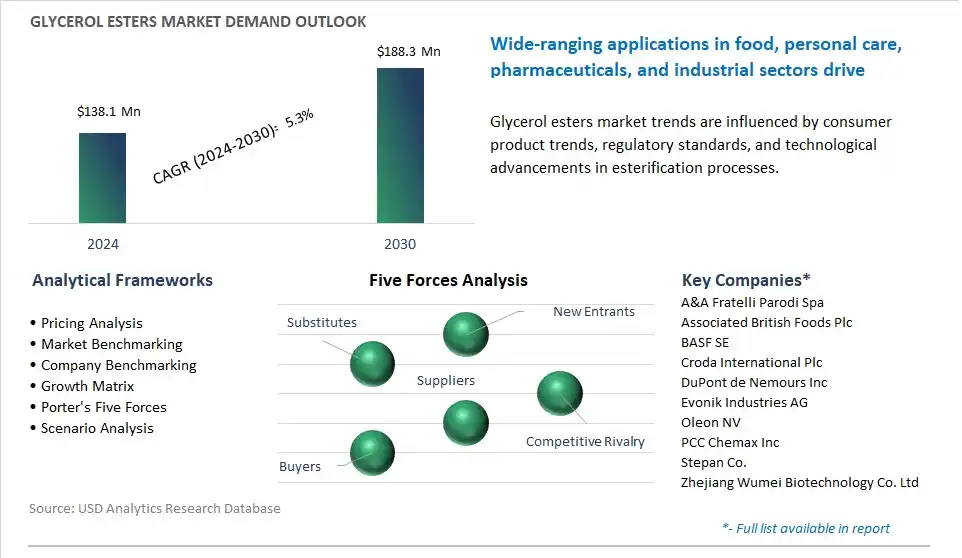
The global Glycerol Esters Market is poised to register a 5.3% CAGR from $138.1 Million in 2024 to $188.3 Million in 2030.
The global Glycerol Esters Market Study analyzes and forecasts the market size across 6 regions and 24 countries for diverse segments -By Application (Food Packaging Films, Agricultural Films, Others).
An Introduction to Global Glycerol Esters Market in 2024
The glycerol esters market is witnessing growth driven by the increasing demand for multifunctional and natural ingredients in the food and beverage, personal care, and pharmaceutical industries. Key trends shaping the future of the industry include innovations in glycerol ester production methods, formulation technologies, and applications development to meet consumer preferences for clean label, sustainable, and functional ingredients. Advanced glycerol esters offer properties such as emulsification, solubilization, stabilization, and texture enhancement, enabling their use as emulsifiers, surfactants, thickeners, and moisturizers in various products. Moreover, the integration of natural sources, such as plant-based oils and fats, and non-GMO (genetically modified organism) raw materials addresses concerns about ingredient transparency, health, and environmental sustainability. Additionally, the growing emphasis on product innovation, performance optimization, and regulatory compliance drives market demand for glycerol esters that enhance product functionality, sensory appeal, and shelf stability while meeting stringent quality and safety standards. As manufacturers and formulators seek to create differentiated products that meet evolving consumer needs and market trends, the glycerol esters market is poised for continued growth and innovation as a versatile and valuable ingredient in various industries.
Glycerol Esters Market Competitive Landscape
The market report analyses the leading companies in the industry including A&A Fratelli Parodi Spa, Associated British Foods Plc, BASF SE, Croda International Plc, DuPont de Nemours Inc, Evonik Industries AG, Oleon NV, PCC Chemax Inc, Stepan Co., Zhejiang Wumei Biotechnology Co. Ltd.
Glycerol Esters Market Dynamics
Glycerol Esters Market Trend: Growing Demand for Natural and Plant-Based Ingredients
The most prominent trend in the glycerol esters market is the growing demand for natural and plant-based ingredients in various industries, driven by increasing consumer preference for clean label products and sustainable manufacturing practices. Glycerol esters, derived from glycerol and fatty acids found in vegetable oils, offer a natural alternative to synthetic emulsifiers and surfactants in food, personal care, pharmaceuticals, and industrial applications. With consumers seeking healthier and environmentally friendly products, manufacturers are reformulating their formulations to replace synthetic additives with glycerol esters, which are perceived as safer, more sustainable, and compatible with clean label claims. This trend is reshaping product formulations and driving innovation in glycerol ester production methods to meet the growing demand for natural ingredients across diverse industries.
Glycerol Esters Market Driver: Functional Properties and Versatility of Glycerol Esters
A key driver in the glycerol esters market is the functional properties and versatility of glycerol esters, making them indispensable ingredients in various applications such as food emulsification, cosmetic formulation, pharmaceutical excipients, and industrial lubricants. Glycerol esters exhibit excellent emulsifying, dispersing, stabilizing, and moisturizing properties, enabling their use as emulsifiers, solubilizers, thickeners, and humectants in a wide range of products. In the food industry, glycerol esters are used to improve texture, shelf stability, and mouthfeel in baked goods, confections, dairy products, and sauces. In personal care products, glycerol esters enhance the sensory attributes and performance of lotions, creams, and hair care formulations. Additionally, glycerol esters serve as carriers for active pharmaceutical ingredients and functional additives in pharmaceutical formulations. The multifunctionality and compatibility of glycerol esters with diverse applications drive their widespread adoption and market growth.
Glycerol Esters Market Opportunity: Expansion into Clean Beauty and Green Chemistry
The glycerol esters market presents a potential opportunity for expansion into clean beauty and green chemistry initiatives, leveraging glycerol esters as sustainable and eco-friendly alternatives to synthetic ingredients in personal care and cosmetic formulations. With the rising demand for clean beauty products free from harmful chemicals, parabens, and synthetic fragrances, there's an opportunity for glycerol esters to replace petroleum-based emulsifiers and preservatives with biodegradable and non-toxic alternatives derived from renewable sources. Manufacturers can capitalize on this opportunity by developing glycerol ester-based formulations that meet the stringent standards of clean beauty and green chemistry, offering consumers safer and more environmentally conscious options for skincare, haircare, and cosmetics. By aligning with sustainability trends and emphasizing the natural origin and biodegradability of glycerol esters, companies can differentiate their products in the competitive clean beauty market and appeal to environmentally conscious consumers seeking safer and greener alternatives for personal care.
Glycerol Esters Market Share Analysis: Food Packaging Films segment generated the highest revenue in the industry
The largest segment in the Glycerol Esters Market is the Food Packaging Films segment. This dominance is primarily due to diverse factors. The glycerol esters are widely used in the production of food packaging films due to their excellent film-forming properties, flexibility, and ability to enhance the mechanical and barrier properties of packaging materials. Glycerol esters act as plasticizers, improving the flexibility and stretchability of packaging films while also imparting moisture resistance and oxygen barrier properties, which help extend the shelf life of packaged food products. Additionally, glycerol esters are considered safe for food contact applications and are approved for use by regulatory authorities worldwide, further driving their adoption in food packaging films. In addition, the growing demand for convenience foods, ready-to-eat meals, and packaged snacks fuels the need for high-performance packaging materials that can maintain the freshness, flavor, and quality of food products throughout their shelf life. Further, increasing consumer awareness of food safety, hygiene, and environmental sustainability further drives the demand for glycerol esters in food packaging films, as they offer an eco-friendly alternative to conventional petroleum-based plastic packaging materials. Over the forecast period, the combination of functional benefits, regulatory approval, and market demand positions the Food Packaging Films segment as the largest and most significant application market for glycerol esters in the Glycerol Esters Market.
Glycerol Esters Market Report Segmentation
By Application
Food Packaging Films
Agricultural Films
Others
Regions Included
North America (US, Canada, Mexico)
Europe (Germany, UK, France, Spain, Italy, Russia, Rest of Europe)
Asia Pacific (China, India, Japan, South Korea, Australia, South East Asia, Rest of Asia)
South America (Brazil, Argentina, Rest of South America)
Middle East and Africa (Saudi Arabia, UAE, Rest of Middle East, South Africa, Egypt, Rest of Africa)
Glycerol Esters Companies Profiled in the Market Study
A&A Fratelli Parodi Spa
Associated British Foods Plc
BASF SE
Croda International Plc
DuPont de Nemours Inc
Evonik Industries AG
Oleon NV
PCC Chemax Inc
Stepan Co.
Zhejiang Wumei Biotechnology Co. Ltd
*- List Not Exhaustive
TABLE OF CONTENTS
1 Introduction to 2024 Glycerol Esters Market
1.1 Market Overview
1.2 Quick Facts
1.3 Scope/Objective of the Study
1.4 Market Definition
1.5 Countries and Regions Covered
1.6 Units, Currency, and Conversions
1.7 Industry Value Chain
2 Research Methodology
2.1 Market Size Estimation
2.2 Sources and Research Methodology
2.3 Data Triangulation
2.4 Assumptions and Limitations
3 Executive Summary
3.1 Global Glycerol Esters Market Size Outlook, $ Million, 2021 to 2030
3.2 Glycerol Esters Market Outlook by Type, $ Million, 2021 to 2030
3.3 Glycerol Esters Market Outlook by Product, $ Million, 2021 to 2030
3.4 Glycerol Esters Market Outlook by Application, $ Million, 2021 to 2030
3.5 Glycerol Esters Market Outlook by Key Countries, $ Million, 2021 to 2030
4 Market Dynamics
4.1 Key Driving Forces of Glycerol Esters Industry
4.2 Key Market Trends in Glycerol Esters Industry
4.3 Potential Opportunities in Glycerol Esters Industry
4.4 Key Challenges in Glycerol Esters Industry
5 Market Factor Analysis
5.1 Value Chain Analysis
5.2 Competitive Landscape
5.2.1 Global Glycerol Esters Market Share by Company (%), 2023
5.2.2 Product Offerings by Company
5.3 Porter’s Five Forces Analysis
5.4 Pricing Analysis and Outlook
6 Growth Outlook Across Scenarios
6.1 Growth Analysis-Case Scenario Definitions
6.2 Low Growth Scenario Forecasts
6.3 Reference Growth Scenario Forecasts
6.4 High Growth Scenario Forecasts
7 Global Glycerol Esters Market Outlook by Segments
7.1 Glycerol Esters Market Outlook by Segments, $ Million, 2021- 2030
By Application
Food Packaging Films
Agricultural Films
Others
8 North America Glycerol Esters Market Analysis and Outlook To 2030
8.1 Introduction to North America Glycerol Esters Markets in 2024
8.2 North America Glycerol Esters Market Size Outlook by Country, 2021-2030
8.2.1 United States
8.2.2 Canada
8.2.3 Mexico
8.3 North America Glycerol Esters Market size Outlook by Segments, 2021-2030
By Application
Food Packaging Films
Agricultural Films
Others
9 Europe Glycerol Esters Market Analysis and Outlook To 2030
9.1 Introduction to Europe Glycerol Esters Markets in 2024
9.2 Europe Glycerol Esters Market Size Outlook by Country, 2021-2030
9.2.1 Germany
9.2.2 France
9.2.3 Spain
9.2.4 United Kingdom
9.2.4 Italy
9.2.5 Russia
9.2.6 Norway
9.2.7 Rest of Europe
9.3 Europe Glycerol Esters Market Size Outlook by Segments, 2021-2030
By Application
Food Packaging Films
Agricultural Films
Others
10 Asia Pacific Glycerol Esters Market Analysis and Outlook To 2030
10.1 Introduction to Asia Pacific Glycerol Esters Markets in 2024
10.2 Asia Pacific Glycerol Esters Market Size Outlook by Country, 2021-2030
10.2.1 China
10.2.2 India
10.2.3 Japan
10.2.4 South Korea
10.2.5 Indonesia
10.2.6 Malaysia
10.2.7 Australia
10.2.8 Rest of Asia Pacific
10.3 Asia Pacific Glycerol Esters Market size Outlook by Segments, 2021-2030
By Application
Food Packaging Films
Agricultural Films
Others
11 South America Glycerol Esters Market Analysis and Outlook To 2030
11.1 Introduction to South America Glycerol Esters Markets in 2024
11.2 South America Glycerol Esters Market Size Outlook by Country, 2021-2030
11.2.1 Brazil
11.2.2 Argentina
11.2.3 Rest of South America
11.3 South America Glycerol Esters Market size Outlook by Segments, 2021-2030
By Application
Food Packaging Films
Agricultural Films
Others
12 Middle East and Africa Glycerol Esters Market Analysis and Outlook To 2030
12.1 Introduction to Middle East and Africa Glycerol Esters Markets in 2024
12.2 Middle East and Africa Glycerol Esters Market Size Outlook by Country, 2021-2030
12.2.1 Saudi Arabia
12.2.2 UAE
12.2.3 Oman
12.2.4 Rest of Middle East
12.2.5 Egypt
12.2.6 Nigeria
12.2.7 South Africa
12.2.8 Rest of Africa
12.3 Middle East and Africa Glycerol Esters Market size Outlook by Segments, 2021-2030
By Application
Food Packaging Films
Agricultural Films
Others
13 Company Profiles
13.1 Company Snapshot
13.2 SWOT Profiles
13.3 Products and Services
13.4 Recent Developments
13.5 Financial Profile
A&A Fratelli Parodi Spa
Associated British Foods Plc
BASF SE
Croda International Plc
DuPont de Nemours Inc
Evonik Industries AG
Oleon NV
PCC Chemax Inc
Stepan Co.
Zhejiang Wumei Biotechnology Co. Ltd
14 Appendix
14.1 Customization Offerings
14.2 Subscription Services
14.3 Related Reports
14.4 Publisher Expertise
By Application
Food Packaging Films
Agricultural Films
Others
Countries Analyzed
North America (US, Canada, Mexico)
Europe (Germany, UK, France, Spain, Italy, Russia, Rest of Europe)
Asia Pacific (China, India, Japan, South Korea, Australia, South East Asia, Rest of Asia)
South America (Brazil, Argentina, Rest of South America)
Middle East and Africa (Saudi Arabia, UAE, Rest of Middle East, South Africa, Egypt, Rest of Africa)
