Glycerol Monostearate Market to Reach $3.5 Billion by 2034 at 6.4% CAGR Driven by Pharma-Grade Expansion and Clean-Label Emulsifier Demand
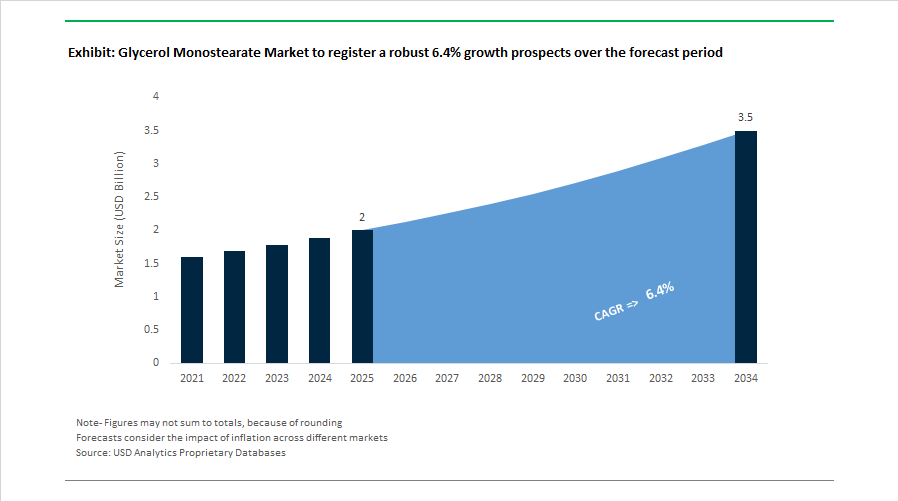
The Glycerol Monostearate (GMS) Market is projected to grow from $2 billion in 2025 to $3.5 billion by 2034, registering a CAGR of 6.4%. Growth is supported by rising demand for multifunctional emulsifiers and stabilizers across pharmaceuticals, processed foods, plant-based dairy, personal care, and polymer additives. Increasing preference for high-purity, plant-derived excipients and clean-label food emulsifiers is reshaping the glycerol monostearate value chain, particularly in Asia-Pacific and North America where healthcare and specialty cosmetics consumption remains robust.
In September 2024, BASF SE launched a pharmaceutical-grade glycerol monostearate powder line tailored for controlled-release drug formulations. The product is positioned as a lipid-based excipient to enhance API stability and bioavailability in oral solid dosage systems. In October 2024, Wilmar International inaugurated a new oleochemical manufacturing facility in China to strengthen local production of high-purity GMS for food and cosmetic applications. During the same month, Oleon NV finalized its acquisition of A. Azevedo Óleos in Brazil, expanding glycerol derivative and GMS capacity in South America to serve personal care and industrial lubricant markets. In November 2024, Cargill Incorporated introduced organic, plant-derived GMS emulsifiers targeting clean-label bakery and dairy segments, while Dow Inc. formed a strategic alliance with a pharmaceutical partner to utilize GMS as a lubricant and solubilizer in advanced drug delivery systems. In Q4 2024, Croda International Plc reported 20% growth in personal care sales, driven in part by demand for high-performance GMS in premium skincare formulations.
Portfolio consolidation and application innovation accelerated in 2025. In March 2025, Cargill showcased GMS-based emulsification systems at the AAHAR International Food & Hospitality Fair, emphasizing plant-based dairy analogues and reduced-fat confectionery requiring stable creamy textures without animal-derived fats. In June 2025, Wilmar acquired PZ Cussons’ stake in PZ Wilmar for $70 million, consolidating its Nigerian consumer goods and oleochemical operations where GMS is widely used in soaps and home care products. Market data from December 2025 indicated relative GMS price stability despite 28% volatility in glycerol and stearic acid feedstock costs, as U.S. and Chinese producers leveraged inland inventories and diversified logistics to maintain steady supply for year-end bakery and confectionery demand.
Innovation and digital transformation expanded into 2026. In January 2026, BASF announced the establishment of a Global Digital Hub in Hyderabad to digitize supply chain operations within its Care Chemicals division, including GMS production and distribution for cosmetics and detergents. In February 2026, at the Plastindia trade fair, BASF highlighted glycerol-derived light stabilizers designed to enhance UV durability in agricultural plastics, illustrating cross-sector integration of glycerol chemistry beyond food and pharma applications.
The Glycerol Monostearate Market outlook reflects increasing pharmaceutical excipient demand, clean-label emulsifier adoption in plant-based foods, oleochemical capacity expansion in Asia and Latin America, and digitalized supply chain optimization. Competitive differentiation is increasingly defined by pharmaceutical-grade purity, organic certification, feedstock traceability, cost-efficient glycerol sourcing, and multifunctional performance across healthcare, food processing, cosmetics, and specialty polymer applications.
Glycerol Monostearate (GMS) Market Trends and Strategic Growth Opportunities
High-Monoester GMS Enables Texture Optimization in Advanced Plant-Based Foods
The global glycerol monostearate market is witnessing a clear shift toward high-monoester grades as plant-based food manufacturers move beyond basic substitution toward true sensory equivalence with animal-derived products. High-purity GMS with monoester content above 90% is increasingly used to replicate the complex lipid structuring of dairy fats and meat marbling, addressing long-standing challenges such as phase separation, oil migration, and weak mouthfeel in vegan formulations. Food science trials conducted in late 2025 demonstrated that GMS-based oleogels and oleofoams can impart solid-like rheology to low-fat matrices, significantly improving hardness, chewiness, and thermal stability. These systems now perform on par with traditional shortenings in applications such as vegan chocolate, bakery fillings, and plant-based meat analogues.
Clean-label positioning is reinforcing this trend. Ingredient suppliers including IFF and Wilmar International are prioritizing distilled monoglycerides marketed as GMS 90 to meet consumer demand for recognizable, minimally processed emulsifiers. High-monoester GMS offers strong emulsification while minimizing flavor masking, which is critical in delicate applications such as oat, almond, and pea-based beverages. In North America, regulatory acceptance under the Food and Drug Administration GRAS framework continues to support rapid adoption. Industry-aligned observations from 2024 indicate that nearly half of new emulsifier applications in packaged convenience foods were driven by texture enhancement needs, underscoring GMS’s expanding role as a functional lipid structurant rather than a commodity emulsifier.
Pharmaceutical-Grade GMS Gains Momentum in Controlled and Individualized Drug Delivery
Parallel to food applications, glycerol monostearate is undergoing strategic repositioning within the pharmaceutical excipients market. Drug manufacturers are increasingly adopting high-purity GMS above 95% as a multifunctional excipient capable of modulating drug release, improving compressibility, and enhancing API compatibility. In 2025, formulation research highlighted the use of GMS-based solid oleogels to create moldable dosage forms suitable for individualized medicine. By applying design-of-experiments methodologies, researchers demonstrated precise dose customization for high-potency drugs while maintaining uniform mass and mechanical stability.
This shift is supported by infrastructure investment from major chemical suppliers. BASF and Evonik are expanding GMP-focused excipient capabilities, including new solution centers opened in 2025 to support lipid-based drug delivery platforms. In solid oral dosage manufacturing, pharmaceutical-grade GMS is increasingly preferred over metallic stearates due to lower interaction risk with sensitive APIs. Market feedback from regions with advanced pharmaceutical production, including India and Germany, indicates that the above-90% purity segment is currently the fastest-growing GMS grade, driven by demand for controlled-release and patient-centric formulations.
Microencapsulation Platforms for Thermally Sensitive Nutraceuticals
The barrier-forming and hydrophobic properties of glycerol monostearate are unlocking high-value opportunities in nutraceutical encapsulation. GMS is emerging as a preferred wall material for protecting heat- and acid-sensitive micronutrients during baking, extrusion, and gastrointestinal transit. A late-2025 study demonstrated that GMS-based composite encapsulation systems achieved encapsulation efficiencies exceeding 98% for folic acid, reducing thermal degradation during baking by more than 40% and significantly improving gastric retention. These performance gains directly address formulation bottlenecks in fortified cereals, snack bars, and baked functional foods.
Probiotic stabilization represents an even larger growth frontier. As functional food brands target therapeutic efficacy thresholds in the gut, GMS-based spray-drying and emulsification systems are increasingly deployed to preserve viable cell counts through processing and digestion. This capability enables fortification of products that were previously incompatible with live cultures, positioning glycerol monostearate as a strategic enabler in the rapidly expanding active nutrition and gut health market.
High-Performance Dispersion in Single-Serve and Automated Beverage Systems
The global expansion of out-of-home coffee consumption and single-serve beverage systems is creating a specialized demand for emulsifiers that deliver instant dispersion without caking or residue buildup. Glycerol monostearate is increasingly used as an instantizing and anti-caking agent in powdered creamers designed for automated machines and pod-based systems. Industry formulation updates in 2025 highlight that GMS-based emulsifier blends support rapid wetting and dispersion, meeting strict hygiene and portion-control requirements in airline catering, hospitality, and vending environments.
Growth prospects are particularly strong in Asia-Pacific, where café culture expansion in countries such as China and South Korea is driving sustained demand for powdered creamers compatible with high-pressure steam and rapid mixing. Manufacturers are also leveraging GMS to stabilize medium-chain triglycerides and protein isolates in functional creamers targeted at keto and protein-focused consumers. These applications require smooth, non-gritty textures and consistent performance across automated platforms, reinforcing glycerol monostearate’s role as a critical functional ingredient at the intersection of convenience, performance, and health-oriented beverage innovation.
Glycerol Monostearate Market Share and Segmentation Insights
Distilled Monoglyceride Grade Dominates the Glycerol Monostearate Market Through High-Purity Emulsifier Performance
Distilled Monoglyceride Grade accounted for 68.40% of the Glycerol Monostearate Market share in 2025, making it the most widely adopted purity category across food, pharmaceutical, and cosmetic formulations. Distilled monoglyceride grade glycerol monostearate typically contains 90% or higher monoglyceride concentration, providing superior emulsification efficiency compared to standard-grade materials that contain higher levels of diglycerides and triglycerides. This high purity ensures consistent functional performance in sensitive formulations, including bakery emulsifiers, pharmaceutical excipients, and cosmetic creams where stability and texture control are critical. In food manufacturing, distilled monoglycerides are widely incorporated into bread, cakes, margarine, ice cream, and whipped toppings to improve crumb softness, aeration, and shelf life stability. In 2025, production technology advancements have strengthened this segment through the adoption of continuous molecular distillation processes, which allow precise separation and purification of glycerol monostearate molecules. These systems enable manufacturers to maintain tight control over monoglyceride purity levels, ensuring consistent emulsifier functionality required by large-scale food processing and pharmaceutical industries.
Emulsifier Applications Drive the Largest Demand for Glycerol Monostearate in Food Processing
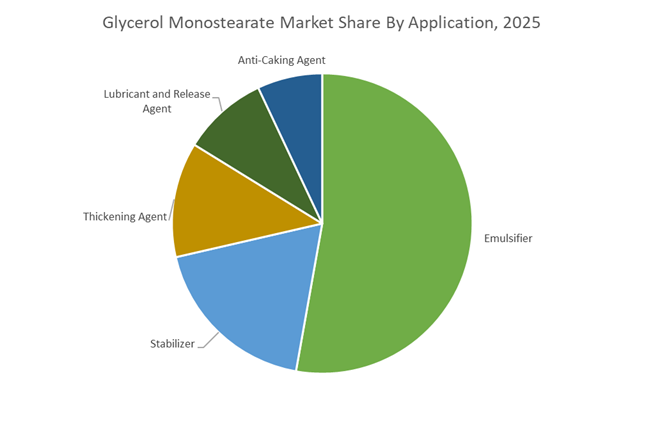
Emulsifier applications represented 52.80% of the Glycerol Monostearate Market share in 2025, establishing emulsification as the primary functional use of glycerol monostearate across global food production systems. As a highly effective oil-in-water emulsifier, glycerol monostearate stabilizes mixtures of fats and water in numerous processed foods, helping maintain uniform texture, product structure, and long-term stability. The ingredient is particularly important in bakery products, margarine, dairy desserts, frozen foods, and confectionery, where it improves dough conditioning, aeration, and fat dispersion. These properties allow manufacturers to enhance product softness, crumb structure, and overall shelf stability in packaged foods. In 2025, glycerol monostearate is gaining additional demand from food producers seeking clean label emulsifier solutions. With increasing consumer scrutiny of synthetic additives, manufacturers are reformulating products using ingredients with established regulatory acceptance and recognizable functionality. Glycerol monostearate benefits from its GRAS status and long history of safe use in food applications, allowing brands to position distilled monoglycerides as label-friendly emulsifiers that maintain product quality while supporting cleaner ingredient lists in processed foods.
Competitive Landscape in Glycerol Monostearate Market
Wilmar International Controls Upstream Integration and High-Monoester Scale
Wilmar International Limited sales are supported by its vertically integrated palm and oleochemical infrastructure. As the world’s largest producer of oleochemical-based emulsifiers, Wilmar supplies GMS 40% AF01, 60% TF01, and 97% DMG-AF01 grades across food, home care, and industrial markets. Investments in high-monoester production facilities in Asia-Pacific have strengthened its position as the leading supplier to the convenience food and processed bakery sectors. Its Timebound Action Plan 2025 to 2026 targets full plantation traceability to comply with EU Deforestation Regulations, protecting export flows to Europe. Wilmar’s scale and feedstock control allow it to anchor global GMS pricing while ensuring consistent supply security.
IFF Expands Clean-Label and Plant-Based GMS Applications
International Flavors & Fragrances Inc. commands a dominant share of the high-purity glycerol monostearate market following integration of DuPont Nutrition & Biosciences. The company is repositioning its GMS portfolio around clean-label functionality, addressing Gen Z demand for plant-derived stabilizers in dairy alternatives and functional beverages. Expansion of the DIMODAN® distilled monoglyceride range in 2025 and 2026 enhances creaminess and mouthfeel in oat and almond-based formulations. IFF is leveraging its global R&D network to develop nano-emulsion systems that improve stability and bioavailability in nutraceutical products. Transition toward fully RSPO-certified palm and soy feedstocks aligns its emulsifier portfolio with long-term sustainability commitments.
BASF SE Targets Pharmaceutical and Specialty Texture Niches
BASF SE focuses on high-margin pharmaceutical-grade and personal care glycerol monostearate applications in Europe. The launch of a pharmaceutical-grade GMS powder line between 2024 and 2026 strengthens its role in controlled-release drug formulations and topical medical creams. In early 2026, BASF introduced a biodegradable GMS variant for cosmetic formulations marketed as a green thickener with improved sensory properties. Under its Winning Ways strategy, the company is divesting non-core assets to concentrate on specialty emulsifiers and bakery texture modifiers. Modular production expansion in Germany and Finland enhances supply reliability for European pharmaceutical and personal care manufacturers requiring GMP-compliant ingredients.
Corbion N.V. Advances Clean-Label and Bakery Performance Solutions
Corbion N.V. integrates glycerol monostearate within its BRIGHT 2030 strategy, prioritizing natural preservation and multifunctional food emulsifiers. The company targets organic sales growth of 3 to 6% annually between 2026 and 2028, driven by Health & Nutrition applications. Its portfolio includes calcium and sodium stearoyl lactylates alongside GMS derivatives that enhance crumb structure, volume, and shelf stability in industrial bakery operations. Corbion’s circular lactic acid production model informs its broader emulsifier sustainability framework, supporting improved supply chain efficiency and targeted margin expansion toward 18% adjusted EBITDA by 2028. The company’s expertise in clean-label systems strengthens its competitive positioning in regulated European food markets.
Riken Vitamin Leads High-Purity Molecular Distillation in Asia
Riken Vitamin Co., Ltd. is leveraging advanced molecular distillation technology. The company dominates Japanese and Southeast Asian food markets where high-purity distilled monoglycerides are essential for tofu coagulation and margarine stabilization. In 2026, Riken is deploying AI-driven formulation tools to help industrial clients optimize GMS dosage levels, reducing material waste by up to 10% in large-scale processing. Export expansion toward North America targets clean-label personal care and food emulsifier markets. Its bead and flake GMS formats are engineered for rapid dispersion in automated mixing systems, enhancing production efficiency.
Stepan Company Expands North American and Industrial Applications
Stepan Company is strengthening its glycerol monostearate footprint through nearshoring and distribution expansion across Latin America. A 2025 and 2026 partnership broadened access to Mexican bakery and confectionery manufacturers seeking high-monoester emulsifiers. The company emphasizes domestic U.S. supply chain resilience to mitigate trade volatility and tariff exposure. Stepan markets GMS as a thickener and dispersant for personal care and oilfield chemicals, leveraging its amphiphilic properties for stable oil-in-water emulsions. Beyond food and cosmetics, Stepan is expanding into plastics and rubber where GMS functions as an internal lubricant and anti-static agent, a segment projected to grow at approximately 7.1% through 2030.
United States: Clean-Label Food Demand Meets Pharmaceutical-Grade Repositioning
The United States glycerol monostearate industry is being reshaped by parallel growth in packaged foods and pharmaceutical excipient demand. According to projections released by the United States Department of Agriculture, domestic packaged food consumption is accelerating through 2025, reinforcing GMS as a critical emulsifier for texture control, shelf-life stability, and moisture retention across bakery, confectionery, and ready-to-eat categories. This demand shift has encouraged ingredient suppliers to prioritize plant-based, allergen-free, and non-GMO GMS grades that align with evolving clean-label procurement standards adopted by national food brands.
Regulatory and industrial dynamics are further elevating GMS into higher-value applications. The Food and Drug Administration revalidated multiple lipid-based drug formulations between 2024 and 2025 that rely on high-purity GMS as a stabilizer and controlled-release matrix, catalyzing new pharmaceutical-grade production lines. Concurrently, tariff-driven cost inflation on imported oleochemicals has pushed firms such as Cargill and ADM to accelerate domestic sourcing and onshoring. Sustainability benchmarks introduced under federal green chemistry guidelines are also driving adoption of Mechanical Vapor Recompression in crystallization, materially reducing energy intensity in U.S. GMS manufacturing.
India: Regulatory Tightening and Bio-Based Feedstock Localization
India’s glycerol monostearate market is transitioning from commodity-grade imports toward regulated, high-purity domestic production. The Food Safety and Standards Authority of India has announced revised purity thresholds for food additives effective February 2026, compelling GMS producers to upgrade analytical testing for heavy metals and align with harmonized global benchmarks. This regulatory pivot is accelerating investments in refined monoglyceride capacity, particularly for food, nutraceutical, and ayurvedic personal care exports.
Policy support is reinforcing this structural shift. Under the expanded Production-Linked Incentive framework, bio-chemical hubs in Gujarat and Maharashtra are receiving targeted capital to localize GMS production and reduce reliance on Chinese technical-grade material. Industrial diversification is also evident, with UPL Limited scaling GMS-based dispersants for high-load agrochemical formulations ahead of the 2026 Kharif season. At the feedstock level, CSIR-led research into fermentation-derived bio-glycerol from agricultural residues is positioning India to build a more resilient and sustainable precursor base for long-term GMS growth.
China: Smart Manufacturing Scale and Industrial Formulation Leadership
China remains the global scale anchor for glycerol monostearate, with policy-driven automation and capacity expansion reinforcing its export competitiveness. The Ministry of Industry and Information Technology mandated AI-enabled smart workshop adoption across emulsifier plants in Shandong during 2025, materially improving esterification efficiency and yield control. This digital manufacturing push has strengthened China’s cost leadership in technical-grade GMS used across plastics, rubber compounding, and industrial lubricants.
Capacity expansion has been led by firms such as Lier Chemical, which finalized major technical-grade GMS investments in 2025 to serve downstream polymer and agrochemical applications. Notably, R&D programs in the Yancheng BioFAB cluster have validated GMS as a stabilizing excipient in L-glufosinate herbicide formulations, supporting export growth in crop protection markets. However, tightening VOC emission standards in coastal chemical belts from 2026 onward are driving consolidation, as smaller producers struggle to finance closed-loop recovery and environmental compliance infrastructure.
Germany: Pharmaceutical Precision and Sensory Innovation
Germany’s glycerol monostearate industry is increasingly defined by pharmaceutical precision and compliance-led innovation. In September 2025, BASF launched a pharmaceutical-grade GMS powder optimized for controlled-release drug delivery, addressing rising European demand for geriatric and chronic-care formulations. This move reflects a broader shift toward excipient-grade differentiation rather than volume-led competition.
Regulatory alignment continues to shape product portfolios. German manufacturers have completed re-audits under Regulation (EC) No 1333/2008 to ensure compliant GMS inclusion levels in dairy alternatives and plant-based beverages. At the same time, Evonik Industries has advanced odor-free GMS technologies through proprietary deodorization, enabling wider adoption in hypoallergenic skincare and dermo-cosmetic applications where sensory neutrality is a key purchasing criterion.
Brazil: Biodiesel Surplus Conversion and Agricultural End-Use Expansion
Brazil’s glycerol monostearate landscape is being reshaped by structural oversupply of crude glycerol generated from expanding biodiesel mandates. In response, the Ministry of Mines and Energy has supported downstream investments that convert surplus glycerol into higher-value monostearates, with multiple new plants commissioned during 2025. This integration is strengthening Brazil’s position as a bio-based oleochemical hub for Latin America.
Beyond industrial processing, agricultural applications are emerging as a stable demand base. In the Mato Grosso region, fertilizer formulators have expanded the use of GMS-based anti-caking agents to address humidity-driven storage challenges during monsoon cycles. This pragmatic, volume-driven application underscores Brazil’s role in anchoring demand for functional, cost-effective GMS grades outside food and pharmaceutical segments.
Comparative Snapshot of Country-Level Strategic Drivers
Glycerol Monostearate Market County Level Snapshot
Rapid domestic capacity build-up and export readiness
China
Smart manufacturing and scale leadership
Cost-efficient technical-grade dominance with consolidation
Germany
Pharma compliance and sensory innovation
High-margin excipient and dermo-cosmetic applications
Brazil
Biodiesel integration and agri-usage
Conversion of glycerol surplus into value-added monostearates
Glycerol Monostearate Market Report Scope
Glycerol Monostearate Market
Parameter
Details
Market Size (2025)
$2 Billion
Market Size (2034)
$3.5 Billion
Market Growth Rate
6.4%
Segments
By Purity Type (Standard Grade, Distilled Monoglyceride Grade), By Physical Form (Powder, Flakes, Granules or Pellets, Liquid or Paste), By Application (Emulsifier, Stabilizer, Thickening Agent, Anti-Caking Agent, Lubricant and Release Agent), By End-Use Industry (Food and Beverages, Pharmaceuticals, Cosmetics and Personal Care, Plastics and Rubber, Agrochemicals, Textiles and Paints)
Study Period
2019- 2025 and 2026-2034
Units
Revenue (USD)
Qualitative Analysis
Porter’s Five Forces, SWOT Profile, Market Share, Scenario Forecasts, Market Ecosystem, Company Ranking, Market Dynamics, Industry Benchmarking
Companies
BASF SE, Cargill, Incorporated, Archer Daniels Midland Company, Croda International Plc, Corbion N.V., Kerry Group plc, Lonza Group AG, Palsgaard A/S, Godrej Industries Limited, Kao Corporation, Riken Vitamin Co., Ltd., Wilmar International Limited, Stepan Company, Evonik Industries AG, Lier Chemical Co., Ltd.
Countries
US, Canada, Mexico, Germany, France, Spain, Italy, UK, Russia, China, India, Japan, South Korea, Australia, South East Asia, Brazil, Argentina, Middle East, Africa
Glycerol Monostearate Market Segmentation
By Purity Type
Standard Grade
Distilled Monoglyceride Grade
By Physical Form
Powder
Flakes
Granules or Pellets
Liquid or Paste
By Application
Emulsifier
Stabilizer
Thickening Agent
Anti-Caking Agent
Lubricant and Release Agent
By End-Use Industry
Food and Beverages
Pharmaceuticals
Cosmetics and Personal Care
Plastics and Rubber
Agrochemicals
Textiles and Paints
By Region
North America (United States, Canada, Mexico)
Europe (Germany, France, United Kingdom, Spain, Italy, Rest of Europe)
Asia Pacific (China, India, Japan, South Korea, Australia, Rest of APAC)
South and Central America (Brazil, Argentina, Rest of SCA)
Middle East and Africa (Saudi Arabia, UAE, South Africa, Rest of Middle East, Rest of Africa)
Top Companies in the Glycerol Monostearate Industry
2. Glycerol Monostearate Market Landscape & Outlook (2026–2034)
2.1. Introduction to Glycerol Monostearate Market
2.2. Market Valuation and Growth Projections (2026–2034)
2.3. Expansion of Clean-Label Emulsifiers in Food and Beverage Processing
2.4. Pharmaceutical Excipient Demand and High-Purity GMS Development
2.5. Oleochemical Feedstock Integration and Supply Chain Digitalization
3. Innovations Reshaping the Glycerol Monostearate Market
3.1. Trend: High-Monoester GMS Enabling Texture Optimization in Plant-Based Foods
3.2. Trend: Pharmaceutical-Grade GMS for Controlled and Individualized Drug Delivery
3.3. Opportunity: Microencapsulation Platforms for Thermally Sensitive Nutraceuticals
3.4. Opportunity: High-Performance Dispersion in Single-Serve and Automated Beverage Systems
4. Competitive Landscape and Strategic Initiatives
4.1. Mergers and Acquisitions
4.2. R&D and Material Innovation
4.3. Sustainability and ESG Strategies
4.4. Market Expansion and Regional Focus
5. Market Share and Segmentation Insights: Glycerol Monostearate Market
5.1. By Purity Type
5.1.1. Standard Grade
5.1.2. Distilled Monoglyceride Grade
5.2. By Physical Form
5.2.1. Powder
5.2.2. Flakes
5.2.3. Granules or Pellets
5.2.4. Liquid or Paste
5.3. By Application
5.3.1. Emulsifier
5.3.2. Stabilizer
5.3.3. Thickening Agent
5.3.4. Anti-Caking Agent
5.3.5. Lubricant and Release Agent
5.4. By End-Use Industry
5.4.1. Food and Beverages
5.4.2. Pharmaceuticals
5.4.3. Cosmetics and Personal Care
5.4.4. Plastics and Rubber
5.4.5. Agrochemicals
5.4.6. Textiles and Paints
6. Country Analysis and Outlook of Glycerol Monostearate Market
6.1. United States
6.2. Canada
6.3. Mexico
6.4. Germany
6.5. France
6.6. Spain
6.7. Italy
6.8. UK
6.9. Russia
6.10. China
6.11. India
6.12. Japan
6.13. South Korea
6.14. Australia
6.15. South East Asia
6.16. Brazil
6.17. Argentina
6.18. Middle East
6.19. Africa
7. Glycerol Monostearate Market Size Outlook by Region (2026–2034)
7.1. North America Glycerol Monostearate Market Size Outlook to 2034
7.1.1. By Purity Type
7.1.2. By Physical Form
7.1.3. By Application
7.1.4. By End-Use Industry
7.2. Europe Glycerol Monostearate Market Size Outlook to 2034
7.2.1. By Purity Type
7.2.2. By Physical Form
7.2.3. By Application
7.2.4. By End-Use Industry
7.3. Asia Pacific Glycerol Monostearate Market Size Outlook to 2034
7.3.1. By Purity Type
7.3.2. By Physical Form
7.3.3. By Application
7.3.4. By End-Use Industry
7.4. South America Glycerol Monostearate Market Size Outlook to 2034
7.4.1. By Purity Type
7.4.2. By Physical Form
7.4.3. By Application
7.4.4. By End-Use Industry
7.5. Middle East and Africa Glycerol Monostearate Market Size Outlook to 2034
7.5.1. By Purity Type
7.5.2. By Physical Form
7.5.3. By Application
7.5.4. By End-Use Industry
8. Company Profiles: Leading Players in the Glycerol Monostearate Market
8.1. BASF SE
8.2. Cargill, Incorporated
8.3. Archer Daniels Midland Company
8.4. Croda International Plc
8.5. Corbion N.V.
8.6. Kerry Group plc
8.7. Lonza Group AG
8.8. Palsgaard A/S
8.9. Godrej Industries Limited
8.10. Kao Corporation
8.11. Riken Vitamin Co., Ltd.
8.12. Wilmar International Limited
8.13. Stepan Company
8.14. Evonik Industries AG
8.15. Lier Chemical Co., Ltd.
9. Methodology
9.1. Research Scope
9.2. Market Research Approach
9.3. Market Sizing and Forecasting Model
9.4. Research Coverage
9.5. Data Horizon
9.6. Deliverables
10. Appendix
10.1. Acronyms and Abbreviations
10.2. List of Tables
10.3. List of Figures
Glycerol Monostearate Market Segmentation
By Purity Type
Standard Grade
Distilled Monoglyceride Grade
By Physical Form
Powder
Flakes
Granules or Pellets
Liquid or Paste
By Application
Emulsifier
Stabilizer
Thickening Agent
Anti-Caking Agent
Lubricant and Release Agent
By End-Use Industry
Food and Beverages
Pharmaceuticals
Cosmetics and Personal Care
Plastics and Rubber
Agrochemicals
Textiles and Paints
By Region
North America (United States, Canada, Mexico)
Europe (Germany, France, United Kingdom, Spain, Italy, Rest of Europe)
Asia Pacific (China, India, Japan, South Korea, Australia, Rest of APAC)
South and Central America (Brazil, Argentina, Rest of SCA)
Middle East and Africa (Saudi Arabia, UAE, South Africa, Rest of Middle East, Rest of Africa)
The Glycerol Monostearate Market is projected to grow from $2 billion in 2025 to $3.5 billion by 2034, registering a CAGR of 6.4%. Growth is supported by expanding use of GMS as a multifunctional emulsifier in processed foods, pharmaceutical excipients, and personal care formulations. Increasing adoption of plant-derived and clean-label ingredients is also strengthening demand across global food and cosmetics industries.
One major trend is the shift toward high-monoester GMS grades above 90% purity, which offer improved emulsification, texture stabilization, and sensory performance. These grades are widely used in plant-based dairy, bakery fillings, and vegan confectionery to replicate the lipid structure of animal fats. Clean-label product development and regulatory acceptance of distilled monoglycerides are further accelerating adoption.
Pharmaceutical manufacturers are increasingly using high-purity glycerol monostearate as a lipid-based excipient in controlled-release drug delivery systems. GMS improves compressibility, stabilizes active pharmaceutical ingredients, and enhances drug bioavailability in oral dosage formulations. Investments by major chemical suppliers in GMP-grade excipient production are expanding its role in advanced pharmaceutical formulations.
Beyond traditional emulsification uses, glycerol monostearate is gaining traction in nutraceutical encapsulation and functional beverage systems. Its hydrophobic barrier properties allow effective microencapsulation of vitamins and probiotics, protecting sensitive nutrients during processing and digestion. In beverage powders and automated coffee systems, GMS improves dispersion, anti-caking performance, and texture stability.
Key companies operating in the Glycerol Monostearate Market include BASF SE, Cargill Incorporated, Archer Daniels Midland Company, Croda International Plc, Corbion N.V., Wilmar International Limited, Riken Vitamin Co., Ltd., Stepan Company, Kao Corporation, and Evonik Industries AG. These players focus on pharmaceutical-grade purity, plant-derived emulsifiers, sustainable oleochemical feedstocks, and application-specific formulation technologies.